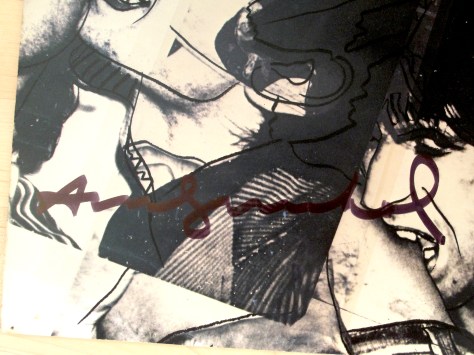
I enjoy visiting the A & D Gallery in Chiltern Street, London, on my regular visits to spend time with my aged mother. I enjoyed the banter with my friends, the late Daniel Brant and Helen Clarkson (who now runs the gallery). I learnt a whole lot about pop art, and in particular about Andy Warhol’s art, from these experts. Daniel had sold a couple of signed copies of the Rolling Stones’ “Love You Live” album in previous years and I had told him hat I would be interested in a copy should he ever find another. Three or four years ago he mailed me that he had included copies of “Sticky Fingers” and “Love You Live” in an auction and I was lucky to be able to buy them.
My signed “Sticky Fingers” LP.
Late in 2018, I met John Peter Nilsson, from Moderna Museet, in Stockholm during the Warhol 1968 exhibition at the museum in Stockholm. I pointed out that one of the eight Andy Warhol designed record covers on display (by The East Village Other) was NOT designed or illustrated by Warhol. And I mentioned that I had a complete set of Warhol covers. John Peter suggested that, when the exhibition moves to Moderna in Malmö in March 2019, my collection would look great in the Malmö exhibition space so I agreed to lend my records to the exhibition.
Just prior to collecting the records I came across an autographed copy of Paul Anka’s 1976 album “The Painter” signed by both Andy Warhol and Paul Anka. Apparently, Warhol signed the cover outside The Factory in December 1986, just two moths before he died, and Paul Anka signed it later.
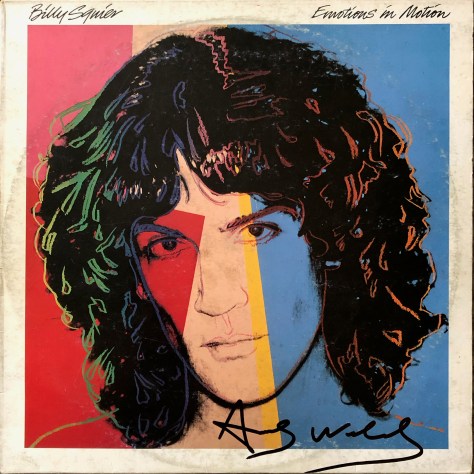
Most recently I found a copy of Billy Squier’s “Emotions in Motion” album signed by Andy Warhol. Unusually, this is an Italian pressing. The provenance is from a gallery in Rome that bought the album from Anita Pallenberg.
Billy Squier’s “Emotions in Motion” signed by Andy Warhol.
Apparently, this was signed in for Anita at The Factory in 1985. I’m a little suspicious, however.The signature soesn’t look 100% and I wonder how Anita Pallenberg happened to have her Italian copy of the album with her in New York… Perhaps I’m being too suspicious, though.
But the signed album any Warhol collector really wants is, of course, a copy of The Velvet Underground & Nico!
“The Velvet Underground & Nico” signed by the band and Andy Warhol.
My friend and fellow collector of record cover art, Stefan Thull, decided in October to sell part of his amazing collection and among the records he was prepared to part with was his signed copy of Rats and Star’s “Soul Vacation” album that he sold to me.
“Soul Vacation” by Rats and Star signed in 1983 in Japan when Andy Warhol met the band.
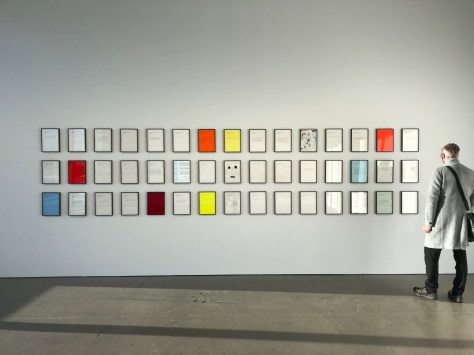
Bonniers Konsthall in Stockholm shows a wide variety of art exhibitions. I saw Turner Prize winner Susan Phillipz “Lost in Space” exhibition there a couple of years ago and I went to see the gallery’s latest exhibition by British artist Peter Liversidge. I hadn’t heard of him before seeing the exhibition. Liversidge’s preferred medium is providing “proposals”–he types suggestions for art happenings on A4 paper on his Olivetti portable typewriter. The proposals range from simple orders to suggestions that are complex and possibly impossible to realise. The exhibition at Bonniers konsthall has 45 of Liversidge’s “proposals” as its starting point. These 45 proposals are neatly framed A4 papers with his suggestions for projects arranged on one wall in three rows of fifteen frames.
Peter Liversidge’s 45 proposals.
On the floor in front of the frames is a pile of A2 papers each printed with “Let’s take a walk together”. Visitors to the exhibition are invited to take one or more of these posters home. There is a shelf on the wall opposite the framed proposals with various implements standing on it, each covered in postage stamps. Apparently Liversidge often uses the postal service to send articles to his exhibitions. Bonniers konsthall allows the postman/postwoman to arrange the item that is being delivered on the shelf. Thus the postal service acts as a sort of exhibition curator.
Peter Liversidge’s posted objects.
Peter Liversidge’s posted objects.
Close-up showing the stamps on each object.
One suspects that some objects might possibly get lost in the post. Nobody knows which, if any, don’t make to their destination, adding mystery to the exhibition.The idea of sending repeated missives through the post reminded me immediately of Japanese -American artist On Kawara (1932-2014), who throughout his career sent postcards to friends and institutions with stamped messages. One series stated “I got up at—-o’clock”, and another simply stated “I am still alive”.
One of On Kawara’s postcards from the “I got up at…” series.
The gallery shows a film of another of Liversidge’s projects. He asked a class at an east London school to make a protest about any subject they felt strongly about. It had to be the children’s project–not one suggested by teachers of adults. The film I saw was a protest about dogs fouling pavements with placards saying things like “clean up after your dog”. This protest was stages at the Whitechapel Gallery in 2014.
Another of Liversidge’s ongoing projects is collecting artifacts that look like faces and one room of the exhibition is devoted to found objects that resemble faces and masks that Liversidge has produced from such objects.
A day or two after I seen the Liversidge exhibition, I got an email about the best record cover designs of 2018 and was surprised when I saw a cover bearing one of Liversidge’s masks among the nominated covers. The album is “Double Negative” by the American band Low (released in September 2018). Liversidge has also designed the cover for the band’s 2015 album “Ones and Sixes”, and it transpires that he has designed at least two other record sleeves: one for High Plains’ album “Cinderland” (2017) and another “Find the Ways” (2017) by Allred & Broderick.
Low’s “Double Negative” with cover art by Peter Liversidge.
I always find it interesting when “fine” artists design record covers. There’s a long list of them ranging from Sir Peter Blake to Damien Hirst via Andy Warhol. I’m looking forward to seeing all Peter Liversidge’s record covers. I currently have two other covers (in addition to the “Double Negative” cover); Allred & Broderick’s “Find The Ways” and High Plains “Cinderland”.
Allred & Broderick’s LP “Find the Ways”. Cover by Peter Liversidge.
High Plains “Cinderland” LP. Cover by Peter Liversidge.
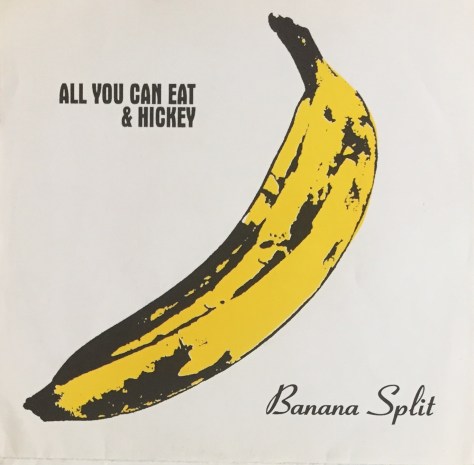
I have already posted the several versions of “The Velvet Underground & Nico” album. I have fallen for the temptation to include albums with cover art that is a pastiche of Warhol’s banana design or designs that influenced Warhol’s designs.
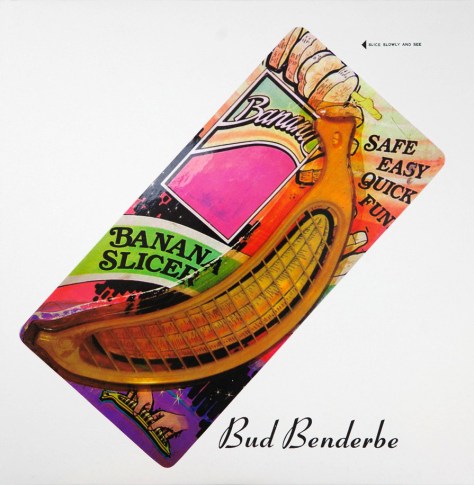
I found six pastiches of the banana cover, including several with removable stickers in various designs.
1. Crue-L Grand Orchestra – Family – 12″ EP – MayDay MayDay Records – 1999.
2. Various Artists – The Velvet Underground & Nico – 12″ LP – Castle Face Records – 2012.
3. Fauré Quartet – Popsongs – 2 x 12″ LP – Deutsche Grammophon – 2009.
4. Bud Benderbe – Slice Slowly & See – 12″ LP – Boo-Hooray Records – 2013.
5. Abwärts – Sonderzug zur endstation – 7″ EP – Virgin – 1990.
6. All You Can Eat / Hickey – Banana Split – Split 7″ EP – Monitor Records – 1995.
The last two of these simply had a printed banana on the covers.
The Cru-el Grand Orchestra’s 12″ single “Family” with its obviously Warhol-inspired banana ice lolly.Castle Face & Friends play the Velvet Underground & Nico album with David Shrigley’s cover art.Bud Benderbe’s cover album.
Abwärts “Sonderzug zur endstation” 7″ single.
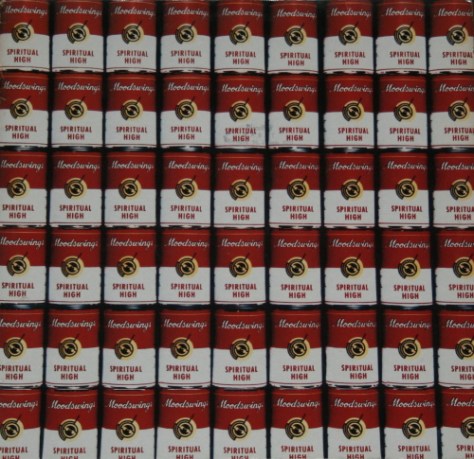
Another Warhol pastiche, this time with soup cans:
1. Mindswings – Spiritual High – 12″ EP – Arista – 1990.
Mindswings “Spiritual High” 12″ EP.
And a cover obviously used by Andy as for the design of the “Progressive Piano” design:
1. Jan August – Plays Songs to Remember – 12″ LP – Mercury – 1955.
Jan August “Plays Songs to Remember” LP cover.
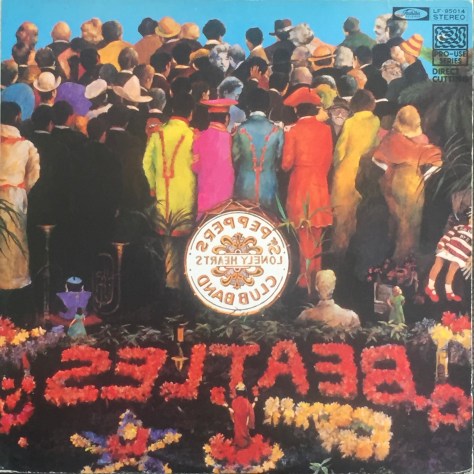
On the subject of pastiches, I also picked up a wonderful “Sgt Pepper” pastiche by Jun Fukamachi with cover painted by Fumio Tamabuchi:
1. Jun Fukamachi – Sgt. Pepper’s Lonely Hearts Club Band – 12″ LP – Toshiba – 1977.
The cover of Jun Fukamachi’s “Sgt. Pepper” album painted by Fumio Tamabuchi.
A while ago I started searching for musicians among winners of the Tate Gallery’s Turner Prize and turned up an astonishing number of artists who were also musicians and had released records with their own art on the covers. In 2017 I could include record cover by two of them–Suzan Philipsz and Wolfgang Tillmans.
Susan Philipsz: Susan Philipsz – Ziggy Stardust – Limited edition Digipak CD (500 copies) Susan Philipsz – Stay With Me – Book / catalogue with CD Susan Philipsz – Lost in Space – Limited edition picture disc LP in box set (300 copies) Susan Philipsz – There Is Nothing Left Here – Limited edition LP
In February I had the good fortune to meet Susan Philipsz at the opening of her “Lost in Space” exhibition at the Bonnier Gallery in Stockholm. She kindly signed the copy of her “Ziggy Stardust” CD and the book/catalogue from her “Stay With Me” exhibition from Malmö’s Konsthall. There was a catalogue introducing the “Lost in Space” exhibition and a limited edition box set of 300 copies that includes a 12″ picture disc of the performance. However, the box set was not available until a couple of months after the opening, so I didn’t get that signed… After considerable searching, I found the catalogue and LP from Philipsz’s 2008 “There Is Nothing Left Here” exhibition at the Centro Galego de Arte Contemporaneo in San Sebastian de Compostela.
Susan Philipsz’ “Ziggy Stardust” CD autographed by her.
Susan Philipsz “Stay With Me” exhibition catalogue with CD.
Susan Philipsz’ “There Is Nothing Left Here” 2008 LP.
The picture disc LP and book of Susan Philipsz’ “Lost in Space” installation.
Wolfgang Tillmans was another Turner Prize winner who’s records I found:
1. Wolfgang Tillmans – Here We Are – 12″ EP – Fragile – 2016.
2. Wolfgang Tillmans – 2016–1986 EP – 12″ EP – Fragile – 2016.
3. Wolfgang Tillmans – Device Control – 12″ EP – Fragile – 2016.
The cover of Tillmans’ latest EP “Thats Desire” EP.
Tillmans’ “Device Control” EP cover.
Wolfgang Tillmans’ “2016-19862 EP cover.
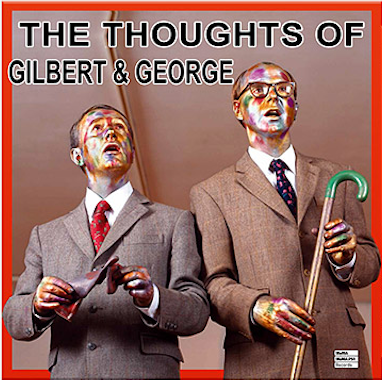
There were diverse other covers: A limited edition LP by Gilbert & George, entitled “The Thoughts of Gilbert & George” released by MoMa:
“The Thoughts of Gilbert & George” LP cover.
A Record Store Day soundtrack double LP release called “Ciao! Manhattan” with a cover drawing of Edie Sedgwick:
Soundtrack LP “Edie Sedgwick: Ciao! Manhattan” has the same image as The Cult’s single “Ciao Edie”.
Having lived in Luleå, in the north of Sweden for more years than I can remember, I am acquainted with Karin “Mamma” Andersson’s art. Mattias Alkberg, poet and rocker, used her art on a 7″ single and a limite edition 12″ EP and I discovered that Beck had used her paintings to illustrate three limited edition 12″ singles, available only through his website.
1. Beck – Gimme – 2 x 12″ EP – Fonograf records – 2013.
1. Beck – Defriended – 12″ EP – Fonograf records – 2013.
1. Beck – I Won’t Be Long – 12″ EP – Fonograf records – 2013.
Beck “Gimme”. Cover art by Karin “Mamma” Andersson.
Beck “Defriended”. Cover art by Karin “Mamma” Andersson.
Beck “I Won’t Be Long”. Cover art by Karin “Mamma” Andersson.
In my music festival days, I got to know singer Henrik Berggren, formerly front man of the now defunct Broder Daniel. Henrik released his first solo album “Wolf’s Heart” after many year’s absence from the music scene. The standard album was released on black vinyl, but six record stores each had limited editions of 300 copies on coloured vinyl. There were yellow, light blue, violet, red, clear and pink vinyl issues. Being totally obsessive I bought copies in each colour.
Henrik Berggren’s “Wolf’s Heart” album on black, violet, red and yellow vinyl.
The pink and light blue vinyl versions of Henrik Berggren’s “Wolf’s Heart” LP.
Well, that sums 2017 up. A record year and the last time I will be publishing a list like this, My collections are so near complete as I can make them. So I feel it’s time to stop. I will try to keep the collections up to date if, and when, any of the artists I collect release new cover art.
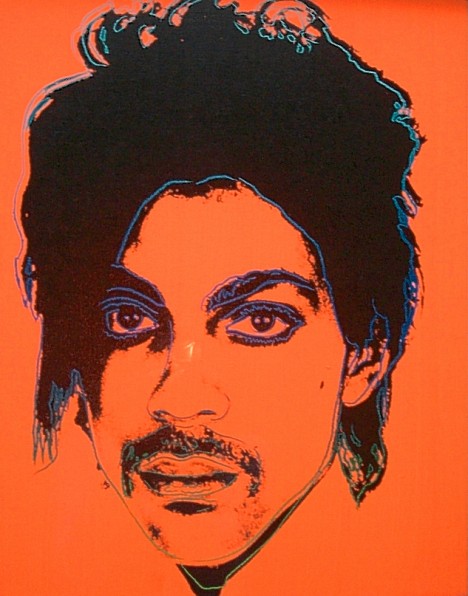
Andy Warhol painted his portrait of Prince Rogers Nelson (June 7, 1958 – April 21, 2016) in 1984 and it appeared in the November issue of Vanity Fair that same year and was used for the cover of Conde Nast’s 2016 memorial magazine “The Genius of Prince”.
The cover of Condé Nast’s Prince commemorative magazine.
Warhol always worked from photographs, usually, though with some famous exceptions, using ones he had taken himself–most commonly with his Polaroid camera.
Andy Warhol’s portrait of Prince.
However, Prince was less than pleased with it, reportedly saying that Warhol’s portrait of MJ (Michael Jackson) was much better!
One photograph that Warhol did not take, however, was the basis for his Flower silkscreens in 1964. He found Patricia Caulfield’s photo of hibiscus flowers in a 1964 issue of the magazine Modern Photography and appropriated it.
Patricia Caulfield’s hibiscus flower photograph.
Two years later Caulfield sued Warhol for infringement of copyright and in a settlement, Warhol offered her two sets of the Flowers prints; an offer Caulfield refused preferring a cash settlement.
Lynn Goldsmith (2013).
In 1981, photographer Lynn Goldsmith had taken a publicity photo of Prince. Warhol’s portrait image looks suspiciously like it is copied from Goldsmith’s photograph and Goldsmith tried to achieve a settlement with the Warhol Foundation for the use of the image. However, the Warhol Foundation, in a preemptive move, decided to sue Goldmith to prevent her from taking legal action against it.
Court comparison of Goldsmith’s photo (left) with Warhol’s portrait (right).
It seems that fair use laws in the U.S. mean that an artist may use other artists work as the basis for their own work and that Warhol’s art is protected under these laws. It seems that Lynn Goldsmith will not benefit from Warhol’s possible use of her original photograph.
Gröna Lund is a permanent attraction in Stockholm with exciting rides, restaurants, bars and an important concert stage on which most of the world’s more famous artistes–ranging from Birgit Nilsson via Chuck Berry to The Clash–have performed.
Posters for events and concerts at Gröna Lund have become highly collectible. Between 1971 and 1988 they were designed by one man, Nils Sture Jansson–who produced about 800 individual posters, sometimes with incredibly short deadlines. In 2012 Premium Publishing produced a book containing 200 of Nils Sture Jansson’s poster designs edited by Nils Sture Jansson’s son, Jonas, and Gröna Lund’s own historian Andreas Theve. The book rapidly sold out when it was published–but I was lucky to find a copy in Söders Bokhandel– a little, but extremely well-stocked bookshop in Stockholm. The book has also become highly collectible.
The book’s cover. The cover picture is of The Ramones (see poster below)
Nils Sture Jansson’s relatively simple illutrations capture the spirit of the artists and, according to the introduction, were much admired by them. Only a few were unhappy–and that was sometimes due to the fact that his or her name was misspellt.
Here are some samples (posters for artists I personally like):
Jansson would be supplied with photos of the artist(s) and deconstruct them to make his poster designs.
Kristian Russell has taken over and is continuing the tradition of Gröna lund posters.
Poster for Henrik Berggren’s concert on the 50th anniversary of Jimi Hendrix’s concert on the same stage.
The 50th anniversary of the release of “Sgt. Pepper’s Lonely Hearts Club Band” has caused considerable interest in various aspects of what came to be called “the summer of love”; 1967’s glorious pop year. It was also the time of “Swinging London” and Carnaby Street’s first heyday.
That the cover of the “Sgt. Pepper” album would become a classic had been foreseen by Beatles manager Brian Epstein who wanted a “proper” artist to design the cover rather than the original psychedelic ideas suggested by fashion designers The Fool. From an idea by Paul McCartney via his friend and gallery owner Robert Fraser, Peter Blake and Jann Haworth were recruited and with some input from Jann’s father, Ted, the couple set to work.
It didn’t take long for the first of many pastiches of the cover art to appear. The Mothers of Invention’s album “We’re Only in It for the Money” released in March 1968, was one of the earliest. Frank Zappa wanted the cover (designed by Cal Schenkel) to be a copy of the “Sgt. Pepper” cover and asked Paul McCartney for approval. Apparently McCartney wished that Zappa’s and The Beatles’ mangers discussed the suggestion. Zappa went ahead but Verve Records, who would release the album, would not allow Schenkel’s copy of the “Sgt. Pepper” montage to appear on the front so the band’s portrait, photographed against a yellow background became the outside of the gatefold.
The front cover of “We’re Only in It for the Money”.
The lyrics, printed against a similar red background to those on the “Sgt. Pepper” cover appeared on the inside of the gatefold opposite Schenkel’s montage.
Release of “We’re Only in It for the Money” was delayed five months because of the record company’s anxiety over a possible infringement of copyright. In the event there was no reaction as the front cover only revealed four band members.
There have been innumerable pastiches of the “Sgt. Pepper” cover since the Mothers of Invention’s album; ranging from albums by the Muppets and Simpsons to more “serious” artist like The Ruttles. An Internet search turns up literally hundreds. Probably only the cover photo from The Beatles’ “Abbey Road” has been copied/parodied more often.
My collection includes only three pastiches of the (probably) hundreds out there, collected because of their originality (and possibly rarity). The oldest, from 1969, is Jack O’Reilly’s “You Can Be a Ventriloquist” (subtitled “Constable O’Rourke’s Wooden Hearts Club Band“, just so that no one would miss the reference to “Sgt. Pepper“). An instructional album that was probably privately pressed and thus in relatively limited numbers. O’Reilly went to inordinate expense to put together a background of forty ventriloquists’ dummies for the cover photograph.
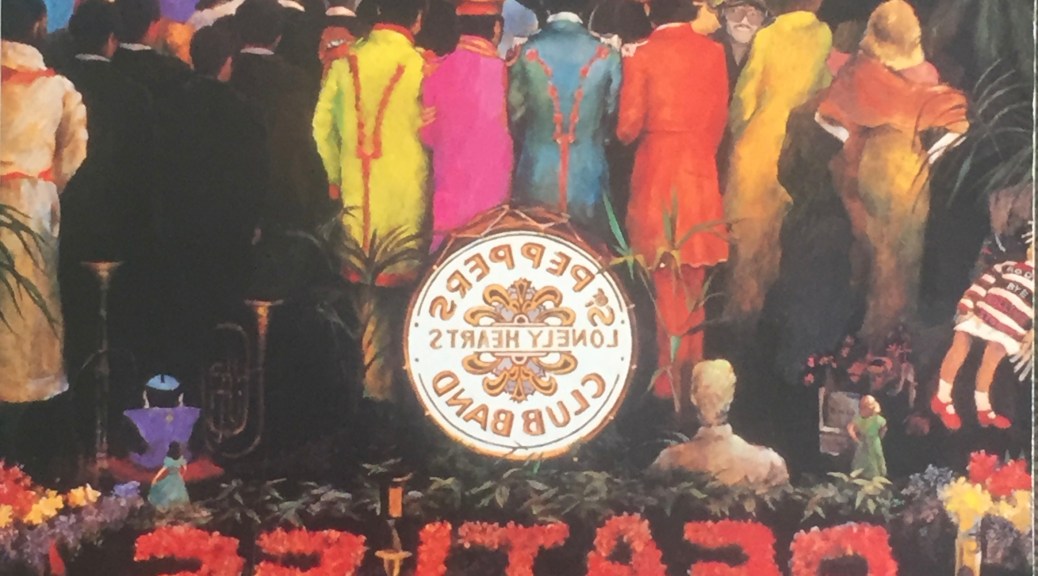
The second example is a Japanese album by Jun Fukamachi called (not so strangely) “Sgt. Pepper’s Lonely Hearts Club Band“. Fukamachi plays several of the “Sgt. Pepper” songs rendered as jazz tunes. I like the cover for the idea of reversing the whole scene. It must have taken weeks to paint!
The cover of Jun Fukamachi’s “Sgt. Pepper” album painted by Fumio Tamabuchi.
And the final parody that I have collected is another Japanese release–Junichi Masuda’s “Pokèmon” LP from 2015. This is an unoffical release on the Moonshake record label. Masuda, who is programmer and director at Pokèmon also makes the music to video games. The “Pokèmon” album was released in several versions. The “standard” album came in four variations of coloured vinyl housed in a cover that is a parody of the “Sgt. Pepper” design.
The Cover of Junichi Masuda’s “Pokèmon” LP. A just recognisable “Sgt. Pepper “pastiche.
Oh, and I have been guilty of plagiarism, too. In 2009 I curated an exhibition of Peter Blake’s record cover art at Piteå Museum. Together with my friends at In the Cold bureau we designed a cover for the exhibition catalogue, of course modelling it on the “Sgt. Pepper” design, but with all the artists that Blake had made record covers for.
The catalogue cover for the “Pop Art” Exhibition of Sir Peter Blake’s record cove art at Piteå Museum, July 22nd–August 31st 2009.
In 2010, I showed my collection of Peter Blake’s record covers at the A and D Gallery in London, and Sir Peter Blake signed m catalogue. I wonder if it didn’t inspire him to produce his 2012 update of the Sgt. Pepper cover…
Vintage Blake–a limited edition print by Sir Peter Blake to celebrate his 80th Birthday in June 2012.
I don’t have this print, though it would make a nice addition to my collection of Sir Peter Blake’s record cover art.
Anyway, I really hope I won’t be tempted to buy any more “Sgt. Pepper” pastiches.
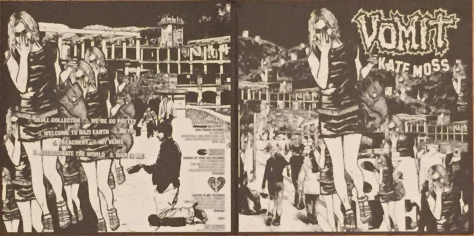
I really felt as though I had exhausted the subject of record covers showing Kate Moss‘ portrait in my previous post. No sooner had the proverbial ink dried than two more covers appeared. The first is a 7-inch single-sided EP by American punk/hardcore/grunge band Vomit, entitled “Kate Moss” on the Give Praise record label.
Now, a search of Discogs will reveal more than ten bands that have used the name Vomit. The Vomit in question seem to only have released this one “Kate Moss” EP.
The gatefold cover of Vomit’s 7″ single-sided EP “Kate Moss” with at least thirteen portraits of Kate.
Then I was reading about the two CD and one DVD set of Bryan Ferry‘s 2010 “Olympia” album. I already have the limited edition Vinyl Factory LP version of this, that includes the cover portrait of Kate Moss but without the text–obviously intended to be framed and hung on a teenager’s wall. I hadn’t considered the box set as I felt it probably wouldn’t add anything to the LP version. Well, I was wrong. The 40-page book that houses the discs contains many more photos from Adam Whitehead‘s sessions for the album. The DVD has an interview with Bryan Ferry on the making of the “Olympia” album and the “You Can Dance” video as well as a video of behind the scenes activity in the making of the “You Can Dance” video.
The box set of Bryan Ferry’s “Olympia” album contains a 40-page book and 2 CDs and a DVD.
The pictures are stunning. Here are a selection:
The CDs and the DVD included in set come in card covers, two of which have different cover photos from the LP and deluxe box.
CD1 has the album cover photo, while CD2 and the DVD cover have different photos. You will have to examine the covers of the CDs to spot the very subtle difference (hint look at Kate’s right hand).
And just when the thrill of finding the box set sort of settled, I came across an Ebay ad by my least favourite seller Majestic Music & Art. I consider this seller to be quite ruthless in his (I presume it is a “he”) price-setting. Many years ago, I bought a couple of albums from Majestic Music & Art that were poorly packaged and arrived damaged. They would not discuss a return or a refund and I promised myself never to buy from them again. But in mid-March 2017 they posted this ad for a copy of the Luke Fair remix of Primal Scream‘s (and Kate Moss‘) “Some Velvet Morning” (the old Lee Hazlewood classic). This single normally comes in a plain black generic cover, but Majestic Music & Art advertised a copy with Kate Garner‘s famous 1992 portraits of an 18-year-old Kate Moss affixed to front and back covers.
“Some Velvet Morning” remix 12″ with one of Jane Garner’s 1992 portraits of Kate on front and rear covers.
Despite my promise to myself never to buy from Majestic Music & Art, I did buy the 12″ single to add to my collection. I knew of Kate Garner‘s Kate Moss portraits from an exhibition of Russell Young‘s recent screen prints at London’s Halcyon Gallery. Russell Young’s portraits are really wonderful–some are as big as 200 x 200 cm and covered in diamond dust, so they really sparkle!
Kate Moss‘ name crops up in music as a songwriter and artist–several tracks by other artists/bands are entitled “Kate Moss“. Examples include Arab Strap‘s 1996 album “The Week Never Starts Around Here” that contains a track entitled “Kate Moss“, but there is no picture of her on the record cover. German rocker Maximilian Hecker‘s 2003 CD “Rose” also has a song called “Kate Moss” as its first track. Again, there is no portrait of her on the cover. I don’t suppose these will be the only songs called with this iconic title.
It has been my ambition to collect all record covers with Andy Warhol‘s art. Most of the seventies and eighties covers are relatively easy to find and shouldn’t cost the earth (an exception is Ultra Violet‘s eponymous LP from 1973), but the earlier ones, particularly the fifties covers have become increasingly expensive. And the original “Velvet Underground & Nico” (1967) along with many of it’s reissues are becoming increasingly expensive.
I have long searched for decent copies of Moondog‘s “The Story of Moondog“. While copies of the Moondog album do pop up relatively frequently on Ebay, most are in pretty poor condition with severely discoloured covers, but I had the great good fortune to find a near mint copy on Discogs which I bought as a Christmas present to myself.
The other major hole in my collection was John Wallowitch‘s second album for Serenus Records called “This Is (The Other Side of) John Wallowitch“. This album doesn’t come up for sale very often and bidding goes crazy on good copies. A reasonable copy popped up on Ebay in late January and despite having depleted my funds the previous month for the Moondog album, I managed to win it with a not too outrageous bid.
Front and rear covers of “This Is (The Other Side of) John Wallowitch”, 1965.
As can be seen, Wallowitch chose as the rear cover picture to reuse the “photo booth” photos taken by Warhol that were on the front cover of his previous Serenus Records release “This Is John Wallowitch“. It’s sort of ironic that the “Man of a Thousand Faces”, as stated on the front cover, is portrayed on the rear from the chin downwards, so one cannot see any of the thousand faces (actually, there are only 56 photos, or parts of photos on the cover, not thousands).
So now there are two of Warhol’s original covers and one bootleg that I need to complete my collection of Warhol’s record covers. These are the pink version of Prokofiev’s “Alexander Nevsky, Cantata Op 78” and the unobtainable “Night Beat” promotional box set that Guy Minnebach wrote about in his Andy Earhole blog (https://warholcoverart.com/2017/03/25/night-beat-rarest-of-the-rare/). Though I do have the facsimile box of the latter.
The remaining bootleg I am still looking for is the limited edition of Keith Richards‘ “Unknown Dreams” (Outsider Bird Records, OBR 93009).
Keith Richards’ bootleg “Unknown Dreams” with Warhol’s car drawing cover.
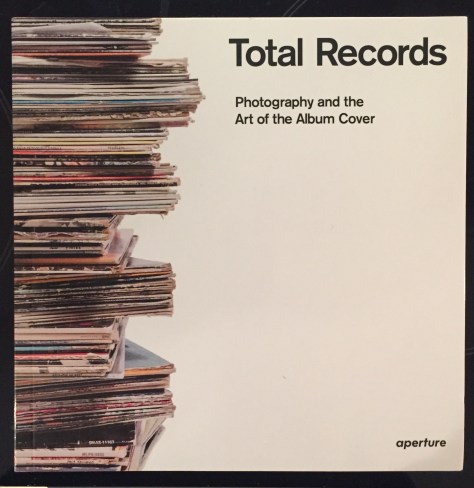
I just found out that I had missed yet another major exhibition of record cover art, this time in Arles in southwest France. The exhibition, called “Total Records” was first presented at Les Rencontres d’Arles from June to September 2015 and is said to be travelling round France. The exhibition catalogue has just (October 2016) been published as a free-standing book also called “TOTAL RECORDS – Photography and the Art of the Album Cover”.
The cover of the “Total Records” book.
I bought the 448 page book as it promised an introduction to how photographers and the record covers they took photographs for came together. However, the short introduction in English at the start of the book doesn’t live up to the promise. You have to turn to the end of the book for the full stories but, unfortunately for me, this section is only in French. Quelle horreur! Zut alors! and all that.
The book is divided into twenty-five “chapters”, some devoted to a single photographer and others more thematic with titles such as “Below the Belt” and “B-side America: Riverside, Bluesville and Yazoo”. There is a section called “Photo-Copy” which shows how some cover art has spawned plagiarism (The Rolling Stones’ “Sticky Fingers“, The Beatles’ “Abbey Road” and “Sgt Pepper’s Lonely Hearts Club Band“.)
But the photographs are great. Most pages picture a single cover. Not surprisingly, as the exhibition is French, there are many French covers. Johnny Halliday and Sylvie Vartan figure prominently alongside less well known French artists including a lovely cover of Catherine Deneuve’s “Souviens-toi de M’Oublier” with cover photo by Helmut Newton. There are also Newton’s photographs on the cover of Sylvie Vartan’s album “Au palais des congress“.
The first cover pictured in the book is Alex Steiweiss’ “Smash Song Hits by Rodgers and Hart“–Steinweiss’ first picture cover for Columbia Records from 1940.
Alex Steinweiss first picture cover for Columbia Records “Smash Song Hits by Rodgers & Hart” from 1940.
The first two chapters in the book, “The Sound I Saw” and “Aural Reappropriation” act as an introduction to the variety of photographs in record cover art and include covers by a multitude of photographers and make up nearly 30% of the book. These include cover photos by Andy Warhol (“This Is John Wallowitch“), Nobuyoshi Araki (Björk’s “Enjoy” and “Possibly Maybe” and Mango Delight’s “Conglomerate of Crazy Souls“), Annie Liebowitz (Cyndi Lauper’s “Change of Heart“, John Lennon’s “Interview Disc” and The Jim Carroll Band’s “Dry Dreams“), Herb Ritts (John Travolta/Olivia Newton-John “Two of a Kind” and Madonna’s “True Blue“). There is even Arthur Doyle’s “No More Crazy Women” with its Cindy Sherman cover photo (see my previous post on Cindy Sherman’s record cover art). Robert Mapplethorpe is represented with the classic Patti Smith cover for “Horses“, Taj Mahal’s “Taj” and Laurie Anderson’s “Strange Angels“.
Following these introductory chapters are sections/chapters devoted to individual photographers. First off are Jean-Paul Goude and Anton Corbijn. Corbijn is, of course, well known for his covers for Depeche Mode and U2. Jean-Paul Goude is best known for his cover photos of Grace Jones and eight of them are pictured in the book. It is a selection of Corbijns photos for U2 that are featured–mainly from the “Joshua Tree” sessions.
Next are eight of Jean-Baptiste Mondino’s covers, including covers of albums by Madonna, Björk, The Eurythmics and Prince.
The chapter after is reserved for Andy Warhol’s photographic covers. “This Is John Wallowitch” appeared in the first section of the book and this section includes the covers for “The Velvet Underground & Nico“, Miguel Bose’ s “Milano/Madrid“, Paul Anka’s “The Painter“, “Silk Electric” by Diana Ross and the cover of the “Muscles” single from the album and finishing with the cover of The Rolling Stones’ “Love You Live” album with a page devoted to the polaroid pictures on which Warhol based the cover design. “Sticky Fingers“, the other Stones album Warhol designed, appears in the section Photo-Copy along with several pastiches.Obviously, in a book on the photography and the art of the album cover, I wouldn’t expect any of Warhol’s graphic covers to be included–and there aren’t any, with the possible exception of “The Velvet Underground & Nico” cover. I’m not sure how much photography was involved. Did Warhol actually photograph the famous banana?
More chapters are devoted to the work of David Bailey (more Rolling Stones covers), Lucien Clergue And Lee Friedlander’s photography for jazz artists on the Atlantic label. The jazz theme is logically continued with a chapter devoted to some of the Blue Note label’s photographic covers with photography by Frank Wolf. And the label theme continues with a chapter on covers from the ECM label photographed by a variety of photographers. Other labels highlighted include Brazil’s Elena Records, ESP-dosc and a chapter devoted to the American Bluesville, Riverside & Yazoo labels before moving on to a chapter of Hipgnosis designs including the usual Pink Floyd covers (but happily, not the “Dark Side of the Moon” cover which I feel has become a cliché).
In the next chapter, aptly titled “Transartistic” there are covers by Robert Rauschenberg (Talking Heads’ “Speaking in Tongues”), Paul Bley (“Paul Bley Quintet“) and Andy Warhol’s “Index” book with the Lou Reed flexidisc. Even Jeff Koons’ cover for Lady Gaga’s “Artpop” and Damien Hirst’s cover for Dave Stewart’s “Greetings From the Gutter” are included.
One of the best chapters is entitled “Propaganda and Slogans” which includes thirty eight covers ranging from the clenched fist on the cover of The BlackVoices album “On the Streets in Watts” to Rage Against the Machines album with the self-imolating buddhist monk on the cover.From this provocative chapter with covers portraying Che Guevara, Charles de Gaulle,Malcolm X and Martin Luther King the book goes “Below the Belt2 with a selection of “racier” covers such as The Jimi Hendrix Experience’s ” Electric Ladyland” (The British cover with the nude models photographed by David Montgomery), Roxy Music’s “County Life” and more Rolling Stones in the form of both versions of the “Beggars Banquet” cover (the originally released version with the white cover which simply stated the group’s name and the record’s title as well as the version The Stones originally wanted with the lavatory interior scene, first released in 1986.
The final three chapters, “A life on Vinyl:David Bowie and Johnny Halliday”, “Word and Image” with many spoken word albums (Allen Ginsberg, Albert Camus, Jack Kerouac, etc.) and “from Grain to Groove”, a homage to the Soundtrack album cover, round off this nice book.
I think this is one of the nicest books on record cover design which I will keep alongside Alex Steinweiss’ “The Inventor of the Modern Record Cover“, Nick de Ville’s “Album: Classic Sleeve Design–Style and Image in Sleeve Design” and Richard Evan’s “The Art of the Album Cover“. I would have been thrilled to see the exhibition and have been able to see the covers full size. But the covers in “Total Records” are beautifully photographed by Romain Riviere and do them justice.
Cindy Sherman and Jeff Koons are two contemporary artists working in totally different media. Cindy Sherman (born 19th January 1954) is a photographer who specialises in self portraits in which she disguises herself in costume and in various situations. She is considered a conceptual artist.
CINDY SHERMAN
I have thus far managed to find six record, video and cassette covers with cover art by Cindy Sherman.The earliest recording I have found that has one of her photographs on its cover was for the television production “Two Moon July” which featured the music of Laurie Anderson, David Byrne (with whom Cindy Sherman had a relationship from 1991 to 2005), Philip Glass and others. The programme was released on VHS in 1986 and on Laserdisk the following year with Cindy‘s photograph of the Empire State Building on the cover.
The cover of the “Two Moon July” Laserdisk.
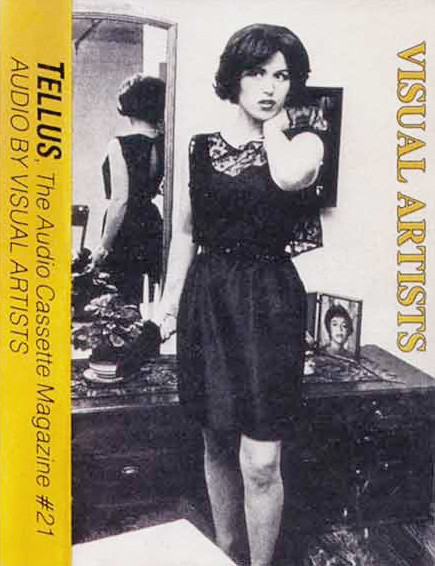
In 1988, one of her self portraits was used as the cover art for a cassette of visual artists talking. The cassette was released as Tellus Magazine #21 entitled “Tellus #21: Audio by Visual Artists“. Tellus was a bi-monthly cassette magazine that was founded in New York in 1983.
Cindy Sherman’s self portrait on the cover of the cassette magazine Tellus from 1988.
Sherman was involved with the female band Babes in Toyland in the 1980s and even appeared in one of their videos. Her photographs appeared on the covers of two of the group’s records “Fontanelle” (1992) and “Painkillers” (1993).
Babes in Toyland’s 1992 LP “Fontanelle” and 12″ “Painkillers” with cover photos by Cindy Sherman.
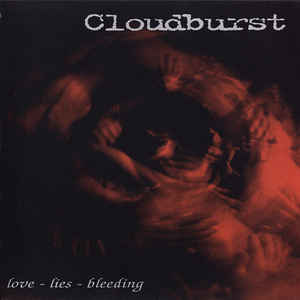
The punk band Cloudburst released two singles. The first, released in France in 1999 was a purple vinyl, three-track 7″ EP entitled “Love-Lies-Bleeding” and had a Cindy Sherman painting as its cover art.
Cloudburst’s 1999 single cover with Cindy Sherman painting.
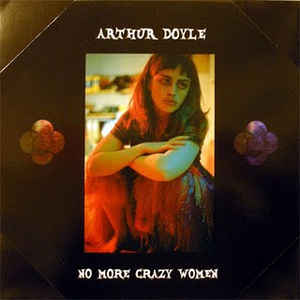
The latest cover i have been able to find is a five-track, single sided, yellow vinyl 12″ EP called “No More Crazy Women” by tenor saxophonist Arthur Doyle. I’ll be returning to Arthur Doyle in my list of Jeff Koon‘s cover art.
The cover of Arthur Doyle’s “No More Crazy Women” 12″ EP-
JEFF KOONS
There only seem to be three record or CD covers with Jeff Koons’ art. Or that is all I have hitherto been able to find.
Eli and Edye Broad have built up a magnificent collection of American postwar art which is housed at The Broad at 221 S. Grand Avenue, Los Angeles and is open to visitors. The Los Angeles County Museum of Art hosted an exhibition of 100 works from the Broad Collection from 7th October 2001 until 6th January 2002. The exhibition was called “Jasper Johns to Jeff Koons: Four Decades of Art from the Broad Collection“. In conjunction with the exhibition a CD was released called “John Cage to David Byrne: Four Decades of Contemporary Music“. The exhibition later transferred to The Corcoran Gallery of Art in Washington DC (16th March-3rd June 2002).
The CD was a compilation of 13 tracks by artists from David Bowie (“Rock ‘n’ Roll Suicide“) to John Cage (“Atlas Eclipticalis”) via The Velvet Underground (“Femme Fatale”), Dizzy Gillespie (“Be Bop”) and Klaus Schulze (“Floating”).
The “John Cage to David Byrne: Four Decades of Contemporary Music” CD cover with a detail of Jasper Johns’ “Flag” and Jeff Koons’ “Rabbit”.
The CD booklet also contains pictures of other artworks from the Broad Collection, including Andy Warhol‘s “Elvis” (1963), Jean-Michel Basquiat‘s “Horn Players” (1983), Sharon Lockhart‘s “Untitled” (1996) and Stephan Balkenhol‘s “Large Woman with Green Pants” (1996). The rear inlay shows Roy Lichtenstein‘s “I… I’m Sorry” (1965-1966).
The second release with Jeff Koons‘ art is another Arthur Doyle record. This time another single-sided, two track 12″ single with cover that shows Koons‘ print “Donkey 1999” from 1999 produced in an edition of 99 copies. The cover, once again, has two corners cut off.
Arthur Doyle Trio’s “Live at the Alterknit” cover.
And the third Jeff Koons cover is the best known. Lady Gaga‘s “ArtPop” from 2013. For this cover Koons acted as photographer.
I will keep looking out for more covers with art by Sherman and Koons and will probably update this post sometime in the future.






























 recordart