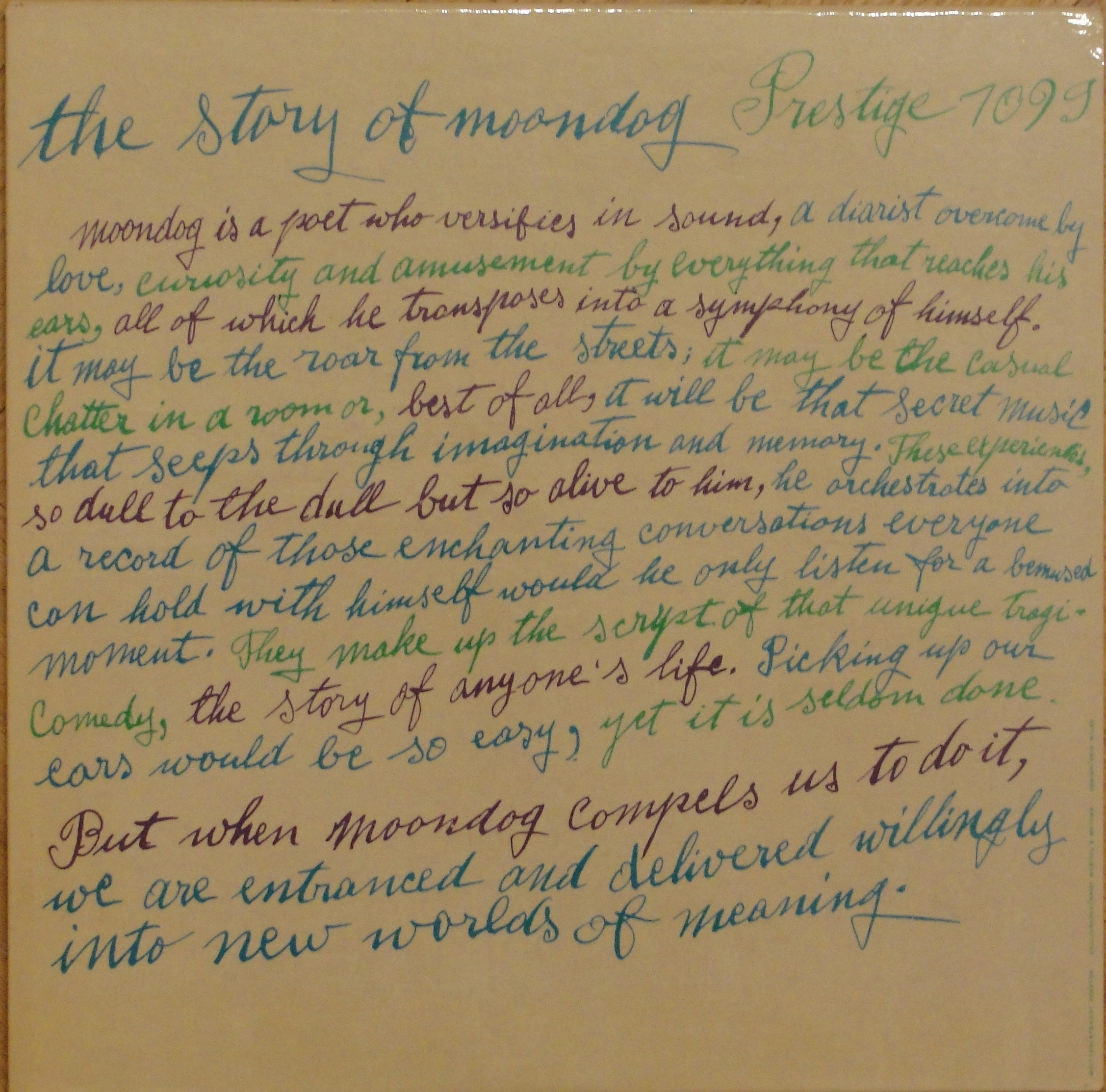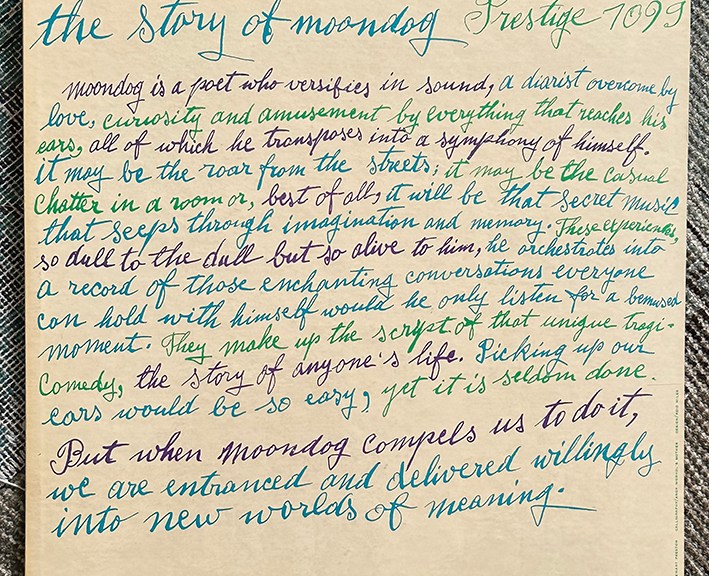
Among the many remarkable objects in Andy Warhol’s early record cover output, The Story of Moondog (Prestige 7099) occupies a unique position. It is, as far as can be determined, the only cover in his entire career that could legitimately be called a collage — and the reason it exists at all has nothing to do with artistic ambition. It exists because his mother couldn’t write in a straight line.
Moondog
First, the subject. Moondog — born Louis Thomas Hardin in 1916 — was one of New York’s most extraordinary figures. Blind from the age of sixteen, he took up residence on Sixth Avenue dressed in a self-made Viking costume, selling his poetry and recordings to passers-by, and became a genuine cult figure among the city’s avant-garde. In his preface to Robert Scotto’s biography Moondog, Philip Glass wrote that he and Steve Reich took Moondog’s work “very seriously and understood and appreciated it much more than what we were exposed to at Juilliard” — a pointed endorsement from two composers who would go on to define American minimalism. He was, as the sleeve note on this very record puts it, “a poet who versifies in sound, a diarist overcome by love, curiosity and amusement by everything that reaches his ears, all of which he transposes into a symphony of himself.”
That sleeve note was written by Stewart Preston. How it came to be on this cover — whether commissioned specifically for it, selected by Reid Miles, or suggested by some other route — is not known. What is known is that it is one of the finer descriptions of a musician ever committed to a record sleeve.
The Cover
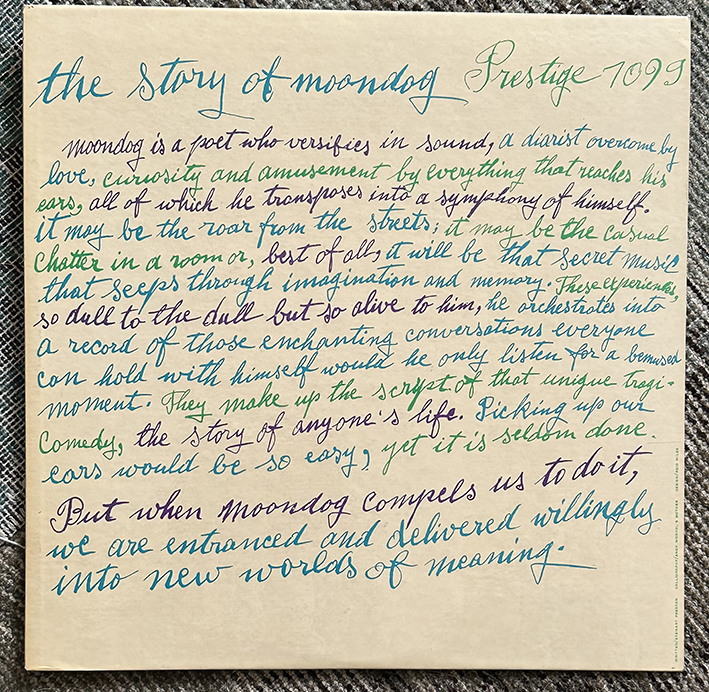
The front cover of The Story of Moondog is dominated entirely by Preston’s text, written out in a flowing, multicoloured script that shifts from teal through green to blue-purple across the page. It is immediately beautiful — fluid, warm, and entirely hand-lettered. There is no illustration, no photograph of Moondog in his Viking costume, no graphic device beyond the words themselves and the hand that rendered them.
Three credits appear on the front cover: POEM/STEWART PRESTON, CALLIGRAPHY/ANDY WORHOL’S MOTHER, and DESIGN/REID MILES.
That second credit is, by some distance, one of the most extraordinary in the history of recorded music. Not her name — she is identified purely by her relationship to her son. Julia Warhola, born Julia Zavacký in the Carpathian village of Miková in what is now Slovakia, credited on an American jazz record as an appendage of her famous son. It is simultaneously touching and faintly absurd.
The reader will also have noticed something else. The name is misspelled. Not Warhol. Worhol. The most celebrated name in American art history, misspelled in the only place it appears on the record — and in a credit that refers not to the artist himself but to his mother.
How It Came About
Reid Miles was one of the supreme graphic designers of the era, responsible for the visual identity of Blue Note Records and an occasional collaborator with Prestige. He had worked with Andy Warhol before — the Kenny Burrell and Thelonious Monk covers establish an existing professional relationship. When the Moondog project came along, Miles called Warhol, gave him Preston’s poem, and asked him to do something with it for the cover.
Andy’s solution was calligraphy. Rather than illustrating the subject — and a blind Viking street musician offers considerable illustrative possibilities — he decided that Preston’s words, rendered by hand, should be the visual. It was a bold and confident creative decision. He handed the poem to his mother.
Julia’s Hand
Julia Warhola’s distinctive handwritten script is well known to Warhol scholars. It appears throughout his self-published books of the 1950s — the calligraphy in 25 Cats Name[d] Sam and One Blue Pussy, A Gold Book, and Wild Raspberries is hers rather than his. Andy incorporated his mother’s hand into his commercial work so regularly that it became, in effect, part of his visual identity during this period.
There was, however, a practical problem. Julia’s script wandered. Her natural handwriting, however beautiful in character, had an irrepressible tendency to drift from the horizontal — lines would rise or fall across the page in a manner entirely charming in a personal letter but unworkable in a design intended for commercial reproduction. Andy’s solution was to cut the calligraphy into strips and reassemble them with each line individually aligned horizontally before pasting the whole thing down. Look carefully at the cover and you can see the logic of it — the lines sit at very slightly different angles to one another, each strip independently levelled by Andy’s intervention.
This makes The Story of Moondog cover Warhol’s only documented collage.
The Exception That Proves the Rule
It is worth being precise about what this means and what it doesn’t. This is not collage in the sense that Peter Blake or Richard Hamilton meant it — the deliberate juxtaposition of found materials to create meaning through contrast and combination. There is no aesthetic theory here, no commentary on the relationship between elements. It is problem-solving: a practical response to a baseline that wouldn’t stay straight.
Warhol was emphatically not a collagist. His output across five decades — drawing, painting, printmaking, photography, film — shows a consistent preference for single-medium approaches. The silkscreen portraits that made his reputation combine photographic source material with paint, but that is printmaking and painting, not collage. The gold leaf work of the mid-1950s is a craft technique borrowed from signwriting. The blotted line illustrations are drawings, however ingeniously transferred. In exhibition after exhibition, the work presents itself in clearly defined media without the cut-and-paste hybridity that defines collage as an art form.
The Moondog sleeve is the single exception — and its very modesty, its entirely practical motivation, serves to highlight by contrast how consistently Warhol worked in other modes. Had Julia Warhola written in straighter lines, even this one example would not exist.
A Final Curiosity
All three collaborators are credited on the front cover: Preston for the text, Julia for the calligraphy, Miles for the design. The one person who goes entirely uncredited is Andy Warhol — the man who took the commission, made the creative decision, and delivered the work. He appears on this record solely as a grammatical relationship to someone else: Andy Worhol’s Mother.
Not only absent, but absent and misspelled.
For an artist who would spend the rest of his career questioning the nature of authorship, creativity, and originality, it is a quietly perfect — if accidental — beginning.
Rockdoc is the author of Rockdoc’s Illustrated Guide to Banksy’s Art on Record Covers (MUSE, forthcoming) and maintains the record art research platform recordart.net*.*