Category Archives: Sgt. Pepper’s Lonely Hearts Club Band

Searching for Joe Ephgrave.

A few years ago, while researching the Sgt. Pepper story I wondered about the mysterious Joe Ephgrave who painted the famous Pepper drum. I could not find any information about him on the Internet apart from a conspiracy theory wound up in the “Paul is dead” theory that suggested that Paul had died in a car crash on 9th November 1966, and the Beatles had continued recording the Sgt. Pepper album with a substitute. Furthermore, the album’s cover image was really of a funeral with the crowd of mourners standing looking down at the fresh grave with the drum as the headstone. Ephgrave was supposed to be a fusion of “epitaph” and “grave” and thus there was no real person called Ephgrave.

I contacted Jann Haworth, co-creator of the Pepper cover and asked her about Joe. Jann told me that he was a circus artist–what today would be called a signwriter–who had been a friend. She had bought two prints from him and he had painted a tiger on her wardrobe. Jann generously shared a photo of her in her studio around the time of the Pepper cover. The wardrobe is on the right.
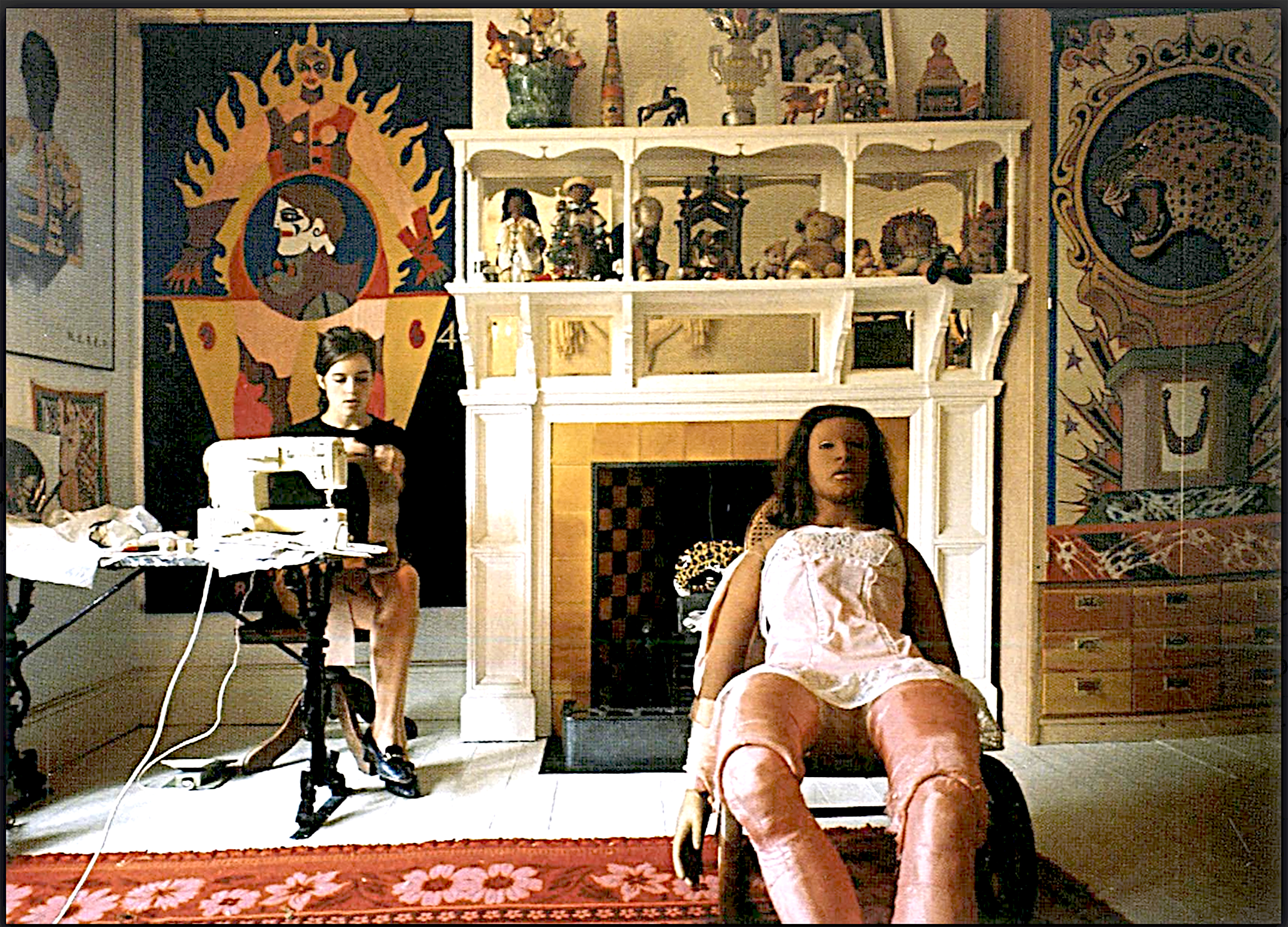
Jon Naar’s photo of Jann Haworth in her London studio in the late sixties with Ephgrave’s wardrobe on the right.

Haworth lost contact with Joe after the Pepper cover and spent considerable time trying to find out what had happened to him. There was a rumour that he had emigrated to Australia but the trail went cold. Eventually, Jann found Joe’s son, Joe junior, who sent her this short biography that I reproduce unedited.:

My dad was a great artist but being honest pretty useless with money, I can remember my mum and dad having quite a few arguments over money, there was a time when my mother held down three job, she would work in a florists in the morning, go cleaning in the afternoon and work nights in an old peoples home just to make ends meet. She was always there for me and my sister in the mornings and to put us to bed.

Money was tight in those days and we could not afford many luxuries but every couple of months or so my mum would buy a packet of Chow Mein as a little treat for my sister and I, it was something special to us as we knew mum had gone out of her way to get it for us, seems crazy these days I know, so when you said we could have anything that day that’s the first thing that sprang to mind as to us it was special.

The final chapter in dad’s history was mum and dad split up around 1978-79 from memory and dad moved to Great Yarmouth and lived and worked on the seafront fairground there. I only saw him once after he moved there, I don’t know if he did any more painting while he was there. He died some years later from a brain tumour and my mum and sister went to see him just before he passed away, I was living in Germany at the time and didn’t get to see him but being honest we had very little contact in the last few years.

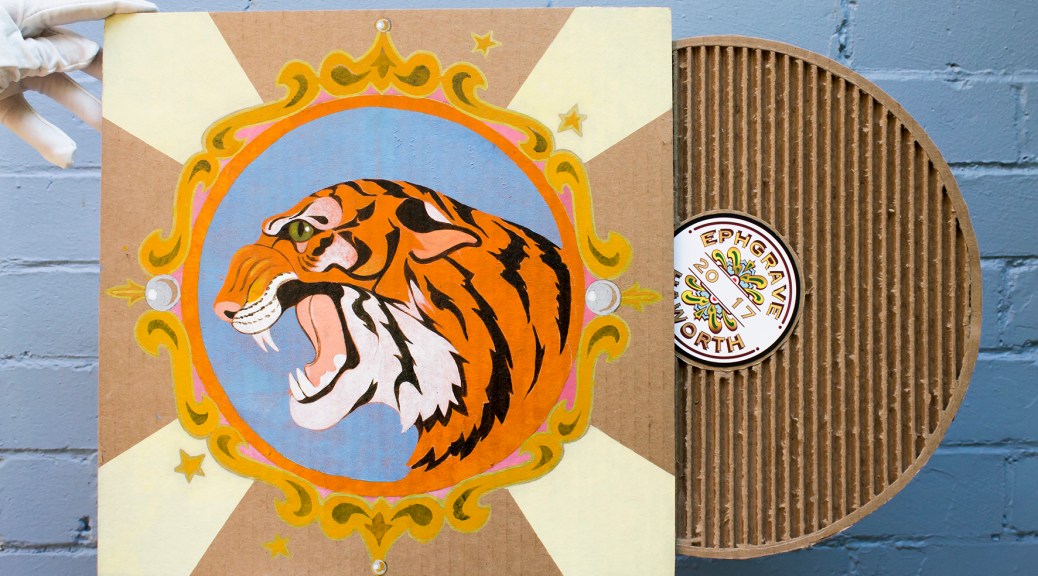
In 2017, Jann decided to paint an homage to Joe and reproduced his tiger motif on a mock record cover made of wellpap. She made two copies, both now in private cllections (one in Denver and the other in Salt Lake City). Here is Jann Haworth’s original. It’s only the second record cover she has designed.
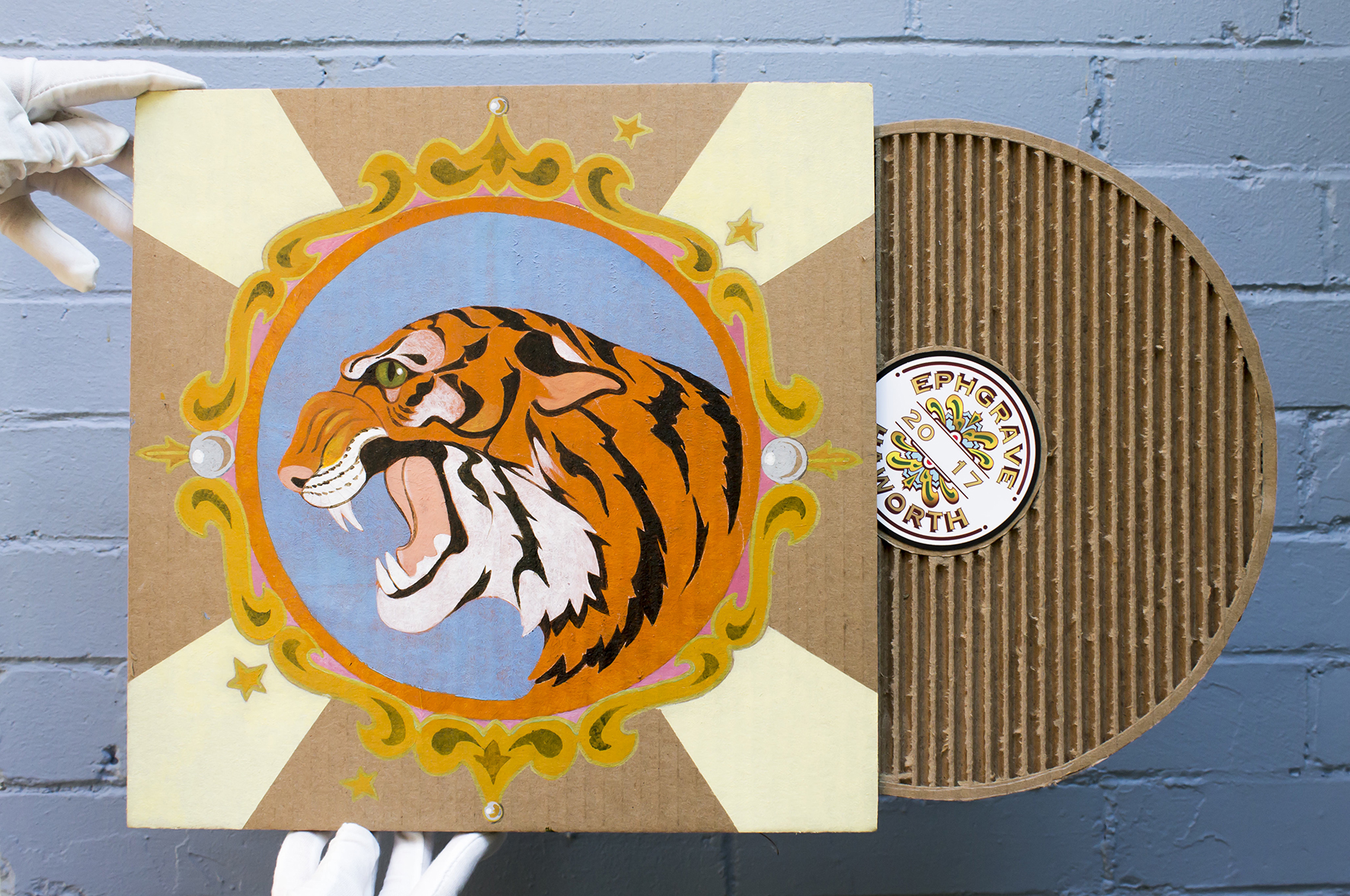
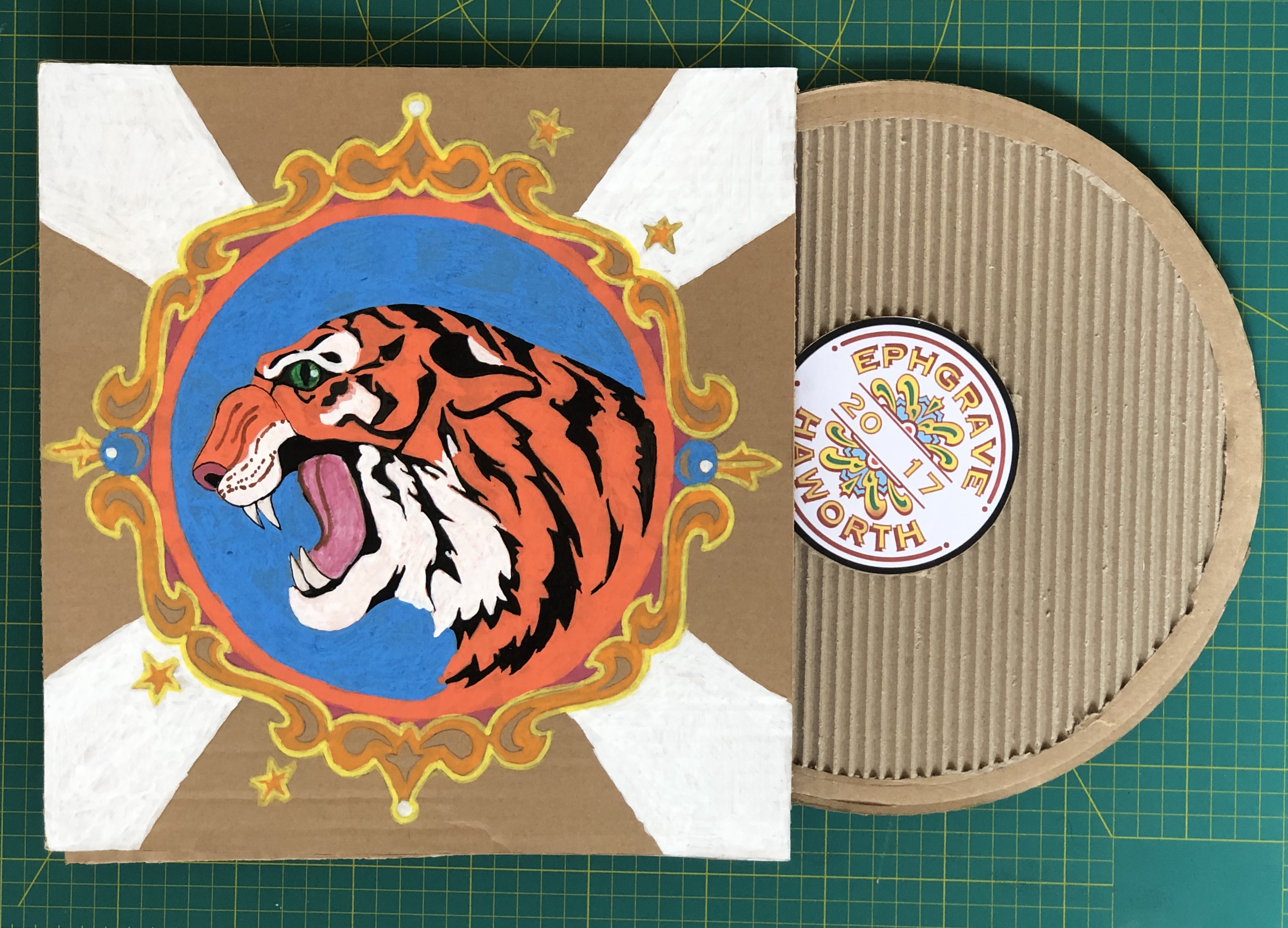
She shared the design with me, and graciously allowed me to make my own replica, even sending me the file with the record label design. Here’s my version.
We have been trying to find out more details of Joe’s life and Jann put me in touch with Kevin Fabbi, who has been researching Joe’s life and had contact with his remaining family. Kevin generously gave me the dates of Joe’s birth and death. He was born in 1928 and died in 2004. So he would have been 39 when he painted the Pepper drum skins.

Amazingly, it turns out that Kevin has also made a reproduction of Joe’s Tiger motif (far more dramatic than mine!) and he kindly allowed me to reproduce it here:

So, now we have identified the THREE designers behind the Sgt. Pepper cover picture–Peter Blake, Jann Haworth AND Joe Ephgrave. Joe has now taken. his rightful place thanks to Jann’s and Kevin’s research.

A “New” Record Cover by Jann Haworth.

When I was preparing an exhibition of Peter Blake’s record cover art at Piteå Museum in northern Sweden in 2009, I realised that Peter Blake had all but taken over responsibility for the design of the Sgt. Pepper’s Lonely Hearts Club Band album cover. I wondered how his ex-wife and co-designer Jann Haworth felt about this and contacted her and we began a correspondence. She acknowledged that she has been marginalised. In 2017 the BBC published an interview with her entitled Jann Haworth: The forgotten creator of the Sgt. Pepper cover. we discussed the inequalities that appeared in retrospect about the characters featured on the cover. Why were there so few people representing ethnic minorities, so few women? Obviously, the cover was a product of its time and these questions were only being formulated in the sixties. Jann, now living in Salt Lake City, Utah, U.S.A., has since tried to address this and has produced a large mural called SLC Pepper.

Janns SLC Pepper
Jann Haworth in front of her mural in Salt Lake City.

Haworth has also produced a seven-panel womens’ mural that has been shown in various locations around the world.

JAnn Haworth Women
Jann Haworth’s Womens mural on seven panels.

During a more recent exchange of emails, Jann told me she had been searching for news of Joe Ephgrave, the artist who painted the Sgt. Pepper drum. He had been a friend of hers and Jann had one of his paintings, of a tiger, on her wall back in the sixties. I asked Jann if she had designed any other covers after the Sgt. Pepper cover. She had not done any covers for real records but in 2017 had taken Joe’s tiger design and produced a painting in the form of a record sleeve.

Tiger 1
Jann Haworth’s 2017 record cover design.

She had made two copies, one in Salt Lake City and the other in Denver, Colorado. And, realising I wouldn’t be able to get one of these, I decided to make my own. First I downloaded the cover picture and sized it in Photoshop and printed it on supersized A3 paper. Then using graphite paper traced the design onto a sheet of wellpap.

Then using acrylic paints I finished my version of the cover picture. However, I had a problem with the record label, which proved much more difficult to copy accurately. I mentioned this to Jann and she kindly helped me by mailing me the design.

Janns Label
Jann’s mail with the design of the record label.

This saved me an enormous amount of work! making the wellpap “record” took some time and then calculating the size of the label was tricky. Finally, my copy was ready.

Richards Tiger cover
My recreation of Jann Haworth’s Tiger cover.

This “artwork” is an homage to both Jann Haworth and to Joe Ephgrave. Perhaps not as professional as Jann’s original, but made with gratitude and in the knowledge that it’s unique.

“Sgt. Pepper’s Lonely Hearts Club Band” Revisited.

I described the 50th anniversary box set of “Sgt. Peppers Lonely Hearts Club Band” in a post in July 2017. Way back in 2008–2009, when I was preparing an exhibition of Sir Peter Blake’s record cover art, I felt that Jann Haworth, his former wife and co-designer of Blake’s most famous cover, had almost been forgotten. Whenever one reads about Peter Blake, in articles or exhibition catalogues, he is invariably introduced as “the designer of the Sgt. Pepper cover”. Indeed, he has said that this is “an albatross sitting on his shoulder”. So I contacted Jann and she was most helpful providing details of the construction of the Pepper set up and even sent pictures. She also agreed to sign my copy  original “Sgt. Pepper’s Lonely Hearts Club Band” LP that Peter Blake had previously signed.

We discussed the gender and racial imbalances of the figures represented on the cover and Jann told me this was something she had been thinking about and tried to redress in a “Pepper” mural in her home town of Salt Lake City, Utah, U.S.A.

SLC Pepper
Jann Haworth’s 2004 mural “SLC Pepper” in Salt Lake City (SLC).

In late 2018 I bought a copy of the 50th anniversary “Sgt. Pepper” LP signed by Sir Peter Blake at a gallery in Liverpool. I thought it would be cool to have this anniversary album signed by both Blake and Haworth, so I contacted her again. She was more than happy to help out and I didn’t waste a moment before posting the record and a couple of other “Pepper” covers to the address I had been given ten years before. I should have checked Jann’s address before posting as it transpired she had moved from the old address. Despite her efforts to trace the parcel it was never delivered to her but found its way back to me in January 2019. So, I repackaged the covers and, after confirming Jann’s address, sent them again.

Jann was busy painting two new murals and had a deadline to keep, so the covers sat with her until the end of March. They arrived in mid April. Jann had signed nine items:
1. The 2017 Pepper anniversary LP signed previously by Peter Blake,
2. The Album cover from the 2017 box set containing four CDs, a DVD & a Blu-Ray disc
3. All four of the CD covers from the above,
4. The stage set from the Japanese 50th anniversary box set, and
5. The cover of an old 1967 copy of “Sgt. Pepper”.
6. The insert from the above.

Pepper-HaworthBlake-50th cropped
the 2017 LP cover signed by both Jann Haworth and Sir Peter Blake.

In the package was a handwritten letter describing the soft figures she made for the Pepper cover. She had made the Shirley Temple doll in 1965 or 1966 and, on the cover, it was sitting in the lap of an old lady. I had never really noticed the old lady–and I suspect few other people had either. The old lady, Jann told me,was modelled on a photo of her great grandmother, a seamstress who had been widowed early and had to raise two children on her own.

Since the arrival of the signed records Jann has kept me informed of some of her current projects, including a joint “Work in Progress” mural with her daughter Liberty Blake. This mural is in seven panels and has been shown in several museums.

banner-4ftx8ft-v
Jann Haworth’s and Liberty Blake’s “Work in Progress” mural.

I recently asked her if she had been involve in any other designs for record covers and it transpires that she has produced one other–a limited edition artwork.

Haworth Ephgrave cover
Jann Haworth’s & Joe Ephgrave’s 2017 cover for a cardboard record.

Jann told me of her work with Joe Ephgrave, the fairground painter who painted the drum om the “Sgt. Pepper” cover. He painted different versions of the Pepper title on each side of the drum. The one we are all familiar with, and another version that he considered “more modern”, that I had not seen until now.

fullsizeoutput_5c4f
Joe Ephgrave’s alternate version of the “Sgt. Pepper” drum.

Joe was paid £25 for the drum painting and disappeared soon afterwards. Internet searches have failed to find any information about him–and there are suggestions that he never existed! However, Jann has scotched that rumour. She has taken Joe’s painting of a tiger and produced a record cover of sorts. In July 2008 the “Pepper” drum was sold at Christie’s for £541,250 ($1.07 million).

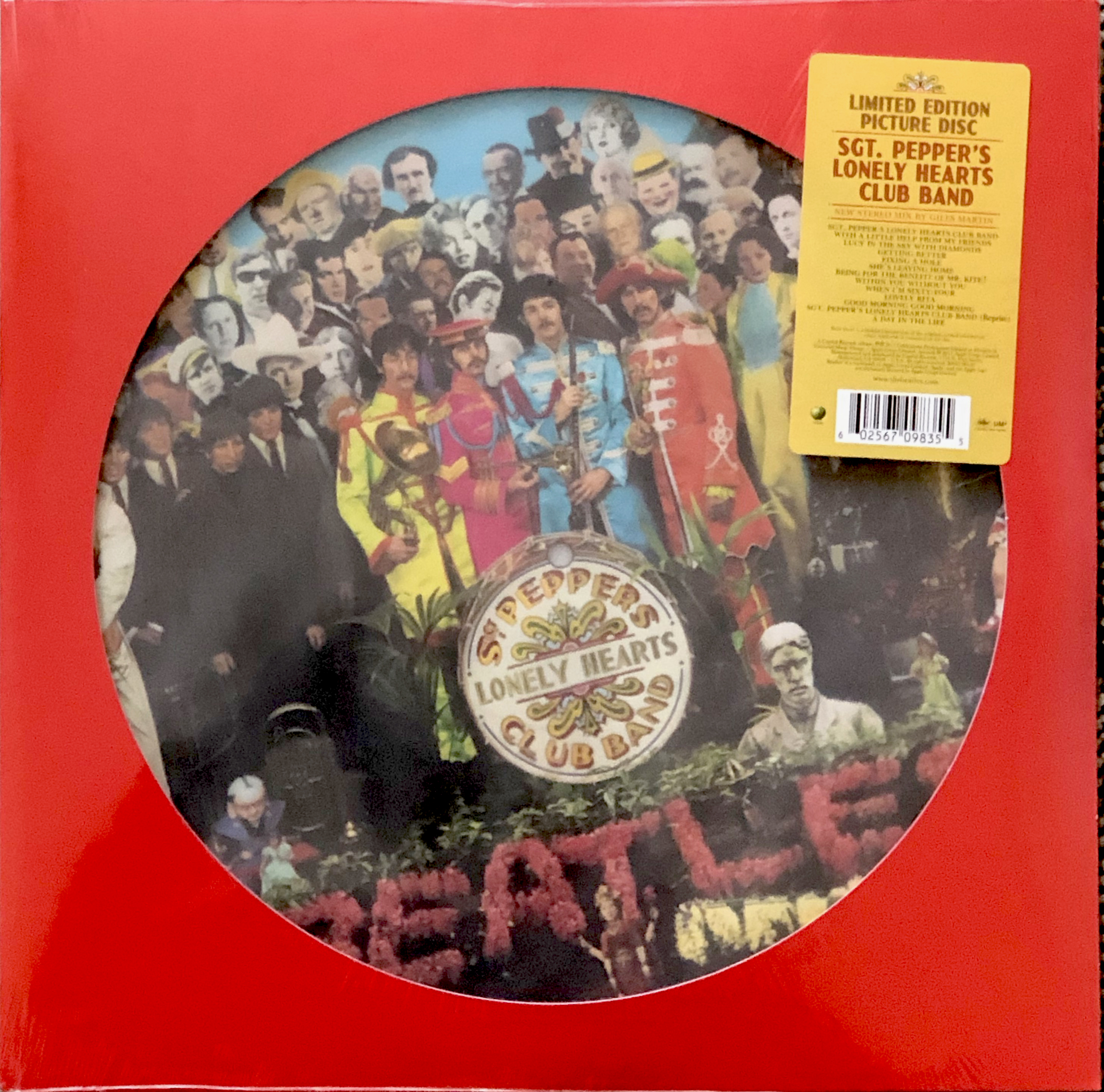
To almost round off my collection of the 50th anniversary issues of “Sgt. Pepper’s Lonely Hearts Club Band” releases I added the limited edition picture disc to my collection.

SgtPLHCB-Pic-fr
The US limited edition picture disc.

The only version of the 50th anniversary issues of “Sgt. Pepper’s Lonely Hearts Club Band” releases I don’t yet have is the double LP version. Perhaps I’ll try to get that some day.


The 50th Anniversary Box Set of “Sgt. Pepper’s Lonely Hearts Club Band” – a set I didn’t think I needed.

Sgt Pepper box ad
The deluxe 50th anniversary box set of “Sgt. Pepper’s Lonely Hearts Club Band” with all the ‘goodies’.

It seems I’ve been writing a lot about “Sgt. Pepper’s Lonely Hearts Club Band” since it’s 50th anniversary on June 1st. In March, I heard about the projected release of an upgraded version of the stereo version of the album together with a variety of previously unreleased alternative takes of the songs (including “Strawberry Fields Forever” and “Penny Lane“, which had not been included on the final album) on double vinyl, double CD and a four CD, Blu-ray and DVD box set which included a 144-page LP-sized book, and 2 posters as well as a reproduction of the original cutout from the LP.

I decided that I already had the original LP (actually TWO copies) and didn’t think I needed to shell out £30 for the double LP or over £100 for the box set as I am not particularly interested in hearing alternate takes. And I felt I didn’t need to listen to a third re-mastering of the original, though I listened to the new stereo version on Spotify and definitely heard a new, clearer mix. My main interest in “Sgt. Pepper” extends to the cover design.

But on a visit to my favourite record store I saw a copy of the box. What first caught my eye and made me take it off the shelf was the lenticular version of the cover image, which made it appear three dimensional. Now, that was a version of Peter Blake’s & Jann Haworth’s cover that I hadn’t seen before. Then, on opening the clamshell inner box I found what I thought was a copy of the LP–but the box clearly stated that it didn’t include the LP only 4 CDs, a Blu-ray and a DVD. There were three posters and the book which had a chapter devoted to the story of how the cover came about. Now, THAT did interest me. So I decided I’d try it and the offer of a 10% discount clinched the deal!

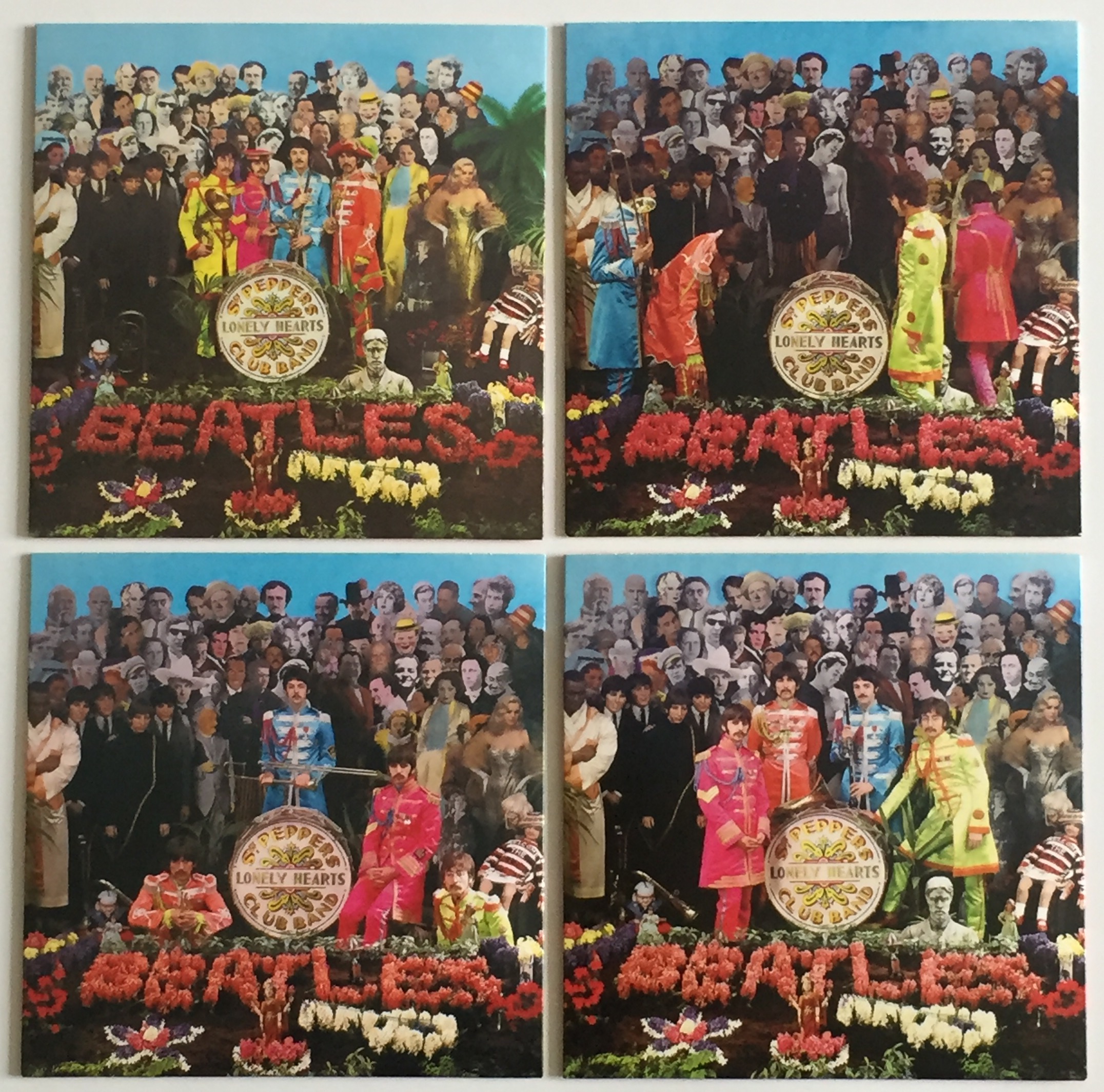
When I got home, I removed the plasticwrap from the LP sized album and from the book. On opening the gatefold I saw the CDs, Blu-ray and DVD were housed in separate LP-style covers. Only when I started to upload the CDs onto my computer did I notice that each CD had a different version of the classic “Sgt. Pepper” photo, with the Beatles in different poses in front of the Blake/Haworth montage.

fullsizeoutput_48be
Four different variations on the original “Pepper” cover. The one at top left is is the standard photo.

The book tells Paul McCartney’s version of how the cover art came to be. He tells that he had the idea of the “Sgt. Pepper” theme while on a flight back from America. He says that Mal Evans asked for him to pass the salt and pepper and he misheard it as Sgt. Pepper, which immediately inspired him to create an alter ego for The Beatles. He says that he mad some sketches for a possible cover scene and took them to his friend, gallery owner Robert Fraser, who proposed Peter Blake and Jann Haworth as artists to realise his ideas.

There is no mention of John Lennon’s discussions with design group “The Fool”, though the chapter ends with an interview with Marijke Koger who tells of the visits by The Beatles to their home, which inspired them to commission a design for the planned “Sgt Pepper” album cover. However, only The Fool’s design for the red, pink and white inner sleeve was used.

I have also now listened to the re-mastered stereo version included in the set as well as the original mono version. There really is a new clarity in the stereo version. But–I have lived with the original stereo version for just over 50 years and it still remains the one I probably will listen to on vinyl.

Anyway, now I can add the lenticular cover of the Blake/Haworth design and the alternative Michael Cooper photos of the “Sgt. Pepper” set to my cover collection.

Some Record Covers Influenced by the Sgt. Pepper Cover.

The 50th anniversary of the release of “Sgt. Pepper’s Lonely Hearts Club Band” has caused considerable interest in various aspects of what came to be called “the summer of love”; 1967’s glorious pop year. It was also the time of “Swinging London” and Carnaby Street’s first heyday.

That the cover of the “Sgt. Pepper” album would become a classic had been foreseen by Beatles manager Brian Epstein who wanted a “proper” artist to design the cover rather than the original psychedelic ideas suggested by fashion designers The Fool. From an idea by Paul McCartney via his friend and gallery owner Robert Fraser, Peter Blake and Jann Haworth were recruited and with some input from Jann’s father, Ted, the couple set to work.

It didn’t take long for the first of many pastiches of the cover art to appear. The Mothers of Invention’s album “We’re Only in It for the Money” released in March 1968, was one of the earliest. Frank Zappa wanted the cover (designed by Cal Schenkel) to be a copy of the “Sgt. Pepper” cover and asked Paul McCartney for approval. Apparently McCartney wished that Zappa’s and The Beatles’ mangers discussed the suggestion. Zappa went ahead but Verve Records, who would release the album, would not allow Schenkel’s copy of the “Sgt. Pepper” montage to appear on the front so the band’s portrait, photographed against a yellow background became the outside of the gatefold.

The lyrics, printed against a similar red background to those on the “Sgt. Pepper” cover appeared on the inside of the gatefold opposite Schenkel’s montage.

Release of “We’re Only in It for the Money” was delayed five months because of the record company’s anxiety over a possible infringement of copyright. In the event there was no reaction as the front cover only revealed four band members.

There have been innumerable pastiches of the “Sgt. Pepper” cover since the Mothers of Invention’s album; ranging from albums by the Muppets and Simpsons to more “serious” artist like The Ruttles. An Internet search turns up literally hundreds. Probably only the cover photo from The Beatles’ “Abbey Road” has been copied/parodied more often.

My collection includes only three pastiches of the (probably) hundreds out there, collected because of their originality (and possibly rarity). The oldest, from 1969, is Jack O’Reilly’s “You Can Be a Ventriloquist” (subtitled “Constable O’Rourke’s Wooden Hearts Club Band“, just so that no one would miss the reference to “Sgt. Pepper“). An instructional album that was probably privately pressed and thus in relatively limited numbers. O’Reilly went to inordinate expense to put together a background of forty ventriloquists’ dummies for the cover photograph.
Jack O'Reilly-fr

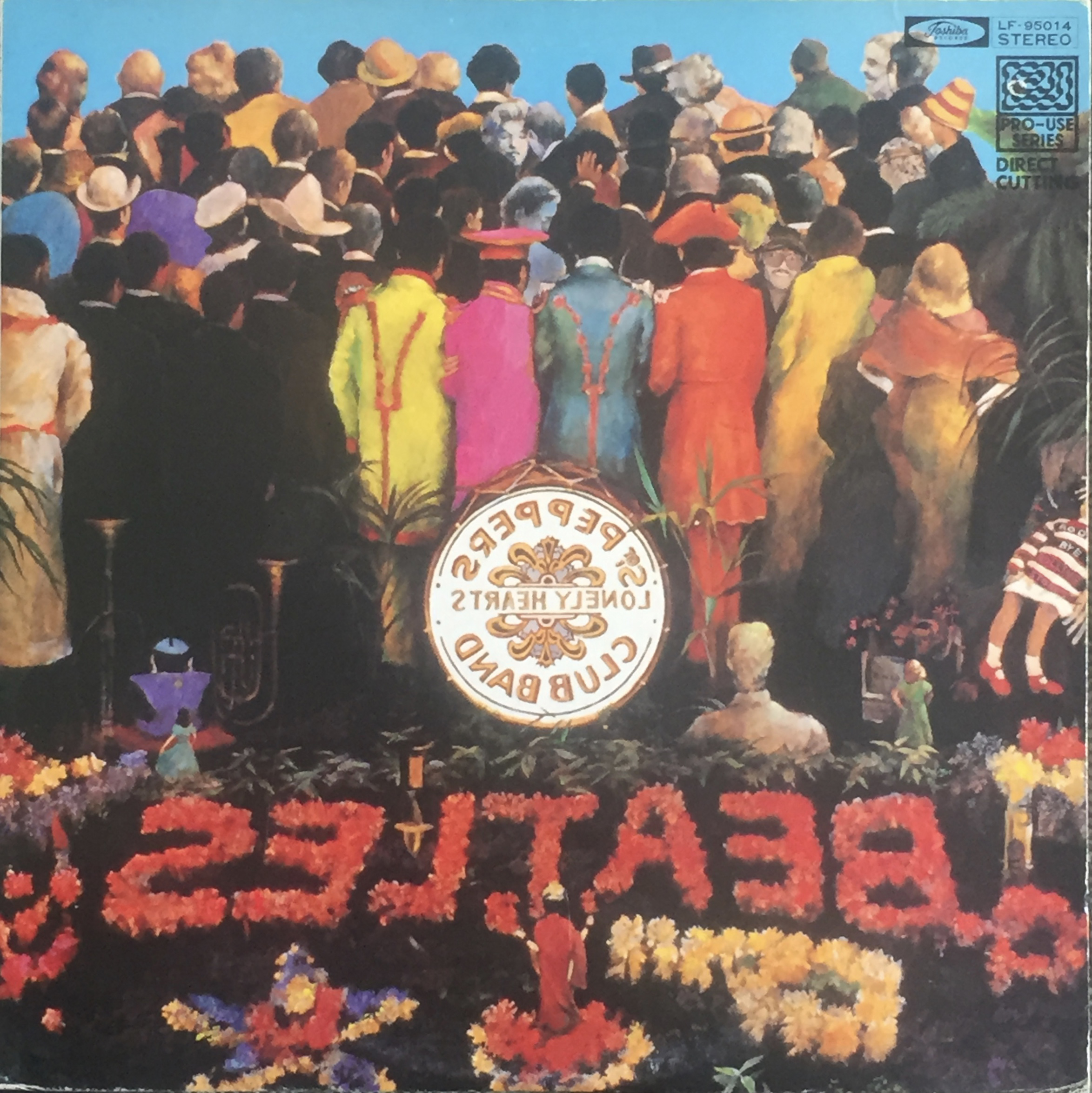
The second example is a Japanese album by Jun Fukamachi called (not so strangely) “Sgt. Pepper’s Lonely Hearts Club Band“. Fukamachi plays several of the “Sgt. Pepper” songs rendered as jazz tunes. I like the cover for the idea of reversing the whole scene. It must have taken weeks to paint!

JunFukamachi-Fr
The cover of Jun Fukamachi’s “Sgt. Pepper” album painted by Fumio Tamabuchi.

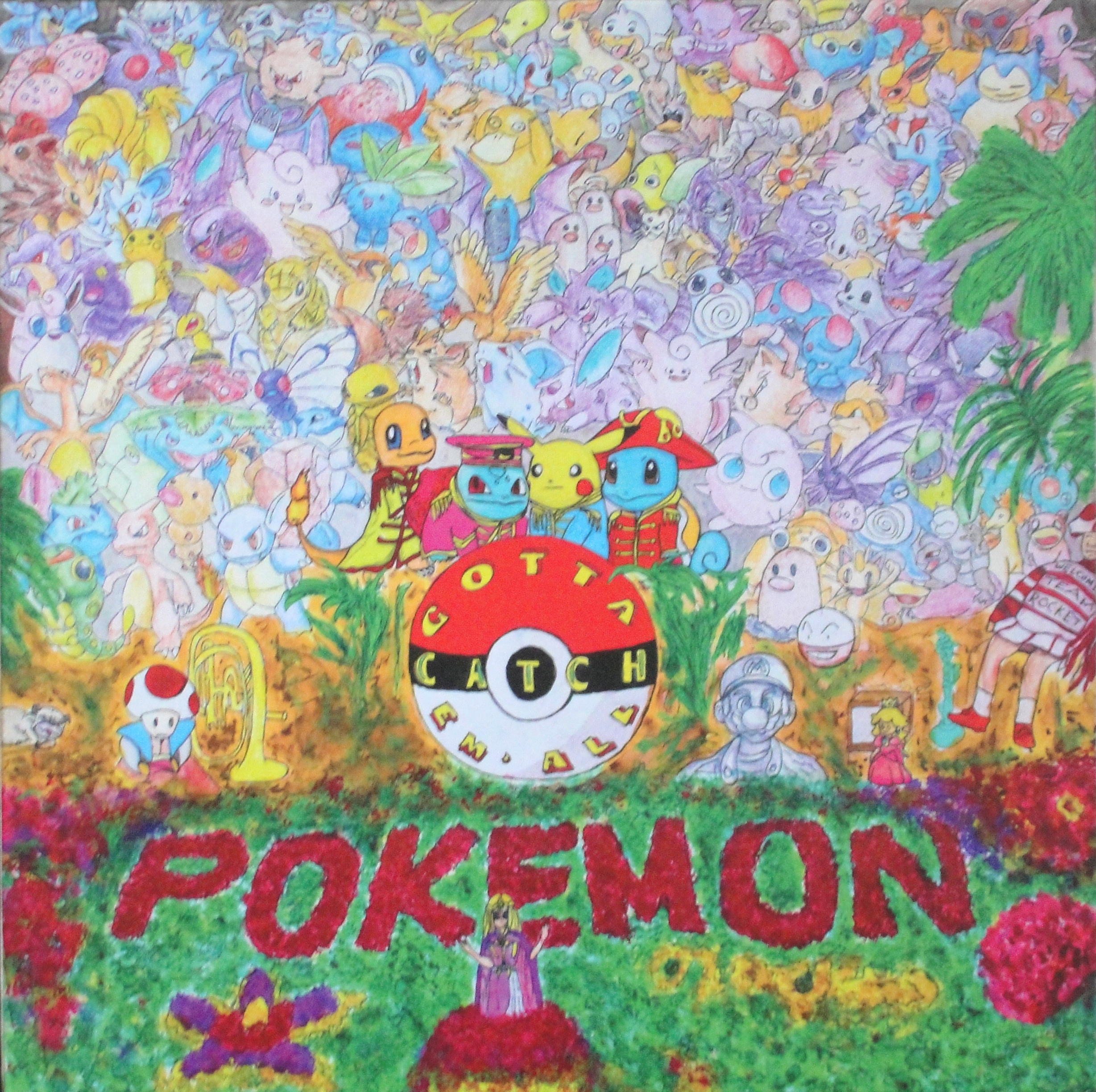
And the final parody that I have collected is another Japanese release–Junichi Masuda’s “Pokèmon” LP from 2015. This is an unoffical release on the Moonshake record label. Masuda, who is programmer and director at Pokèmon also makes the music to video games. The “Pokèmon” album was released in several versions. The “standard” album came in four variations of coloured vinyl housed in a cover that is a parody of the “Sgt. Pepper” design.

pokemon_redblue-fr
The Cover of Junichi Masuda’s “Pokèmon” LP. A just recognisable “Sgt. Pepper “pastiche.

Oh, and I have been guilty of plagiarism, too. In 2009 I curated an exhibition of Peter Blake’s record cover art at Piteå Museum. Together with my friends at In the Cold bureau we designed a cover for the exhibition catalogue, of course modelling it on the “Sgt. Pepper” design, but with all the artists that Blake had made record covers for.

fullsizeoutput_4854
The catalogue cover for the “Pop Art” Exhibition of Sir Peter Blake’s record cove art at Piteå Museum, July 22nd–August 31st 2009.

In 2010, I showed my collection of Peter Blake’s record covers at the A and D Gallery in London, and Sir Peter Blake signed m catalogue. I wonder if it didn’t inspire him to produce his 2012 update of the Sgt. Pepper cover…

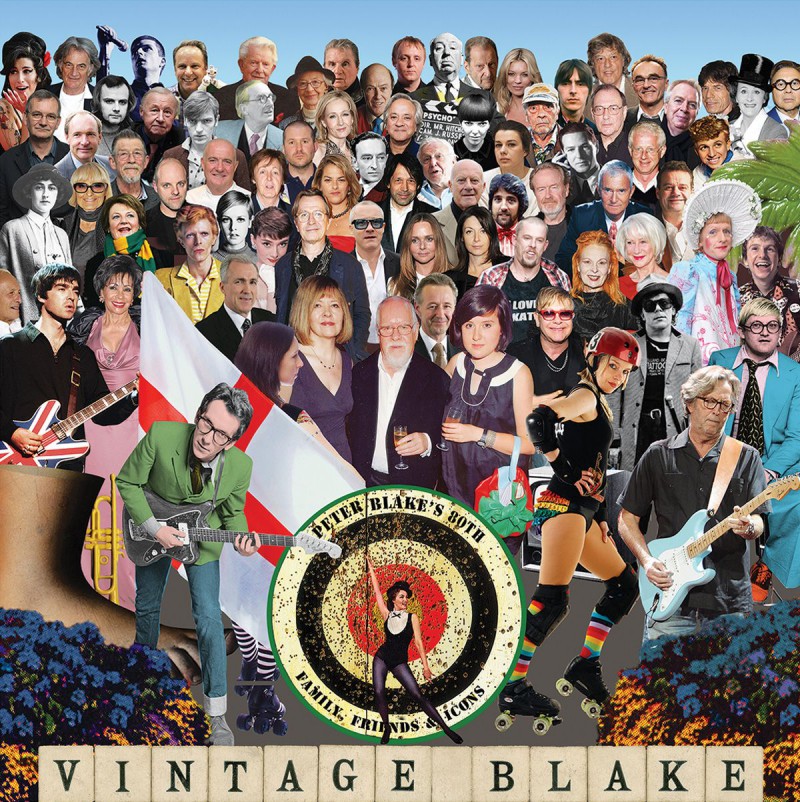
Vintage Blake
Vintage Blake–a limited edition print by Sir Peter Blake to celebrate his 80th Birthday in June 2012.

I don’t have this print, though it would make a nice addition to my collection of Sir Peter Blake’s record cover art.

Anyway, I really hope I won’t be tempted to buy any more “Sgt. Pepper” pastiches.


It Was Fifty Years Ago Tomorrow…

This is a year of musical anniversaries. One could say 1967 was the year popular music became ART – in capital letters. Seminal albums by The Velvet Underground, The Jimi Hendrix Experience, Cream, The Who, The Doors, Captain Beefheart’s Magic Band, The Jefferson Airplane and Traffic to name just a few of my favourites were released that year, but none had the advanced expectations of The Beatles’ “Sgt. Pepper’s Lonely Hearts Club Band”. The album, released on June 1st 1967 had been preceded in February, by the double A-sided single “Penny Lane/Strawberry Fields Forever” and the Beatles, despite rumours of drug-taking, could seemingly do no wrong.

May had been a musically exciting month. I had been to The Saville Theatre on the 7th to see the Jimi Hendrix Experience (they played eight songs and I wrote the playlist into my programme). Five days I went to the Pink Floyd’s “Games For May” concert at the Queen Elizabeth Hall–the first time I smelled the sweet smell of hash being smoked. I still have the ticked stub from that concert; unfortunately my Hendrix programme was sold to help finance my move to a flat.

I used to take time off from my studies and visit One Stop Records in South Moulton Street, where they sold records imported from America. An imported LP would set med back £3/15/0d–an enormous sum for a student. The guys behind the tiny counter suggested albums I might like and, at the end of May, put a copy of The Doors first album into my trembling hands and sent me to the listening booth to hear it. Even the cover design fascinated me. I was totally floored by the album and bought it on the spot.

The BBC had announced that the whole “Sgt. Pepper “album would be played at midnight and many sat glued to their trannies to hear it. I listened together with my flatmates. I don’t remember exactly when I bought “Sgt. Pepper”; probably in Moorlands record shop across the road from our canteen, but it would have been within a few days of its release. I was careful to buy a stereo copy as my parents had bought me a stereo gramophone for my 21st birthday, the previous year.

The album had an interesting side effect. It introduced me to pop art. I had seen articles on poster design from San Francisco and had started to design my own posters for college dances and lectures. These were heavily influenced by the psychedlic art used my artists such as Wes Wilson, Victor Moscoso, Stanley Mouse and Rick Griffin. I started going to art galleries and exhibitions–and buying records with great cover art.

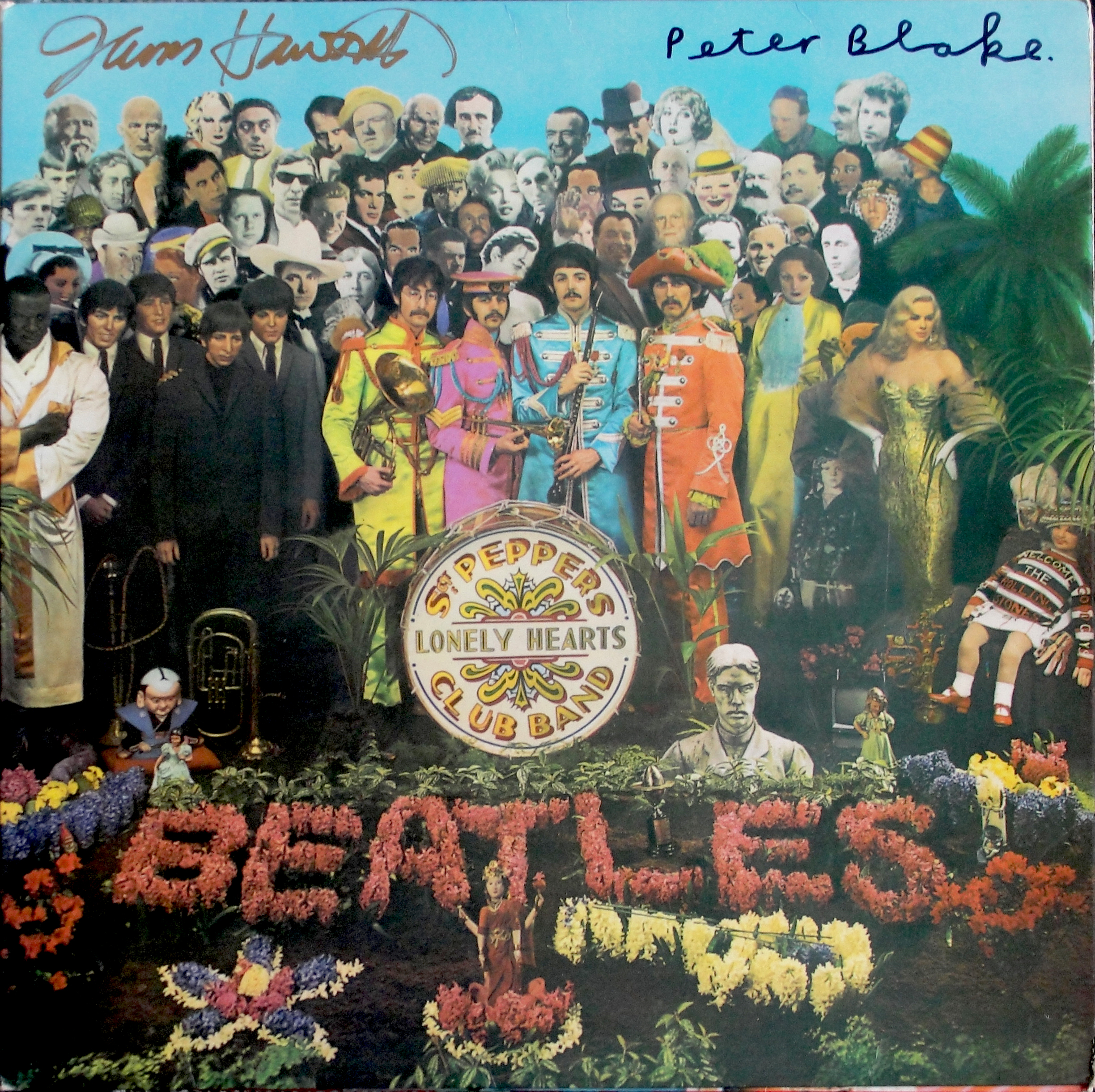
So, I suppose I could say that “Sgt. Pepper’s Lonely Hearts Club Band” was the start of my addiction to record cover art. I am thrilled to own a copy autographed, not by The Beatles, but by both Sir Peter Blake and his co-designer Jann Haworth.

Sgt Pepper-signed
Sgt. Pepper’s Lonely Hearts Club Band cover signed by Jann Haworth and Sir Peter Blake.