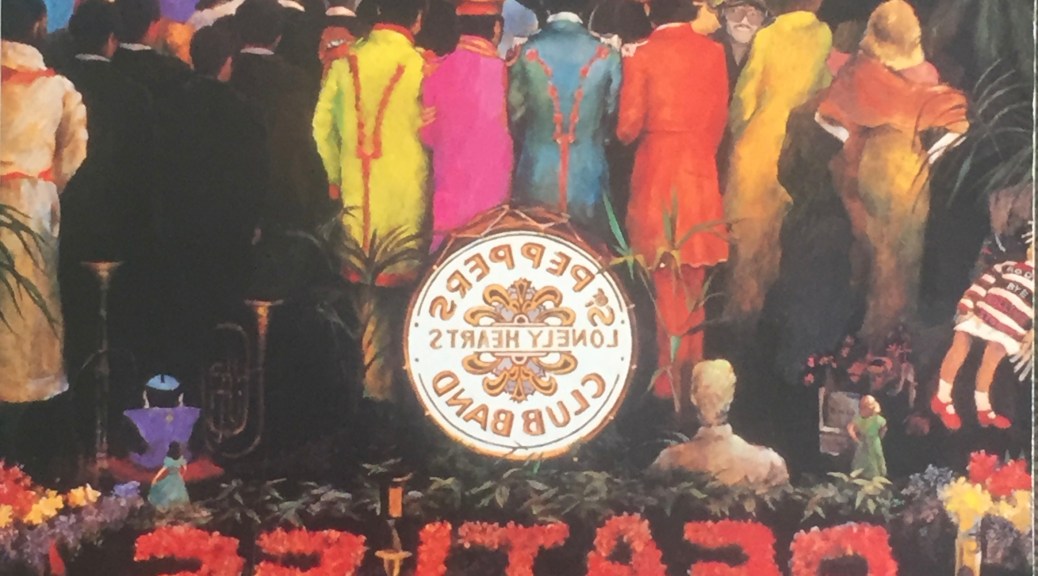
The 50th Anniversary Box Set of “Sgt. Pepper’s Lonely Hearts Club Band” – a set I didn’t think I needed.

Sgt Pepper box ad
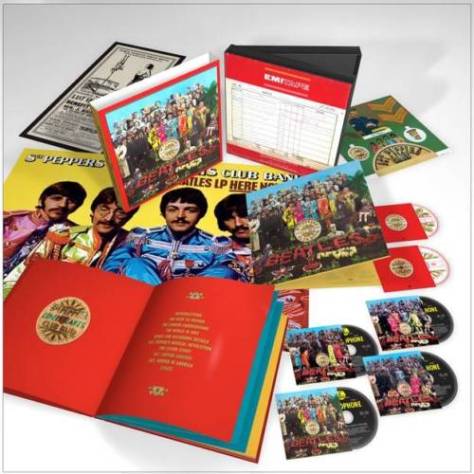
The deluxe 50th anniversary box set of “Sgt. Pepper’s Lonely Hearts Club Band” with all the ‘goodies’.

It seems I’ve been writing a lot about “Sgt. Pepper’s Lonely Hearts Club Band” since it’s 50th anniversary on June 1st. In March, I heard about the projected release of an upgraded version of the stereo version of the album together with a variety of previously unreleased alternative takes of the songs (including “Strawberry Fields Forever” and “Penny Lane“, which had not been included on the final album) on double vinyl, double CD and a four CD, Blu-ray and DVD box set which included a 144-page LP-sized book, and 2 posters as well as a reproduction of the original cutout from the LP.

I decided that I already had the original LP (actually TWO copies) and didn’t think I needed to shell out £30 for the double LP or over £100 for the box set as I am not particularly interested in hearing alternate takes. And I felt I didn’t need to listen to a third re-mastering of the original, though I listened to the new stereo version on Spotify and definitely heard a new, clearer mix. My main interest in “Sgt. Pepper” extends to the cover design.

But on a visit to my favourite record store I saw a copy of the box. What first caught my eye and made me take it off the shelf was the lenticular version of the cover image, which made it appear three dimensional. Now, that was a version of Peter Blake’s & Jann Haworth’s cover that I hadn’t seen before. Then, on opening the clamshell inner box I found what I thought was a copy of the LP–but the box clearly stated that it didn’t include the LP only 4 CDs, a Blu-ray and a DVD. There were three posters and the book which had a chapter devoted to the story of how the cover came about. Now, THAT did interest me. So I decided I’d try it and the offer of a 10% discount clinched the deal!

When I got home, I removed the plasticwrap from the LP sized album and from the book. On opening the gatefold I saw the CDs, Blu-ray and DVD were housed in separate LP-style covers. Only when I started to upload the CDs onto my computer did I notice that each CD had a different version of the classic “Sgt. Pepper” photo, with the Beatles in different poses in front of the Blake/Haworth montage.

fullsizeoutput_48be
Four different variations on the original “Pepper” cover. The one at top left is is the standard photo.

The book tells Paul McCartney’s version of how the cover art came to be. He tells that he had the idea of the “Sgt. Pepper” theme while on a flight back from America. He says that Mal Evans asked for him to pass the salt and pepper and he misheard it as Sgt. Pepper, which immediately inspired him to create an alter ego for The Beatles. He says that he mad some sketches for a possible cover scene and took them to his friend, gallery owner Robert Fraser, who proposed Peter Blake and Jann Haworth as artists to realise his ideas.

There is no mention of John Lennon’s discussions with design group “The Fool”, though the chapter ends with an interview with Marijke Koger who tells of the visits by The Beatles to their home, which inspired them to commission a design for the planned “Sgt Pepper” album cover. However, only The Fool’s design for the red, pink and white inner sleeve was used.

I have also now listened to the re-mastered stereo version included in the set as well as the original mono version. There really is a new clarity in the stereo version. But–I have lived with the original stereo version for just over 50 years and it still remains the one I probably will listen to on vinyl.

Anyway, now I can add the lenticular cover of the Blake/Haworth design and the alternative Michael Cooper photos of the “Sgt. Pepper” set to my cover collection.

“Voices and Events” – A Previously Unrecognised Andy Warhol Record Cover.”

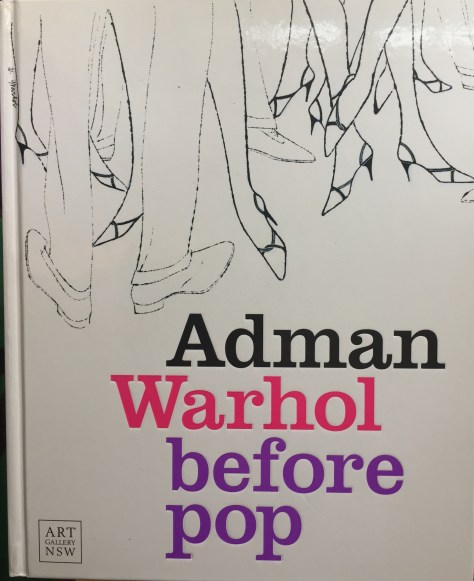
Occasionally serendipity strikes. A week ago I went to Stockholm’s Moderna Museet to see the retrospective exhibition of Marie-Louise Ekman’s art. In true Banksy style I left thru’ the gift shop and while there I noticed a new book about Andy Warhol’s early career–“Adman-Warhol Before Pop“, published b the Art Gallery of New South Wales, Australia, to coincide with their exhibition of the same name, which ran from February to 28th May 2017.

IMG_0265
Nicholas Chamber’s exhibition book published by the Art Gallery of New South Wales.

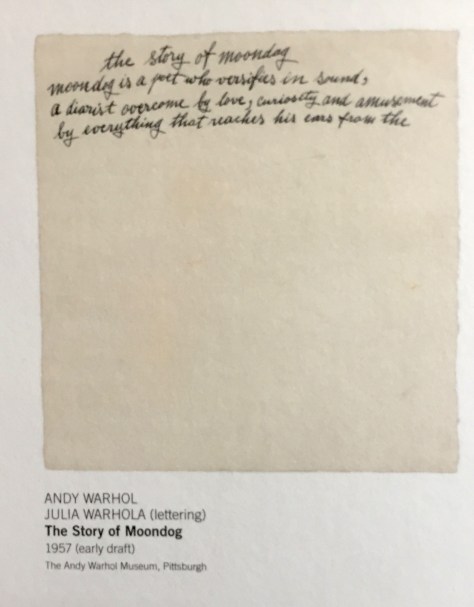
I couldn’t resist a quick flick through just to see if there were any record covers featured. I was excited to see quite a few of Warhol’s earliest covers, including “A Program of Mexican Music“, “The Story of Moondog“, with Julia Warhola’s beautifully querky calligraphy, Johnny Griffin’s “The Congregation” and sketches for the Tennessee Williams LP, Billie Holiday EPs and one of the “Progressive Piano” designs. There was also a picture of one of Julia Warhola’s early attempts to write the cover for “The Story of Moondog” album.

Adman-Spread5
Julia Warhola’s trial version of the cover text for “The Story of Moondog”.

But what I wasn’t prepared for was:

Adman-Spread3
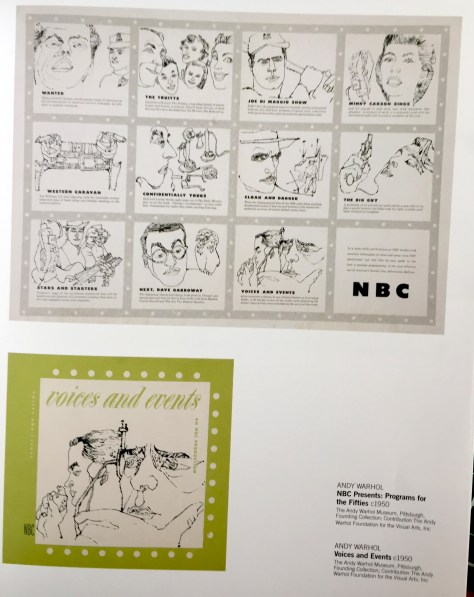
Page 97 in “Adman-Warhol Before Pop” with a picture of the cover slick for an recording of an NBC radio programme called “Voices and Events“.
Voices&Events-slick
The cover slick for “Voices and Events” box set.

Having made reproductions of the “Night Beat” box set, I immediately recognised that this was the design for a similar box. While there exists a physical example of the “Night Beat” set, discovered by famous Warhol collector and author, Paul Maréchal, that has a record company catalogue number, as far as I know no physical example of the “Voices and Events” box exists and so I cannot know if it was actually released. I don’t even know if it was intended for a box of seven-inch EPs or for LPs, but I suspect the former.

So–all you Warhol cover collectors out there please start searching! Meanwhile I’m gonna try to make me a copy.

Banksy Picture Discs – All That Glitters Is Not Gold!

Readers of this blog may already have suspected that I have a serious case of OCD or just plain collectors’ mania. I aim to keep my collections of record cover art by artists/themes I collect as complete as possible. Therefore, I have compiled lists of each of these which I try to remember to update when I find or acquire new items.

So, a couple of weeks ago, picture discs with Banksy cover art began to appear on Ebay posted by a seller from Israel. The looked really cool and I could imagine hanging a selection on my wall.
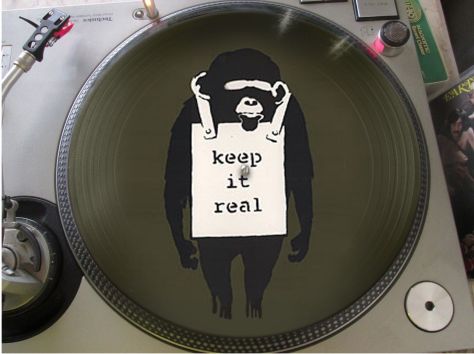
Think TankPulp FIctionKeep It real-1

The prices were high–but genuine records with Banksy covers are fetching quite amazing prices nowadays, so I didn’t reflect too much. I made an offer on one disc which was promptly accepted and I was happy. The seller informed me that he had “a couple of other Banksy picture discs” and was prepared to offer me an even “better” price if I bought those, too. He even offered free shipping, so I agreed.

Less than a week later, the package arrived.

These turned out to be single-sided singles. The “Keep It Real” is a version by Jamal, called “Keep It Real“. As shown, it came in a die-cut, black card sleeve. The other two are shaped picture discs. The Blak Twang record is the “Kik Off” single and the One Cut has the track “Mr. X“.
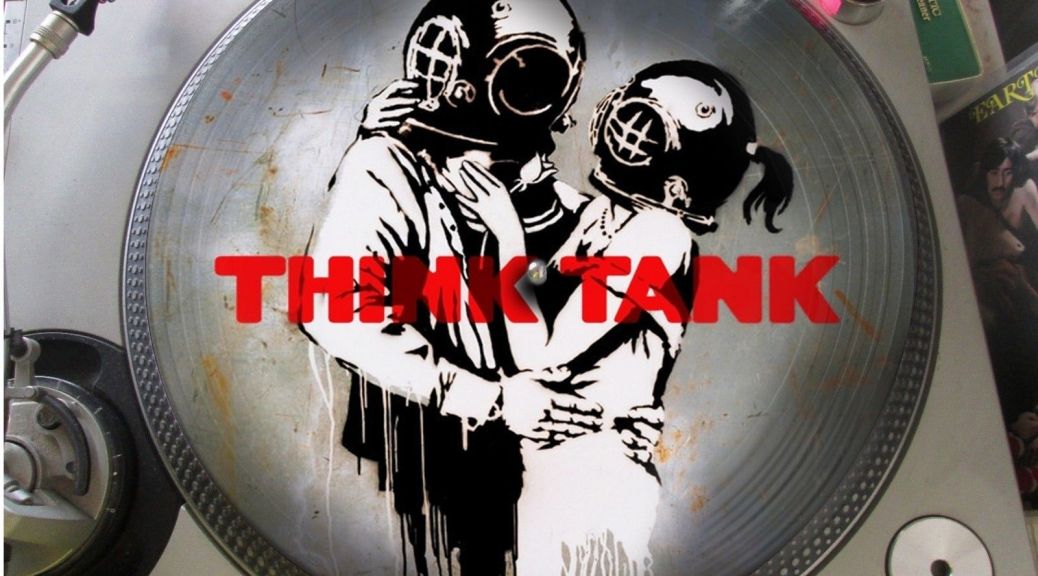
Examination revealed that the records are 2 mm thick pieces of perspex with a sort of  thick flexidisc with the image and sound track affixed. The image is slightly blurred as if it has been copied from a picture sourced on the Internet.The sound quality is poor, probably lifted from an MP3 file.

The seller informed me that he had “bought” the discs and the person who had sold them to him said they were made in Japan and only twenty or so copies existed. He had about twenty-five different discs with Banksy cover art for sale and was prepared to let me have them for the “bargain” price of $139 each.

Further research on Ebay gave more surprises. The same seller is selling picture discs by other artists, such as Björk, Aphex Twin, Led Zeppelin and others at the same sort of inflated prices.

These records are not proper pressings. They are produced to appeal to collectors and sold at wildly inflated prices. They cannot really be called bootlegs as they are not really records at all. And the quality of the artwork, not to mention the sound, is really poor.

I decided not to “invest” in the 25-or-so Banksy picture discs the seller had on offer. I prefer “proper” records, not pieces of perspex with a flexidisc attached. And I would like to issue a warning to other collectors not to support this type of exploitation solely aimed at fleecing collectors.


The Beatles–Some Swedish Single and EP Covers.

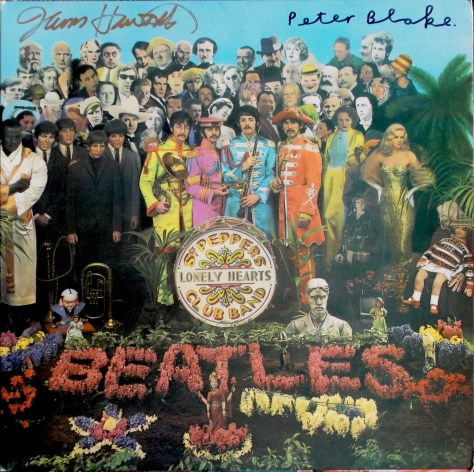
I used to have a fantastic collection of Beatles records–everything from Mono and Stereo copies of “Please Please Me” LPs with the black and gold Parlophone labels, an autographed copy of “Love Me Do” single and just about every LP and boxes of albums and EPs. I also had a complete set of the HMV boxes of the 1987 CDs. I actually SAW The Beatles live on 24th October 1964 at the Gaumont State Cinema. I still have the “Four Aces” programme from the concert, which cost 1/- (one shilling, for those of you too young to remember pre-decimal currency). However, my Beatles records went when I sold most of my music collection when I moved to Stockholm four years ago. The only Beatles record I kept was my copy of “Sgt. Pepper’s Lonely Hearts Club Band” as a part of my collection of Sir Peter Blake’s record cover art, a copy signed by Peter Blake, which I later asked Jann Haworth to also sign (which she gracefully did!)

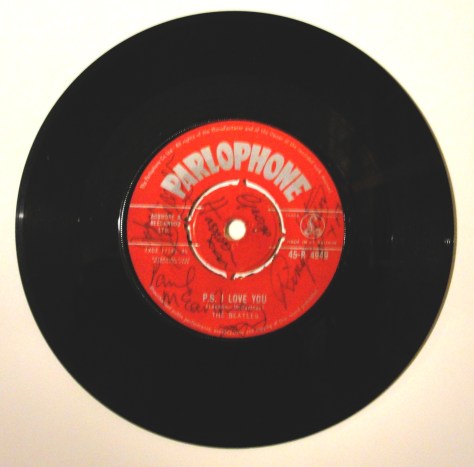
LoveMeDo_signed45
The signed “Love Me Do / P.S. I Love You” single, which I always said would be my pension insurance.
Sgt Pepper-signed
Sgt. Pepper’s Lonely Hearts Club Band cover signed by Jann Haworth and Sir Peter Blake.

I can’t say I have missed my Beatles collection, though. The Beatles released 22 singles in the United Kingdom and I had them all both in a singles box and as 3″ CD singles and the complete set of picture disc singles released on the 20th anniversary of each single’s original release.  However, despite living in Sweden, I was never tempted to buy the Beatles’ Swedish singles or EPs.

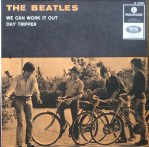
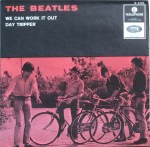
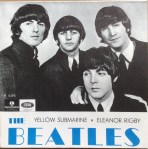
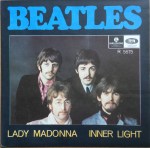
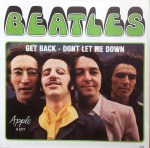
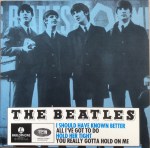
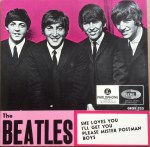
The Beatles released 32 singles in Sweden between 1963 and 1970. However, the Beatles’ first single, “Love Me Do/P. S. I Love You“, was never released as a single in Sweden. Today, I was given a pile of nineteen mint covers for Swedish Beatles singles (fourteen different single covers plus four duplicates with slightly different colours) together with four EP covers, one of which is apparently very rare. So I now have fourteen of the 32 single covers (43,75%).

The story behind these is that Daniel Burfitt who owns Nostalgipalatset in Stockholm, to whom I sold my record collection, comes from the town of Strängnäs, where the printers of many of the Swedish record covers were located. Daniel was contacted by the printer a couple of years ago when he was having a clear out and wanted Daniel to buy some old LPs. While looking through them, he was shown a box of unused Beatles single covers, which he bought. He asked the printer why he had kept them for fifty-odd years and was told “Well, The Beatles were special”.

The covers for Swedish singles were generally made of thin paper and were easily worn, dogeared or torn and collectors with records in good condition were, naturally, very interested in these pristine covers to replace damaged ones.

There were 20 Beatles EPs released in Sweden. Among the covers Daniel gave me are four EP covers. These were printed on heavier paper and are laminated. Again all are in mint condition.

So, a nice collection of Fab Four singles and EP covers reminding me of some of the best music of the sixties. What a great gift! Thank you Daniel.

Some Record Covers Influenced by the Sgt. Pepper Cover.

The 50th anniversary of the release of “Sgt. Pepper’s Lonely Hearts Club Band” has caused considerable interest in various aspects of what came to be called “the summer of love”; 1967’s glorious pop year. It was also the time of “Swinging London” and Carnaby Street’s first heyday.

That the cover of the “Sgt. Pepper” album would become a classic had been foreseen by Beatles manager Brian Epstein who wanted a “proper” artist to design the cover rather than the original psychedelic ideas suggested by fashion designers The Fool. From an idea by Paul McCartney via his friend and gallery owner Robert Fraser, Peter Blake and Jann Haworth were recruited and with some input from Jann’s father, Ted, the couple set to work.

It didn’t take long for the first of many pastiches of the cover art to appear. The Mothers of Invention’s album “We’re Only in It for the Money” released in March 1968, was one of the earliest. Frank Zappa wanted the cover (designed by Cal Schenkel) to be a copy of the “Sgt. Pepper” cover and asked Paul McCartney for approval. Apparently McCartney wished that Zappa’s and The Beatles’ mangers discussed the suggestion. Zappa went ahead but Verve Records, who would release the album, would not allow Schenkel’s copy of the “Sgt. Pepper” montage to appear on the front so the band’s portrait, photographed against a yellow background became the outside of the gatefold.

The lyrics, printed against a similar red background to those on the “Sgt. Pepper” cover appeared on the inside of the gatefold opposite Schenkel’s montage.

Release of “We’re Only in It for the Money” was delayed five months because of the record company’s anxiety over a possible infringement of copyright. In the event there was no reaction as the front cover only revealed four band members.

There have been innumerable pastiches of the “Sgt. Pepper” cover since the Mothers of Invention’s album; ranging from albums by the Muppets and Simpsons to more “serious” artist like The Ruttles. An Internet search turns up literally hundreds. Probably only the cover photo from The Beatles’ “Abbey Road” has been copied/parodied more often.

My collection includes only three pastiches of the (probably) hundreds out there, collected because of their originality (and possibly rarity). The oldest, from 1969, is Jack O’Reilly’s “You Can Be a Ventriloquist” (subtitled “Constable O’Rourke’s Wooden Hearts Club Band“, just so that no one would miss the reference to “Sgt. Pepper“). An instructional album that was probably privately pressed and thus in relatively limited numbers. O’Reilly went to inordinate expense to put together a background of forty ventriloquists’ dummies for the cover photograph.
Jack O'Reilly-fr

The second example is a Japanese album by Jun Fukamachi called (not so strangely) “Sgt. Pepper’s Lonely Hearts Club Band“. Fukamachi plays several of the “Sgt. Pepper” songs rendered as jazz tunes. I like the cover for the idea of reversing the whole scene. It must have taken weeks to paint!

JunFukamachi-Fr
The cover of Jun Fukamachi’s “Sgt. Pepper” album painted by Fumio Tamabuchi.

And the final parody that I have collected is another Japanese release–Junichi Masuda’s “Pokèmon” LP from 2015. This is an unoffical release on the Moonshake record label. Masuda, who is programmer and director at Pokèmon also makes the music to video games. The “Pokèmon” album was released in several versions. The “standard” album came in four variations of coloured vinyl housed in a cover that is a parody of the “Sgt. Pepper” design.

pokemon_redblue-fr
The Cover of Junichi Masuda’s “Pokèmon” LP. A just recognisable “Sgt. Pepper “pastiche.

Oh, and I have been guilty of plagiarism, too. In 2009 I curated an exhibition of Peter Blake’s record cover art at Piteå Museum. Together with my friends at In the Cold bureau we designed a cover for the exhibition catalogue, of course modelling it on the “Sgt. Pepper” design, but with all the artists that Blake had made record covers for.

fullsizeoutput_4854
The catalogue cover for the “Pop Art” Exhibition of Sir Peter Blake’s record cove art at Piteå Museum, July 22nd–August 31st 2009.

In 2010, I showed my collection of Peter Blake’s record covers at the A and D Gallery in London, and Sir Peter Blake signed m catalogue. I wonder if it didn’t inspire him to produce his 2012 update of the Sgt. Pepper cover…

Vintage Blake
Vintage Blake–a limited edition print by Sir Peter Blake to celebrate his 80th Birthday in June 2012.

I don’t have this print, though it would make a nice addition to my collection of Sir Peter Blake’s record cover art.

Anyway, I really hope I won’t be tempted to buy any more “Sgt. Pepper” pastiches.


It Was Fifty Years Ago Tomorrow…

This is a year of musical anniversaries. One could say 1967 was the year popular music became ART – in capital letters. Seminal albums by The Velvet Underground, The Jimi Hendrix Experience, Cream, The Who, The Doors, Captain Beefheart’s Magic Band, The Jefferson Airplane and Traffic to name just a few of my favourites were released that year, but none had the advanced expectations of The Beatles’ “Sgt. Pepper’s Lonely Hearts Club Band”. The album, released on June 1st 1967 had been preceded in February, by the double A-sided single “Penny Lane/Strawberry Fields Forever” and the Beatles, despite rumours of drug-taking, could seemingly do no wrong.

May had been a musically exciting month. I had been to The Saville Theatre on the 7th to see the Jimi Hendrix Experience (they played eight songs and I wrote the playlist into my programme). Five days I went to the Pink Floyd’s “Games For May” concert at the Queen Elizabeth Hall–the first time I smelled the sweet smell of hash being smoked. I still have the ticked stub from that concert; unfortunately my Hendrix programme was sold to help finance my move to a flat.

I used to take time off from my studies and visit One Stop Records in South Moulton Street, where they sold records imported from America. An imported LP would set med back £3/15/0d–an enormous sum for a student. The guys behind the tiny counter suggested albums I might like and, at the end of May, put a copy of The Doors first album into my trembling hands and sent me to the listening booth to hear it. Even the cover design fascinated me. I was totally floored by the album and bought it on the spot.

The BBC had announced that the whole “Sgt. Pepper “album would be played at midnight and many sat glued to their trannies to hear it. I listened together with my flatmates. I don’t remember exactly when I bought “Sgt. Pepper”; probably in Moorlands record shop across the road from our canteen, but it would have been within a few days of its release. I was careful to buy a stereo copy as my parents had bought me a stereo gramophone for my 21st birthday, the previous year.

The album had an interesting side effect. It introduced me to pop art. I had seen articles on poster design from San Francisco and had started to design my own posters for college dances and lectures. These were heavily influenced by the psychedlic art used my artists such as Wes Wilson, Victor Moscoso, Stanley Mouse and Rick Griffin. I started going to art galleries and exhibitions–and buying records with great cover art.

So, I suppose I could say that “Sgt. Pepper’s Lonely Hearts Club Band” was the start of my addiction to record cover art. I am thrilled to own a copy autographed, not by The Beatles, but by both Sir Peter Blake and his co-designer Jann Haworth.

Sgt Pepper-signed
Sgt. Pepper’s Lonely Hearts Club Band cover signed by Jann Haworth and Sir Peter Blake.


Wolfgang Tillmans–Some Record Covers.

Back in March I published a post about winners of the Tate Museum’s Turner Prize. A surprising number of these artists are involved in music projects, either as musicians themselves or as contributors of record cover art. Another post dealt with Turner Prize winner Susan Philipsz’ records. Wolfgang Tillmans won the Turner Prize in 2000. He was the first non-British winner. Besides being an internationally famous photographer and conceptual artist, Tillmans has also released three extended play 12″ vinyl records and provided their cover art.

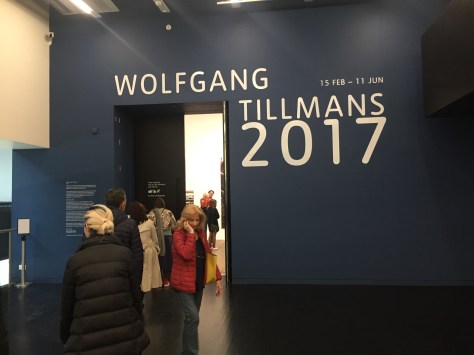
Today I went to see the Tillmans exhibition at the Tate Modern.

IMG_9893
The queue to see the Wolfgang Tillmans retrospective at the Tate Modern.

The exhibition was vast. Unfortunately there was no audio guide to help visitors understand what the exhibition was about. I found it extremely difficult to appreciate more than a minority of the photographs on show and didn’t spend much time going through the many rooms. My feeling was that, as most photographs in true Tillmans style, were of everyday objects and often unidentified people I didn’t get much from looking at them. I obviously need a guide to looking at Tillmans art.

BUT, following Banksy’s advice, I exited through the gift shop and there were Tillmans’ three vinyl EPs on sale. As a Tate member I even got a members’ discount.
First there was the 2016-1986 EP:

2016-1986 EP-fr
Wolfgang Tillmans’ “2016-19862 EP cover.

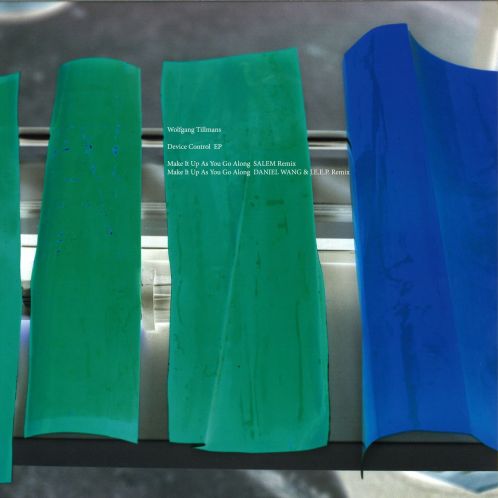
Second: the Device Control EP:

Device Control EP-fr
Tillmans’ “Device Control” EP cover.

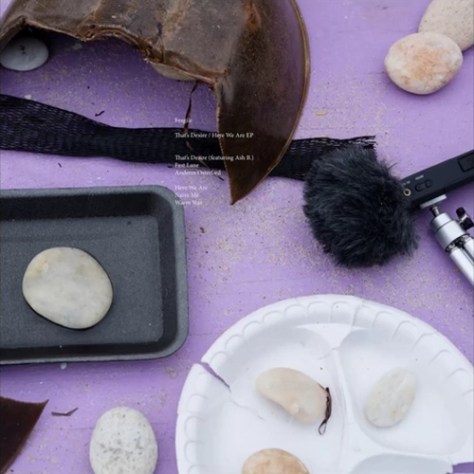
And third: the “Thats Desire” EP:

Thats Desire EP-fr
The cover of Tillmans’ latest EP “Thats Desire” EP.

Each EP comes with a mp3 download.

I couldn’t resist putting the covers of the 2016-1986 and “Device Control” EPs side by side as the pictures seemed to be from a single image photographed in different lighting conditions and with altered coloured hangings. Are they the same images but manipulated, or what?


The Velvet Underground & Nico–The Obsession.

I have previously discussed my collection of Velvet Underground & Nico albums and this time I thought I’d celebrate the fact that this album was officially released 50 years and two months ago.

This historic album was, of course, initially recorded as a ten-track acetate in Norman Dolph’s Scepter Studios in New York on 25th April 1966. Two acetates were pressed and one was given to Andy Warhol offered it to Columbia Records, Atlantic Records and Elektra who all turned it down. Warhol then took the band to Los Angeles and with Ted Wilson re-recorded most of the songs and Verve Records agreed to release it. Warhol’s acetate disappeared but the other copy surfaced in a New York street sale in 2006 and was bought by record collector Warren Hill for 75 cents. Hill put the record up for auction on eBay, and eventually sold it for $25,200. It was resold in 2014.

A bootleg of the acetate recording called “Unripened” appeared in 2007, pressed first on green and later on black vinyl with a pastiche of Warhol’s original cover for the Velvet’s album. The green banana was not peelable and instead of “Peel slowly and see” beside the banana’s neck this version said “Unripened listen slowly and hear.”

Unripened_LP-fr
The cover of the 2007 bootleg first release of the Norman Dolph acetate recording of The Velvet Underground’s first album

The album received its first official release on CD together with the 45th Anniversary 6 CD set in 2012 and a limited edition of 5000 numbered copies was released on vinyl for Record Store Day that April.

Scepter Acetate
The 2012 vinyl release of The Velvet Underground’s “Scepter Studios” acetate.

There was a later unnumbered vinyl release. There is yet another version released in 2014 in a different cover.

Norman Dolph-front
The latest bootleg version of The Velvet Underground & Nico’s Norman Dolph acetate superimposed the classic banana image over a photo from the 1966 film of the Velvets in concert.

The historic value of the acetate recording is indisputable, but musically it is inferior to the re-recorded full album. In its first year “The Velvet Underground & Nico” appeared in several versions. There were at least two promotional copies, both mono, released in the original “torso” covers. One with a yellow label and the other with a white label. The identical slick could be used for mono or stereo copies,– the mono slick was pasted with the stem of the banana almost at the cover’s top edge.

Both mono and stereo versions were originally released with the “torso” cover, which was soon withdrawn when Eric Emerson demanded payment to allow his picture to be used on the cover. Verve recalled many albums and stuck a large black sticker over the offending “torso” photograph. Later printings replaced the “torso” cover with an  version with Emerson’s picture airbrushed out. These were still gatefold covers.

The original U.K. release was housed in a single cover with the an unpeelable banana. In Germany an unusual reissue was produced in 1976. This cover is unique; coloured blue and with an image of the peeled banana.

VU&N_Rotation_fr
The 1976 German reissue with banana.

The first CD version of the album appeared in 1986. There was a limited edition of 3000 copies German release in a slipcase with a peelable banana that was hand numbered the following year.

.In 1991 a further reissue appeared in the U.S.A. and Australia that had a single cover and the album’s title on the front cover as shown on the 1986 CD. Mobile Fidelity released a gold CD version of the album in 1997.

MFSL reissue CD
The cover design of the MFSL gold CD.

There have been many reissues since the late nineteen eighties both on CD and since 2000 on vinyl. I mentioned the picture disc varieties in my previous post. The latest vinyl reissues have been pressed on 180 g virgin vinyl and have restored the original cover including a peelable banana and a restored “torso” rear cover released as a 45th anniversary issue in 2012. And there have been numerous reissues pressed on coloured vinyl. I have seen yellow and red vinyl issues as well as Newbury Comics limited (1000 copies) pressed on yellow/black split vinyl which also has a peelable banana and “torso” rear cover.

Newbury VU&N
The Newbury Comics version of the Velvet Underground & Nico album.

There are at least three complete cover albums of Velvet Underground & Nico album. The first appeared in 1990 in Italy where a series of punk bands played the songs from the Velvet Underground & Nico album.

Tribute to Andy warhol
The cover of the Tribute to Andy Warhol alum on the Crazy Mannequin Record label.The cover came in several colour variations.

The second cover album was another various artists compilation of the VU & Nico album tracks recorded on the Castle Face Record label in 2012. The banana on the cover was by David Shrigley, who drew a portrait of Andy Warhol on the back cover.

A third cover album called “The Velvet Underground & Nico and Ben Benderbe” was recorded by Bud Benderbe and released as a limited edition LP with a very strange large sliced banana sticker.

Bud Benderbe-fr
Bud Benderbe’s cover album.

There are also numerous records that use variations on Warhol’s banana image that have no other relationship to the Velvet’s music. These include the split single by Eat All You Can and Hickey called “Banana Split”.
Banana Split-fr

Another is a rare jazz LP by the Instant Composers Pool Group, recorded in Holland in 1970.Jazz Banana.jpg

The classical quartet’s, the Fauré Quartet, first recording “Popsongs”, released on the Deutsche Grammophon label had an apple sticker on the cover which, when peeled revealed a raspberry.
Faure-Popsongs-fr

A very recent variation on the design is a 2017 release by John Nemeth called “Feelin’ Freaky”. On this cover, though, the banana was replaced by a red gherkin.
Feelin-Freaky-Cover


Often called the album that launched a thousand bands, “The Velvet Underground & Nico” has proved itself to be one of rock music’s most influential albums and the number of reissues on both CD and vinyl confirm its importance. Andy Warhol’s cover art was a major work of pop art and has had almost as great an influence on cover design as the music has had on the development of rock music.

The Return of Henrik Berggren.

Okay, I have to admit that I have a soft spot for Henrik Berggren, former frontman of Swedish indie band Broder Daniel, who disappeared from radar after the band’s 2008 farewell concert in its native Gothenburg.

Henrik and fellow school comrade Daniel Gilbert formed Broder Daniel in 1989 and the band was joined by Håkan Hellström (who went to the same school as Henrik and Daniel, and would become an enormously popular artist in his own right) on drums and later by Johan Neckvall and Anders Göthberg (guitar; 9th October 1975-30th March 2008). Broder Daniel released its first album “Saturday Night Engine” as a Digipak CD in 1995. Gilbert left the band after the “Saturday Night Engine” tour and was replaced on bass by Teodor Jensen (who would go on to form the band The Plan). Hellström left the band in 1994 to join Honey Is Cool.

Broder Daniel‘s tours were infamous for alcohol and drug use and for unreliability that made concert-bookers wary of booking the band. In particular Henrik Berggren misused a variety of drugs together with alcohol and often performed ‘under the influence’.

Håkan Hellström rejoined the band in 1998, now playing bass, and Broder Daniel‘s third album “Broder Daniel Forever” was released on 22nd April 1998.

Broder Daniel toured the album over the summer of 1998 and were scheduled to play Hultsfred’s Festival in June 1998. I was one of the festival doctors and the medical team received a phone call at about 10 a.m. on Friday 12th June from an hotel in Vimmerby, about 30 kms from Hultsfred, to say that a member of a band that was due to play at 15.15 h that afternoon was unwell and could we send a doctor. “No.” We couldn’t send a doctor as the medical crew was based in the festival area. However, Vimmerby had a general practice near the hotel, and, it being Friday, it was open and we suggested that the band member went there.

At about 1 p.m. the band arrived at Hultsfred’s Pampas stage and I was called to examine the singer (Henrik Berggren) who was not at all well. We learned that he had consumed a fair amount of alcohol and various uppers and downers and felt he couldn’t perform. I had two hours to get him shipshape for the show. He was mainly complaining of stomach pains so I gave him a Zantac tablet dissolved in water and suggested he rest until it was time to go on stage. I checked in on him every half hour or so and he seemed to brighten up. By 3 p.m. he was up and about and could do the hour-long show!

Broder Daniel Forever
The cover of “Broder Daniel Forever“. Unfortunately I never photographed my signed copy.

I had brought a copy of the limited edition “Broder Daniel Forever” LP with me and after the band had done their thing I asked them all to sign it. Håkan Hellström refused to believe it was my album and said he thought it must be my daughter’s! Actually, my daughters had bought it for me for my birthday a couple of months earlier.

Fast forward to July 1999 and a new festival in Stockholm called Stockholm Open. Broder Daniel were again scheduled to appear. I was in charge of the medical crew for this festival and had managed to recruit many of the members of the previous year’s Hultsfred crew to help out. While I was out patrolling the festival area Henrik Berggren came to the Medical tent and asked Kajsa, one of the nurses, if “his doctor” was at the festival. Kajsa knew he meant me and reported that he had been asking for me. But this time he was only looking for reassurance and didn’t need any medical attention. As the Festival ended early on Sunday morning, I waited outside the medical tent for my daughters, who had been at the festival with me, and their classmate Tobbe who would be coming with us back to town. We were talking about Henrik and I said that I really felt fatherly towards him (“jag får faderskänslor”. Tobbe, who was gay, immediately replied “Jag får sambokänslor” (I feel he could be my partner).

I met up with Henrik at a couple more festivals in the ensuing years and we went to after festival parties  and chatted. He always struck me as a gentle soul with quite a wide education.

However, after Broder Daniel‘s farewell concert in Gothenburg in 2008, just months after the band’s guitarist Anders Göthberg had died, Broder Daniel disbanded and Henrik disappeared. Apparently, he developed chronic tiredness syndrome and has lived as a recluse. But then in March 2017 posters appeared all over Stockholm announcing a new solo album by Henrik due for release on May 5th!

fullsizeoutput_4638
The poster for Henrik Berggren’s new album “Wolf’s Heart” and summer tour.

The album, “Wolf’s Heart” will be released on CD and LP. There will be a standard black vinyl LP and at least five limited editions of 300 copies each on coloured vinyl; pale blue, pink, red, violet and yellow. Thus there are at least six variations of “Wolf’s Heart” on vinyl. The five coloured vinyl versions amount to 1500 copies. I’m not sure how limited the black vinyl version will be but Henrik is obviously counting on selling at least 2000 copies. He will probably succeed, knowing the growing cult following his old band

fullsizeoutput_4745
Henrik Berggren’s “Wolf’s Heart” album on black, violet, red and yellow vinyl.

.


I have an unwritten rule that I will not start collecting any new artists’ records, but rules are made to be broken,and I have ordered copies of all the variations of “Wolf’s Heart” on vinyl!

More Sources of Warhol’s Record Cover Illustrations and Daniel Blau’s Book of Warhol’s 1950s Drawings.

Artipelag is an art gallery on Sweden’s Baltic coast about a 30-minute drive eastwards from Stockholm. It was founded by Björn Jacobsson, the man behind the Baby Björn range of infant products. Jacobsson had a vision for a gallery located on a rocky outcrop overlooking the sea and found an architect willing to design it. There have been many inspiring exhibitions there since it opened in 2012. One of the more recent exhibitions was “The Legacy of Andy Warhol” which ran from 15th April until 25th September 2016. This exhibition was curated by Artipelag’s artistic director Bo Nilsson, himself an avid Warhol fan and, as far as I have been able to ascertain, the first to write about Warhol’s record cover art in the catalogue to Sweden’s Nationalmuseum’s 1981-1982 exhibition of record covers.

fullsizeoutput_46de
The subway poster for Artipelag’s exhibition “The Legacy of Andy Warhol”.

The first thing that met visitors to the exhibition was a mountain of Brillo boxes, like the ones on the poster, specially made for the show.
IMG_5623

One large, silver foil-clad exhibition space was devoted to films including Roland Nameth‘s 1966 film “The Exploding Plastic Inevitable” featuring the Velvet Underground, apparently the first time the film has been shown with its original soundtrack, and Warhol‘s “Empire State Building“.

IMG_5650

There was a small room with walls lined with a selection of reproductions of Warhol’s record covers–though mainly from the 70’s onwards, although the “Velvet Underground & Nico” cover was there, too, and surprisingly one of Warhol’s drawings for a projected Billie Holiday EP was included. I thought it a pity that there were no actual record covers, only prints.
IMG_5634

A real surprise waited just through the sliding doors into the next space. The walls were lined with a large selection of Daniel Blau‘s collection of Warhol‘s drawings from the 1950s. I suppose there were about thirty drawings, but the two that I immediately reacted to were obviously related to Warhol‘s record cover art.

The drawing of the apple made me think of the “William Tell Overture” cover and the reclining woman was obviously a study for Kenny Burrell‘s “Blue Lights” album cover.

There was also a photo booth at the exhibition–a real Warholian touch! Visitors could photograph themselves free. And out came a card with four Warhol-style photos!
fullsizeoutput_364f

I visited the exhibition twice and photographed myself both times. but I lost the second photo in the restaurant. Clumsy!

I put the exhibition out of my mind until I read Guy Minnebach‘s wonderful “Andy Earhole-Another Blog about Andy Warhol’s Cover art” and a post about the “Night Beat” box set, which Guy illustrated with a picture of a man talking on the telephone from Daniel Blau‘s 2012 book “From Silverpoint to Silver Screen–Andy Warhol, 1950s Drawings“. I immediately ordered a copy and consider it one of the best books on Warhol‘s art in my book collection. Not only are the pictures superb, but the essay “Environments, Situations, Spaces” by James Hofmaier is a wonderful introduction to Andy Warhol‘s world.

Daniel Blau fr
Daniel Blau’s “From SIlverpoint to Silver Screen–Andy Warhol, 1950s Drawings”.

There were more drawings in Blau’s book that resembled Warhol’s cover illustrations. The only one I couldn’t find in the book was the apple drawing I saw at Artipelag. Here are a selection with the respective cover.
fullsizeoutput_46d2fullsizeoutput_46cdfullsizeoutput_46d0fullsizeoutput_46d3

Note that the original drawings for the “Blue Lights” cover and the hands on the Jan August cover are mirror images of the original photos. This is because they are blots of Warhol‘s original tracing. The drawing of the piano playing hands from the Jan August album was used for the unreleased “Progressive Piano” LP and EP.

ProgressivePiano_10"_600
Cover lithograph of the unreleased “Progressive Piano” 10″ LP with Warhol’s drawing of hands playing the piano copied from the Jan August LP cover.

The drawing I have placed beside the Horowitz album is not the one used on the record sleeve, but just shows how Warhol drew many pictures of hands playing the piano. Perhaps this drawing was intended for the “Progressive Piano” cover too, but was never used.

I really must thank Guy Minnebach for telling me about Blau‘s magnificent book “From Silverpoint to Silver Screen–Andy Warhol, 1950s Drawings“, I will spend many happy hours enjoying the superb drawings. It obviously is the catalogue of an exhibition of Warhol‘s 1950’s drawings–an exhibition I would love to have seen. But seeing many of the original drawings at Artipelag feels like I did get a little peek.

Record sleeve art by artists I collect