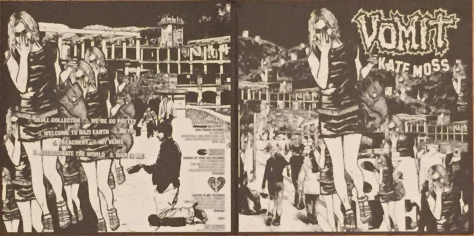
I really felt as though I had exhausted the subject of record covers showing Kate Moss‘ portrait in my previous post. No sooner had the proverbial ink dried than two more covers appeared. The first is a 7-inch single-sided EP by American punk/hardcore/grunge band Vomit, entitled “Kate Moss” on the Give Praise record label.
Now, a search of Discogs will reveal more than ten bands that have used the name Vomit. The Vomit in question seem to only have released this one “Kate Moss” EP.
The gatefold cover of Vomit’s 7″ single-sided EP “Kate Moss” with at least thirteen portraits of Kate.
Then I was reading about the two CD and one DVD set of Bryan Ferry‘s 2010 “Olympia” album. I already have the limited edition Vinyl Factory LP version of this, that includes the cover portrait of Kate Moss but without the text–obviously intended to be framed and hung on a teenager’s wall. I hadn’t considered the box set as I felt it probably wouldn’t add anything to the LP version. Well, I was wrong. The 40-page book that houses the discs contains many more photos from Adam Whitehead‘s sessions for the album. The DVD has an interview with Bryan Ferry on the making of the “Olympia” album and the “You Can Dance” video as well as a video of behind the scenes activity in the making of the “You Can Dance” video.
The box set of Bryan Ferry’s “Olympia” album contains a 40-page book and 2 CDs and a DVD.
The pictures are stunning. Here are a selection:
The CDs and the DVD included in set come in card covers, two of which have different cover photos from the LP and deluxe box.
CD1 has the album cover photo, while CD2 and the DVD cover have different photos. You will have to examine the covers of the CDs to spot the very subtle difference (hint look at Kate’s right hand).
And just when the thrill of finding the box set sort of settled, I came across an Ebay ad by my least favourite seller Majestic Music & Art. I consider this seller to be quite ruthless in his (I presume it is a “he”) price-setting. Many years ago, I bought a couple of albums from Majestic Music & Art that were poorly packaged and arrived damaged. They would not discuss a return or a refund and I promised myself never to buy from them again. But in mid-March 2017 they posted this ad for a copy of the Luke Fair remix of Primal Scream‘s (and Kate Moss‘) “Some Velvet Morning” (the old Lee Hazlewood classic). This single normally comes in a plain black generic cover, but Majestic Music & Art advertised a copy with Kate Garner‘s famous 1992 portraits of an 18-year-old Kate Moss affixed to front and back covers.
“Some Velvet Morning” remix 12″ with one of Jane Garner’s 1992 portraits of Kate on front and rear covers.
Despite my promise to myself never to buy from Majestic Music & Art, I did buy the 12″ single to add to my collection. I knew of Kate Garner‘s Kate Moss portraits from an exhibition of Russell Young‘s recent screen prints at London’s Halcyon Gallery. Russell Young’s portraits are really wonderful–some are as big as 200 x 200 cm and covered in diamond dust, so they really sparkle!
Kate Moss‘ name crops up in music as a songwriter and artist–several tracks by other artists/bands are entitled “Kate Moss“. Examples include Arab Strap‘s 1996 album “The Week Never Starts Around Here” that contains a track entitled “Kate Moss“, but there is no picture of her on the record cover. German rocker Maximilian Hecker‘s 2003 CD “Rose” also has a song called “Kate Moss” as its first track. Again, there is no portrait of her on the cover. I don’t suppose these will be the only songs called with this iconic title.
It has been my ambition to collect all record covers with Andy Warhol‘s art. Most of the seventies and eighties covers are relatively easy to find and shouldn’t cost the earth (an exception is Ultra Violet‘s eponymous LP from 1973), but the earlier ones, particularly the fifties covers have become increasingly expensive. And the original “Velvet Underground & Nico” (1967) along with many of it’s reissues are becoming increasingly expensive.
I have long searched for decent copies of Moondog‘s “The Story of Moondog“. While copies of the Moondog album do pop up relatively frequently on Ebay, most are in pretty poor condition with severely discoloured covers, but I had the great good fortune to find a near mint copy on Discogs which I bought as a Christmas present to myself.
The other major hole in my collection was John Wallowitch‘s second album for Serenus Records called “This Is (The Other Side of) John Wallowitch“. This album doesn’t come up for sale very often and bidding goes crazy on good copies. A reasonable copy popped up on Ebay in late January and despite having depleted my funds the previous month for the Moondog album, I managed to win it with a not too outrageous bid.
Front and rear covers of “This Is (The Other Side of) John Wallowitch”, 1965.
As can be seen, Wallowitch chose as the rear cover picture to reuse the “photo booth” photos taken by Warhol that were on the front cover of his previous Serenus Records release “This Is John Wallowitch“. It’s sort of ironic that the “Man of a Thousand Faces”, as stated on the front cover, is portrayed on the rear from the chin downwards, so one cannot see any of the thousand faces (actually, there are only 56 photos, or parts of photos on the cover, not thousands).
So now there are two of Warhol’s original covers and one bootleg that I need to complete my collection of Warhol’s record covers. These are the pink version of Prokofiev’s “Alexander Nevsky, Cantata Op 78” and the unobtainable “Night Beat” promotional box set that Guy Minnebach wrote about in his Andy Earhole blog (https://warholcoverart.com/2017/03/25/night-beat-rarest-of-the-rare/). Though I do have the facsimile box of the latter.
The remaining bootleg I am still looking for is the limited edition of Keith Richards‘ “Unknown Dreams” (Outsider Bird Records, OBR 93009).
Keith Richards’ bootleg “Unknown Dreams” with Warhol’s car drawing cover.
As you all know by now, record cover art has become highly collectible. The long player, invented by Columbia Records in 1948 allowed graphic artists a 31 x 31 cm canvas on which to apply their art.The arrival of the compact disc in 1982 was predicted to banish the LP forever and, in the mid 1990s many artists had abandoned the format. However, the vinyl LP didn’t die; it faded away for a time, but has made a dramatic recovery in the last few years and artists are once more releasing albums on vinyl. And this has made designers and artists return to the medium and produce many great works of cover art.
Some record covers by famous artists now change hands for extraordinary sums. Nowadays, collectors will only pay top buck for a record cover if it is in pristine condition and preferably for an original pressing. One can only congratulate those who bought some of the rarer records when they were first released as the cover art has proved a surprising investment.
There have been many exhibitions of record cover art over the past thirty or so years. The first one I heard about (and visited) was produced by Aarhus Kunstmuseum in 1981 (shown there from 5th September until 4th October 1981), which then transferred to Nationalmuseum in Stockholm, where it was shown from 24th October 1981 until 17th January 1982 and later to Bildmuseet in Umeå. I saw both the exhibitions in Stockholm and Umeå (and lent 30 covers to the Umeå exhibition) and I still have the exhibition catalogue and even a poster from the Stockholm exhibition, signed by Andy Warhol!
Catalogue from Nationalmuseets 1981-2 exhibition “Skivomslag” (record covers).
Poster from Nationalmuseet’s exhibition, signed by Andy Warhol.
Many books have been published illustrating “great” record covers, “The 100 (or even 500) best record covers of all time” or just plain record covers. There have been a few good books on the history of record cover art. My favourites are Steven Heller‘s, Alex Steinweiss‘ & Kevin Reagan‘s “Alex Steinweiss Inventor of the Modern Album Cover“, Nick De Ville‘s “Album: Style and Image in Sleeve Design” and Richard Evans‘ “The Art of the Record Cover“. There have been even fewer books devoted to a single designer: Paul Maréchal‘s pioneering “Andy Warhol–The Record Covers 1949-1987. Catalogue Raissonné” from 2008 and updated in 2015 as “Andy Warhol–The Complete Commissioned Record Covers 1949-1987” and, again, the “Alex Steinweiss Inventor of the Modern Album Cover” are wonderful examples. Fewer books focus on the artists behind the record covers.
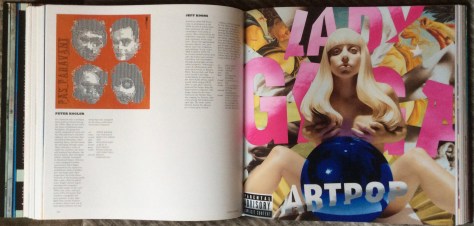
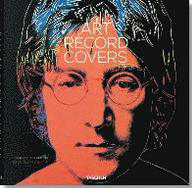
In January 2017, Taschen published Francesco Spampinato‘s “Art Record Covers” edited by Julius Weidemann. This book with over 400 pages provides an overview of artists who have produced record cover art, ranging from the early days of record cover art with covers by Salvador Dali and Andy Warhol to currently active artists including Banksy, Jeff Koons, Karin “Mamma” Andersson and with in depth interviews with Tauba Auerbach, Shepard Fairey, Kim Gordon,Christian Marclay, Albert Oehlen and Raymond Pettibon. Thereafter the bulk of the book, over 300 pages, is an alphabetical presentation of, I guess, 500 artists with selected illustrations of their work.
Spampinato must have an enviable collection of record cover art! Many (most?) of the photos are of records from his personal collection. The book is beautifully produced, being almost LP sized (30 x 29.5 cm) and on heavyweight paper. Many of the covers are reproduced almost full size.
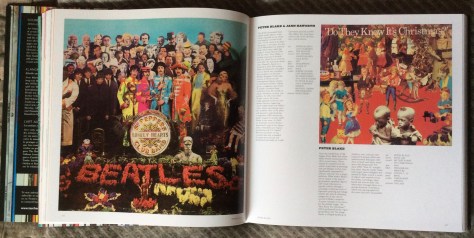
Banksy’s Blur covers.Jeff Koons’ “Artpop” cover for Lady Gaga.The only two Peter Blake covers.
Do I have any criticisms? The book concentrates on artists not affiliated with record companies, so there are no Reid Miles or Vaughan Oliver or Peter Saville, or even Alex Steinweiss covers. The covers chosen for the book are all art works and there are no photographic covers. there are a couple of artists that I miss: Anton Corbijn has designed loads of covers for U2 and Depeche Mode that aren’t purely photographic. And there is Klaus Voormann who has designed record covers for over fifty years for artists such as The Bee Gees, Manfred Mann and, not least The Beatles‘ “Revolver“. These are really only petty quibbles though. The “Art Record Covers” is a magnificent book and a snip at its recommended price of £49,99. So, go out and buy it! But be warned, it’s heavy so take a cart with you.
A couple of years ago (July 2014, to be exact) I posted that I had found a record cover using a painting by internationally renowned painter Karin “Mamma” Andersson. The limited edition (1000 copies) EP by Mattias Alkberg called “Epitafium” was released for Record Store Day 2014. It comes in a poster sleeve with art by Mamma Andersson. It initially proved difficult to find, but now there are copies available on line at reasonable prices. Since then I have found a few more covers that use her art.
Karin “Mamma” Andersson’s painting as a cover poster for Mattias Alkberg’s “Epitafium” EP.
Not long after I had managed to get hold of the “Epitafium” EP, I found out that Mattias Alkberg has released another limited edition featuring Karin “Mamma” Andersson‘s art on its cover. This time it was a limited edition, blue vinyl, 7-inch EP entitled “Skända flaggan” (which means “insult/deface the flag”).
The “Skända flaggan” EP had two different Mamma Andersson paintings on front and rear covers. Well, I thought I had found all covers featuring her art until I received my copy of the wonderful “Art Record Covers” book by Francesco Spampinato (edited by Julius Wiedemann).
Art Record Covers by Francesco Spampinato.
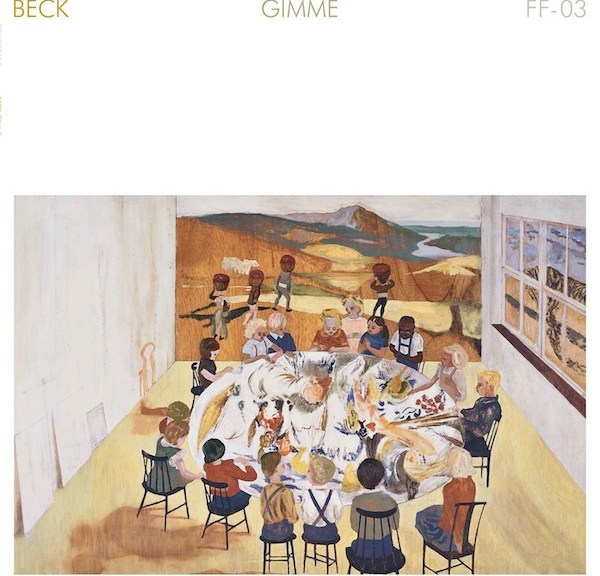
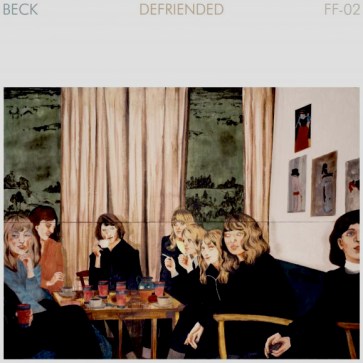
In the book, Spampinato pictures the covers of two limited edition 12″ singles by Beck with cover art by Mamma Andersson. These are “Defriended” and “I Won’t Be Long“. Apparently they were released in 2013 and only available through Beck‘s website and sold out completely. A Discogs search showed me that there was even a third Beck 12″ with a different Karin Andersson painting on the cover. This was a double 12″ called “Gimme“. All three 12-inchers were readily available, though I suppose considerably more expensive than originally.
So now I wonder if there are any more records with Karin”Mamma” Andersson’s art on their covers.
I don’t know anything about the band called Skyline, but they released a 12″, 5-track bootleg album in 1978 on the Four Stars label (catalogue No. FS001) with a cover picture of Manhattan. On the rear of the cover the photo was credited to “A. Warhol.”
The album had totally impossible credits beside the “Warhol” cover credit. The musicians were listed as Johnny Thunders (Lead Vocals, Guitar), Lonnie Davis (Keyboards), Peter Ford (Drums, Percussion) and Charles La Croix (Bass, Keyboards, Vocals). However, the album became a kind of underground disco hit and was re-issued with a different cover.
Skyline’s 1978 EP “I’m Gonna Fall in Love” with cover picture of Susanne de Maria from a Warhol screen test.
A few years ago Guy Minnebach, who has an encyclopaedic memory about Andy Warhol‘s art, and Raimund Flöck recognised the cover photo of Susanne de Maria as being from one of Andy Warhol‘s 1964 screen tests and is published in a book of them. And since then this version of the record has been in demand not only by fans of the disco music but now also by collectors of Andy Warhol‘s record cover art. Interestingly, the original bootleg lacked the photo credit to A. Warhol on the rear. I have been looking for a copy for my collection and saw one recently on Ebay on which I bid unsuccessfully. However, I noticed in the photos on Ebay that the cover had the “Photo by A. Warhol” credit on the rear cover and also included a photo of Susanna de Maria (note the correct spelling of Susanna), which sparked my curiosity..
About a month later the seller contacted be via a second chance offer and told me he had another copy for sale, and a deal was done. The record duly arrived and I realised this must be a reprint of the original 12″. It is on a different label–Paint the Case Productions–and has no obvious catalogue number. Included in my copy were two photos of Susanna de Maria; one with “No 49” on the rear and the other with “No 49 out of 50” on the back. Could it be that this repressing was limited edition of just 50 copies?
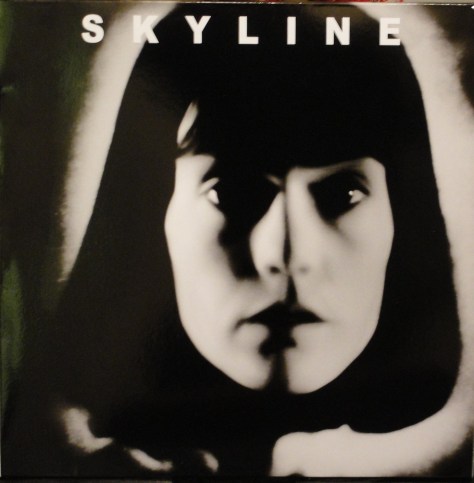
The repressed version of Skyline’s 12″ EP.
As anyone can see, the image is much less sharp than on the original 1978 pressing (no, it’s not due camera shake). Even the included photos of Susanna are not 100% focused.
One of the posters included with the album.
Anyway, the album is a nice addition to my collection of Andy Warhol covers. But I suspect I’ll still look for one of the original 1978 pressings.* After a discussion with Guy Minnebach who originally recognised the photo as being from one of Andy Warhol‘s screentests, I conclude that this must be a bootleg of a bootleg! Guy pointed out that bootlegs have previously always been about making music recently an LP version of Paul Anka‘s “Amigos” album appeared. This album was only officially released on CD so the vinyl version seems to be a bootleg only produced for it Warholian cover art. This seems to be the reason for the new pressing of the Skyline album.
*I finally found a copy on 8th August 2017. Hooray!
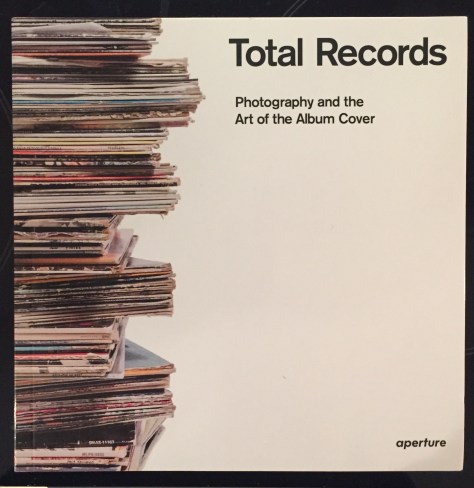
I just found out that I had missed yet another major exhibition of record cover art, this time in Arles in southwest France. The exhibition, called “Total Records” was first presented at Les Rencontres d’Arles from June to September 2015 and is said to be travelling round France. The exhibition catalogue has just (October 2016) been published as a free-standing book also called “TOTAL RECORDS – Photography and the Art of the Album Cover”.
The cover of the “Total Records” book.
I bought the 448 page book as it promised an introduction to how photographers and the record covers they took photographs for came together. However, the short introduction in English at the start of the book doesn’t live up to the promise. You have to turn to the end of the book for the full stories but, unfortunately for me, this section is only in French. Quelle horreur! Zut alors! and all that.
The book is divided into twenty-five “chapters”, some devoted to a single photographer and others more thematic with titles such as “Below the Belt” and “B-side America: Riverside, Bluesville and Yazoo”. There is a section called “Photo-Copy” which shows how some cover art has spawned plagiarism (The Rolling Stones’ “Sticky Fingers“, The Beatles’ “Abbey Road” and “Sgt Pepper’s Lonely Hearts Club Band“.)
But the photographs are great. Most pages picture a single cover. Not surprisingly, as the exhibition is French, there are many French covers. Johnny Halliday and Sylvie Vartan figure prominently alongside less well known French artists including a lovely cover of Catherine Deneuve’s “Souviens-toi de M’Oublier” with cover photo by Helmut Newton. There are also Newton’s photographs on the cover of Sylvie Vartan’s album “Au palais des congress“.
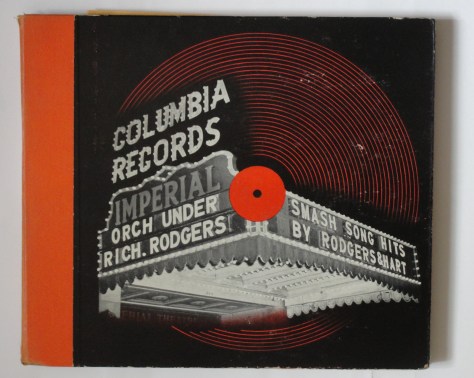
The first cover pictured in the book is Alex Steiweiss’ “Smash Song Hits by Rodgers and Hart“–Steinweiss’ first picture cover for Columbia Records from 1940.
Alex Steinweiss first picture cover for Columbia Records “Smash Song Hits by Rodgers & Hart” from 1940.
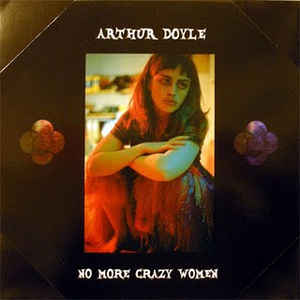
The first two chapters in the book, “The Sound I Saw” and “Aural Reappropriation” act as an introduction to the variety of photographs in record cover art and include covers by a multitude of photographers and make up nearly 30% of the book. These include cover photos by Andy Warhol (“This Is John Wallowitch“), Nobuyoshi Araki (Björk’s “Enjoy” and “Possibly Maybe” and Mango Delight’s “Conglomerate of Crazy Souls“), Annie Liebowitz (Cyndi Lauper’s “Change of Heart“, John Lennon’s “Interview Disc” and The Jim Carroll Band’s “Dry Dreams“), Herb Ritts (John Travolta/Olivia Newton-John “Two of a Kind” and Madonna’s “True Blue“). There is even Arthur Doyle’s “No More Crazy Women” with its Cindy Sherman cover photo (see my previous post on Cindy Sherman’s record cover art). Robert Mapplethorpe is represented with the classic Patti Smith cover for “Horses“, Taj Mahal’s “Taj” and Laurie Anderson’s “Strange Angels“.
Following these introductory chapters are sections/chapters devoted to individual photographers. First off are Jean-Paul Goude and Anton Corbijn. Corbijn is, of course, well known for his covers for Depeche Mode and U2. Jean-Paul Goude is best known for his cover photos of Grace Jones and eight of them are pictured in the book. It is a selection of Corbijns photos for U2 that are featured–mainly from the “Joshua Tree” sessions.
Next are eight of Jean-Baptiste Mondino’s covers, including covers of albums by Madonna, Björk, The Eurythmics and Prince.
The chapter after is reserved for Andy Warhol’s photographic covers. “This Is John Wallowitch” appeared in the first section of the book and this section includes the covers for “The Velvet Underground & Nico“, Miguel Bose’ s “Milano/Madrid“, Paul Anka’s “The Painter“, “Silk Electric” by Diana Ross and the cover of the “Muscles” single from the album and finishing with the cover of The Rolling Stones’ “Love You Live” album with a page devoted to the polaroid pictures on which Warhol based the cover design. “Sticky Fingers“, the other Stones album Warhol designed, appears in the section Photo-Copy along with several pastiches.Obviously, in a book on the photography and the art of the album cover, I wouldn’t expect any of Warhol’s graphic covers to be included–and there aren’t any, with the possible exception of “The Velvet Underground & Nico” cover. I’m not sure how much photography was involved. Did Warhol actually photograph the famous banana?
More chapters are devoted to the work of David Bailey (more Rolling Stones covers), Lucien Clergue And Lee Friedlander’s photography for jazz artists on the Atlantic label. The jazz theme is logically continued with a chapter devoted to some of the Blue Note label’s photographic covers with photography by Frank Wolf. And the label theme continues with a chapter on covers from the ECM label photographed by a variety of photographers. Other labels highlighted include Brazil’s Elena Records, ESP-dosc and a chapter devoted to the American Bluesville, Riverside & Yazoo labels before moving on to a chapter of Hipgnosis designs including the usual Pink Floyd covers (but happily, not the “Dark Side of the Moon” cover which I feel has become a cliché).
In the next chapter, aptly titled “Transartistic” there are covers by Robert Rauschenberg (Talking Heads’ “Speaking in Tongues”), Paul Bley (“Paul Bley Quintet“) and Andy Warhol’s “Index” book with the Lou Reed flexidisc. Even Jeff Koons’ cover for Lady Gaga’s “Artpop” and Damien Hirst’s cover for Dave Stewart’s “Greetings From the Gutter” are included.
One of the best chapters is entitled “Propaganda and Slogans” which includes thirty eight covers ranging from the clenched fist on the cover of The BlackVoices album “On the Streets in Watts” to Rage Against the Machines album with the self-imolating buddhist monk on the cover.From this provocative chapter with covers portraying Che Guevara, Charles de Gaulle,Malcolm X and Martin Luther King the book goes “Below the Belt2 with a selection of “racier” covers such as The Jimi Hendrix Experience’s ” Electric Ladyland” (The British cover with the nude models photographed by David Montgomery), Roxy Music’s “County Life” and more Rolling Stones in the form of both versions of the “Beggars Banquet” cover (the originally released version with the white cover which simply stated the group’s name and the record’s title as well as the version The Stones originally wanted with the lavatory interior scene, first released in 1986.
The final three chapters, “A life on Vinyl:David Bowie and Johnny Halliday”, “Word and Image” with many spoken word albums (Allen Ginsberg, Albert Camus, Jack Kerouac, etc.) and “from Grain to Groove”, a homage to the Soundtrack album cover, round off this nice book.
I think this is one of the nicest books on record cover design which I will keep alongside Alex Steinweiss’ “The Inventor of the Modern Record Cover“, Nick de Ville’s “Album: Classic Sleeve Design–Style and Image in Sleeve Design” and Richard Evan’s “The Art of the Album Cover“. I would have been thrilled to see the exhibition and have been able to see the covers full size. But the covers in “Total Records” are beautifully photographed by Romain Riviere and do them justice.
Cindy Sherman and Jeff Koons are two contemporary artists working in totally different media. Cindy Sherman (born 19th January 1954) is a photographer who specialises in self portraits in which she disguises herself in costume and in various situations. She is considered a conceptual artist.
CINDY SHERMAN
I have thus far managed to find six record, video and cassette covers with cover art by Cindy Sherman.The earliest recording I have found that has one of her photographs on its cover was for the television production “Two Moon July” which featured the music of Laurie Anderson, David Byrne (with whom Cindy Sherman had a relationship from 1991 to 2005), Philip Glass and others. The programme was released on VHS in 1986 and on Laserdisk the following year with Cindy‘s photograph of the Empire State Building on the cover.
The cover of the “Two Moon July” Laserdisk.
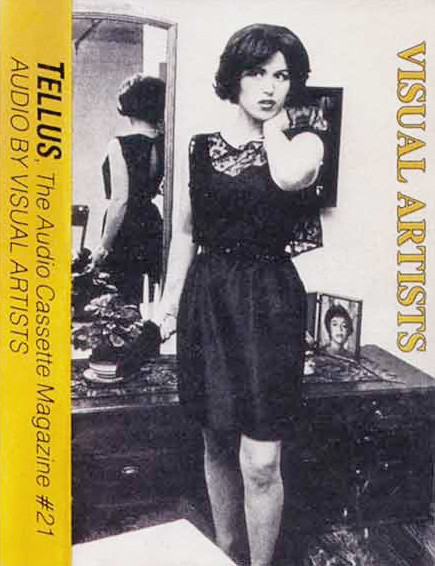
In 1988, one of her self portraits was used as the cover art for a cassette of visual artists talking. The cassette was released as Tellus Magazine #21 entitled “Tellus #21: Audio by Visual Artists“. Tellus was a bi-monthly cassette magazine that was founded in New York in 1983.
Cindy Sherman’s self portrait on the cover of the cassette magazine Tellus from 1988.
Sherman was involved with the female band Babes in Toyland in the 1980s and even appeared in one of their videos. Her photographs appeared on the covers of two of the group’s records “Fontanelle” (1992) and “Painkillers” (1993).
Babes in Toyland’s 1992 LP “Fontanelle” and 12″ “Painkillers” with cover photos by Cindy Sherman.
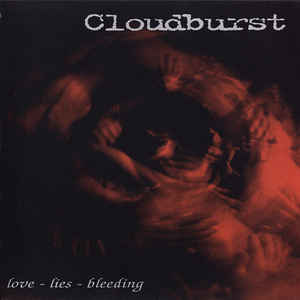
The punk band Cloudburst released two singles. The first, released in France in 1999 was a purple vinyl, three-track 7″ EP entitled “Love-Lies-Bleeding” and had a Cindy Sherman painting as its cover art.
Cloudburst’s 1999 single cover with Cindy Sherman painting.
The latest cover i have been able to find is a five-track, single sided, yellow vinyl 12″ EP called “No More Crazy Women” by tenor saxophonist Arthur Doyle. I’ll be returning to Arthur Doyle in my list of Jeff Koon‘s cover art.
The cover of Arthur Doyle’s “No More Crazy Women” 12″ EP-
JEFF KOONS
There only seem to be three record or CD covers with Jeff Koons’ art. Or that is all I have hitherto been able to find.
Eli and Edye Broad have built up a magnificent collection of American postwar art which is housed at The Broad at 221 S. Grand Avenue, Los Angeles and is open to visitors. The Los Angeles County Museum of Art hosted an exhibition of 100 works from the Broad Collection from 7th October 2001 until 6th January 2002. The exhibition was called “Jasper Johns to Jeff Koons: Four Decades of Art from the Broad Collection“. In conjunction with the exhibition a CD was released called “John Cage to David Byrne: Four Decades of Contemporary Music“. The exhibition later transferred to The Corcoran Gallery of Art in Washington DC (16th March-3rd June 2002).
The CD was a compilation of 13 tracks by artists from David Bowie (“Rock ‘n’ Roll Suicide“) to John Cage (“Atlas Eclipticalis”) via The Velvet Underground (“Femme Fatale”), Dizzy Gillespie (“Be Bop”) and Klaus Schulze (“Floating”).
The “John Cage to David Byrne: Four Decades of Contemporary Music” CD cover with a detail of Jasper Johns’ “Flag” and Jeff Koons’ “Rabbit”.
The CD booklet also contains pictures of other artworks from the Broad Collection, including Andy Warhol‘s “Elvis” (1963), Jean-Michel Basquiat‘s “Horn Players” (1983), Sharon Lockhart‘s “Untitled” (1996) and Stephan Balkenhol‘s “Large Woman with Green Pants” (1996). The rear inlay shows Roy Lichtenstein‘s “I… I’m Sorry” (1965-1966).
The second release with Jeff Koons‘ art is another Arthur Doyle record. This time another single-sided, two track 12″ single with cover that shows Koons‘ print “Donkey 1999” from 1999 produced in an edition of 99 copies. The cover, once again, has two corners cut off.
Arthur Doyle Trio’s “Live at the Alterknit” cover.
And the third Jeff Koons cover is the best known. Lady Gaga‘s “ArtPop” from 2013. For this cover Koons acted as photographer.
I will keep looking out for more covers with art by Sherman and Koons and will probably update this post sometime in the future.
I have been collecting record cover art since the 1980s. First designers including Vaughan Oliver and his collaborations with Nigel Grierson as 23 Envelope and, later, as V23 with Chris Bigg. Neville Brody ,with his covers (mainly) for the Fetish label, was another designer I collected. Then, when I moved to Sweden, I started collecting covers by Martin Kann, who is responsible for the cover art for Swedish rockers bob hund. Most of the record covers I had by these designers disappeared when I had to sell my record collection and I had to decide which designers’ covers to keep.
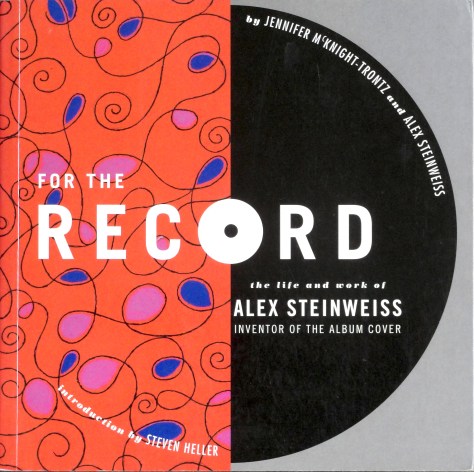
I thought I knew the history of record cover design, but to my eternal shame, I only found out that one individual, Alex Steinweiss (1917-2011), had started the whole field of record cover design in about 2005 when I read Nick de Ville‘s great book on record cover design “Album-Style & Image in Sleeve Design” from 2003.But I HAD for years seen some of Steinweiss‘s work at my parents’ home! They had a condo i Sarasota, Florida, for many years. Sarasota was Steinweiss‘s retirement home and he produced posters for the celebrated Sarasota Jazz Festival and my father had bought three of these posters, which hung on a bedroom wall at home, but I had no idea Steinweiss had designed record covers! Once I had seen de Ville‘s book, I started looking for some Steinweiss covers. They were not easy to find as few Internet sellers recognised Steinweiss‘s work and sold records only by their artist/title. Then, in 2006, I bought Jennifer McKnight-Trontz’s “For the Record: The Life and Work of Alex Steinweiss, Inventor of the Album Cover“. A great place to start researching Steinweiss‘s production of over 2500 record covers.
Jennifer McKnight-Trontz’s “For the Record-The Life and Works of Alex Steinweiss“
Steinweiss may not have been the first to illustrate record covers–here the purists argue–but he was the first to convince a record company that pictures on covers could actually sell records. In 1939, at the tender age of 22, he was hired by Columbia Records as art director for the company’s recorded music division, principally to be responsible for advertising material.
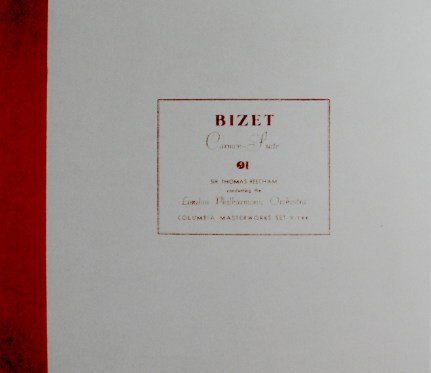
Few dedicated record shops existed in the 1930’s. Music was mainly sold as sheet music and records were usually sold in general stores, electrical appliance stores and i a few record shops. Records were only available as 78 r.p.m shellac discs, ten or twelve inches in diameter. Single discs were generally packaged in brown envelopes with or without a central hole that showed the record label with the title and artist on the record. Longer works, such as classical recordings had to be split onto several discs and were packaged in book-like albums that contained any number of records from two to ten. The front covers were generally plain perhaps with record company, the record’s catalogue number and the record title. They were affectionately known as “tombstone covers”!
A “Tombstone cover” as albums were sold prior to Steinweiss deciding to add pictures to covers.
The album’s spine showed the title and artist and the record’s catalogue number. These albums were generally stored like books in a library, with only the spines visible.
Steinweiss, during his artistic studies, had seen the power of pictures in selling and suggested to his superiors that adding a picture to illustrate the music might actually increase sales of these albums. Despite initial scepsis the directors allowed Steinweiss to produce a limited number of pictorial covers and the first “Smash Song Hits by Rodgers & Hart” appeared in 1940 (Jennifer McKnight-Trontz says 1939).
Alex Steinweiss’s first picture cover for Columbia Records “Smash Song Hits by Rodgers & Hart” from 1940.
I collected about fifty Steinweiss covers and was lucky enough to find a copy of the “Smash Song Hits by Rodgers & Hart” in really good condition early on. This album seems extremely rare as I have been on a fruitless search for a second copy ever since. It seems important for anyone particularly interested in record sleeve design to have this seminal design, so I kept it when my other Steinweiss covers vanished.
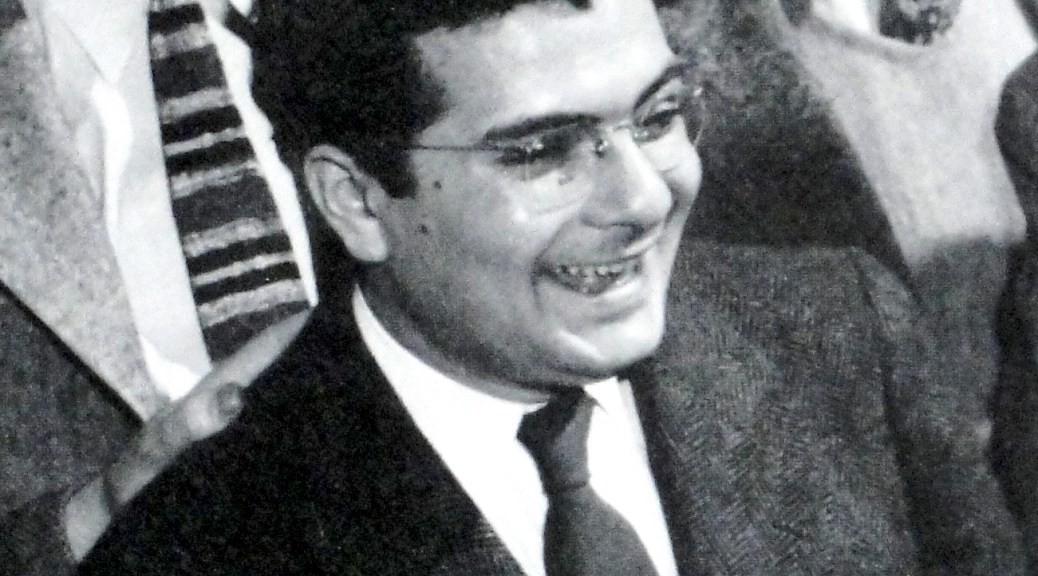
Of course, Steinweiss‘s new picture covers increased the sales of Columbia Records’ Albums and he was allowed to continue producing sleeve art. When, in 1948, Columbia introduced the microgroove LP, it fell to Steinweiss to design a suitable packaging and he came up with the LP record sleeve with a design on the front, text on the rear and on the spine. Many of the designs he produced for the 78 r.p.m albums were transferred when a work was reissued in the new format. But Steinweiss‘s burden of designing new covers meant that he couldn’t do them all himself. He enlisted other talented designers to work for Columbia, including Jim Flora and a commercial artist named Andrew Warhola, just arrived in New York from Pittsburgh.
Steinweiss (in dark suit) with other Columbia employees including Jim Flora (With the striped tie standing behind Steinweiss).
Steinweiss left Columbia in 1949 and went freelance. He subsequently designed covers for several other record companies including Everest, Decca and London and RCA.
in 2009, Kevin Reagan and Steven Heller convinced Taschen to publish a luxurious book simply entitled “Steinweiss” with the subtitle “The Inventor of the Modern Record Cover“. I addition to a standard edition Taschen produced an art edition; one hundred copies numbered 1-100 contained a print of Steinweiss‘s design for Decca Records’ recording of Igor Stravinsky‘s “The Firebird“, the second time Steinweiss had designed a cover for that work.
The lithograph of Steinweiss’s design for Decca Records’ recording of Stravinsky’s “The Firebird Suite”.
There were also a further one hundred art copies, numbered 101-200, that did not contain the print. Steinweiss, aged 92, was involved in the production of the book and the art editions were all signed by him as were the prints included in the first one hundred copies. My copy is No. 96.
The book contains full-sized pictures of over two hundred of Steinweiss‘s cover designs as well as pictures of posters and books and ceramics that he made. A worthy tribute to the man without whom I probably wouldn’t be collecting record cover art.
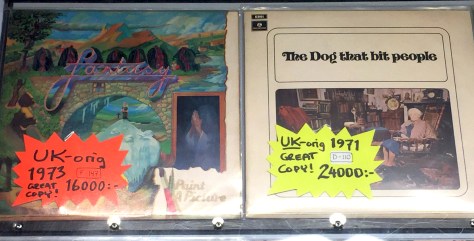
Whoever thought that records could become valuable? I was recently staggered by the price tags on a couple of records from the 1970s that I saw in a collectors’ record emporium (SEK 16,000 is equivalent to £1,380 or $1,600; SEK 24,000 is almost £2,000 or $2,500!)
Fantasy’s 1973 Polydor album “Paint a Picture” and The Dog that Bit People’s 1971 Parlophone album of the same name.
I knew, of course, that records by The Beatles could command exorbitant prices–I actually once owned some of the rarest Beatles items including both the stereo and mono versions of “Please Please Me” with the black and gold Parlophone labels, and an autographed copy of “Love Me Do“, signed on the day after its release in October 1962.
But that albums by bands that I had never heard of could be that expensive was a surprise. Obviously, these albums are in demand for the music they contain. But in recent years prices for records whose cover art is by a famous artist have also rocketed.
Wikipedia has published a list of the “most valuable records of all time” sourcing Record Collector magazine, Popsike, Ebay and others (https://en.wikipedia.org/wiki/List_of_the_most_valuable_records). Number one is, to my surprise a copy of The Wu Tang Clan‘s LP “Once Upon a Time in Shaolin“. Only one copy was pressed and it apparently sold to a hedge fund manager for $2 million! The recent sale of Ringo Starr‘s copy of The Beatles‘ “White Album” for a mere $790,000 pales in comparison!
In August 2016 a copy of an obscure EP by a band called Skyline was sold on Ebay for $1,500. The EP was released in France in 1978 and it was only in 2015 that Warhol collectors Guy Minnebach and Raimund Flöck recognised the cover image as a still from one of Warhol’s 1964 screen tests featuring Susanna de Maria, and added it to their lists of Warhol record covers. Apparently, this EP is a cult disco rarity and was expensive even before the Warhol association was recognised.
Skyline’s 1978 EP “I’m Gonna Fall in Love” with cover picture of Susanne de Maria from a Warhol screen test.
Prices of the records with cover art by Andy Warhol from the 1950s have generally increased considerably in value. I believe that the publication of Paul Maréchal‘s book “Andy Warhol: The Complete Commissioned Record Covers 1949-1987” has played a part in making the early, rarer covers more valuable. It has stimulated interest in this aspect of Andy Warhol‘s work and more collectors searching after a limited number of records means inevitably that prices will rise. However, less scrupulous sellers try to sell records with Warhol art from the 70s and 80s for inflated prices despite the fact that they are generally easy to find quite cheaply if one is prepared to search a bit.
I started collecting record cover art by Banksy in 2008. Covers were then easy to find and not overly expensive. The most expensive covers I bought included a copy of the first pressing of Dirty Funker‘s “Let’s Get Dirty” which cost £100 and two copies of the “Peace Not War” CD that was given away with the February 2008 issue of the magazine The Big Issue for about £40 each. The value of these has more than doubled. CDs with Banksy cover art can still be found at very reasonable prices, it’s the vinyl versions that seem to be most sought after and all have become expensive.
It is still possible to collect a complete collection of records with cover art by Sir Peter Blake for a modest sum. One might have to settle for a modern reissue of the “Sgt Pepper’s Lonely Hearts Club Band” LP to keep costs down, but otherwise it should be possible to collect most of his 24 covers for around £600. The expensive ones being Oasis‘s “Stop the Clocks” triple vinyl set and Paul Weller‘s “Dragonfly” EP. A couple of Peter Blake covers are getting hard to find; “Brand New Boots and Panties: Tribute to Ian Dury“and Paul Weller‘s “Stanley Road” both on LP. Even Brian Wilson‘s “Gettin’ in over My Head” is becoming rare on vinyl. However, if you want to add some of the special, limited editions of Eric Clapton‘s or Paul Weller‘s releases you’ll have to shell out a bit more.
Some art galleries have cottoned on to the fact that artists who are in demand have designed record covers and advertise these as limited edition art works–often calling them “lithographs”. Damien Hirst is one artist’s covers I have seen advertised by galleries. His “Use Money, Cheat Death” 12″ single with his famous Kate Moss portrait was released in a numbered edition of 666 copies. Galleries have been advertising copies for £500+, but I’m not sure anyone buys them.
Damien Hirst’s “Use Money, Cheat Death” 12″ single, with his portrait of Kate Moss.
Another gallery has advertised two (the yellow and pink covers below) of the five singles Damien Hirst and Jason Beard designed for the group The Hours as limited edition lithographs at an asking price of £133 for the pair.
Damien Hirst’s & Jason Beard’s covers for the five singles by The Hours.
The yellow version of “Ali in the Jungle” is now difficult to find but the remaining four covers in the series can still be found at reasonable prices.
Probably the most reasonably priced covers in my collection are those by Klaus Voormann. Even his early covers in the “Pioneers of Jazz” series from 1960 are still affordable.
All twenty of Coral Records series “Pioneers of Jazz” released in 1960 with cover illustrations by a young Klaus Voormann.
His very first official cover–for The Typhoons (“Walk, Don’t Run“, a cover of The Ventures hit)–is impossible to find as is a mythical album of jazz tunes that I have only heard about but never seen.
Cover of The Typhoons’ single “Walk Don’t Run”.
It seems there’s no limit to what a record cover with art by a famous artist can cost. So desirable covers seem to be not only beautiful, but are even a good investment.
While I specifically collect cover art by five designers — the artist known as Bansky, Sir Peter Blake, Damien Hirst, Klaus Voormann and Andy Warhol — sometimes other artists I admire produce record covers. Over the past couple of years a number of such covers have found their way into my collection.
Here’s a list of these “odd” record covers.
1. Lady Gaga–“ArtPop” – 2xLP. Cover by Jeff Koons.
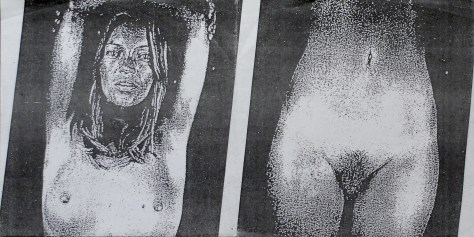
2. The Unholy Two–“Kutter/Porkys” – 7″ single in fold-out cover with Chuck Close‘s portraits of Kate Moss.
3. Paul Simon–“Stranger to Stranger” – LP and insert with Chuck Close‘s portrait of Simon.
4. Soníc Youth–“Sonic Nurse” – 2xLP. Cover art by Richard Prince.
5. Mattias Alkbergs Begravning–“Epitafium” – 12″ EP. Cover art by Karin “Mamma” Andersson.
6. Mattias Alkbergs Begravning–“Skända flaggan” – 4-track 7-inch EP. Cover art by Karin “Mamma” Andersson
7. The Weaklings–“It’s so Criminal/Real Cool Time” 7″ single. Cover photo by Richard Avedon.
As readers of this blog may recall, I described Lady Gaga‘s “ArtPop” album cover designed and photographed by Jeff Koons in my post about Stockholm’s Spritmuseum’s 2014 exhibition entitled “ArtPop“. A copy of the double vinyl has found its way into my collection.
“ArtPop” – the inner spread of this gatefold cover showing Jeff Koons photographing the artist.
The Unholy Two “Kutter/Porkys“: The Unholy Two is a hardcore/punk trio from Columbus, Ohio, who have released two albums to date. The members are Chris Lutzko, Bo Davis and Adam Smith.
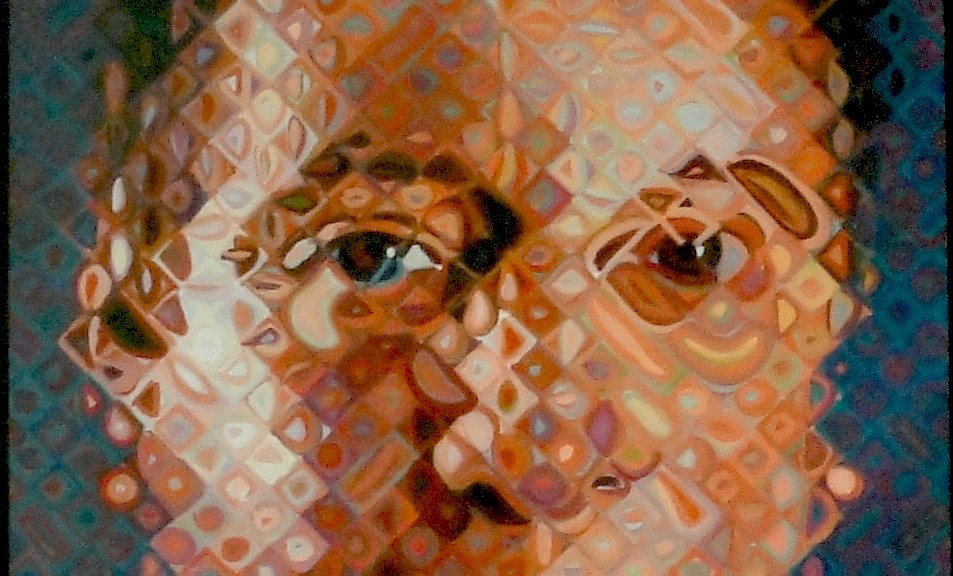
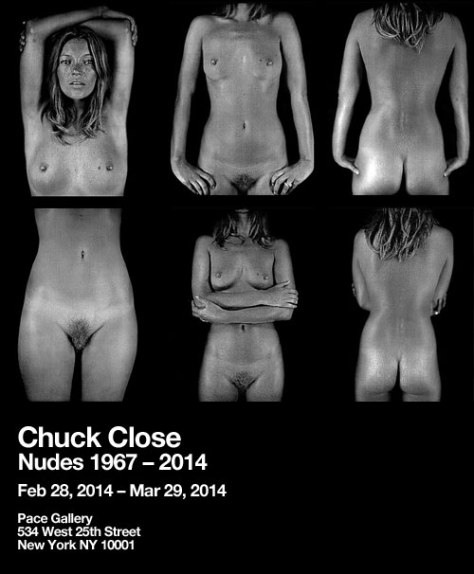
There’s a story behind how I came to find this single. Sometime in the 1990s I saw a painting by American artist Chuck Close (born 5th July 1940). It was a large portrait of a man’s face made up of tiny units. I was fascinated. I’ve looked at Close‘s work in galleries and museums since. He is both a painter and a photographer. In 1988 he suffered a spinal artery collapse (whatever that means) and was paralysed. He now paints with a special support on his arm enabling him to hold a brush. He has ascribed is interest in painting portraits to his prosopagnosia or inability to recognise faces. Neurologist and author Oliver Sachs was a fellow sufferer from prosopagnosia. In 2005 Close took a series of photographs of a nude Kate Moss and it was when I was compiling my list of record covers with portraits of Kate, that I stumbled across this single. I first saw it in an Ebay ad which described the cover portrait as being by Richard Avedon (15th May 1923-1st October 2004). I soon found out who the artist actually was.
Poster for a Chuck Close exhibition showing his 2005 photographs of Kate Moss.
The Unholy Two’s “Kutter/Porkys” single cover:
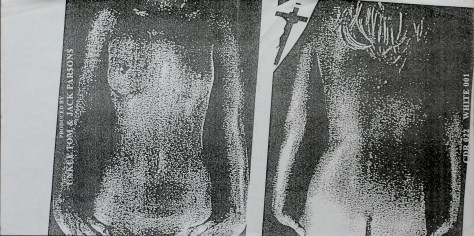
The outer spread of The Unholy Two’s “Kutter/Porkys” single.The inner spread of The Unholy Two’s “Kutter/Porkys” single.
Paul Simon “Stranger to Stranger” LP album released in 2016 has an insert with Close‘s portrait of Simon.
The lyric insert with Chuck CLose’s portrait of Paul Simon and a close-up of the study.
The outer sleeve used an enlarged picture of Paul Simon’s eye.
Paul Simon’s right eye from the full portrait.
These are the only two covers with art by Chuck Close that I have thus far been able to identify. Does anyone know of any others?
Sonic Youth‘s “Sonic Nurse” was originally released in 2004. It was reissued in July 2016 on heavyweight vinyl with the original cover paintings by Richard Prince (born 6th August 1949). Prince is both a photographer and a painter and often uses other peoples’ work as his starting point. I have not been able to find any other record covers painted or photographed by Richard Prince, but he recorded a CD in 1985 entitled “Loud Song” and a limited edition 12″ was released with cover art by Sonic Youth‘s Kim Gordon.
Richard Prince’s cover painting for Sonic Youth’s “Sonic Nurse” LP-
Mattias Alkberg is a poet and guitarist and most recently a journalist. He has fronted a number of bands, starting with the Bear Quartet and Mattias Albergs BD. More recent constellations include Mattias Alkbergs Begravning and Mattias Alkbergs Södra Sverige. He released the “Skända flaggan” in 2013 as a limited edition blue vinyl 7-inch EP, and the 12″ EP “Epitafium” was released as a limited edition for Record Store Day in 2014; I think 1000 copies were pressed. Mattias Alkberg lives in Luleå in northern Sweden and chose the celebrated painter Karin “Mamma” Andersson for the artwork for the double-sided poster cover . Karin “Mamma” Andersson also hails from Luleå.
Front and rear cover of Mattias Alkbergs Begravning’s “Epitafium” EP.
Mattias Alkberg also used two other paintings by Karin “Mamma” Andersson on the front and rear covers of his 7″ EP “Skända flaggan” released in 2013.
Karin “Mamma” Andersson’s painting on the cover of “Skända flaggan”.
Richard Avedon‘s photographs have graced the covers of many albums, ranging from Simon & Garfunkel‘s “Bookends” to Allen Ginsberg‘s “Kaddish” and including albums by Cher, Sly & the Family Stone, Barbra Streisand and The Fugs.
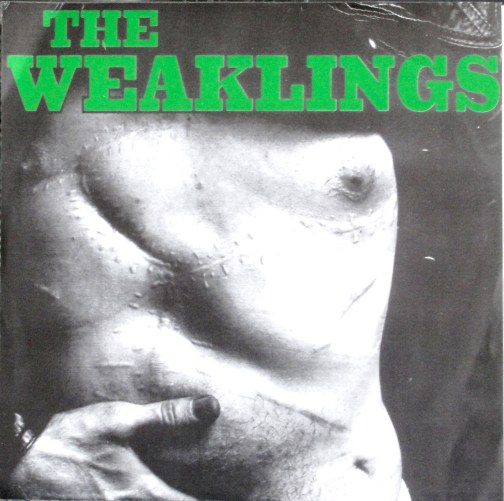
In 1999 The Weaklings, a punk band from Portland, Oregon, released their ninth single “It’s so Criminal/Real Cool Time” and chose Richard Avedon‘s famous photograph of Andy Warhol‘s abdomen showing the scars after operations to remove the bullet shot by Valerie Solanas on June 3, 1968. Solanas fired three shots at Warhol, but the first two missed. I used to own several records with Avedon‘s cover photographs, but now only have The Weaklings‘ single. The reason being that I include this cover in my collection of Andy Warhol cover art.
Richard Avedon’s photograph of Andy Warhol’s abdomen after he was shot in 1968 on the cover of The Weaklings’ 1999 single.
I do not doubt that other covers with art by artists/photogtaphers I admire will find their way into my collection. I’ll keep you posted as and when any new covers arrive.
































 recordart