All posts by rockdoc999

I used to be a music nerd with a large collection of all sorts of recorded music, though mainly a vinyl freak. I started out in the sixties, got swept away by psychedelia and into music posters which I continued to collect up until 2013, when space shortage meant I had to sell the major part of my collection. I had already started collecting record cover art and had large collections of art by Vaughan Oliver (4AD) and Neville Brody (Fetish Records), which unfortunately had to go. My collections of Andy Warhol’s, Sir Peter Blake's and Banksy’s and the Swedish band kent’s record covers have been exhibited in major exhibitions both in Sweden and internationally. I also have collections of David Shrigley’s, Damien Hirst’s, Klaus Voorman’s, Cindy Sherman’s and Richard Prince’s record cover art and a couple od Jean-Michel Basquiat’s covers.

The Velvet Underground & Nico–The Obsession.

I have previously discussed my collection of Velvet Underground & Nico albums and this time I thought I’d celebrate the fact that this album was officially released 50 years and two months ago.

This historic album was, of course, initially recorded as a ten-track acetate in Norman Dolph’s Scepter Studios in New York on 25th April 1966. Two acetates were pressed and one was given to Andy Warhol offered it to Columbia Records, Atlantic Records and Elektra who all turned it down. Warhol then took the band to Los Angeles and with Ted Wilson re-recorded most of the songs and Verve Records agreed to release it. Warhol’s acetate disappeared but the other copy surfaced in a New York street sale in 2006 and was bought by record collector Warren Hill for 75 cents. Hill put the record up for auction on eBay, and eventually sold it for $25,200. It was resold in 2014.

A bootleg of the acetate recording called “Unripened” appeared in 2007, pressed first on green and later on black vinyl with a pastiche of Warhol’s original cover for the Velvet’s album. The green banana was not peelable and instead of “Peel slowly and see” beside the banana’s neck this version said “Unripened listen slowly and hear.”

Unripened_LP-fr
The cover of the 2007 bootleg first release of the Norman Dolph acetate recording of The Velvet Underground’s first album

The album received its first official release on CD together with the 45th Anniversary 6 CD set in 2012 and a limited edition of 5000 numbered copies was released on vinyl for Record Store Day that April.
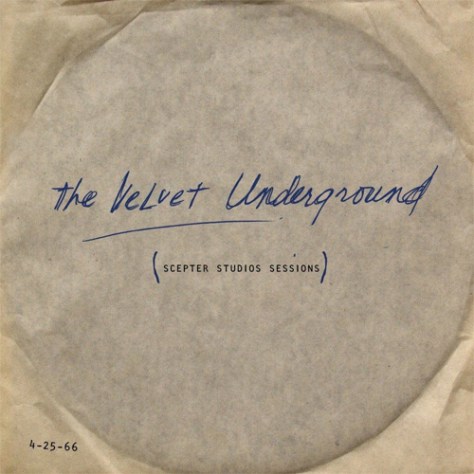
Scepter Acetate
The 2012 vinyl release of The Velvet Underground’s “Scepter Studios” acetate.

There was a later unnumbered vinyl release. There is yet another version released in 2014 in a different cover.

Norman Dolph-front
The latest bootleg version of The Velvet Underground & Nico’s Norman Dolph acetate superimposed the classic banana image over a photo from the 1966 film of the Velvets in concert.

The historic value of the acetate recording is indisputable, but musically it is inferior to the re-recorded full album. In its first year “The Velvet Underground & Nico” appeared in several versions. There were at least two promotional copies, both mono, released in the original “torso” covers. One with a yellow label and the other with a white label. The identical slick could be used for mono or stereo copies,– the mono slick was pasted with the stem of the banana almost at the cover’s top edge.

Both mono and stereo versions were originally released with the “torso” cover, which was soon withdrawn when Eric Emerson demanded payment to allow his picture to be used on the cover. Verve recalled many albums and stuck a large black sticker over the offending “torso” photograph. Later printings replaced the “torso” cover with an  version with Emerson’s picture airbrushed out. These were still gatefold covers.

The original U.K. release was housed in a single cover with the an unpeelable banana. In Germany an unusual reissue was produced in 1976. This cover is unique; coloured blue and with an image of the peeled banana.

VU&N_Rotation_fr
The 1976 German reissue with banana.

The first CD version of the album appeared in 1986. There was a limited edition of 3000 copies German release in a slipcase with a peelable banana that was hand numbered the following year.

.In 1991 a further reissue appeared in the U.S.A. and Australia that had a single cover and the album’s title on the front cover as shown on the 1986 CD. Mobile Fidelity released a gold CD version of the album in 1997.
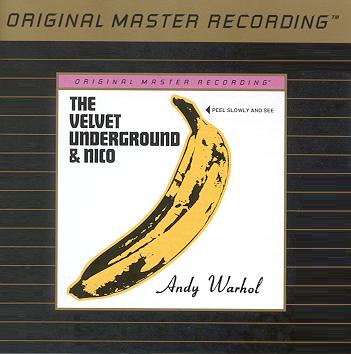
MFSL reissue CD
The cover design of the MFSL gold CD.

There have been many reissues since the late nineteen eighties both on CD and since 2000 on vinyl. I mentioned the picture disc varieties in my previous post. The latest vinyl reissues have been pressed on 180 g virgin vinyl and have restored the original cover including a peelable banana and a restored “torso” rear cover released as a 45th anniversary issue in 2012. And there have been numerous reissues pressed on coloured vinyl. I have seen yellow and red vinyl issues as well as Newbury Comics limited (1000 copies) pressed on yellow/black split vinyl which also has a peelable banana and “torso” rear cover.
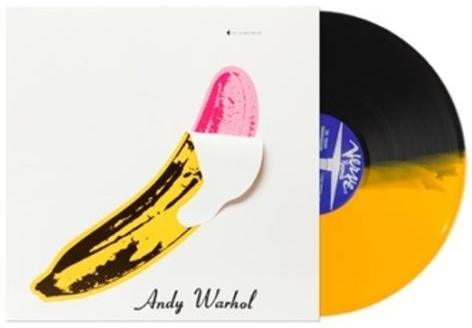
Newbury VU&N
The Newbury Comics version of the Velvet Underground & Nico album.

There are at least three complete cover albums of Velvet Underground & Nico album. The first appeared in 1990 in Italy where a series of punk bands played the songs from the Velvet Underground & Nico album.

Tribute to Andy warhol
The cover of the Tribute to Andy Warhol alum on the Crazy Mannequin Record label.The cover came in several colour variations.

The second cover album was another various artists compilation of the VU & Nico album tracks recorded on the Castle Face Record label in 2012. The banana on the cover was by David Shrigley, who drew a portrait of Andy Warhol on the back cover.

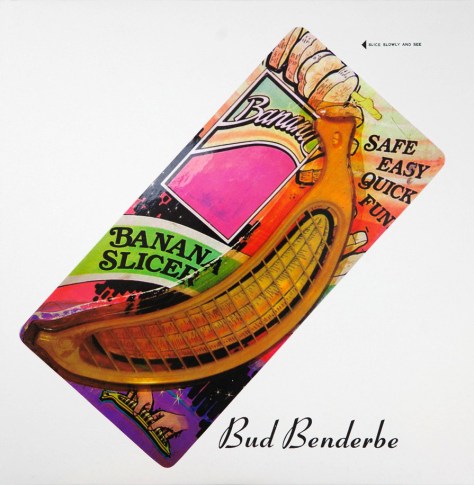
A third cover album called “The Velvet Underground & Nico and Ben Benderbe” was recorded by Bud Benderbe and released as a limited edition LP with a very strange large sliced banana sticker.
Bud Benderbe-fr
Bud Benderbe’s cover album.

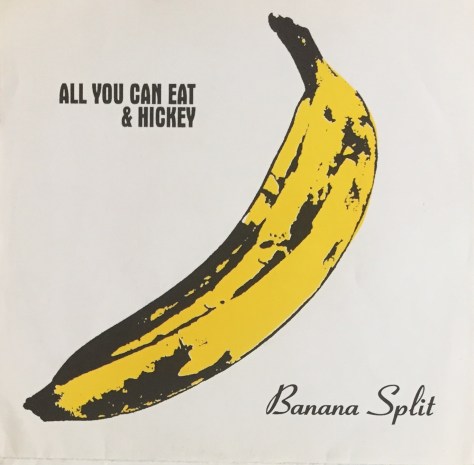
There are also numerous records that use variations on Warhol’s banana image that have no other relationship to the Velvet’s music. These include the split single by Eat All You Can and Hickey called “Banana Split”.
Banana Split-fr

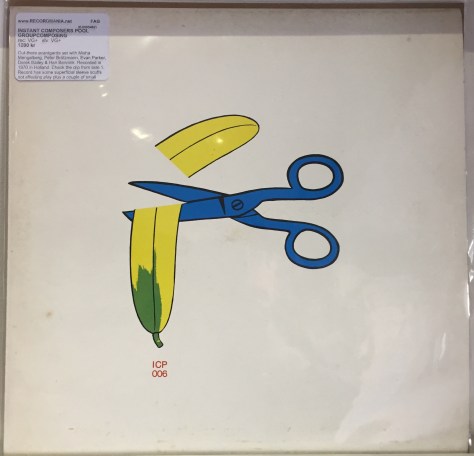
Another is a rare jazz LP by the Instant Composers Pool Group, recorded in Holland in 1970.Jazz Banana.jpg
The classical quartet’s, the Fauré Quartet, first recording “Popsongs”, released on the Deutsche Grammophon label had an apple sticker on the cover which, when peeled revealed a raspberry.
Faure-Popsongs-fr

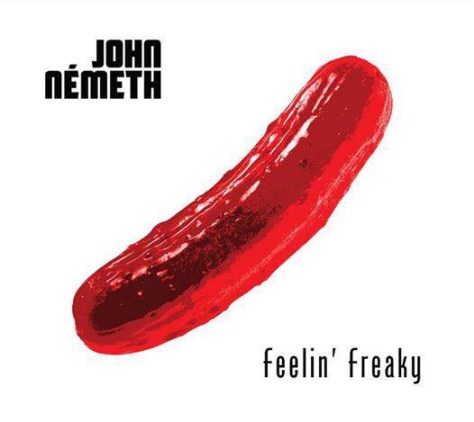
A very recent variation on the design is a 2017 release by John Nemeth called “Feelin’ Freaky”. On this cover, though, the banana was replaced by a red gherkin.
Feelin-Freaky-Cover


Often called the album that launched a thousand bands, “The Velvet Underground & Nico” has proved itself to be one of rock music’s most influential albums and the number of reissues on both CD and vinyl confirm its importance. Andy Warhol’s cover art was a major work of pop art and has had almost as great an influence on cover design as the music has had on the development of rock music.

The Return of Henrik Berggren.

Okay, I have to admit that I have a soft spot for Henrik Berggren, former frontman of Swedish indie band Broder Daniel, who disappeared from radar after the band’s 2008 farewell concert in its native Gothenburg.

Henrik and fellow school comrade Daniel Gilbert formed Broder Daniel in 1989 and the band was joined by Håkan Hellström (who went to the same school as Henrik and Daniel, and would become an enormously popular artist in his own right) on drums and later by Johan Neckvall and Anders Göthberg (guitar; 9th October 1975-30th March 2008). Broder Daniel released its first album “Saturday Night Engine” as a Digipak CD in 1995. Gilbert left the band after the “Saturday Night Engine” tour and was replaced on bass by Teodor Jensen (who would go on to form the band The Plan). Hellström left the band in 1994 to join Honey Is Cool.

Broder Daniel‘s tours were infamous for alcohol and drug use and for unreliability that made concert-bookers wary of booking the band. In particular Henrik Berggren misused a variety of drugs together with alcohol and often performed ‘under the influence’.

Håkan Hellström rejoined the band in 1998, now playing bass, and Broder Daniel‘s third album “Broder Daniel Forever” was released on 22nd April 1998.

Broder Daniel toured the album over the summer of 1998 and were scheduled to play Hultsfred’s Festival in June 1998. I was one of the festival doctors and the medical team received a phone call at about 10 a.m. on Friday 12th June from an hotel in Vimmerby, about 30 kms from Hultsfred, to say that a member of a band that was due to play at 15.15 h that afternoon was unwell and could we send a doctor. “No.” We couldn’t send a doctor as the medical crew was based in the festival area. However, Vimmerby had a general practice near the hotel, and, it being Friday, it was open and we suggested that the band member went there.

At about 1 p.m. the band arrived at Hultsfred’s Pampas stage and I was called to examine the singer (Henrik Berggren) who was not at all well. We learned that he had consumed a fair amount of alcohol and various uppers and downers and felt he couldn’t perform. I had two hours to get him shipshape for the show. He was mainly complaining of stomach pains so I gave him a Zantac tablet dissolved in water and suggested he rest until it was time to go on stage. I checked in on him every half hour or so and he seemed to brighten up. By 3 p.m. he was up and about and could do the hour-long show!

Broder Daniel Forever
The cover of “Broder Daniel Forever“. Unfortunately I never photographed my signed copy.

I had brought a copy of the limited edition “Broder Daniel Forever” LP with me and after the band had done their thing I asked them all to sign it. Håkan Hellström refused to believe it was my album and said he thought it must be my daughter’s! Actually, my daughters had bought it for me for my birthday a couple of months earlier.

Fast forward to July 1999 and a new festival in Stockholm called Stockholm Open. Broder Daniel were again scheduled to appear. I was in charge of the medical crew for this festival and had managed to recruit many of the members of the previous year’s Hultsfred crew to help out. While I was out patrolling the festival area Henrik Berggren came to the Medical tent and asked Kajsa, one of the nurses, if “his doctor” was at the festival. Kajsa knew he meant me and reported that he had been asking for me. But this time he was only looking for reassurance and didn’t need any medical attention. As the Festival ended early on Sunday morning, I waited outside the medical tent for my daughters, who had been at the festival with me, and their classmate Tobbe who would be coming with us back to town. We were talking about Henrik and I said that I really felt fatherly towards him (“jag får faderskänslor”. Tobbe, who was gay, immediately replied “Jag får sambokänslor” (I feel he could be my partner).

I met up with Henrik at a couple more festivals in the ensuing years and we went to after festival parties  and chatted. He always struck me as a gentle soul with quite a wide education.

However, after Broder Daniel‘s farewell concert in Gothenburg in 2008, just months after the band’s guitarist Anders Göthberg had died, Broder Daniel disbanded and Henrik disappeared. Apparently, he developed chronic tiredness syndrome and has lived as a recluse. But then in March 2017 posters appeared all over Stockholm announcing a new solo album by Henrik due for release on May 5th!

fullsizeoutput_4638
The poster for Henrik Berggren’s new album “Wolf’s Heart” and summer tour.

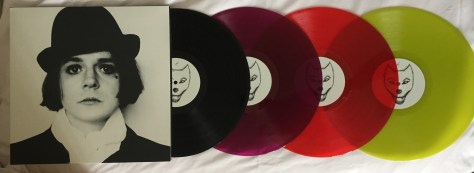
The album, “Wolf’s Heart” will be released on CD and LP. There will be a standard black vinyl LP and at least five limited editions of 300 copies each on coloured vinyl; pale blue, pink, red, violet and yellow. Thus there are at least six variations of “Wolf’s Heart” on vinyl. The five coloured vinyl versions amount to 1500 copies. I’m not sure how limited the black vinyl version will be but Henrik is obviously counting on selling at least 2000 copies. He will probably succeed, knowing the growing cult following his old band

fullsizeoutput_4745
Henrik Berggren’s “Wolf’s Heart” album on black, violet, red and yellow vinyl.

.


I have an unwritten rule that I will not start collecting any new artists’ records, but rules are made to be broken,and I have ordered copies of all the variations of “Wolf’s Heart” on vinyl!

More Sources of Warhol’s Record Cover Illustrations and Daniel Blau’s Book of Warhol’s 1950s Drawings.

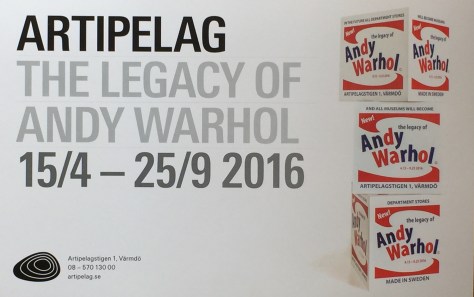
Artipelag is an art gallery on Sweden’s Baltic coast about a 30-minute drive eastwards from Stockholm. It was founded by Björn Jacobsson, the man behind the Baby Björn range of infant products. Jacobsson had a vision for a gallery located on a rocky outcrop overlooking the sea and found an architect willing to design it. There have been many inspiring exhibitions there since it opened in 2012. One of the more recent exhibitions was “The Legacy of Andy Warhol” which ran from 15th April until 25th September 2016. This exhibition was curated by Artipelag’s artistic director Bo Nilsson, himself an avid Warhol fan and, as far as I have been able to ascertain, the first to write about Warhol’s record cover art in the catalogue to Sweden’s Nationalmuseum’s 1981-1982 exhibition of record covers.

fullsizeoutput_46de
The subway poster for Artipelag’s exhibition “The Legacy of Andy Warhol”.

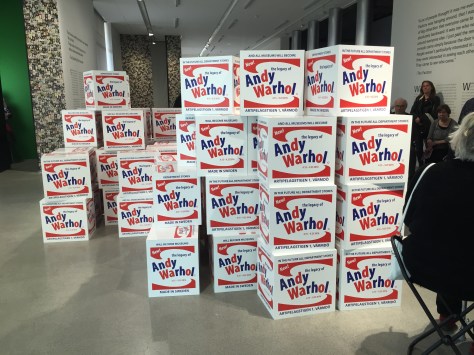
The first thing that met visitors to the exhibition was a mountain of Brillo boxes, like the ones on the poster, specially made for the show.
IMG_5623

One large, silver foil-clad exhibition space was devoted to films including Roland Nameth‘s 1966 film “The Exploding Plastic Inevitable” featuring the Velvet Underground, apparently the first time the film has been shown with its original soundtrack, and Warhol‘s “Empire State Building“.

IMG_5650

There was a small room with walls lined with a selection of reproductions of Warhol’s record covers–though mainly from the 70’s onwards, although the “Velvet Underground & Nico” cover was there, too, and surprisingly one of Warhol’s drawings for a projected Billie Holiday EP was included. I thought it a pity that there were no actual record covers, only prints.
IMG_5634

A real surprise waited just through the sliding doors into the next space. The walls were lined with a large selection of Daniel Blau‘s collection of Warhol‘s drawings from the 1950s. I suppose there were about thirty drawings, but the two that I immediately reacted to were obviously related to Warhol‘s record cover art.

The drawing of the apple made me think of the “William Tell Overture” cover and the reclining woman was obviously a study for Kenny Burrell‘s “Blue Lights” album cover.

There was also a photo booth at the exhibition–a real Warholian touch! Visitors could photograph themselves free. And out came a card with four Warhol-style photos!
fullsizeoutput_364f

I visited the exhibition twice and photographed myself both times. but I lost the second photo in the restaurant. Clumsy!

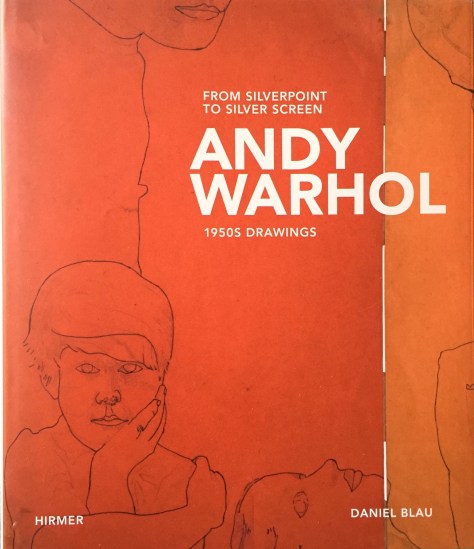
I put the exhibition out of my mind until I read Guy Minnebach‘s wonderful “Andy Earhole-Another Blog about Andy Warhol’s Cover art” and a post about the “Night Beat” box set, which Guy illustrated with a picture of a man talking on the telephone from Daniel Blau‘s 2012 book “From Silverpoint to Silver Screen–Andy Warhol, 1950s Drawings“. I immediately ordered a copy and consider it one of the best books on Warhol‘s art in my book collection. Not only are the pictures superb, but the essay “Environments, Situations, Spaces” by James Hofmaier is a wonderful introduction to Andy Warhol‘s world.

Daniel Blau fr
Daniel Blau’s “From SIlverpoint to Silver Screen–Andy Warhol, 1950s Drawings”.

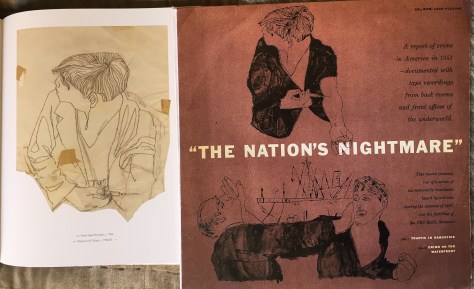
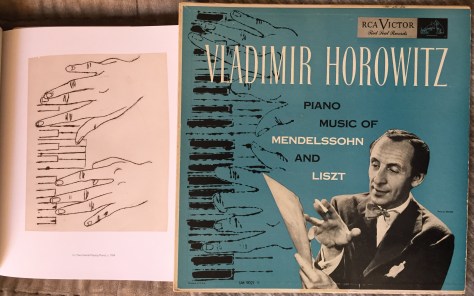
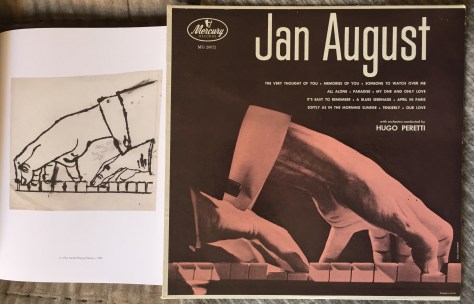
There were more drawings in Blau’s book that resembled Warhol’s cover illustrations. The only one I couldn’t find in the book was the apple drawing I saw at Artipelag. Here are a selection with the respective cover.
fullsizeoutput_46d2fullsizeoutput_46cdfullsizeoutput_46d0fullsizeoutput_46d3

Note that the original drawings for the “Blue Lights” cover and the hands on the Jan August cover are mirror images of the original photos. This is because they are blots of Warhol‘s original tracing. The drawing of the piano playing hands from the Jan August album was used for the unreleased “Progressive Piano” LP and EP.

ProgressivePiano_10"_600
Cover lithograph of the unreleased “Progressive Piano” 10″ LP with Warhol’s drawing of hands playing the piano copied from the Jan August LP cover.

The drawing I have placed beside the Horowitz album is not the one used on the record sleeve, but just shows how Warhol drew many pictures of hands playing the piano. Perhaps this drawing was intended for the “Progressive Piano” cover too, but was never used.

I really must thank Guy Minnebach for telling me about Blau‘s magnificent book “From Silverpoint to Silver Screen–Andy Warhol, 1950s Drawings“, I will spend many happy hours enjoying the superb drawings. It obviously is the catalogue of an exhibition of Warhol‘s 1950’s drawings–an exhibition I would love to have seen. But seeing many of the original drawings at Artipelag feels like I did get a little peek.

More Kate Moss on Record Covers.

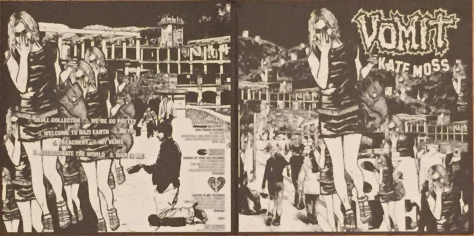
I really felt as though I had exhausted the subject of record covers showing Kate Moss‘ portrait in my previous post. No sooner had the proverbial ink dried than two more covers appeared. The first is a 7-inch single-sided EP by American punk/hardcore/grunge band Vomit, entitled “Kate Moss” on the Give Praise record label.

Now, a search of Discogs will reveal more than ten bands that have used the name Vomit. The Vomit in question seem to only have released this one “Kate Moss” EP.

Vomit-Kate-Spread
The gatefold cover of Vomit’s 7″ single-sided EP “Kate Moss” with at least thirteen portraits of Kate.

Then I was reading about the two CD and one DVD set of Bryan Ferry‘s 2010 “Olympia” album. I already have the limited edition Vinyl Factory LP version of this, that includes the cover portrait of Kate Moss but without the text–obviously intended to be framed and hung on a teenager’s wall. I hadn’t considered the box set as I felt it probably wouldn’t add anything to the LP version. Well, I was wrong. The 40-page book that houses the discs contains many more photos from Adam Whitehead‘s sessions for the album. The DVD has an interview with Bryan Ferry on the making of the “Olympia” album and the “You Can Dance” video as well as a video of behind the scenes activity in the making of the “You Can Dance” video.

Olympia box-fr complete
The box set of Bryan Ferry’s “Olympia” album contains a 40-page book and 2 CDs and a DVD.

The pictures are stunning. Here are a selection:

The CDs and the DVD included in set come in card covers, two of which have different cover photos from the LP and deluxe box.
Olympia Box CD1-frOlympia Box CD2-frOlympia Box CD3-fr

CD1 has the album cover photo, while CD2 and the DVD cover have different photos. You will have to examine the covers of the CDs to spot the very subtle difference (hint look at Kate’s right hand).

And just when the thrill of finding the box set sort of settled, I came across an Ebay ad by my least favourite seller Majestic Music & Art. I consider this seller to be quite ruthless in his (I presume it is a “he”) price-setting. Many years ago, I bought a couple of albums from Majestic Music & Art that were poorly packaged and arrived damaged. They would not discuss a return or a refund and I promised myself never to buy from them again. But in mid-March 2017 they posted this ad for a copy of the Luke Fair remix of Primal Scream‘s (and Kate Moss‘) “Some Velvet Morning” (the old Lee Hazlewood classic). This single normally comes in a plain black generic cover, but Majestic Music & Art advertised a copy with Kate Garner‘s famous 1992 portraits of an 18-year-old Kate Moss affixed to front and back covers.

Despite my promise to myself never to buy from Majestic Music & Art, I did buy the 12″ single to add to my collection. I knew of Kate Garner‘s Kate Moss portraits from an exhibition of Russell Young‘s recent screen prints at London’s Halcyon Gallery. Russell Young’s portraits are really wonderful–some are as big as 200 x 200 cm and covered in diamond dust, so they really sparkle!

Kate Moss‘ name crops up in music as a songwriter and artist–several tracks by other artists/bands are entitled “Kate Moss“. Examples include Arab Strap‘s 1996 album “The Week Never Starts Around Here” that contains a track entitled “Kate Moss“, but there is no picture of her on the record cover. German rocker Maximilian Hecker‘s 2003 CD “Rose” also has a song called “Kate Moss” as its first track. Again, there is no portrait of her on the cover. I don’t suppose these will be the only songs called with this iconic title.

This Is (the Other Side of) John Wallowitch–A Rare Warhol Cover.

It has been my ambition to collect all record covers with Andy Warhol‘s art. Most of the seventies and eighties covers are relatively easy to find and shouldn’t cost the earth (an exception is Ultra Violet‘s eponymous LP from 1973), but the earlier ones, particularly the fifties covers have become increasingly expensive. And the original “Velvet Underground & Nico” (1967) along with many of it’s reissues are becoming increasingly expensive.

I have long searched for decent copies of Moondog‘s “The Story of Moondog“. While copies of the Moondog album do pop up relatively frequently on Ebay, most are in pretty poor condition with severely discoloured covers, but I had the great good fortune to find a near mint copy on Discogs which I bought as a Christmas present to myself.

The other major hole in my collection was John Wallowitch‘s second album for Serenus Records called “This Is (The Other Side of) John Wallowitch“. This album doesn’t come up for sale very often and bidding goes crazy on good copies. A reasonable copy popped up on Ebay in late January and despite having depleted my funds the previous month for the Moondog album, I managed to win it with a not too outrageous bid.

As can be seen, Wallowitch chose as the rear cover picture to reuse the “photo booth” photos taken by Warhol that were on the front cover of his previous Serenus Records release “This Is John Wallowitch“. It’s sort of ironic that the “Man of a Thousand Faces”, as stated on the front cover, is portrayed on the rear from the chin downwards, so one cannot see any of the thousand faces (actually, there are only 56 photos, or parts of photos on the cover, not thousands).

So now there are two of Warhol’s original covers and one bootleg that I need to complete my collection of Warhol’s record covers. These are the pink version of Prokofiev’s “Alexander Nevsky, Cantata Op 78” and the unobtainable “Night Beat” promotional box set that Guy Minnebach wrote about in his Andy Earhole blog (https://warholcoverart.com/2017/03/25/night-beat-rarest-of-the-rare/). Though I do have the facsimile box of the latter.
img_8450

The remaining bootleg I am still looking for is the limited edition of Keith Richards‘ “Unknown Dreams” (Outsider Bird Records, OBR 93009).

OBR93009
Keith Richards’ bootleg “Unknown Dreams” with Warhol’s car drawing cover.

Will my collection ever be “complete”?


Art Record Covers – a new book.

As you all know by now, record cover art has become highly collectible. The long player, invented by Columbia Records in 1948 allowed graphic artists a 31 x 31 cm canvas on which to apply their art.The arrival of the compact disc in 1982 was predicted to banish the LP forever and, in the mid 1990s many artists had abandoned the format. However, the vinyl LP didn’t die; it faded away for a time, but has made a dramatic recovery in the last few years and artists are once more releasing albums on vinyl. And this has made designers and artists return to the medium and produce many great works of cover art.

Some record covers by famous artists now change hands for extraordinary sums. Nowadays, collectors will only pay top buck for a record cover if it is in pristine condition and preferably for an original pressing. One can only congratulate those who bought some of the rarer records when they were first released as the cover art has proved a surprising investment.

There have been many exhibitions of record cover art over the past thirty or so years. The first one I heard about (and visited) was produced by Aarhus Kunstmuseum in 1981 (shown there from 5th September until 4th October 1981), which then transferred to Nationalmuseum in Stockholm, where it was shown from 24th October  1981 until 17th January 1982 and later to Bildmuseet in Umeå. I saw both the exhibitions in Stockholm and Umeå (and lent 30 covers to the Umeå exhibition) and I still have the exhibition catalogue and even a poster from the Stockholm exhibition, signed by Andy Warhol!

Many books have been published illustrating “great” record covers, “The 100 (or even 500) best record covers of all time” or just plain record covers. There have been a few good books on the history of record cover art. My favourites are Steven Heller‘s, Alex Steinweiss‘ & Kevin Reagan‘s “Alex Steinweiss Inventor of the Modern Album Cover“, Nick De Ville‘s “Album: Style and Image in Sleeve Design” and Richard Evans‘ “The Art of the Record Cover“. There have been even fewer books devoted to a single designer: Paul Maréchal‘s pioneering “Andy Warhol–The Record Covers 1949-1987. Catalogue Raissonné” from 2008 and updated in 2015 as “Andy Warhol–The Complete Commissioned Record Covers 1949-1987” and, again, the “Alex Steinweiss Inventor of the Modern Album Cover” are wonderful examples. Fewer books focus on the artists behind the record covers.

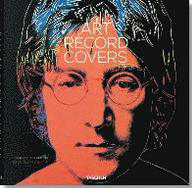
In January 2017, Taschen published Francesco Spampinato‘s “Art Record Covers” edited by Julius Weidemann. This book with over 400 pages provides an overview of artists who have produced record cover art, ranging from the early days of record cover art with covers by Salvador Dali and Andy Warhol to currently active artists including Banksy, Jeff Koons, Karin “Mamma” Andersson and with in depth interviews with Tauba Auerbach, Shepard Fairey, Kim Gordon, Christian Marclay, Albert Oehlen and Raymond Pettibon. Thereafter the bulk of the book, over 300 pages, is an alphabetical presentation of, I guess, 500 artists with selected illustrations of their work.
fullsizeoutput_4618

Spampinato must have an enviable collection of record cover art! Many (most?) of the photos are of records from his personal collection. The book is beautifully produced, being almost LP sized (30 x 29.5 cm) and on heavyweight paper. Many of the covers are reproduced almost full size.

fullsizeoutput_461f
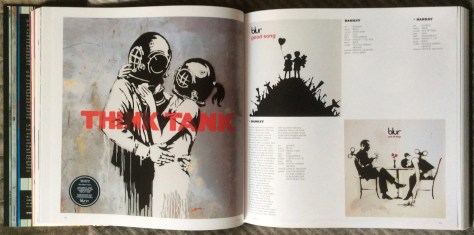
Banksy’s Blur covers.
fullsizeoutput_461e
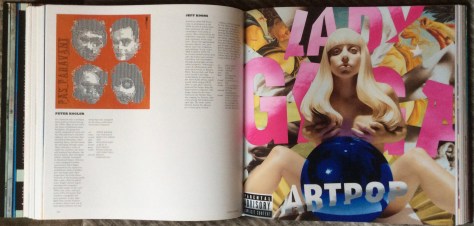
Jeff Koons’ “Artpop” cover for Lady Gaga.
fullsizeoutput_461d
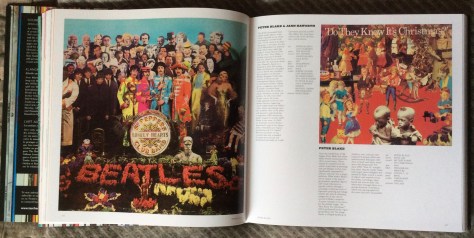
The only two Peter Blake covers.

Do I have any criticisms? The book concentrates on artists not affiliated with record companies, so there are no Reid Miles or Vaughan Oliver or Peter Saville, or even Alex Steinweiss covers. The covers chosen for the book are all art works and there are no photographic covers. there are a couple of artists that I miss: Anton Corbijn has designed loads of covers for U2 and Depeche Mode that aren’t purely photographic. And there is Klaus Voormann who has designed record covers for over fifty years for artists such as The Bee Gees, Manfred Mann and, not least The Beatles‘ “Revolver“. These are really only petty quibbles though. The “Art Record Covers” is a magnificent book and a snip at its recommended price of £49,99. So, go out and buy it! But be warned, it’s heavy so take a cart with you.


Andy Warhol by Sir Peter Blake. Post Dedicated to Daniel Brant.

As readers of this blog will know, I collect both Andy Warhol‘s and, not by any coincidence, Peter Blake‘s record cover art.. I would list these great Pop Artists as the equals–Warhol as an exponent of American Pop Art and Blake curiously English.

Andy Warhol died on 22nd February 1987, just 30 years ago. Art lovers, it seems, love and hate him in almost in equal measures. However, Warhol‘s art still causes excitement and discussion. Peter Blake‘s art continues to evolve, now in his 85th year.

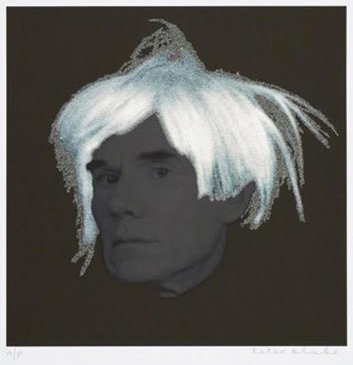
In 2009 Sir Peter Blake produced a 355 x 355 mm (14 x 14 in) print of Andy Warhol in an edition of 25, complete with diamond dust. A new, larger (510 x 510 mm) edition 0f 75 was produced in 2016.

Warhol by Blake
Sir Peter Blake’s 2009/2016 print “Andy Warhol”.

This would make a great addition to both my collections! I’m going to start saving up tomorrow.

I dedicate this post to the memory of Daniel Brant of the A and D Gallery, who died on 19th January 2017 and who gave me many insights into Andy Warhol‘s art and gave me the opportunity to meet Sir Peter Blake at the opening of the Gallery’s show Peter Blake‘s “I Love London” in 2010. I suppose it is also an homage to Andy Warhol and Peter Blake, too.

Karin “Mamma” Andersson’s art on record covers.

A couple of years ago (July 2014, to be exact) I posted that I had found a record cover using a painting by internationally renowned painter Karin “Mamma” Andersson. The limited edition (1000 copies) EP by Mattias Alkberg called “Epitafium” was released for Record Store Day 2014. It comes in a poster sleeve with art by Mamma Andersson. It initially proved difficult to find, but now there are copies available on line at reasonable prices. Since then I have found a few more covers that use her art.

epitafium-poster-fr
Karin “Mamma” Andersson’s painting as a cover poster for Mattias Alkberg’s “Epitafium” EP.

Not long after I had managed to get hold of the “Epitafium” EP, I found out that Mattias Alkberg has released another limited edition featuring Karin “Mamma” Andersson‘s art on its cover. This time it was a limited edition, blue vinyl, 7-inch EP entitled “Skända flaggan” (which means “insult/deface the flag”).

The “Skända flaggan” EP had two different Mamma Andersson paintings on front and rear covers. Well, I thought I had found all covers featuring her art until I received my copy of the wonderful “Art Record Covers” book by Francesco Spampinato (edited by Julius Wiedemann).

art-record-covers-fr
Art Record Covers by Francesco Spampinato.

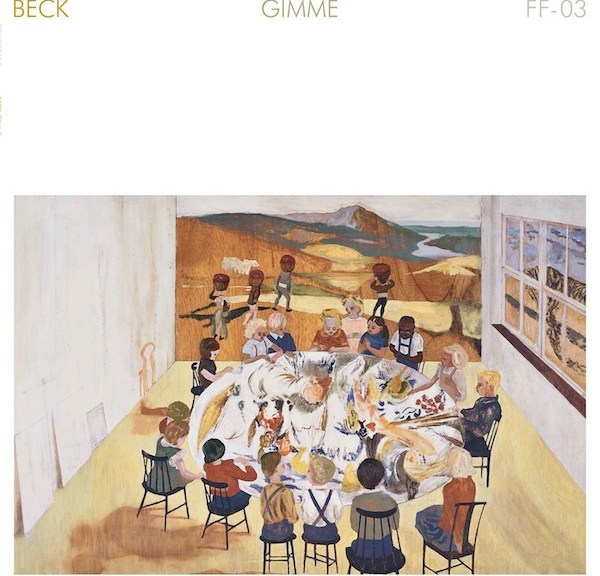
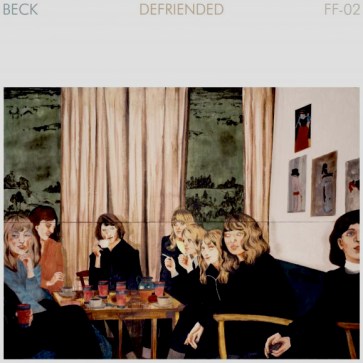
In the book, Spampinato pictures the covers of two limited edition 12″ singles by Beck with cover art by Mamma Andersson. These are “Defriended” and “I Won’t Be Long“. Apparently they were released in 2013 and only available through Beck‘s website and sold out completely. A Discogs search showed me that there was even a third Beck 12″ with a different Karin Andersson painting on the cover. This was a double 12″ called “Gimme“. All three 12-inchers were readily available, though I suppose considerably more expensive than originally.
i-wont-be-longdefriendedbeck-gimme

So now I wonder if there are any more records with Karin”Mamma” Andersson’s art on their covers.

Records by Turner Prize Winner Susan Philipsz.

In my last post I started researching record cover art by winners of the prestigious Turner Prize awarded annually by the Tate Gallery to an artist under the age of 50 for an exhibition. Susan Philipsz won the prize in 2010. When I started writing the previous post, I had no idea that I would have the chance to meet one of the Turner Prize winners so soon.

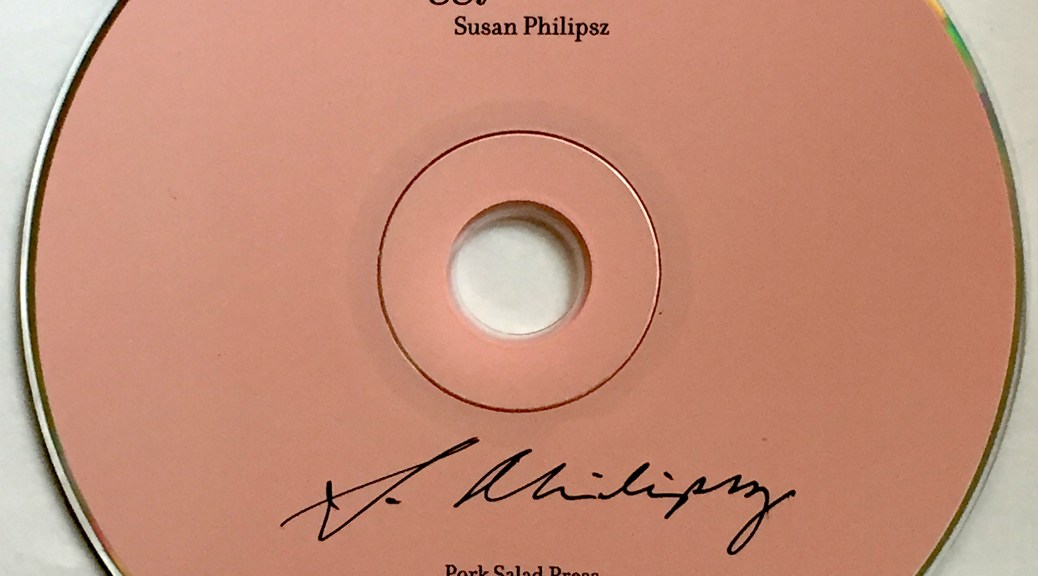
Philipsz (born 1965 in Glasgow, Scotland) began her artistic career as a sculptor. She was fascinated by sound and moved on to sound installations. in 2001 she recorded an a capella version of David Bowie‘s “Ziggy Stardust” album at Stockholm’s Bonnier konsthall. The recording was released on a limited edition (500 copies) Digipak CD in 2004.

Philipsz had an exhibition at the Gallician Centre of Contemporary Art (CGAC) in Santiago de Compostela, Spain, in 2008, called “There Is Nothing Left Here“. There was a book published by the CGAC together with an LP which features sound from the exhibition in a cover showing Philipsz and one of her sisters sitting looking out over a mountain.

philipsz-nothing-lp
Susan Philipsz’ “There Is Nothing Left Here” 2008 LP.

In 2005, Malmö konsthall allowed Philipsz to use their exhibition space for an installation entitled “Stay With Me“. The hardcover exhibition catalogue also contained a CD of the sound installation.

Susan Philipsz has again been chosen to be Bonnier konsthalls artist in residence for the first part of 2017. This time she presents a four-work exhibition called “Lost in Space“. The main work is a 23 minute film of violinist Leila Akhmetova playing a single note from the opening of Karl-Birger Blomdahl‘s opera “Aniara“. Philipsz deconstructed the music and required Akhmetova to only play each note of C. Philipsz filmed the process with a camera constantly circling Akhmetova catching her concentration on following the score while a computer screen beside indicates how the performance is progressing. Apart from a 24-page catalogue, Philipsz has produced a limited edition picture disc LP (300 copies) in a box set with a 300 page book.

lost-in-space-lp-display
The picture disc LP and book of Susan Philipsz’ “Lost in Space” installation.

At the opening of the “Lost in Space” exhibition, Susan Philipsz introduced the works in a 45.minute talk during which she explained her methods and showed films of various projects she has been involved in, including her Tate Britain installation of tones produced from wind instruments damaged in various wars from the Battle of Waterloo, The Crimea and WWI. After the talk I had the opportunity to talk with her and get the “Ziggy Stardust” CD and “Stay With Me” book signed.

Winners of the Turner Prize Who Have Their Art on Record Covers, Part One.

The Turner Prize was instigated in 1984 by the Tate Gallery in London to recognise an exhibition by a British artist aged under 40. The Prize has been awarded yearly with the exception of 1990, when sponsorship was lacking. The basic statistics are that 6 of the 32 (one further winner was a group of indeterminate gender) prize winners (18.8%) has been male while 42 of 110 nominees (38.2%) have been men.

When I had the idea to try to see if any winners of the Tate Gallery’s Turner Prize has produced any record or CD cover art I could not have imagined that so many had done so. I have tried to research the careers of all the winners and this has turned out to be a major undertaking.  In my ignorance I thought that perhaps a handful had some involvement with music but it turns out that there seems to be a unique connection between music and art – nowhere better shown than on record and CD covers. Initially, I had identified four Turner Prize winners who have their art on record or CD covers. Howard Hodgkin, Gilbert and George, Damien Hirst and Martin Creed but when I started researching further I found that many more had been involved in musical projects and many had contributed record cover art. In retrospect, it would have been easier to list the Turner Prize winners who have not been involved with music or produced cover art!

In this first part, I have so far been able to identify twelve Turner Prize winners who have their art on record or CD covers. In alphabetical order:  Martin Boyce, Martin Creed, Jeremy Deller, Gilbert and George, Damien Hirst, Howard Hodgkin, Mark Leckey, Grayson Perry, Susan Philipsz, Simon Starling, Wolfgang Tillmans and Mark Wallinger.

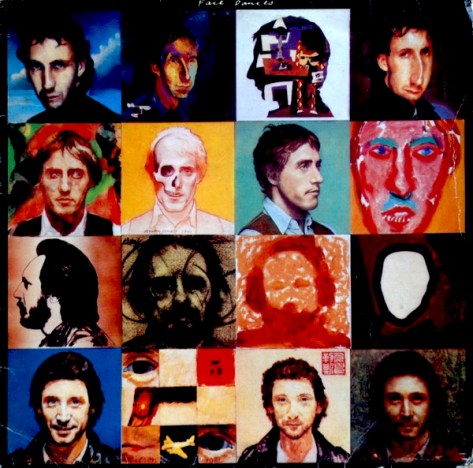
The 1985 winner was Howard Hodgkin (born 1932) who was invited by Peter Blake to paint one of the four portraits of John Entwistle on the cover of The Who‘s 1981 “Face Dances” album.

facedances
The Who’s “Face Dances” album with Howard Hodgkin’s John Entwistle portrait third from left in row three.

I haven’t been able to find any other contributions to record cover art by Howard Hodgkin.

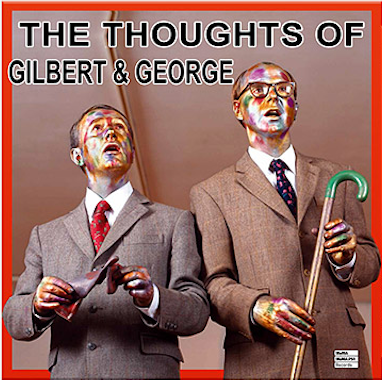
Gilbert & George won the Prize the following year (1986). In August 2016 they released an LP of their Museum of Modern Art show “The Singing Sculpture” from 1969.

gilbertgeorge-lp
Damien Hirst won the Turner Prize in 1995. He has not only been in a band (Fat Lez), released a single of his own together with Kate Moss,  but also been responsible for about thirty record and CD covers for bands such as The Hours (which he signed to his own label ISGOOD), Babyshambles and, of course Fat Lez. He also designed the cover for Dave Stewart‘s “Greetings From the Gutter” album and the singles and EPs taken from it. He was asked to design the cover for Band Aid‘s 20th anniversary re-issue of “Don’t They Know It’s Christmas?” CD but his design was considered too harrowing and was replaced by another.

Here are Dave Stewart‘s “Greetings from the Gutter”
greetingsfrom

Damien Hirst & Kate MossUse Money, Cheat Death

R-1875335-1249421346.jpeg

The Hours‘ singles “Ali in the Jungle“, “Back When You Were Good“, “Love You More“, “Ali in the Jungle, 2” and “Big Black Hole

And here are some Babyshambles covers including the album “Sequel to the Prequel“, and two limited edition singles, “Nothing Comes to Nothing” and “Fall From Grace

Next up is musician and Turner Prize winning artist Martin Creed, who won the Turner Prize in 2001. He has released several albums on both CD and vinyl with his own paintings on the covers. The Vinyl Factory has produced limited vinyl editions of at least four of his albums with covers hand painted by Martin himself. These are “Love You To“, “Chicago“, “Mind Trap” and a two-track 12″ single “Work No 1651“. Creed has also painted the cover art for a split single “Where You Go/Dawning” by Creed and Box Codax.

Five hand painted covers by Martin Creed. Clockwise from top left: “Love You to“, “Chicago“, “Work 1651“, “Where You Go/Dreaming” and “Mind Trap“.

2016 Turner Prize winner Helen Marten doesn’t appear to have her art on any record cover yet, but she has contributed the text to one track on Kasia Fudakowski‘s 2014 album “Stoikerinnen“.

Elizabeth Price, the 2012 winner, played guitar and sang in the 80s girl band Talulah Gosh, but has said that she hated being on stage. She left the band in 1987 and the band disbanded the following year. Talulah Gosh released and album, six singles plus one flexi single and there were three compilation albums. While the band’s early singles credit the cover art, later ones name Matthew Fletcher as designer. It seems Elizabeth Price didn’t design any of the band’s record covers.

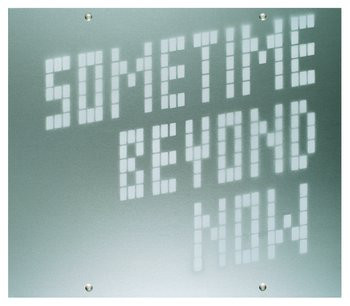
Martin Boyce (born1967) won the Turner Prize in 2011. In 2008 he designed a limited edition 12″ by the American band The Aluminum Group entitled “Sign for Some Place” there was a record and an anodised plate painted with the words “Sometime Beyond Now“.

sometime-beyond-now
Martin Boyce’s contribution to The Aluminum Group’s 2005 12″ single.

The 2010 winner, Susan Philipsz works with sound and video and has released a CD entitled “Ziggy Stardust“and a limited edition vinyl 12″that was untitled.. In 2005 she had a solo exhibition a Malmö konsthall entitled “Stay With Me” and, as I understand it, the exhibition catalogue also contained a CD.

Richard Wright, an artist and musician received the Turner Prize in 2009 for his golden and temporary mural. I have not been able to find any record covers that are attributed to him.

Mark Leckey is also a musician and artist with three records to his credit. Leckey won the Turner Prize in 2008. The limited edition LP “Fiorucci Made Me Hardcore” was released on his own label The Death of Rave in 2012. His next LP was “Hecker Leckey Sound Voice Chimera” in 2015 and the third was “Dream English Kids 1964-1999AD“.


The 2007 Turner Prize winner Mark Wallinger who mainly works in sculpture has designed the cover for Leftfield‘s 2015 album “Alternative Light Source“.

mark-wallinger-lp
Mark Wallinger’s design for Leftfield’s album cover “Alternative Light Source”.

The conceptual artist Simon Starling won the Prize in 2006. It turns out he has been responsible for two record covers.He photographed the cover for Superstar‘s EP “Breathing Space” in 1997 and the cover of a limited edition LP by Oren Ambarchi entitled “Stacte 4“.

Jeremy Deller, the 2004 Prize winner, spent two weeks at The Factory after meeting Andy Warhol in 1986. He has a long musical history. In 1997 he fused the music of a traditional British brass band from Stockton with acid house and Detroit techno music in a project called “Acid Brass“. He contributed the photography to a book with a CD produced by the CCAC Wattis Institute entitled “After the Gold Rush“, a collaboration between Deller and Willam Elliot Whitmore, an American Blues, country and folk singer.

Grayson Perry, the 2003 Turner Prize winner, works mainly in ceramics. Apparently he played in a punk band for a time, but the only connection with record cover art that Sir Peter Blake included his portrait in his 80th birthday re-working of the Sgt Pepper’s Lonely Hearts Club Band cover art in 2012.

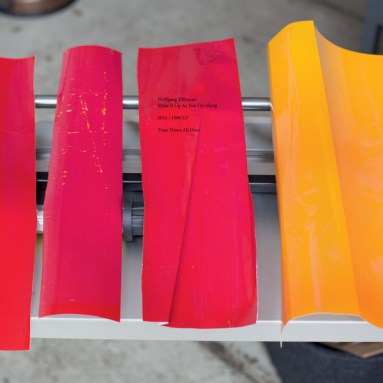
Wolfgang Tillmans, the German photographer, who divides his time between Berlin and London, won the Turner Prize in 2000. He was the first non-Brit to win the award. Heis a musician, having contributed the opening track to Frank Ocean‘s Album “Endless” and music for some of his own projects. Tillmans collaborated with the Pet Shop Boys on their single “Home and Dry” has released two 12″ singles in his own name and is part of the collective XXX. He has designed many record and CD covers including Sun Electric‘s 1993 “Kitchen” LP, Tiga‘s 2006 single “3 Weeks” as well as a remix of it,  John Maus‘ 2012  “A Collection of Rarities and Previously Unreleased Material” and many others.

tillmans-1986-2012
Wolfgang Tillmans’ 12″ “2016 / 1986”.
kitchen-lp
The cover of Sun Electric’s “Kitchen” LP designed by Tillmans.
tiga-3-weeks
The cover of Tiga’s 12″ “3 Weeks” with with detail of Tillmans’ photograph “Anemone II”.

These are the first twelve Turner Prize winners for whom I have discovered record cover art or at least a music connection. I will continue this post with details of winners of the Prize between 1988 and 1999 in a future post, so don’t go away.