Tag Archives: record collecting

Alex Steinweiss – The Inventor of the Illustrated Record Cover.

I have been collecting record cover art since the 1980s. First designers including Vaughan Oliver and his collaborations with Nigel Grierson as 23 Envelope and, later, as V23 with Chris Bigg.  Neville Brody ,with his covers (mainly) for the Fetish label, was another designer I collected. Then, when I moved to Sweden, I started collecting covers by Martin Kann, who is responsible for the cover art for Swedish rockers bob hund. Most of the record covers I had by these designers disappeared when I had to sell my record collection and I had to decide which designers’ covers to keep.

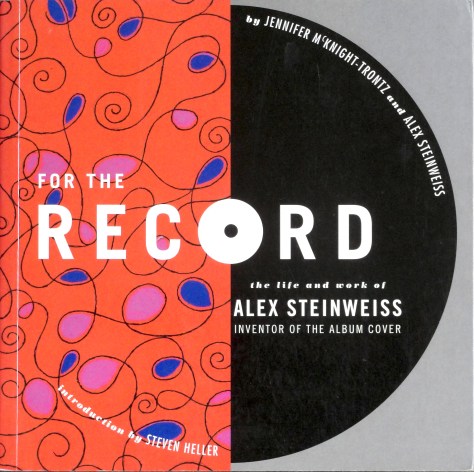
I thought I knew the history of record cover design, but to my eternal shame, I only found out that one individual, Alex Steinweiss (1917-2011), had started the whole field of record cover design in about 2005 when I read Nick de Ville‘s great book on record cover design “Album-Style & Image in Sleeve Design” from 2003.But I HAD for years seen some of Steinweiss‘s work at my parents’ home! They had a condo i Sarasota, Florida, for many years. Sarasota was Steinweiss‘s retirement home and he produced posters for the celebrated Sarasota Jazz Festival and my father had bought three of these posters, which hung on a bedroom wall at home, but I had no idea Steinweiss had designed record covers! Once I had seen de Ville‘s book, I started looking for some Steinweiss covers. They were not easy to find as few Internet sellers recognised Steinweiss‘s work and sold records only by their artist/title. Then, in 2006, I bought Jennifer McKnight-Trontz’s “For the Record: The Life and Work of Alex Steinweiss, Inventor of the Album Cover“. A great place to start researching Steinweiss‘s production of over 2500 record covers.
lifeworks-of-as
Jennifer McKnight-Trontz’s “For the Record-The Life and Works of Alex Steinweiss

Steinweiss may not have been the first to illustrate record covers–here the purists argue–but he was the first to convince a record company that pictures on covers could actually sell records. In 1939, at the tender age of 22, he was hired by Columbia Records as art director for the company’s recorded music division, principally to be responsible for advertising material.

Few dedicated record shops existed in the 1930’s. Music was mainly sold as sheet music and records were usually sold in general stores, electrical appliance stores and i a few record shops. Records were only available as 78 r.p.m shellac discs, ten or twelve inches in diameter. Single discs were generally packaged in brown envelopes with or without a central hole that showed the record label with the title and artist on the record. Longer works, such as classical recordings had to be split onto several discs and were packaged in book-like albums that contained any number of records from two to ten. The front covers were generally plain perhaps with record company, the record’s catalogue number and the record title. They were affectionately known as “tombstone covers”!
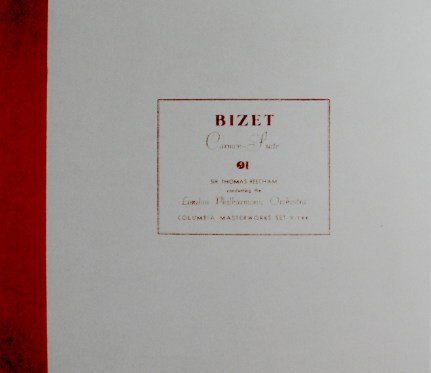
tombstone-cover
A “Tombstone cover” as albums were sold prior to Steinweiss deciding to add pictures to covers.

The album’s spine showed the title and artist and the record’s catalogue number. These albums were generally stored like books in a library, with only the spines visible.

Steinweiss, during his artistic studies,  had seen the power of pictures in selling and suggested to his superiors that adding a picture to illustrate the music might actually increase sales of these albums. Despite initial scepsis the directors allowed Steinweiss to produce a limited number of pictorial covers and the first “Smash Song Hits by Rodgers & Hart” appeared in 1940 (Jennifer McKnight-Trontz says 1939).
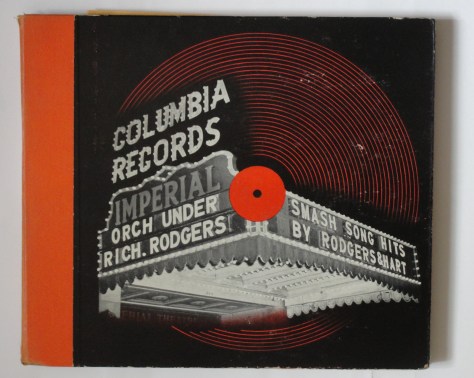
steinweiss-smash-hits
Alex Steinweiss’s first picture cover for Columbia Records “Smash Song Hits by Rodgers & Hart” from 1940.

I collected about fifty Steinweiss covers and was lucky enough to find a copy of the “Smash Song Hits by Rodgers & Hart” in really good condition early on. This album seems extremely rare as I have been on a fruitless search for a second copy ever since. It seems important for anyone particularly interested in record sleeve design to have this seminal design, so I kept it when my other Steinweiss covers vanished.

Of course, Steinweiss‘s new picture covers increased the sales of Columbia Records’ Albums and he was allowed to continue producing sleeve art. When, in 1948, Columbia introduced the microgroove LP, it fell to Steinweiss to design a suitable packaging and he came up with the LP record sleeve with a design on the front, text on the rear and on the spine. Many of the designs he produced for the 78 r.p.m albums were transferred when a work was reissued in the new format. But Steinweiss‘s burden of designing new covers meant that he couldn’t do them all himself. He enlisted other talented designers to work for Columbia, including Jim Flora and a commercial artist named Andrew Warhola, just arrived in New York from Pittsburgh.

steinweiss-photo4
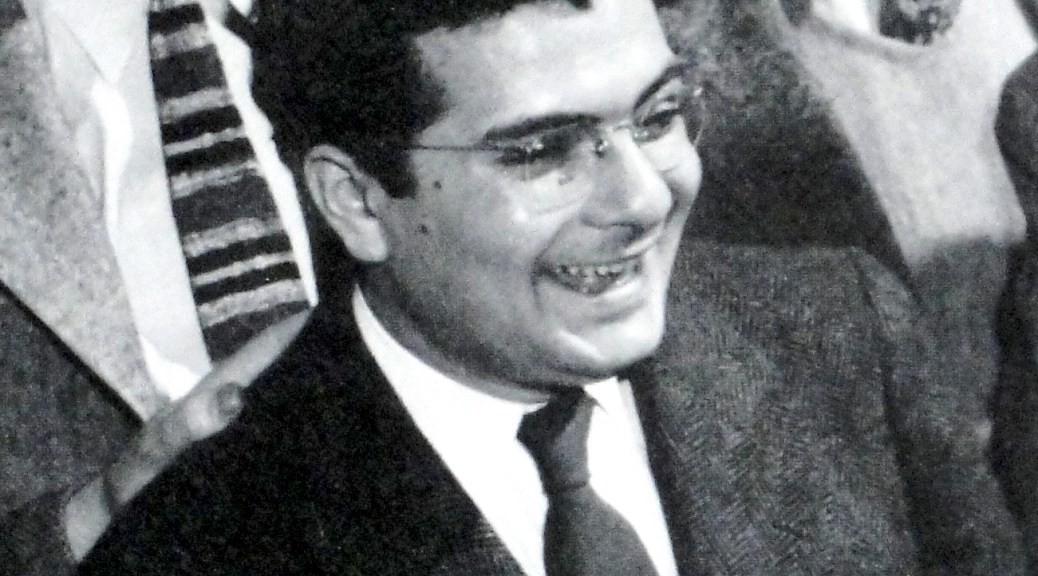
Steinweiss (in dark suit) with other Columbia employees including Jim Flora (With the striped tie standing behind Steinweiss).

Steinweiss left Columbia in 1949 and went freelance. He subsequently designed covers for several other record companies including Everest, Decca and London and RCA.

in 2009, Kevin Reagan and Steven Heller convinced Taschen to publish a luxurious book simply entitled “Steinweiss”  with the subtitle “The Inventor of the Modern Record Cover“. I addition to a standard edition Taschen produced an art edition; one hundred copies numbered 1-100 contained a print of Steinweiss‘s design for Decca Records’ recording of Igor Stravinsky‘s “The Firebird“, the second time Steinweiss had designed a cover for that work.
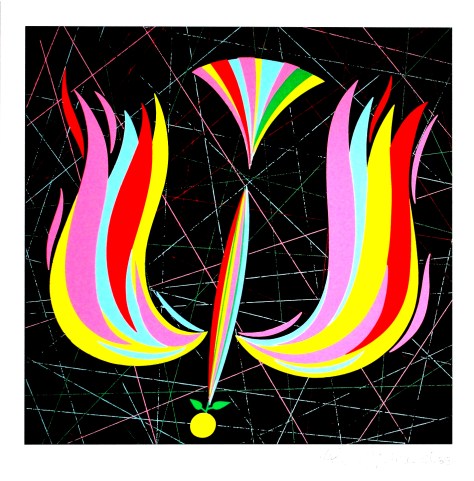
steinweiss-taschen-print_fr
The lithograph of Steinweiss’s design for Decca Records’ recording of Stravinsky’s “The Firebird Suite”.

There were also a further one hundred art copies, numbered 101-200, that did not contain the print. Steinweiss, aged 92, was involved in the production of the book and the art editions were all signed by him as were the prints included in the first one hundred copies. My copy is No. 96.

The book contains full-sized pictures of over two hundred of Steinweiss‘s cover designs as well as pictures of posters and books and ceramics that he made. A worthy tribute to the man without whom I probably wouldn’t be collecting record cover art.
 

Record collecting – a love affair or an addiction?

Okay, as you probably have gathered if you read my blog, I live in Sweden. This is not a very important piece of information, but it explains why this post was inspired (probably not the right word) by a recent book and a magazine number. The book, by Olle Johansson, is called “En skivsamlares memoarer” (ISBN 9789163776618, Rabarber förlag, Stockholm, 2015), which translates to “A Record Collector’s Memoirs” and the magazine is the Spring 2016 number of the Swedish music magazine Sonic–a 116 page special number entitled “Alla talar om skivsamlande“, again in translation “Everyone is talking about record collecting“.

Most people would not see any difference between a record collector and a music collector, but there is huge difference and these two publications illustrate it perfectly. Olle Johansson is a MUSIC collector. He is not interested in the format the recording is presented on. He does not care about record labels, catalogue numbers, or the cover art. He wants the music, and it doesn’t matter if it is a reissued CD or vinyl. He doesn’t search for original pressings or special editions. He just wants the music or the artist.

A record collector, however, cares about all, or at least some, of these things. There are those who collect a particular artist–and must have EVERYTHING released by that artist, including unofficial (bootleg) releases. Alternatively, the collector may collect a particular record label, quite independently of the type of music released (though the label will probably have released music that suits the collector’s taste). Then there are collectors who will collect a particular format– say 1960s EPs, or picture discs; the options are endless. And there are strange types, like me, who collect record cover art. Even here there are subdivisions; record cover art by a particular artist, cover art by any famous artist, or cover art that uses a particular design feature or a certain typography.
There are loads of books on record cover art and others on greater or lesser celebrities’ record collections. One recent, almost encyclopaedic one is Eilon Paz‘s “Dust & Grooves: Adventures in Record Collecting“. Paz visited record collectors and photographed them with their hoards of vinyl–everything from rare 78s to the world’s largest collection of coloured vinyl records. Sonic magazine interviewed musicians, DJs, record collectors and record buyers at record stores. I used to have a library of books about record cover art. I have only kept a few that I really treasure. These include Nick de Ville‘s “Album: Classic Sleeve Design: Style and Image in Sleeve Design“, Richard Evans‘ “The Art of the Record Cover“, Paul Maréchal‘s “The Complete Commissioned Record Covers“, Jennifer McKnight-Trontz’ & Alex Steinweiss’For the Record: The Life and Work of Alex Steinweiss, Inventor of the Album Cover” and the catalogue from Stockholm’s Nationalmuseum’s 1981-2 exhibition “Ytans innehåll: utställning av skivomslag” [“The Surface’s Contents: An Exhibition of Record Covers“].

Where did my collection begin? Born in the mid forties, I was raised on vinyl records. My father loved music and had a few hundred LPs and a few 78s. In my late teens I had a friend, Chris,  who worked on Saturdays at The Chelsea Record Centre, a shop on The King’s Road, Chelsea. We used to go to pubs and listen to R ‘n’ B and, when I went to University we started going regularly to the 100 Club on Oxford Street. We could see The Pretty Things, The Graham Bond Organisation or The Artwoods. One night–I suppose in 1964 or 1965– we went to see Bo Diddley and his famous band (who I had at that time only heard of through some Buddy Holly recordings.) Well, to call that concert mindblowing was an understatement.

The first records I bought were LPs–Eddie Cochran‘s “Memorial Album“, “The Buddy Holly Story” and John Lee Hooker‘s “Don’t Turn Me From Your Door“. One evening in late November 1963 my friend Chris came home with a copy of “With the Beatles” and we spent an evening just playing and replaying the album. And almost a year later on the 24th October 1964, Chris and I went to the Gaumont State Cinema in Kilburn to see The Beatles–I can’t say we heard them because of all the screaming. I still have the “Four Aces” programme from the concert! I started buying records and became a regular at two of London’s independent record shops that imported American albums; One Stop Records in South Moulton Street and Musicland in Berwick Street.

In early 1967, My brother, who had been living in America, returned to England and presented me with a bundle of records including Big Brother & The Holding Company‘s eponymous first album (on the Mainstream label), Country Joe & The Fish‘s “I Feel Like I’m Fixin’ to Die“, The Jefferson Airplane‘s “Takes Off” and “Surrealistic Pillow“. I  bought The Doors‘ first album, which was one of the greatest albums of 1967, at One Stop, and they recommended an album by The Velvet Underground & Nico, which I bought but didn’t really get into. I liked the cover, though. Then I discovered bluebeat, ska and reggae and for the first time bought singles. Prince Buster, The Ethiopians and Desmond Dekker before finding Phil Spector and then soul music in the form of Doo Wop with Clyde McPhatter & the Dominoes, The Coasters, The Drifters, Don Covay, Joe Tex and, of course, Otis Redding. Thus far, I was still a music collector.

Then in April 1971, I bought The Rolling Stones‘ “Sticky Fingers” with its Andy Warhol designed cover. I already had The Velvet Underground & Nico, so this was my second Andy Warhol cover. I also had two covers by Peter Blake: “Sgt Pepper’s Lonely Hearts Club Band” and The Pentangle‘s “Sweet Child“. So I had the beginnings of two cover art collections. In the early 1980s I stumbled across an album by The Cocteau Twins and soon started collecting albums on the 4AD label designed by Vaughan Oliver and Nigel Grierson (as 23 Envelope) and Vaughan Oliver and Chris Bigg (as v23). I also found Fetish Record‘s “Final Testament” and collected every cover I could find with Neville Brody‘s art.I also had all three of Joy Division‘s albums but didn’t start collecting Peter Saville‘s record covers in any systematic way, though a few did find their way into my collection. In the early 2000s I fell for Rob Jones‘ work–both as a poster artist for the White Stripes, The Raconteurs and Dead Weather–and for his record cover art. I also collected Swedish designer Martin Kann‘s covers for the band bob hund. All the while my collection of covers by Warhol and Blake grew. I also found that I had many covers by Klaus Voormann and then Damien Hirst produced a few record covers that found their way into my collection. In about 2008  I picked up a couple of albums with cover art by the artist known as Banksy and managed over the course of two years to collect almost all the covers bearing his art.

When I retired in 2010 it was apparent that my wife and I would have to move to a flat and that I would not be able to take my collection of records, posters and CDs with me. I had to downsize. I decided only to keep my collections of record cover art. I said “good bye” to my 4AD, Martin Kann, and Rob Jones records and kept only my Banksy, Blake, Hirst, Voormann and Warhol collections. So now I am a RECORD collector rather than a music collector. The music is secondary to the cover art.


Peter Blake and Eric Clapton’s “24 Nights”

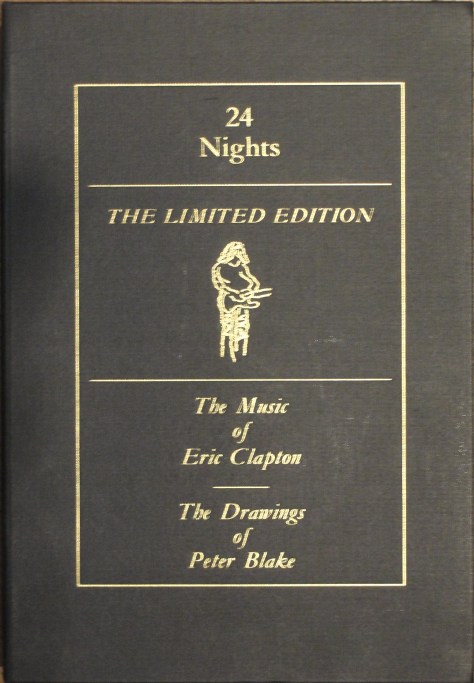
During the past few months I have been concentrating on Sir Peter Blake’s record cover art and trying to do some in-depth research to find out how his record covers came about, who made the commissions, which techniques he used, upon which photographs were illustrations based and any other facts, relevant or not. I have tried to contact the artists involved where possible. I have also nurtured a lust to get hold of the one item of Peter Blake‘s record cover art that I had not managed to find. I refer to the Genesis Publication’s set “24 Nights –  The Limited Edition. Music by Eric Clapton / Drawings by Peter Blake“. This box set included two books – a “Scrapbook“, an A4 sized book of Peter Blake‘s drawings and photographs and a 58-page “Commentary” by Derek Taylor – some “memorabilia” comprising a badge, guitar strings, four plectra and a backstage pass from the Journeyman tour and two photographs of Eric Clapton. This set was published in a numbered edition of 3,500 copies as well as a further 200 copies numbered in Roman numerals “for review purposes”. All copies were signed by both Peter Blake and Eric Clapton. Published in 1991, it soon sold out.

Genesis-24 Nights-fr.jpg

The cast:
Eric Clapton (born 30th March 1945)- legendary guitarist and lover of the Blues.
Peter Blake (born 25th June 1932) – equally legendary artist.
Derek Taylor (1932-2008) – Journalist, author, friend of the above and former press officer for The Beatles.
Brian Roylance (1945-2005) – founder of Genesis Publications and friend of all three above.
Roger Forrester (born August 1949) – Eric Clapton’s manager until 1998.

The 24 night series of concerts at London’s Royal Albert Hall were to be the finale to Eric Clapton‘s “Journeyman” world tour that played 153 concerts in 78 cities around the world over 14 months and were seen by almost 2.5 million fans. The tour was a promotional tour for Eric’s 1989 album “Journeyman” and his record company Reprise Records, a Warner Brothers subsidiary, planned a live album to be released after the tour. Eric Clapton knew Brian Roylance (1945-2005) the founder of Genesis Publications and suggested a documentation of the tour. Warner Brothers commissioned Peter Blake to paint a portrait of Eric Clapton, and wanted three other artists to do the same for an album to be called “Four Faces of Eric Clapton” but in the end only Peter Blake was commissioned instead to draw four portraits. Peter Blake had not met Eric at this time.

The Journeyman tour started in Birmingham on January 14th 1990 and ended at the Royal Albert Hall on March 9th 1991. There was a break for Christmas from 13th December 1990 until 31st January 1991 when it would resume in Dublin. The band reconvened in Dublin earlier to rehearse. Brian Roylance wanted Eric Clapton‘s longtime friend Derek Taylor (1932-2008) to write a commentary to the project and asked Derek and his wife Joan to travel to Dublin to be at the rehearsals. Peter Blake arrived in Dublin around the 26th January and had dinner with Roger Forrester who asked Blake if he liked Eric Clapton’s music. Blake replied, “No, I’ve never been a fan. I hate long guitar solos.”

Peter Blake had access all areas to make his sketches and said everyone got so used to him being around that they hardly noticed him. He could sketch freely. He followed Eric Clapton back to England and continued sketching at the Royal Albert Hall and at the two blues concerts at the Brixton Academy on February 21st and 22nd, 1991. Warner Reprise Records got their cover drawing for the “24 Nights” album released on 8th October 1991.

Twenty-five years after the release of the “24 Nights” album and Genesis Publications’ box set I managed to get hold of my own copy of this wonderful set. And thanks to Derek Taylor‘s “Commentary” book included in the set and Peter Blake‘s detailed notes in the “Scrapbook” have helped me piece together this story.
24Nights_Commentary.jpg


John Lennon’s Records and Compact Discs with Andy Warhol Art

john Lennon’s 1986 album “Menlove Ave” is probably the best known of his recordings that use Andy Warhol’s art. But there are some others and one, in particular, that has not previously been recognized.

John and Yoko Lennon and Andy Warhol were friends. I’m sure they basked in each others’ glory. Andy Warhol took Polaroid photos of John and two of these were recently auctioned at Christies (https://onlineonly.christies.com/s/pop-culture/john-lennon-97/3106/).

Andy Warhol's Polaroid pictures of John Lennon. Circa 1969.
Andy Warhol’s Polaroid pictures of John Lennon. Circa 1969.

The photo on the left bears a striking resemblance to the cover photo on Lennon’s album “Imagine”, released on 5th September, 1971. Only the position of the cloud is different.

John Lennon's "Imagine" LP cover.
John Lennon’s “Imagine” LP cover.

There may be an explanation for this, however. Photographer Iain Macmillan was a good friend of the Lennons. He had been introduced to John by Yoko at her 1966 exhibition at the Indica Gallery in London, where she first met John. Macmillan was commissioned to take the cover photo for The Beatles’ “Abbey Road” album and had take portrait photographs of John as well. It was he, apparently, that placed the cloud on the cover of the Plastic Ono Band’s “Live Peace in Toronto” 1969 album.

"Live Peace in Toronto" cover art.
“Live Peace in Toronto” cover art.

The cover design of Lennon’s “Imagine” album is credited to Yoko Ono but Wikipedia’s article on the album credits the cover photo to Andy Warhol. Thus this album is a previously unrecognized Andy Warhol cover appearing only five months after Warhol’s cover design for The Rolling Stones’ “Sticky Fingers” LP. Several singles bear the same cover photo including Lennon’s “Jealous Guy”/”Going Down on Love” and versions of “Imagine”.

Macmillan’s Lennon portraits turned up first on Lennon’s posthumous “Menlove Ave” LP compiled by Yoko Ono and released in 1986. According to the story I have heard, Yoko approached Warhol with Macmillan’s Lennon photographs and asked him to paint two portraits for use on the album cover.

"Menlove Ave" LP front and rear art.
“Menlove Ave” LP front and rear art.

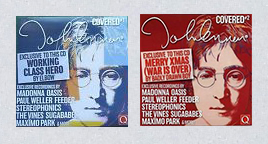
These portraits would reappear when Q magazine with the May 2005 edition which contained two CDs of John Lennon’s songs covered by other artists including Madonna, Oasis, Paul Weller, Wilco and Badly Drawn Boy, amongst others.

John Lennon Covered #1 and #2.
The Front covers of Q Magazine’s CDs “John Lennon Covered #1 and #2.”
Andy Warhol's two portraits of John Lennon.
Andy Warhol’s two portraits of John Lennon.

There are other pressings that use Warhol’s Polaroid photos, including a 12-inch maxi and the 1971 Japanese “Imagine/It’s so Hard” 7-inch single.

Icon Worship – Kate Moss on Record Covers

My blog is usually about record design and some of my favourite cover designers. This post is about an icon who appears on record covers.

According to a dictionary an icon is either: a devotional painting of Christ or another holy figure, typically executed on wood and used ceremonially in the Byzantine and other Eastern Churches, OR
a person or thing regarded as a representative symbol or as worthy of veneration.

I don’t suppose anyone would argue that supermodel Kate Moss is a 21st Century icon. Her face is on the covers of fashion magazines and there are coffee table books of photographs of her. She has even appeared on record sleeves. The first one that I have been able to identify is Dirty Funker‘s “Let’s Get Dirty” which used Banksy‘s Kate Moss portrait from 2005

Banksy's Warhol style Kate Moss portraits (2005)
Banksy’s Warhol style Kate Moss portraits (2005)

Apparently Kate Moss bought one but it was stolen in 2010 together with other Banksy works that she had bought.

Dirty Funker‘s use of Banksy‘s Kate Moss’ portrait on his record sleeve was not authorised by Banksy. But hey ho, who cares? A first pressing showed only Moss‘ face with no title or other text, while a second (more common) had a black Dymo tape with the record’s title across Moss‘ eyes on the front and across her mouth on the rear.

LetsGetDirty_1st_150

First and second pressings of Dirty Funker's "Let's Get Dirty" 12-inch single.
First and second pressings of Dirty Funker’s “Let’s Get Dirty” 12-inch single.

The February 2008 number of TAR Magazine contained a photographic essay of Kate Moss. And the magazine’s cover was adorned with Damien Hirst‘s portrait of Kate, with the right side of her face dissected down to the muscles.

TAR Magazine cover and the record sleeve.

624e2a543996df02ffa92fc2bee036be
The following Year Hirst released a single-sided 12-inch single in an edition of 666 copies pressed on white vinyl that used the TAR Magazine picture on its cover.

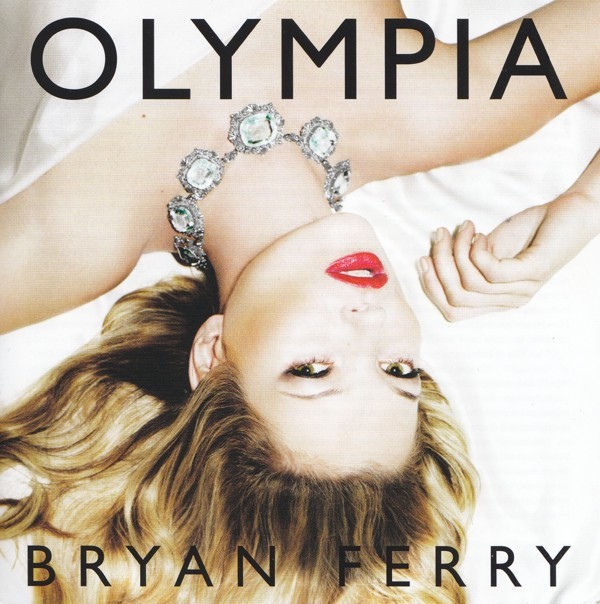
Bryan Ferry released his thirteenth album “Olympia” on 25th October 2010. The album was released as a CD, CD with DVD, a collectors’ edition with extra tracks as well as a limited edition LP. He seems to have been besotted with Kate as the album and five singles’ covers taken from it all bear Kate‘s portrait. There is a video of the photo shoot for the cover photo

The Olympia cover.
The Olympia cover.

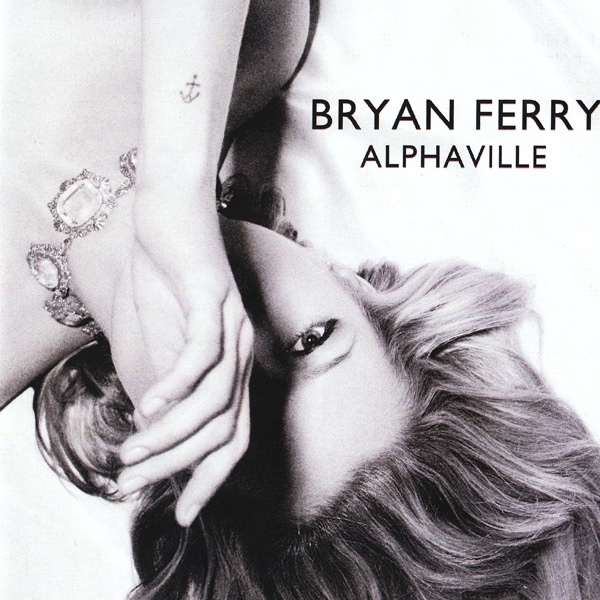
The Vinyl Factory in London released five limited edition 12-inch singles from the album in 2010 and 2011. All with cover photographs of Moss. These are “You Can Dance” (2010), “Shameless Remixes” (2010), “Alphaville” (2011), “Heartache by Numbers” (2011) and “BF Bass (Ode to Olympia) (Remixes)” (2011). The portraits of Kate Moss on these covers are by british photographer Adam Whitehead (born 1973).

You Can Dance cover.
Shameless Remixes cover.
Alphaville cover.
Alphaville cover.
The limited edition version of Alphaville.
Heartache By Numbers cover.
BF Bass (Ode to Olympia) Remixes cover.

Thus I have been able to find ten covers with portraits of Kate Moss released in less than 10 years. I think this fulfills the second definition of an icon. Perhaps I have missed a cover or two. Readers are very welcome to let me know of any I have missed.

More additions to my Warhol cover collection

When I first tried to collect all known record covers designed or illustrated by Andy Warhol I counted about sixty-five covers. I wanted to put on an exhibition of his record covers and but I had little knowledge about his early work in the 1950s and had no idea there were colour variations of some of the early covers. Paul Maréchal’s book “Andy Warhol: The Record Covers 1949-1987. Catalogue Raisonné” had not yet been published. I had the great good fortune to have made contact with Warhol collector Guy Minnebach who helped put on the exhibition by lending some of these early covers.

Since 2008 there has been an enormous amount of new knowledge about Warhol’s record cover art, greatly aided by Paul Maréchal’s book. Several record covers have been identified as being illustrated by Warhol. So the search has continued. Over the past months I have managed to find a further four Warhol sleeves; two vinyl covers and two CDs.

There has been considerable debate as to whether the three albums released in 1957 on RCA Victor Bluebird Classical label were illustrated by Warhol. However, they are now generally accepted as being Warhol covers. These three albums are:
– Byron Janis: Gershwin’s “Rhapsody in Blue” coupled with Grofé’s “Grand Canyon Suite” (LBC-1045)
– Indianapolis Symphony Orchestra (Sevitsky, cond.) Gershwin’s “Porgy and Bess” coupled with Grieg’s “Symphonic Dances” (LBC-1059).
– Erica Morini: Tchaikovsky’s “Violin Concerto” (LBC-1061)
I suppose the acid test of their acceptance will be seeing whether they are included in Paul Maréchal’s new book “The Complete Commissioned Record Covers” due to be published in early 2015. [Note added January 21st, 2016: The second edition of Maréchal’s book includes the Tchaikovsky “Violin Concerto” but does NOT include the “Porgy & Bess / Symphonic Dances” covers.)

Tchaikovky's Violin Concerto.
Tchaikovky’s Violin Concerto.
Cover of the "Porgy & Bess / Symphonic Dances" album.
Cover of the “Porgy & Bess / Symphonic Dances” album.
Byron Janis recording of "Rhapsody in Blue" and "Grand Canyon Suite".
Byron Janis recording of “Rhapsody in Blue” and “Grand Canyon Suite”.

Rarest of these three is, without doubt, the “Porgy and Bess / Symphonic Dances” and I had been looking for a copy since 2008 and just before Christmas 2014 I found one in lovely condition that I could afford. That completed my collection of the three Bluebird Classics albums.

From the sublime to the cor blimey. Like most other collectors of Warhol covers I keep regular checks of what is on sale on Ebay and other internet markets. There is one seller from Germany who manages to find some interesting records and CDs with covers by famous artists, not only by Warhol. It is always worth checking what is on offer on that site. Then trying to find the same item cheaper elsewhere. Well, I saw the Diana Ross “So Close” 7-inch single in a poster pack on the site with a ridiculous starting price. So the search began to find a cheaper copy. About ten minutes later the mission was accomplished.

The Diana Ross "So Close" single in its poster cover.
The Diana Ross “So Close” single in its poster cover.

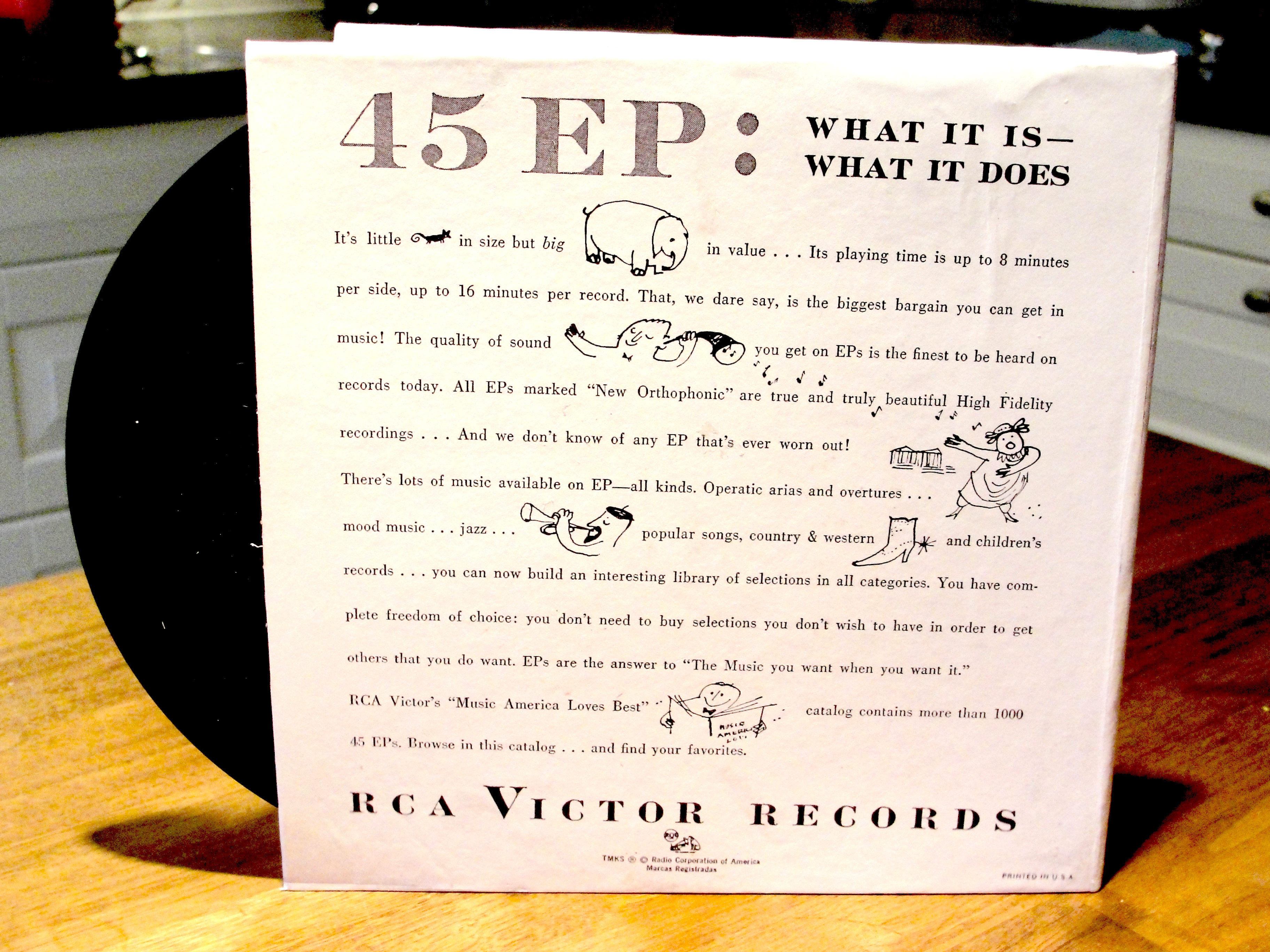
As readers of this blog may remember I have made mock ups of several extremely rare early Warhol covers. Among these was a cover for a double EP with the”Progressive Piano” design. As Warhol cover collectors know this disc was never released, but I wanted to add the cover to my collection. Lithographs of cover designs for both a 10-inch and 7-inch version exist in The Warhol Museum. So, having found the front cover image, I needed to find a rear cover that would possibly have been used. I went to the double EP of Toscanini’s recording of the William Tell and Semiramide Overtures on the RCA Victor label. It transpires that there are at least two variants of the rear cover design. The one I used is:

The rear cover used on the "Progressive Piano" mock-up.
The rear cover used on the “Progressive Piano” mock-up.

I have now managed to find the record with the alternative rear cover:

The alternative rear cover on the "William Tell" Overture" .
The alternative rear cover on the “William Tell” Overture” .

Perhaps I shall decide to make an alternative “Progressive Piano” sleeve using this rear cover.

Again, I saw a couple of CD from this German Ebay seller; both at rather inflated prices. One is a various artists CD called “Open Ends: Musical Exploration in New York 1960-2000” released in 2000 by the Museum of Modern Art. The cover image is nine of Warhol’s 1967 self portraits. ANd I found a cheaper copy after a short Internet search.

The booklet from "Open Ends: Musical Exploration in New York 1960-2000". Released by the Museum of Modern Art.
The booklet from “Open Ends: Musical Exploration in New York 1960-2000”. Released by the Museum of Modern Art.

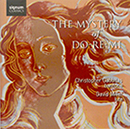
Also on the German seller’s site was a CD entitled “The Mystery of Do-Re-Mi” with baritone Christopher Gabbitas accompanied by lutist David Miller with a starting price of $49. I found one on Amazon for $4. The cover uses a detail of Warhol’s rendering of Botticelli’s “The Birth of Venus” from his Renaissance Details series from 1987. Another CD that used another image from the same series was Karl-Aage Rasmussen’s “Three Friends: Works for Symphonetta” from 1993 that uses Warhol’s “The Annunciation”.

"The Mystery of Do-Re-Mi" by Christopher Gabbitas and David Miller. Image from Warhol's "Birth of Venus".
“The Mystery of Do-Re-Mi” by Christopher Gabbitas and David Miller. Image from Warhol’s “Birth of Venus”.

I also thought I had bought a copy of The Velvet Underground’s bootleg LP “Psychedelic Sounds From the Gymnasium”. But, I had not read the article description and was somewhat disappointed to find that I had ordered the CD. But the cover image is the same as that on the LP.

The Velvet Underground's "Psychedelic Sounds From the Gymnasium".
The Velvet Underground’s “Psychedelic Sounds From the Gymnasium”.

So there, I have been able to add another six Warhol covers added to my collection. There are still more out there. Some extremely rare and some not so rare. I will never manage to collect all the record and CD covers that have art by Andy Warhol, but I’m going to keep trying.

A review of 2014 – my collections grow

Readers of this blog will by now know that it deals with collecting record cover art by five designers

  1.     Andy Warhol
    2. Peter Blake
    3. Klaus Voormann
    4. Damien Hirst
    5. Banksy

When I sat down to put my thoughts together on the past year’s collecting I could not immediately recall any real high points. Then I started to look through my list of acquisitions and soon saw that 2014 had been another successful year. Let’s take things in order.

Andy Warhol
Well, I’ve managed to add twenty-one covers to my collection of Andy Warhol sleeves – surprisingly, the majority by The Rolling Stones. I have added three variations of the “Emotional Tattoo” bootleg cover. Frank Edwards very kindly sent me his extra copy of the 1983 version on orange vinyl in exchange for a set of “Giant Size $1.57 Each” covers and I bought the two variations of the 2014 numbered reissues of the album, one on black and the other on green vinyl.

Early in the year I had decided to go for the Rolling Stones singles with variations on the “Sticky Fingers” cover art. I had previously not been interested in singles or EPs but the wonderful RCA and RCA Camden covers with Warhol art have changed my mind. Anyway, fellow Warhol Cover Collectors Club member Guy Minnebach had tipped me off about the Mexican “Brown Sugar” singles (entitled “Azucar Morena” in Spanish). One was a two-track single and the other a three-track EP that happened to pop up on Ebay soon after he had told me about them.

The Rolling Stones “Azucar Morena” single in a fold out cover.

Rolling Stones “Azucar Morena” EP.

Then I had to add the original “Brown Sugar / Bitch / Let It Rock” single and a German pressing of the single, both of which used the “Sticky Fingers” rear cover photo on their rear covers. I also found a copy of the “Brown Sugar” shaped picture disc single to complete the set.

“Brown Sugar / Bitch” picture disc single.

When it comes to “classic” Warhol covers, I – like most collectors of Warhol’s cover art – had been looking for a cheap copy of the Lew White “Melodic Magic” EP. Well, I found the single on Discogs for $3.86 plus $12 shipping. Unfortunately, the record had no cover, but I bought another RCA Camden EP with the same rear cover list of other artists on the Camden label and peeled off the cover slick and stuck a Lew White cover slick in its place and – wonder of wonders – I have the Lew White EP, indistinguishable from the real thing – as it IS the real thing (almost) and all for about $40!

The next “classic” cover I managed to get hold of was the “Alexander Nevsky” re-issue sleeve with the green colour blocks. I already had both the original “blue” and the re-issue “orange” covers. Now all I need to find is the “pink” cover variation.

My three “Alexander Nevsky” covers.

When I first started to seriously collect Andy Warhol’s record cover art I saw Wilhelm Loibner’s “Ballet From Vienna” listed as a Warhol cover. The cover is a solarised photo credited to William Hughes. The rear cover has no image. Guy Minnebach informed me that the original copies of this LP had an inner sleeve with Warhol’s drawing of part of an orchestra, the same image as used o the cover of “4 Divertimenti”. The “Ballet From Vienna” cover appears on Ebay with monotonous regularity, but almost NEVER with the inner sleeve. However, one did turn up advertised from Spain in mint condition so I added it to my collection.

“Ballet From Vienna” Front of inner sleeve and front cover.

The other Warhol covers I managed to find included Diana Ross’ “Muscles” and “So Close” seven-inch singles and Billy Squier’s “Everybody Wants You” single.

And then there was an unusual CD that came up on Ebay in August. It was a Japanese promotional double CD with a line drawing of an ear and some arrows with the sole word “ear” beside the drawing. The handwriting was so like Andy Warhol’s that I took a chance and bought the set. Guy Minnebach immediately recognised the drawing as one of a series in a Warhol portfolio entitled “Playbook of you S Bruce 2:30-4:00”.

The other covers with Warhol art were two Velvet Underground bootlegs; “NYC” and “Orange Disaster” which both had pictures from Warhol’s Deaths and Disaster prints.

Peter Blake

There were no new record sleeve designs by Sir Peter Blake in 2014 but one old one did surface – the rejected cover for the group Landscape’s 1982 album “Manhattan Boogie-Woogie”. I saw an art gallery advert for a 2009 silkscreen of the cover image. I managed to find a high-resolution copy of the image and could resize it to LP-format and get several slicks printed. I stuck one slick of the front cover to one of the rear cover from the issued album and there was (my version of) the original cover restored.

Klaus Voormann

2014 saw many additions to my Voormann collection. The first cover I found was the last cover needed to complete my set of all twenty “Pioneers of Jazz” EPs. I had managed to find nineteen previously and been searching the Internet for Volume 18, the only one I lacked. In February I finally found it.

The next cover I found was George Harrison’s “When We Was Fab” promo box with the seven inch single. I already had the twelve-inch version and this was a nice addition. I felt I had just about completed my Voormann collection when I found some purely German releases: “Stinker” LP and seven inch single “von Drüben” by Marius Müller-Westernhagen.

Klaus Voormann’s first official cover was for a band called The Typhoons about which I have failed to find any information. Klaus has informed me that he never met the band and could only say that it was a German combo active in the early sixties. Heliodor records had released their cover of “Walk… Don’t Run”, the old Ventures hit. I had made a copy of the cover from an image on Klaus Voormann’s portfolio and I have seen a cover in poor condition sell on Ebay for over €100 but never seen the record until one turned up without the cover. So, true to form I bought the single to live in the cover I had made. I’m still looking for a proper cover…

I had already bought Klaus Voormann’s album “A Sideman’s Journey” on LP with a limited edition poster and eyed the limited edition box set, which included the album on CD, a DVD of the making of the album, a book of drawings and the poster – signed by Klaus. The box was expensive and I felt I did not really need it until a second-hand copy came up for half the normal price.

My friend, gallery-owner Daniel Brant found two copies of Voormann’s poster of John Lennon and Paul McCartney eating breakfast in the Abbey Road canteen during the “Revolver” sessions and he let me have a copy.


The last item needed to complete my Voormann collection was the CD of covers entitled “A Guide to Modern Country Living” by The Twang. There is, however, one cover that has only been released as a digital download and that is “Picasso’s Party” by a band called The Dogs of Bali. I have the download.

So, with the exception of a proper cover for the “Walk… Don’t Run” single, my Klaus Voormann Collection seems complete – at least until Klaus produces more cover designs.

Damien Hirst

This has probably been the year when I have obtained the largest number of Damien Hirst covers. There were three covers for Babyshambles, including the LP “Prequel to the Sequel” and the two singles from the album, “Nothing Comes From Nothing” and “Fall From Grace”.

Next was The Red Hot Chili Peppers’ LP “I’m With You” with the cover picture of a fly on a medicine capsule. Then Joe Strummer & The Mescaleros promo CD “Tony Adams (The Morning Sun)” and the very rare twelve inch EP “Yalla Yalla”. Somehow, Thirty Seconds to Mars had been allowed to use one of Damien Hirst’s spot paintings for the cover of their CD “Love, Lust, Faith + Dreams”. I got hold of the limited edition box set of the album thinking the box and LP cover were also designed by Damien Hirst – but they aren’t! However, the box set did include a book with the spot painting on the cover. I had to get the CD as well for completeness. A seller in Germany advertised a twelve-inch EP of Dave Stewart’s “Heart of Stone (The Dance Mixes)” which I had never heard of. I could not find a copy elsewhere so I bought his expensive copy. Then I found out there was another remix EP of “Heart of Stone (The Sure Is Pure Remixes)”. That one was easy to find and did not cost an arm and a leg.

My final Damien Hirst find for the year was the USB promotional version of The Hours’ “See the Light” album. A nice little skull-shaped USB stick.

Banksy

I have not been able to find any new records with Banksy images in 2014. My collection of Bansky records has been touring Sweden throughout the year and I sincerely hope that they will return home in 2015.

Meanwhile, I wish all my readers a Happy and Prosperous New Year – and wish you all success with your collecting in 2015.

A discography of RCA Camden EPs

I must have gone bonkers! I have wasted a couple of days compiling a list of seven inch 45 RPM EPs on the RCA Camden label. “Why?”, I hear you ask. Well, Andy Warhol designed covers for a couple of them and some collectors have submitted some other Camden EP covers, wondering whether they could also be by Warhol – usually they are not. So, I began to go through all the RCA Camden EPs that I could find to see if there could be any so far unrecognised Warhol covers among them.

The RCA Camden label was/is a budget subsidiary of the Radio Company of America (RCA, to you.) RCA invented the seven inch 45 RPM format and tried to introduce it as an alternative to 78 RPM discs in about 1949 – the year after Columbia Records introduced the LP. Ultimately, RCA was also forced to adopt the LP format, but continued to release seven inch EPs throughout the 1950s and 1960s. As far as I can ascertain Camden EPs were given catologue numbers starting at CAE 100 and the last that I have been able to identify is CAE 448.

I have scoured Discogs and Ebay and made Internet searches and I have thus far been able to find and list 105 Camden EPs and will continue to add more as I find them. I have been able to find pictures of the majority of their covers, too. But so far no new Warhol designs. But, not wishing to waste my hard work, I will share my list with you here.

Cat No—–Artist———————–Title—————————————–
CAE 100 The Cosmopolitan Orchestra – World Wide Favorites
CAE 101 Warwick Symphony Orchestra – Sibelius: Finlandia / Wagner: Die Walküre
CAE 104 Festival Concert Orchestra – Vienna Jubilee
CAE 106 Festival Concert Orchestra – Johann Strauss, Jr. / Josef Strauss – Loves of the Poet Waltz, Opus 38.
CAE 108 Kenny Baker – Beloved Songs
CAE 110 The Goldman Band – Sousa Marches
CAE 113 Ray Kinney & His Coral Islanders – Blue Hawaii
CAE 114 Texas Jim Robertson – Home on the Range
CAE 115 Joe Reichman with Rhythm Accompaniments – Make Believe Piano Moods
CAE 118 Capitol City Four – Let’s Harmonize (Barber Shop Ballads)
CAE 124 Caroleers & Yuletide Choristers Caroleers & Yuletide Choristers
CAE 125 Carollers & Yuletide Choristers Christmas Day
CAE 126 Lew White – Christmas Time
CAE 127 Richard Crooks with Orchestra – Vintage Blue Ribbons
CAE 131 Harold Coates & His Orchestra – Waltzes You Love
CAE 133 Donald Dame Lonesome – That’s All / A Little Love, a Little Kiss / Kathleen Mavourneen / I’ll Take You Home Again, Kathleen
CAE 135 Festival Concert Orchestra – World Wide Favorites
CAE 142 Festival Concert Orchestra – Favorite Encores
CAE 143 Lew White – Organ Cameos
CAE 151 Festival Concert Orchestra – Aïda Ballet Suite/ Coppelia Ballet Suite
CAE 158 Johann Strauss Jr – Waltzes by Johann Strauss Jr
CAE 159 Harold Coates’ Orchestra – Top Show Tunes
CAE 162 Festival Concert Orchestra – Viennese Concert Waltzes
CAE 163 George M. Cohan / Harold Coates Orchestra – George M. Cohan Hits
CAE 164 Ray Kinney & His Coral Islanders – Hawaiian Favorites
CAE 166 The Goldman Band – Manhattan Beach / Semper Fidelus / Fairest of the Fair / High School Cadets
CAE 172 Harold Coates’ Orchestra, Chorus & Soloists – Song Hits from Frank Loesser’s Guys & Dolls. Vol 1
CAE 179 Globe Symphony Orchestra – Handel: The Faithful Shepherd Suite
CAE 185 Richard Crooks – Songs of Faith
CAE 187 Warwick Symphony Orchestra  – Tchaikovsy: Dances from the Nutcracker Suite
CAE 188 Warwick Symphony Orchestra – Debussy: Clair de Lune / Sibelius: Valse Triste / Schubert: Moment Musical
CAE 193 Lew White & His Orchestra – Melodic Magic
CAE 208 Richard Crooks – Christmas Songs
CAE 209 Charles M. Courboin – Ave Maria / Ave Verum / Silent Night / Holy God, We Praise Thy Name
CAE 214 Festival Concert Orchestra – Strauss Encores
CAE 223 Cosmopolitan Orchestra / Harian Ramsey – Latin Rhythms for Dancing
CAE 224 Mindy Carson with Orchestra – The Touch of Your Lips / Together / The Best Things in Life Are Free / You Are the Cream in My Coffee
CAE 244 William Primrose – Encores by William Primrose
CAE 225 Don Cornell with Orchestra – Don Cornell Sings
CAE 227 Morton Downey  – Sings
CAE 229 Harold Coates Orchestra – Show Tunes That Linger, Vol 1
CAE 231 Dick Liebert – Musical Dreams
CAE 251 William Primrose William – Primrose Plays
CAE 256 Warwick Symphony Orchestra – Eight Russian Folk Songs
CAE 259 Xavier Cugat – That Latin Beat!
CAE 260 Johnny Desmond with The Page Cavanagh Trio – Guilty / I’ll Close My Eyes / Just Plain Love / If It’s True
CAE 263 Snooky Larson with Johnny Guarnieri & His Orchestra – Earth Angel / Sincerely / Tweedle Dee / Unsuspecting Heart
CAE 265 Guy Lombardo & His Canadians – Guy Lombardo Plays
CAE 268 Tommy Dorsey – Plays, Vol 1
CAE 271 Sammy Kaye & His Orchestra – Easter Parade / Baby Face / Begin the Beguine/ Pretty Baby
CAE 279 Frank Parker – Sings for You
CAE 280 Lena Horne – St. Louis Blues
CAE 284 Frank Parker – Great Religious Songs
CAE 285 Jack Haskell / Jeannie McKeon with Johnnny Guarnieri – Today’s Hits
CAE 288 Fran Warren – Sings Harold Arlen Songs
CAE 289 Giselle MacKenzie – Today’s Hits
CAE 291 Paul Wing – Favorite Stories for Children
CAE 299 Kukla, Fran & Ollie – Here We Are
CAE 301 Charlie Spivak & His Orchestra, Honey Drippers & Audrey Morris – Today’s Hits
CAE 304 Bob Carroll with Alvy West & His Orchestra – Today’s Hits
CAE 305 Jack Haskell / Jose Melis &His Trio – Today’s Hits
CAE 308 Guy Lombardo & His Royal Canadians – Guy Lombardo Favorites
CAE 310 Jesse Crawford – Plays for You
CAE 312 Wayne King – The Waltz King
CAE 315 Frank Parker – Sings Songs of Easter
CAE 320 Freddy Martin & His Orchestra Dance – Party with Freddy Martin & His Orchestra
CAE 321 Wayne King – Let’s Dance!
CAE 323 Chopin – Josef Lhevinne Plays Chopin
CAE 327 Wayne King – The Wayne King Style
CAE 329 Tex Beneke & His Orchestra – Today’s Hits
CAE 330 Earl Sheldon The Honey Dreamers
CAE 332 Polly Stevens – Today’s Hits
CAE 337 Johnny Guarnieri & His Group with The Townsmen – Friendly Persuasion / The Bus Stop Song / Just Walking in the Rain / Blueberry Hill
CAE 345 Xavier Cugat & His Waldorf-Astoria Orchestra – That Latin Bea!
CAE 346 Tony Mottola & His All-Stars – Cocktail Time
CAE 348 Henri René & His Orchestra – Pretend
CAE 350 The Delta Rhythm Boys – Dry Bones / September Song / My Blue Heaven / St. Louis Blues
CAE 352 Freddy Martin & His Orchestra – Make Believe
CAE 354 Tex Beneke & His Orchestra – Star Dust / Lazy Bones / Georgia On My Mind / Rockin’ Chair
CAE 354 Dick Liebert at the Organ – Musical Reflections
CAE 358 Ralph Flanagan & His Orchestra – Dancing Down Broadway
CAE 372 Domenico Savino & The Rome Festival Orchestra – O Come All Ye Faithful (Adeste Fidelis)
CAE 375 Jack Say & His Orchestra – The Best from Frank Loesser’s The Most Happy Fella
CAE 376 Dinah Shore – Dinah Shore
CAE 377 Tex Beneke & His Orchestra – Swinging Marches
CAE 380 Lena Horne – Lena Horne Sings The Blues
CAE 388 Vaughn Monroe & His Orchestra – Meet Me Tonight in Dreamland
CAE 400 Tex Beneke & His Orchestra – Petticoats of Portugal / Hey! Jealous Lover / Singing the Blues /
Tra La La
CAE 403 George de Witt – Today’s Hits
CAE 410 Perry Como – Dream Along With Me
CAE 411 Little Richard – Every Hour / I Brought It on Myself / Ain’t Nothin’ Happenin’ / Why Did You Leave Me?
CAE 416 Little Richard – Little Richard
CAE 417 Red Callender – The Red Callender Sextet
CAE 419 Art Tatum – Art Tatum
CAE 423 Buddy Morrow & His Orchestra – Let’s Have a Dance Party!
CAE 429 Shep Fields & His Rippling Rhythm Orchestra – Ripplin’ Rhythm
CAE 431 Johnny Guarnieri & His Group – Side by Side
CAE 433 George de Witt /Earl Sheldon & Orchestra – Young Blood / Love Letters in the Sand / Bye Bye Love / White
Sports Coat
CAE 434 Peter Ricardo & His Calypso – Take Her to Jamaica
CAE 441 Lionel Hampton & His Orchestra – Jivin’ the Vibres / Drum Stomp / Piano Stomp / Muskrat Ramble
CAE 442 Al Goodman – South Pacific
CAE 443 Perry Como – Perry Como
CAE 446 Little Richard – Little Richard Rocks!
CAE 448 Dave Martin & His Group with The Strollers – The Stroll
————————————————————————————————————-
To date, only two Camden EPs have been identified that have cover art by Andy Warhol. These are: CAE 158 “Waltzes by Johann Strauss, Jr.” and CAE 193, Lew White – “Melodic Magic”. The “Waltzes” EP has already been included in Paul Maréchal’s cataogue raisonné öover Warhol’s record covers and the Lew White will appear in the second edition, which will be published in 2015.

Currently, there is a copy of CAE 188 “Debussy – Clair de Lune / Sibelius – Valse Triste / Schubert – Moment Musical” on Ebay as a possible Warhol cover at an asking price $199. It is obviously NOT by Warhol. CAE 214 “Strauss Encores” has also been suggested to have been illustrated by Warhol, but combined expertise has concluded that while the shoes and boots are very much in the Warhol style, the heels are not right.

Camden CAE 158 - Waltzes by Johann Strauss, Jr.
Camden CAE 158 – Waltzes by Johann Strauss, Jr.

I wish readers much joy from this list – although I cannot imagine why anyone would be interested! Merry Christmas to all my readers

Andy Warhol art on 45s – Part 1

I have mainly collected LPs and have never really been interested in singles or extended play (EPs), which has proved to be a mistake from an investment point of view. Original pop EPs from sixties bands have become valuable as they sold in relatively small numbers.
Columbia Records indroduced the LP record in June 1948. RCA Records was initially unwilling to licence this format and were developing its own rival format. RCA introduced the seven inch 45 rpm single in February 1949. The seven inch single could accomodate one three minute recording on each side. However, almost immediately RCA began producing extended play versions of the seven inch disc, with two tracks on each side, increasing playing time to almost ten minutes per side.
 
Paul Maréchal pubished his book “Andy Warhol – The Record Covers 1949-1987” in 2008. The book lists all the records known to have been designed by Andy Warhol that were recognised at that time and lists the formats each was issued in. As most 45 r.p.m. records used the same design as the LP, Maréchal has only illustrated the LP-versions. This list is intended to focus on the seven inch versions and includes a couple of covers not listed by Maréchal.

Artist

Title

Format

Label

Cat.No

Year

Frank Lovejoy Night Beat 3×7” box set NBC EO-CX-342 1949/1950
Arthur Fiedler & The Boston Pops Latin Rhythms 7” RCA ERA-25 1952
Arturo Toscanini / NBC Symphony Orchestra William Tell Overture /Semiramide Overture 2×7” RCA ERB 7054 1954
Count Basie Count Basie 3×7” in gatefold cover RCA EPC-1112-1, 2, 3 1956
Joe Newman Octet I’m Still Swinging 3×7″ RCA EPC-1198-1, 2, 3 1956
Johann Strauss Jr. Waltzes 7” Camden CAE 158 1956
Artie Shaw Both Feet in the Groove 2×7” RCA EPA 767 1956
Byron Janis Rhapsody in Blue / Grand Canyon Suite 2×7” box set Bluebird WBC 1045 1957
Keely Smith I Wish You Love 7” Capitol EAP 1-914 1957
Count Basie Count Basie 3×7” discs RCA   1957
Artie Shaw Any Old Time 7” RCA EPA 1570 1958
Rolling Stones The Rolling Stones Black vinyl picture sleeve Rolling Stones EP 287 1977
Rolling Stones The Rolling Stones 7” picture disc (Bootleg?) Rolling Stones EP 287 1977
Andy Warhol’s first commissions as a record cover artist came from Robert M. Jones, who succeeded Alex Steinweiss as art director at Columbia Records, soon after Warhol had arrived in New York in 1949. That same year Warhol also received a commission from RCA to illustrate the cover of a promotional EP box released to promote NBC’s “Night Beat” radio serial, which featured Frank Lovejoy as the Chicago Star’s reporter Randy Stone. “Night Beat” was broadcast in the US between Febrary 1950 and September 1952. This promotional release was produced as three EPs on blue vinyl in a box. Incidentally, NBC was a subsidiary of RCA since it was bought by the parent company in 1928.
 
RCA, and its daughter labels (such as Bluebird and Camden), continued to release EPs with selections from LPs throughout the 1950s and usually with the same cover art on the EP as had been used on the LP. Andy Warhol was one of a number of commercial artists commissioned by RCA to illustrate record covers. One of the first, from about 1954, was probably the cover for a project that appears never to have been released. RCA obviously planned to produce a ten inch LP and a double EP comprising eight tracks of jazz piano music entitled “Progressive Piano”, even assigning the release a catalogue number (LJM 3001 for the LP version and 45EP-EJB 3001 for the EP version). Andy Warhol designed the cover and The Warhol Museum has lithographs of the design. The design of the hands in this illustation is reminiscent of the way Warhol drew the hands on Horowitz’ recording of “Piano Music by Mendelssohn and Grieg” (RCA – LM 9021).
A single EP “Latin Rhythms” by The Boston Pops was probably released around 1952. I have not been able to find an LP of Latin Rhythms by The Boston Pops Orchestra from around this time although they did record a 3 LP box with the same title, probably later. The cover of the Latin Rhythms EP is a classic Warhol coloured illustration with four musicians against a background with multiple green and pick blobs.
In 1954 RCA released a 10″ LP with Rossini’s William Tell Overture coupled with the Semiramide Overture played by the NBC Symphony Orchestra conducted by Arturo Toscanini and a double EP with these tracks was also released with Warhol’s representation of the famous apple that Tell shot from his son’s head as the cover motif.
The next EP collection was a tripple EP in an unusual tripple gatefold cover
Image
The three Count Basie EPs were released separately in Germany, each having the same Warhol Basie portrait on the cover (catalogue Nos: EPC 1112-1, EPC 1112-2, EPC 1112-3).
 
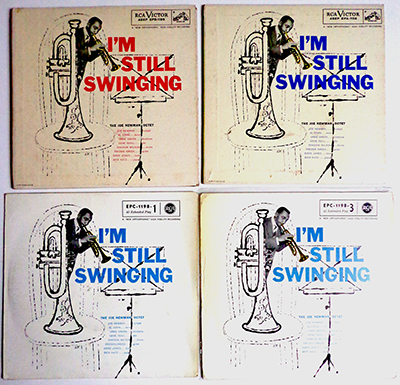
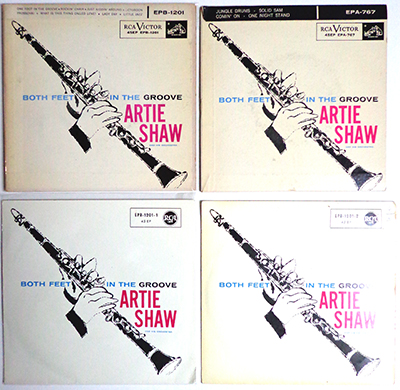
RCA also released EPs of the Joe Newman Octet’s “I’m Still Swinging” LP at about the same time as the Count Basie set on three separate EPs. The only difference in the cover art was a change from red to blue in the colour . Similarly, the company released a double gatefold EP of the Artie Shaw “Both Feet in the Groove” LP. According to Guy Minnebach there were several different tints of blue on the EP covers.
4 EP covers for the Joe Newman Octet 45s. Courtesy of Guy Minnebach.
The recording of Gershwin’s “Rhapsody in Blue” together with Grofé’s “Grand Canyon Suite” was issued as an LP that is not included in Maréchal’s book. The cover illustration has since been generally accepted as a Warhol drawing. A box set of two EPs was also released (catalogue No: WBC 1045).
 
Keely Smith’s first LP “I Wish You Love” was released on the Capitol label in 1957 and there was a 45 r.p.m. EP with the same cover art. The front cover has a cheezy portrait of a smiling Keely and on the rear  cover a drawing of a hand holding a bunch of flowers. The drawing is definitely in the style of Andy Warhol, but he is not known to have had any association with Capitol Records. Further, in 1957 Warhol was an acclaimed commercial artist and many others had adopted his drawing style, so we cannot be absolutely sure that this illustration is by Andy Warhol, but I list in just in case.
 
Another compilation of Artie Shaw’s tracks from the 30s and 40s was put together by RCA in 1958 with the title “Any Old Time”. The LP had a cover photo by Raymond Jacobs and Warhol’s drawing of a chain of clock faces on the reverse. The EP version hade a slightly different arrangement of the clocks.
Artie Shaw's "Both Feet in the Groove" EPs. Courtesy of Giy Minnebach.
Artie Shaw’s “Both Feet in the Groove” EPs. Courtesy of Giy Minnebach.


I have not been able to find any further 45 r.p.m. discs with Andy Warhol art released in the fifties or sixties. The next one seems to be the promotional EP for The Rolling Stones’ “Love You Live!” album from 1977. The EP, released both as black vinyl EP in a picture sleeve and as a picture disc (according to Guy Minnebach, probably a bootleg), features four of the polaroid pictures Warhol took of the band members biting or licking each other.
Picture sleeve for The Rolling Stones' promo EP
Picture sleeve for The Rolling Stones’ promo EP


There are lots of later seven inch records with Andy Warhol covers and I will follow up the 45 r.p.m. releases from the eighties and after, that have Andy Warhol’s art in future posts. I’d like to thank Guy Minnebach for his constructive cristicism of this post, which has led to some major improvements.