Tag Archives: Painting

Is Appropriated Art Fair? — Cecilia Edefalk — A Modern Case History.

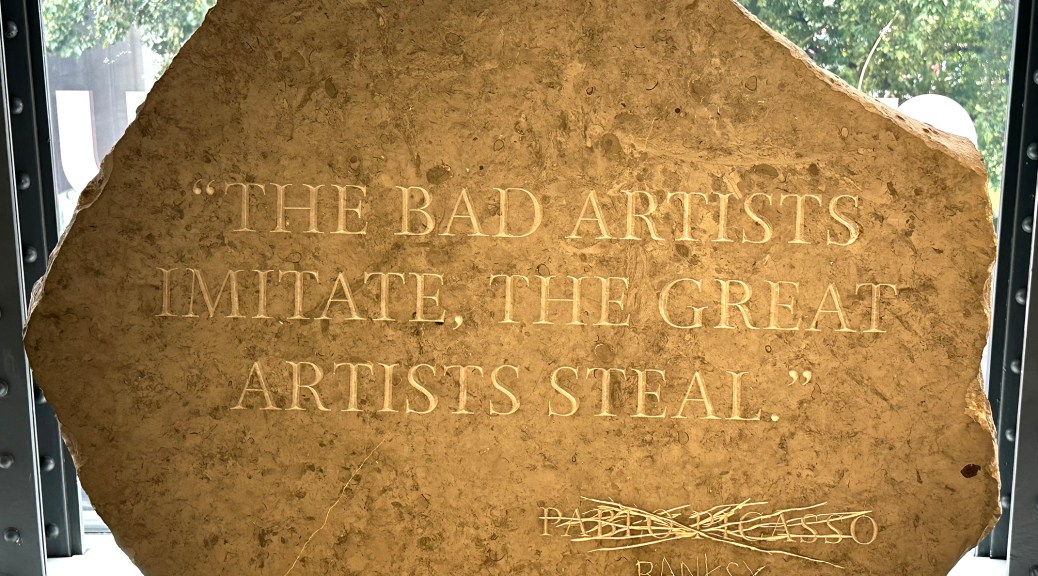
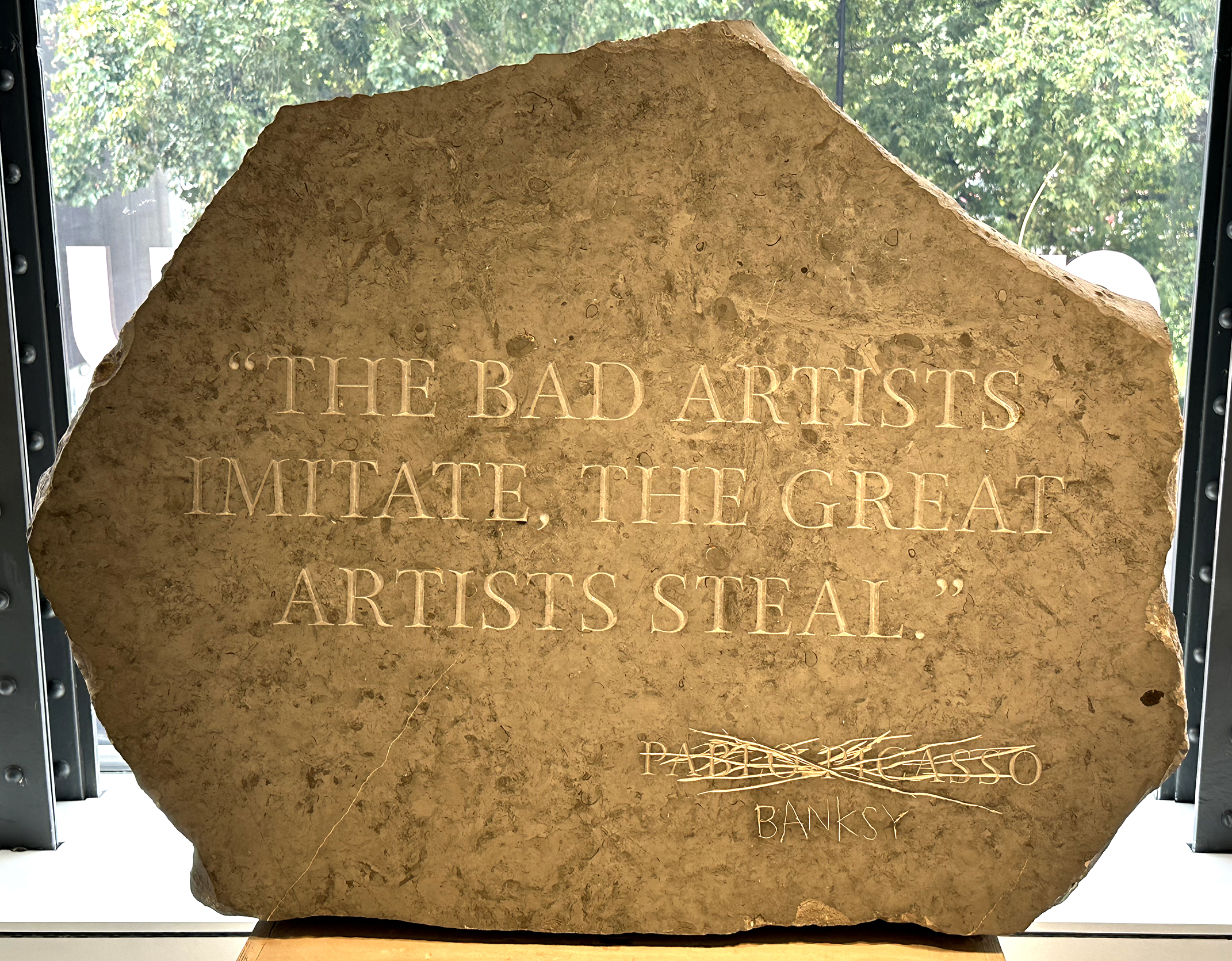
Banksy’s sculpture ”Bad Artists Imitate…” An appropriation.

In September 2023 I wrote about the implications of photographer Lynn Goldsmith’s successful legal action against the Andy Warhol Foundation and Condé Nast over Warhol’s appropriation of her portrait of Prince. The Supreme Court ruling established a notably stricter interpretation of “transformative use” than many in the art world had anticipated. You can read that post [here].

A recent Swedish television documentary has prompted me to revisit the subject.

Jag är inte här, jag drömmer (I’m not here, I’m dreaming), broadcast on SVT on 26 April 2026, profiles Cecilia Edefalk (born 1954), one of Sweden’s most celebrated contemporary artists. It is a sympathetic portrait, following her career from when she left art school to the present day. Distinguished critics including Daniel Birnbaum — former director of Moderna Museet and one of the most respected voices in the international art world — speak warmly about the importance of her work, noting that she borrows from mass media and advertising, adding or subtracting to make something new.

Nobody asks the obvious question.

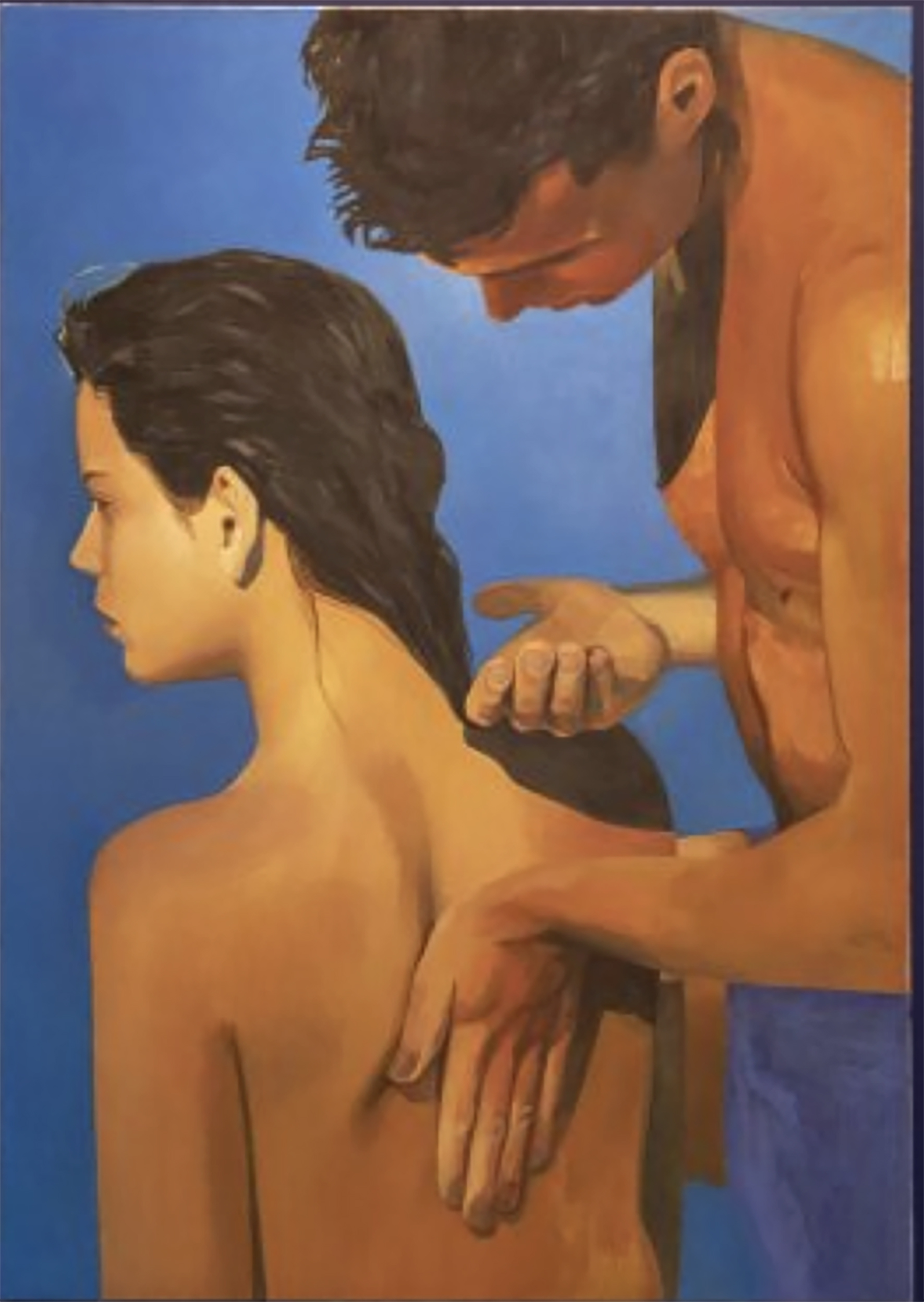
In one remarkable sequence, Edefalk holds up her source material for one of her better known paintings— a double page spread from Clic magazine, issue 3, 1988. Clic was founded by Cay Bond in 1981 as a forum for Swedish fashion design, using Swedish photographers throughout its run. The photograph shows a man applying suntan lotion to a woman’s back. Edefalk explains her modifications: she removed the suntan lotion bottle, painted the woman nude by removing her bathing costume, and changed the background colour from grey-brown to blue. The result, rendered at monumental scale in oil, which she painted in at least seven versions of varying sizes, has been exhibited internationally and commands serious prices.
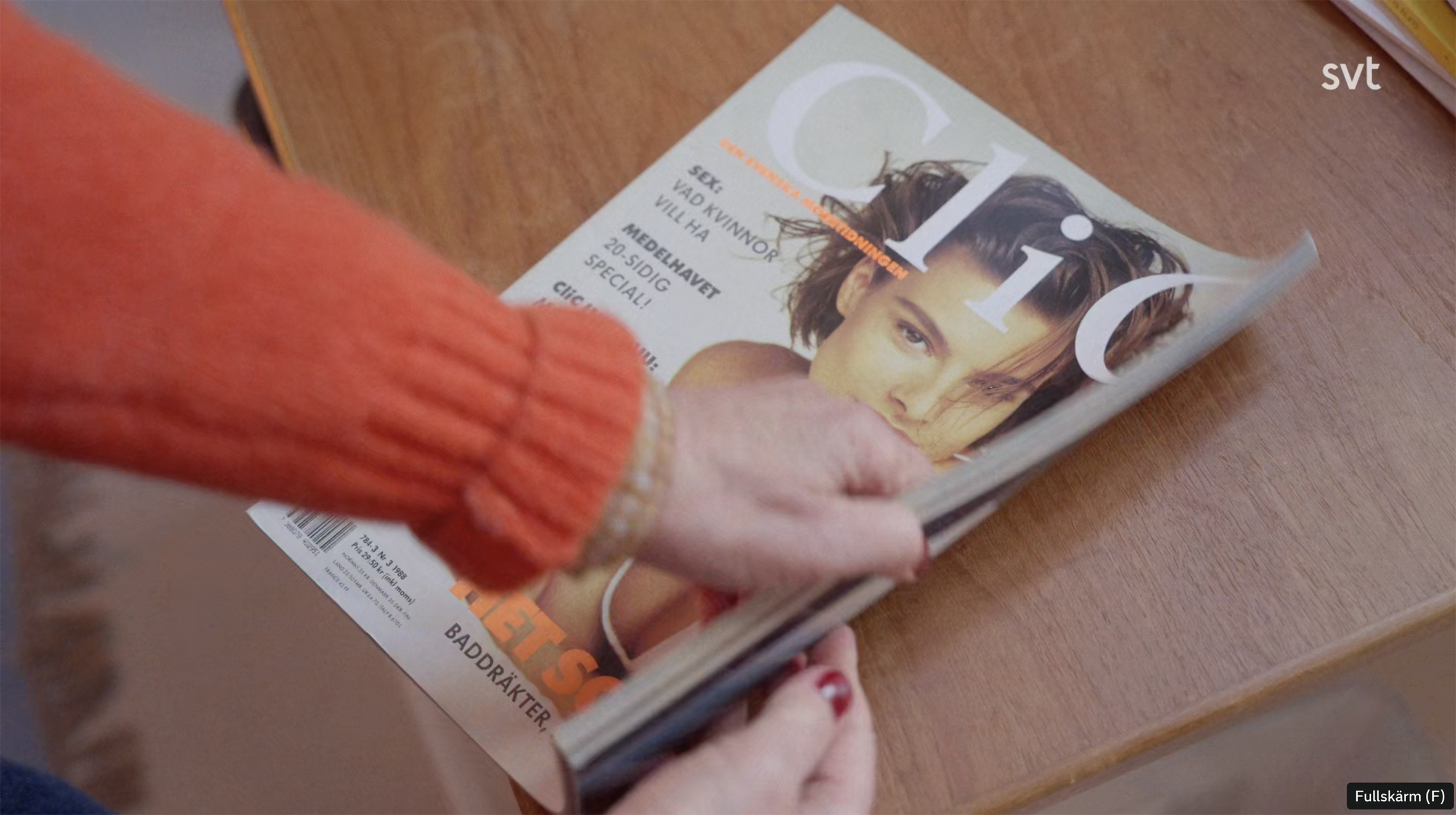
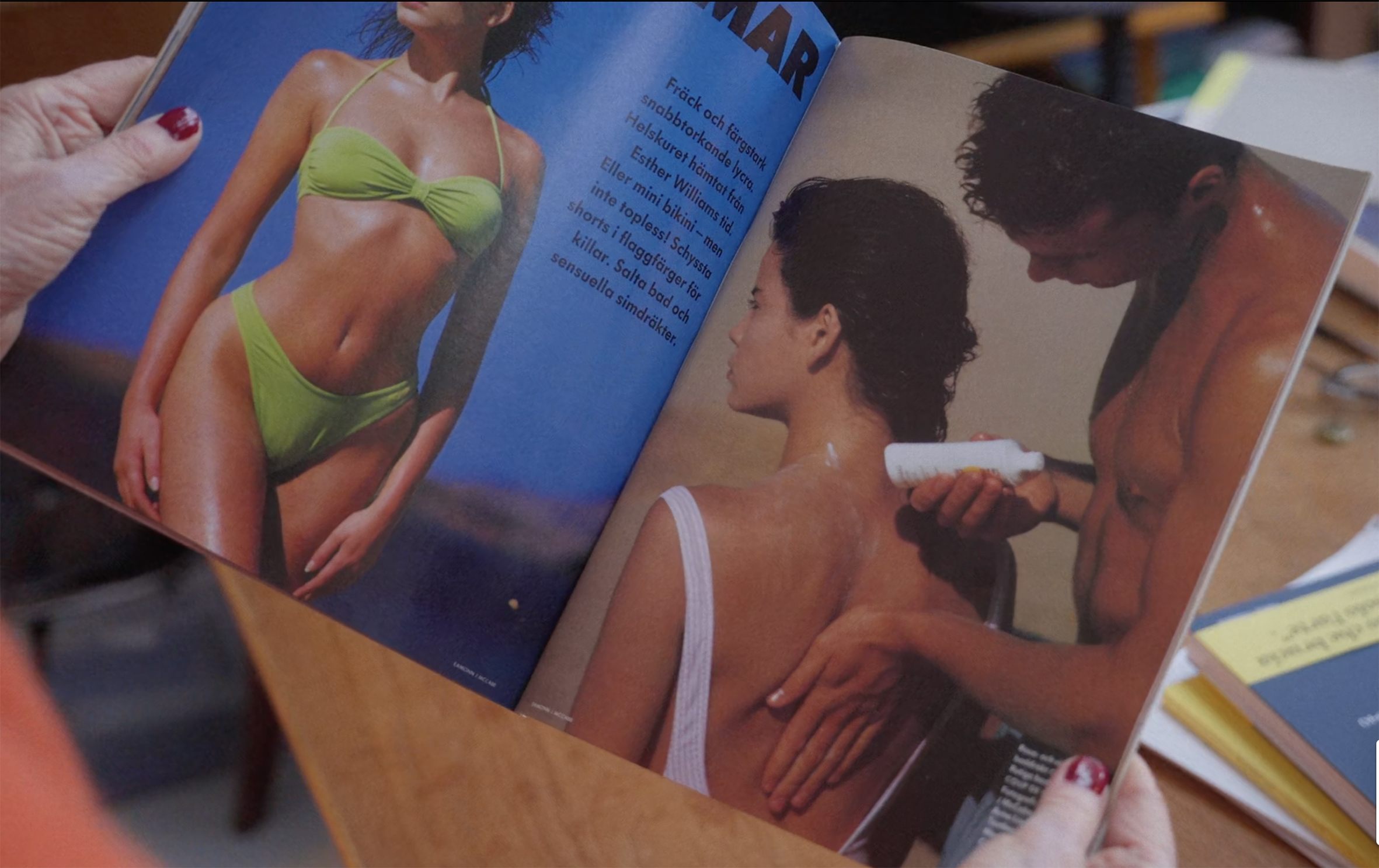
The final painting with the suntan oil bottle, the woman’s bathing costume removed and the backgrund colour changed.

The photographer — almost certainly a Swedish professional working on commission for a Swedish publication — is not mentioned. Neither is the question of credit, compensation or consent. The model, painted nude without her apparent knowledge or agreement, is similarly absent from the conversation.

Edefalk has produced this and similar works in multiple identical versions of various sizes — a strategy echoing Warhol’s silkscreen series. But where Warhol’s multiples worked through the silkscreen process itself, introducing colour variations and surface irregularities that were intrinsic to the meaning, identical painted versions in different sizes raises a different question: if the work is genuinely transformative, why does it need to be reproduced identically, many times, at different scales? One might argue that the source photograph is doing most of the artistic heavy lifting.

Edefalk has also painted a series of works based on Laurel and Hardy film stills — among them “Family” (1999), now in the collection of the Museum für Moderne Kunst in Frankfurt. The source is a bedroom scene from a 1932 film, reproduced in monochrome — which, it should be noted, is also the tonality of the original black and white film still, making the nature of the “transformation” somewhat difficult to identify. In fairness to Edefalk, a 1932 film still was almost certainly in the public domain in 1999, and the legal landscape around appropriation at that time was considerably more permissive than it is today. The post-Goldsmith world asks harder questions than the art world of 1999 was inclined to. Whether MMK Frankfurt — acquiring the work in full knowledge of its source — would approach the matter differently today is an interesting question that nobody appears to be asking.
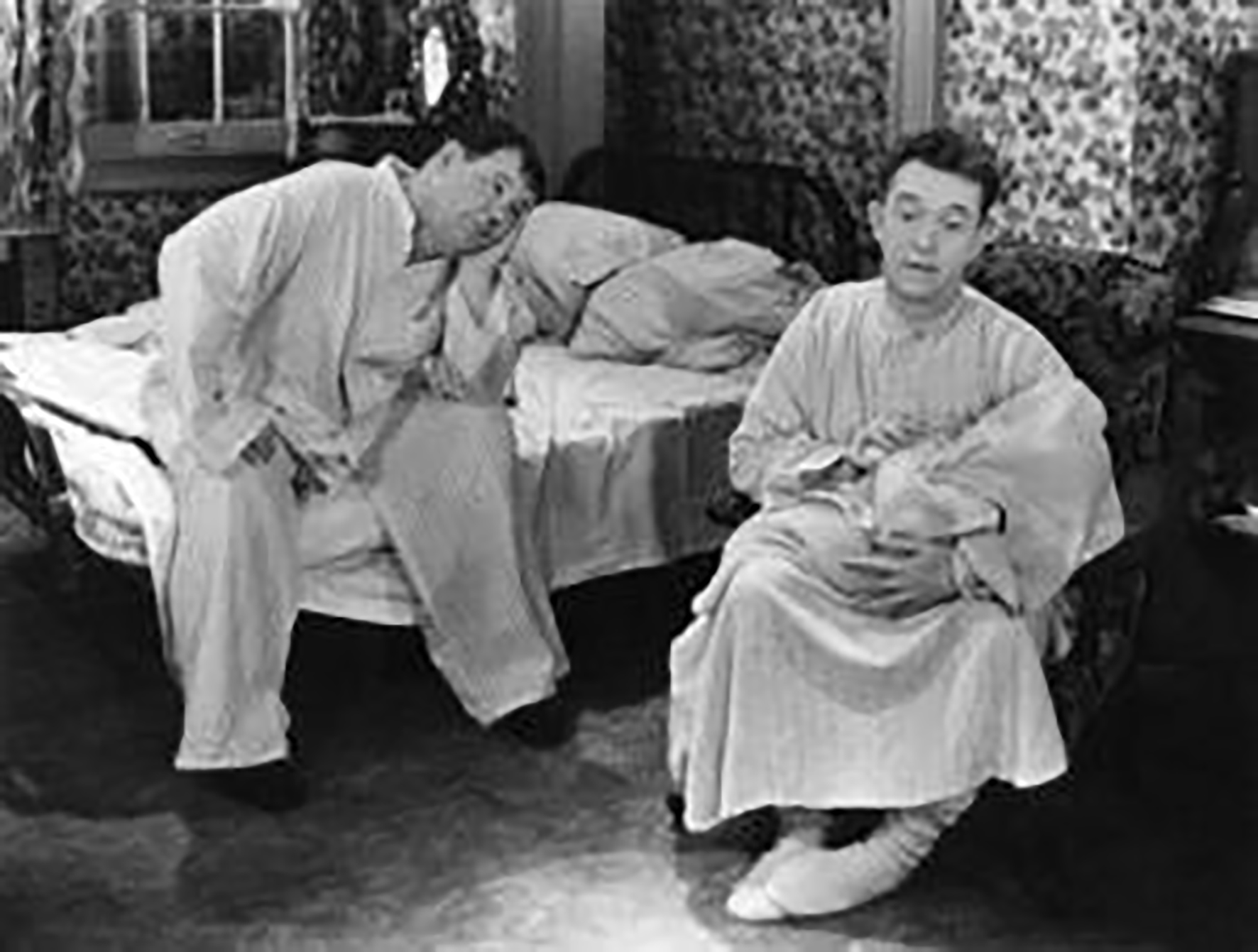
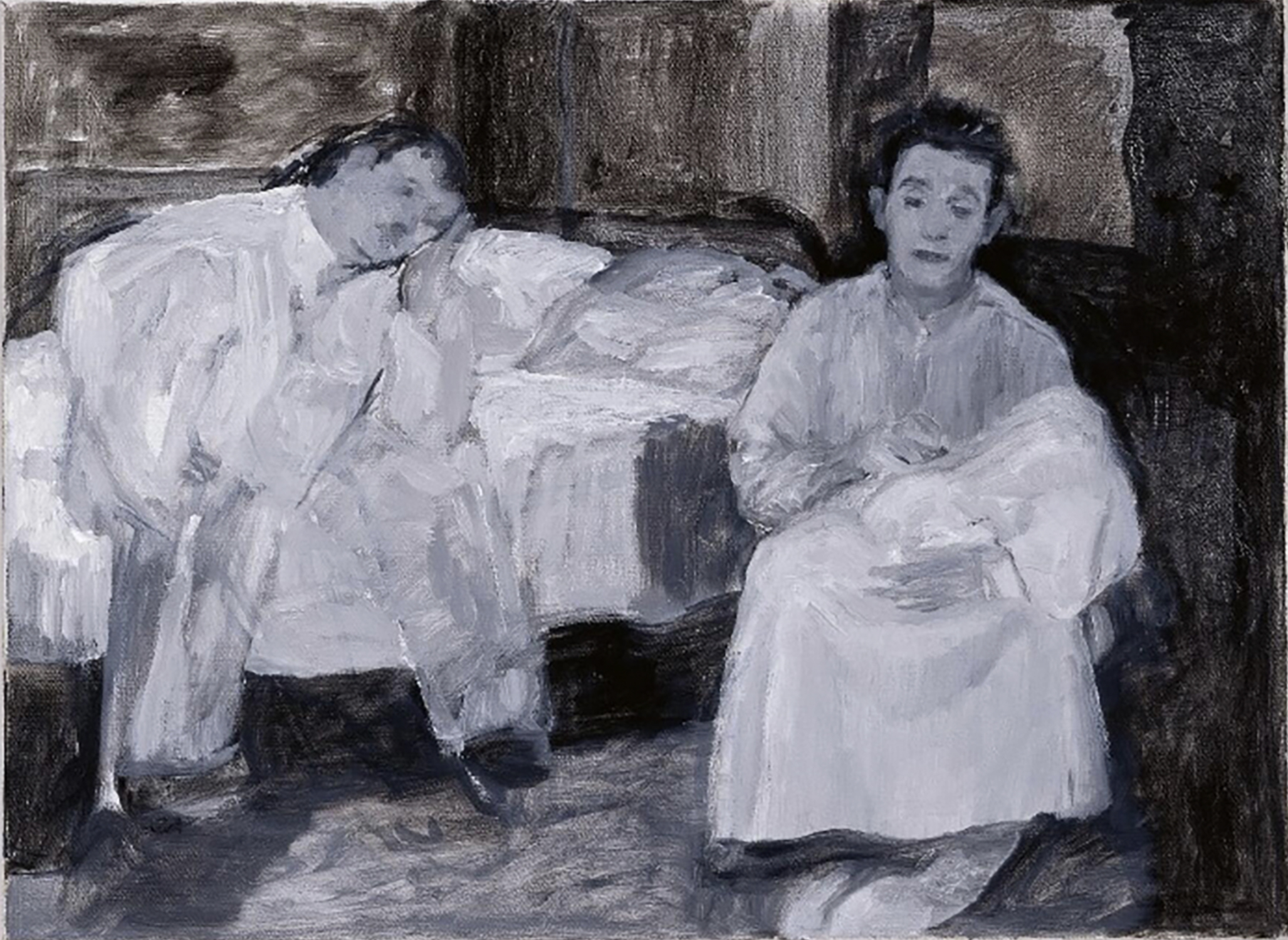
However, Edefalk’s use of copyrighted material has not been entirely unchallenged. Swedish photographers raised objections and there was press coverage of the copyright implications. She and her supporters have their answer — Birnbaum’s formulation of “borrowing to make something new” is the standard defence of appropriation art, and it is not without merit. The question is whether removing a suntan lotion bottle, undressing a model and changing a background colour constitutes making something sufficiently “new” — particularly in the light of the post-Goldsmith legal landscape.

The precedents are not encouraging for appropriation artists. Patricia Caulfield successfully sued Warhol for using her photograph of hibiscus flowers as the basis for his celebrated Flowers series. Richard Prince has faced multiple legal challenges over his appropriation of other photographers’ work, with largely unfavourable results. And the Supreme Court’s Goldsmith ruling confirmed that even an image unmistakably bearing an artist’s signature style may not clear the transformative use bar if it serves a similar commercial purpose to the original.

Against this backdrop, Elaine Sturtevant’s practice stands out as the most philosophically rigorous position in the appropriation canon. Sturtevant copied works by Warhol, Duchamp, Beuys and others — but from memory rather than directly from the originals. The inevitable drift introduced by memory made her copies meditations on the nature of the original rather than reproductions of it. She was also admirably transparent about her method. That combination of philosophical intent and acknowledged practice is rather different from simply painting from a magazine spread.

I should, in the spirit of full disclosure, acknowledge my own position in this conversation. I have made hand-painted reconstructions of unissued Warhol cover designs for a proposed Billie Holiday album — designs Warhol created in the 1950s, possibly on commission, possibly simply for his own amusement and a 50th anniversary series of his Giant Size $1.57 Each, as well as his Progressive Piano covers (ten-inch and seven-inch versions) . The immediate inspiration for the Billie Holiday cover creations was seeing one of Warhol’s original collages displayed on the wall of a Swedish museum exhibition, apparently sourced from the internet and included among genuine Warhol cover designs. My reconstructions, complete with period Columbia Records labels and liner notes signed with my Internet moniker “Rockdoc,” are explicitly labelled as such. I am also the author of forthcoming books on Banksy’s and Peter Blake’s record cover art — artists whose own relationships with appropriation, quotation and borrowed imagery are central to their practices. Thus I am not a disinterested observer.

The appropriation debate is genuinely complex and I have no wish to reduce it to simple condemnation. Borrowing, quoting, referencing and transforming are as old as art itself. But the critical establishment’s apparent incuriosity about the specifics — an unnamed Swedish photographer’s uncredited and uncompensated work, a model painted nude without apparent consent, a legal landscape that has shifted considerably since these works were made — is harder to excuse, particularly from critics who know perfectly well where these questions lead.

The suntan lotion bottle and the bathing costume, at least, had been removed. Whether what remains constitutes transformation or merely tidying up — and undressing — is left as an exercise for the reader.
The Resurrection of Pauline Boty.

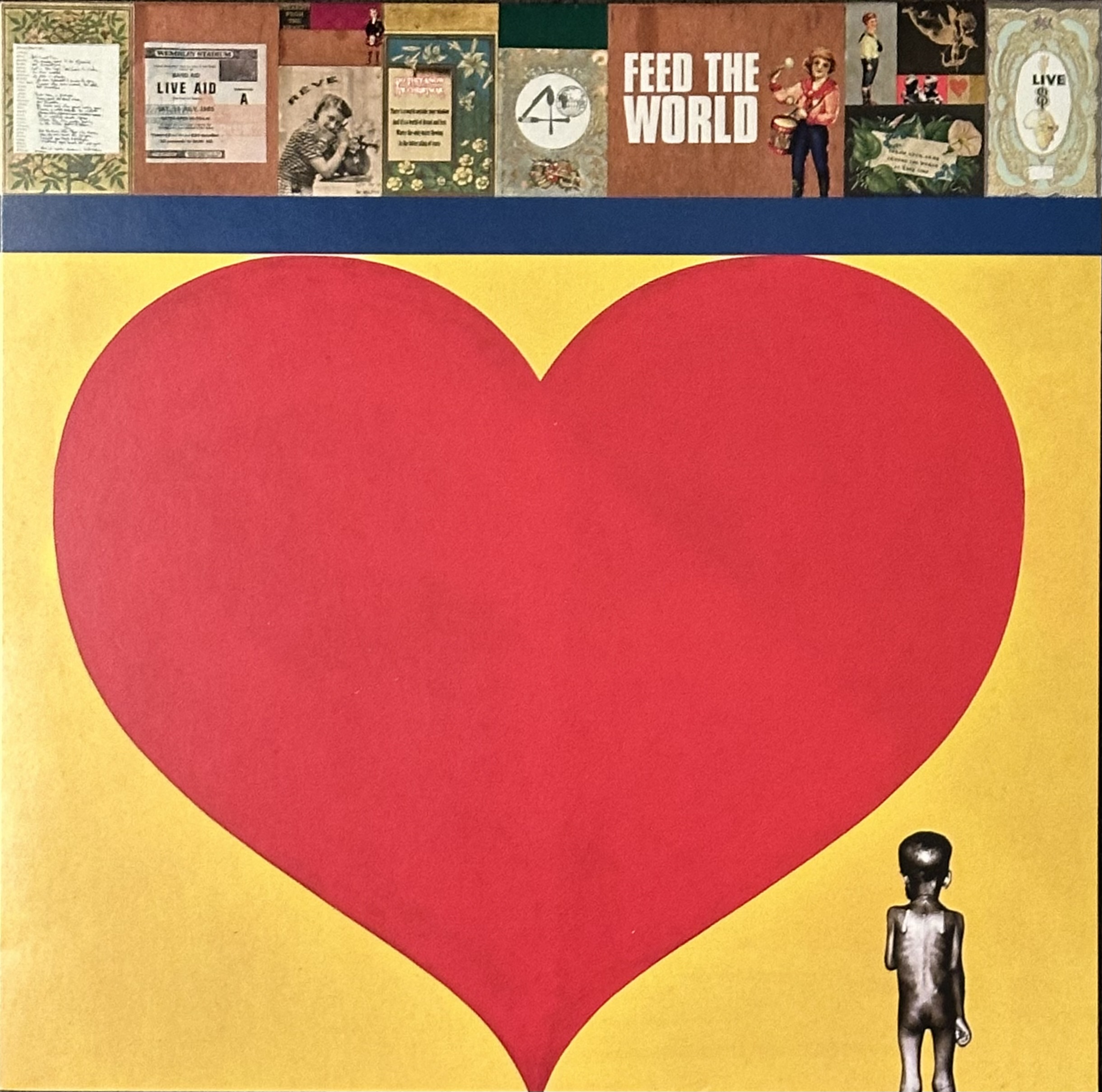
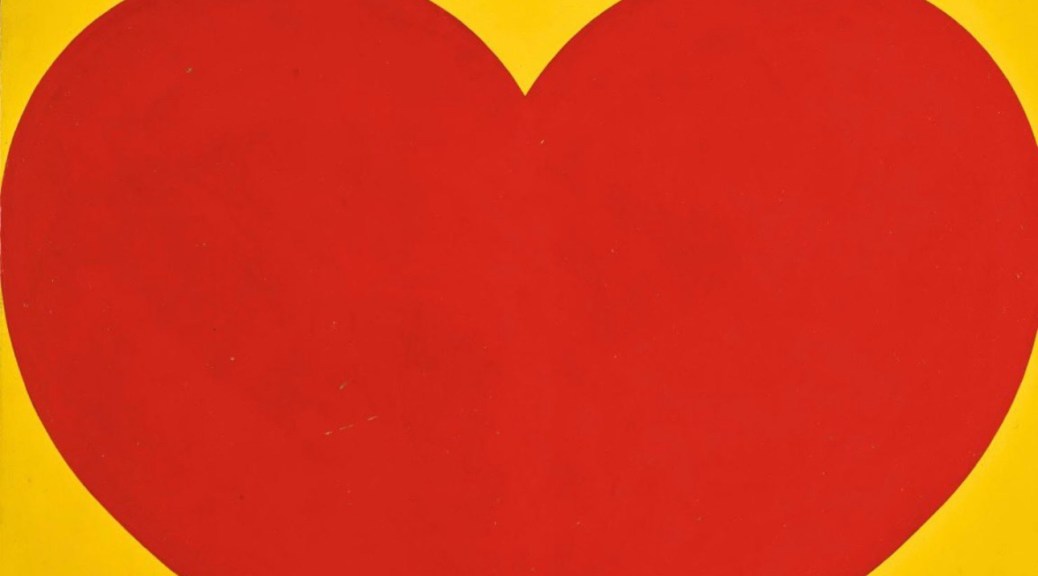
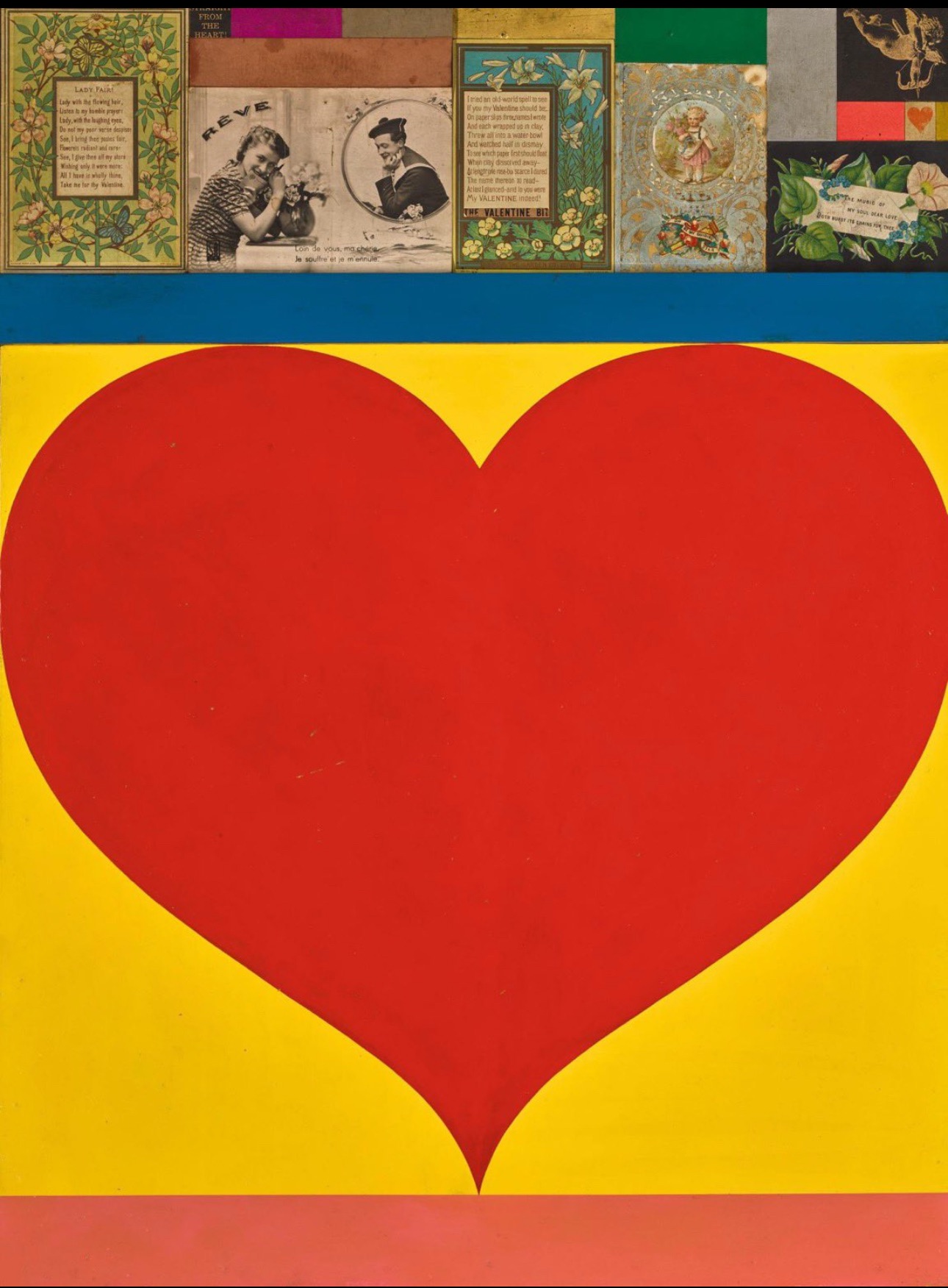
Pauline Boty (1938 – 1966) was a founder member of the British school of Pop Art. She was a painter, collagist, poet, model, dancer and actress. I came across her name when researching Peter Blake’s record cover art and found that Blake had recycled his 1959-60 painting “Valentine (for Pauline Boty)” for the cover of Band Aid’s 40th anniversary release of “Do They Know It’s Christmas?” with just a few changes in the collaged upper panel.

Peter Blake’s “Valentine (for Pauline Boty)” and  the cover of Band Aid’s 40th anniversary release 

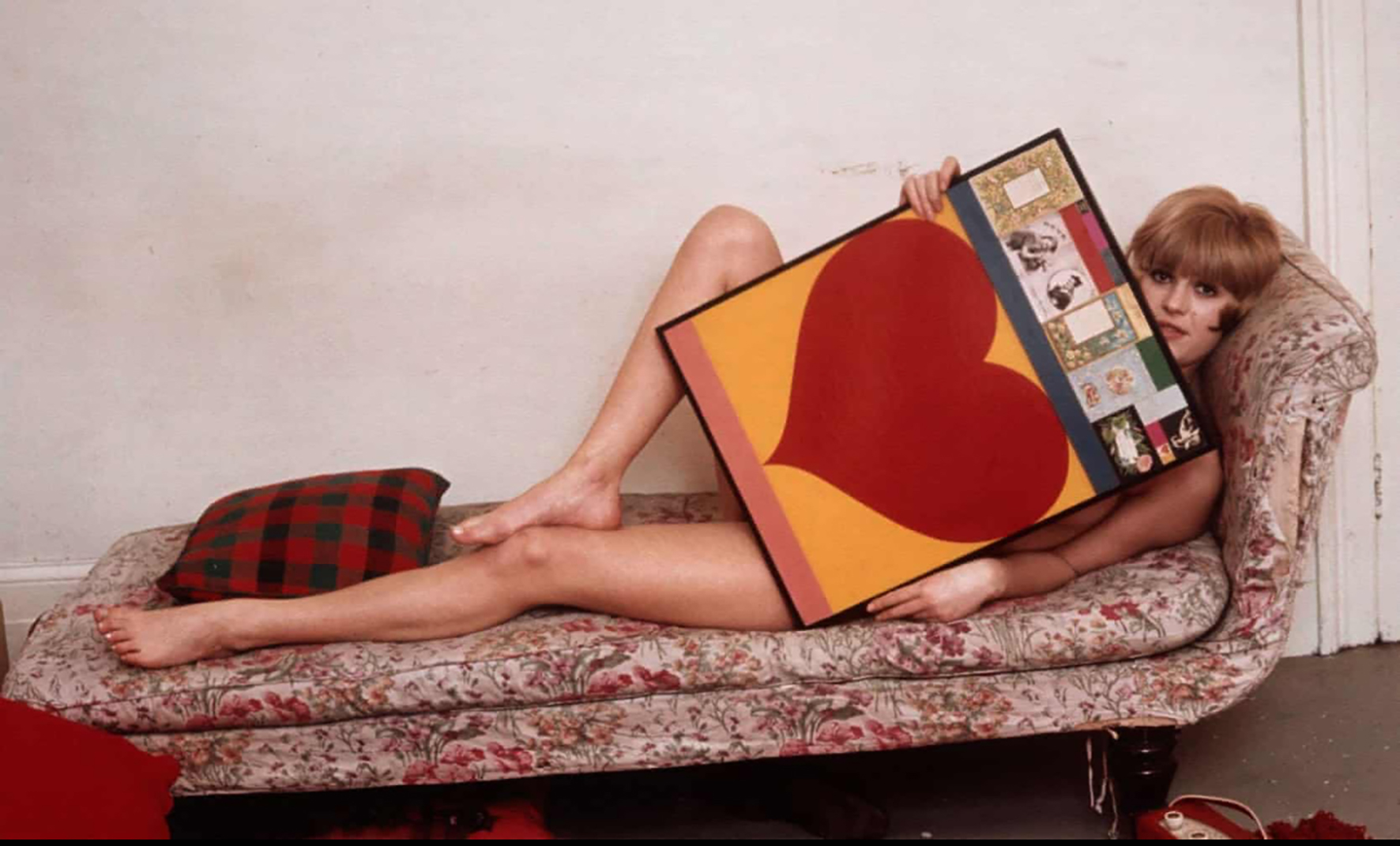
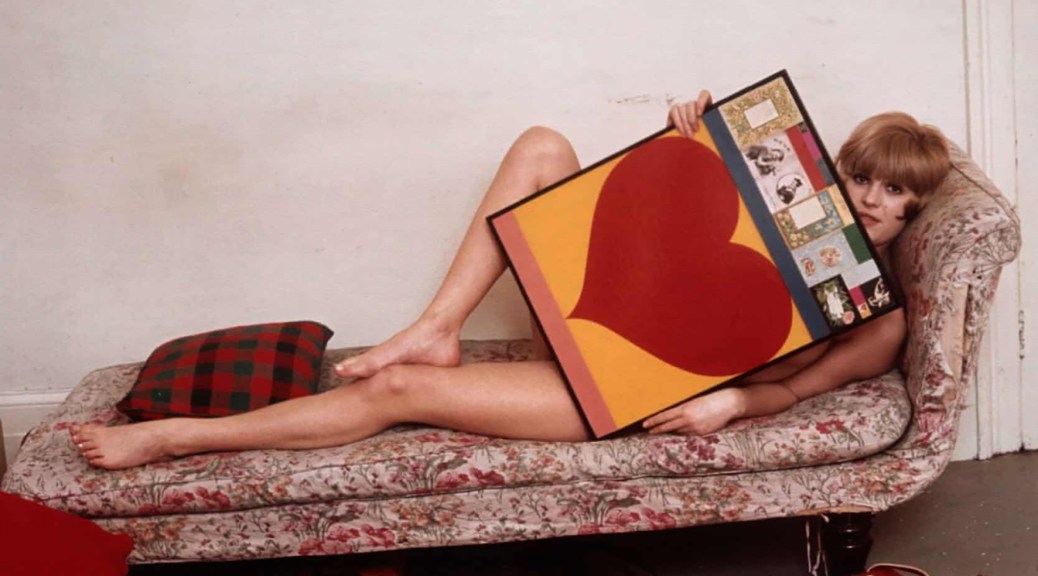
I then found Lewis Morley’s portrait of Pauline holding the painting.

Lewis Morley’s photograph of Pauline Boty holding Peter Blake’s “Valentine” painting.

This photograph of Boty is striking for several reasons. First because she was free-spirited enough to allow herself to be photographed nude and also because in most other portraits she is shown with her own paintings. In this picture she holds Blake’s “Valentine”.

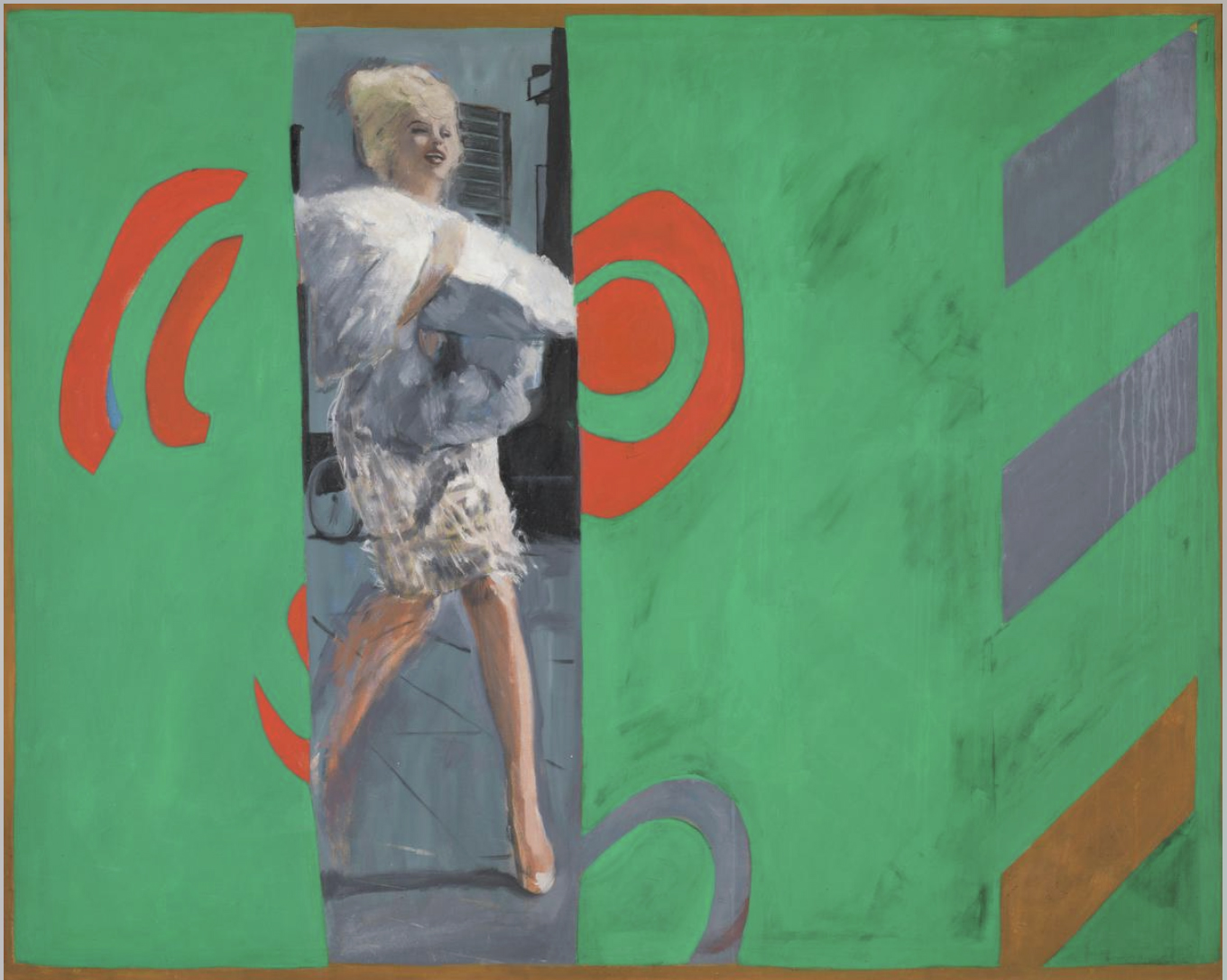
Boty’s art was all but forgotten until a retrospective in 1993 when David Mellor discovered a collection of her paintings on Pauline’s brother’s farm and showed them in a major show at The Barbican called “The Sixties Art Scene in London”. Art historian Sue Tate started researching Boty’s life and work and helped curate the 1998 joint exhibition at London’s Whitford Fine Art and Mayor Galleries called “The Only Blonde in the World” and the Tate Gallery bought the eponymous painting .

Pauline Boty “The Only Blonde in the World” 1963. Tate London.

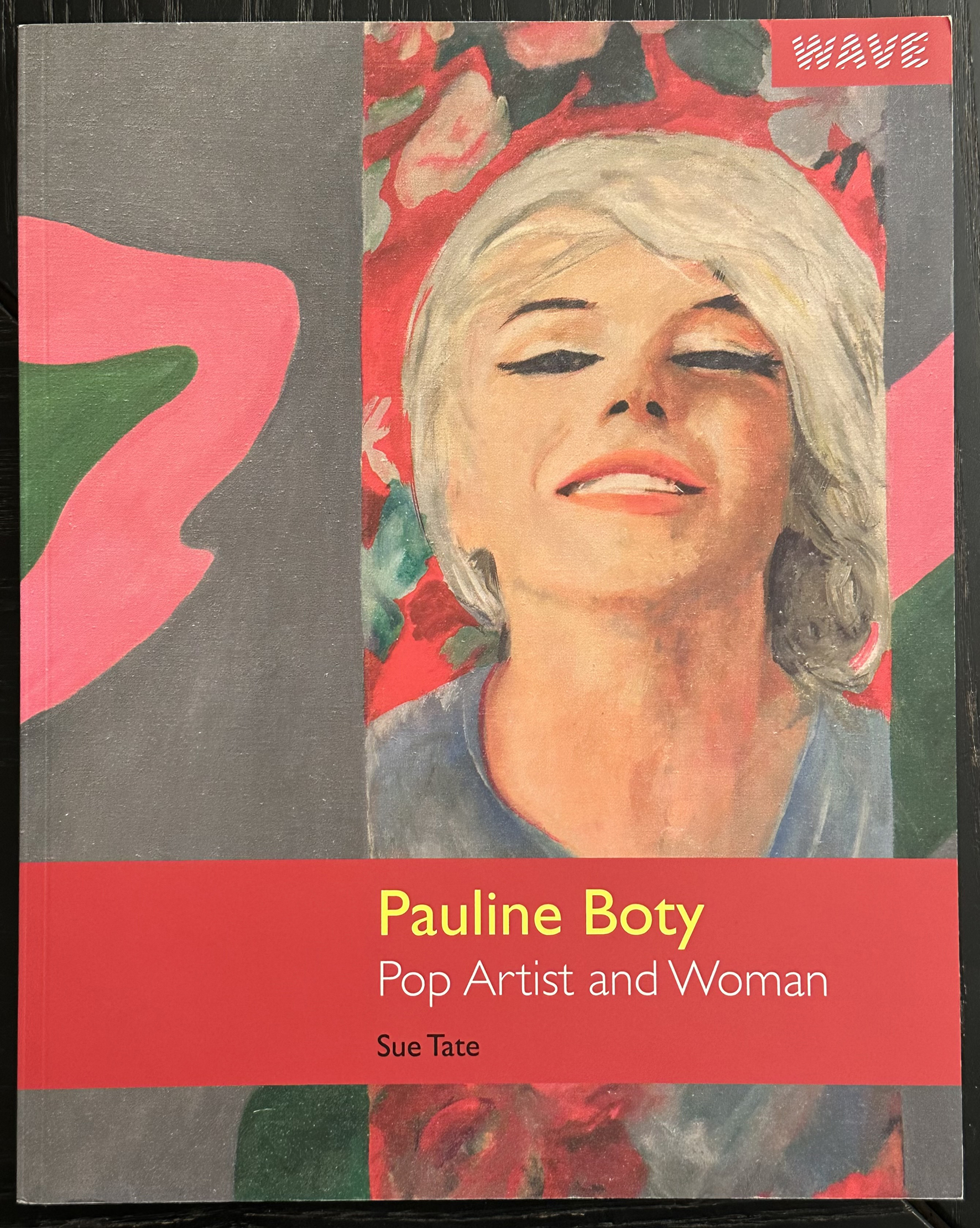
The Wolverhampton Art Gallery bought Boty’s painting “Color Her Gone”[1] in 2012 and in 2013 invited Tate to curate a major retrospective of her work “Pauline Boty: Pop Artist and Woman”. Tate wrote an illustrated biography of Boty to accompany the exhibition which travelled to the Pallant House Gallery and to a museum in Poland.

Sue Tate’s book cover

Peter Blake’s “Valentine” painting was sold at Sotheby’s in 2019, and the auction catalogue described how the painting came about. Boty met Peter Blake while she was a student at the Royal College of Art and became his girlfriend while having relationships with other men. She had a long-term relationship with the television producer Philip Saville, who would have an important role in her life and career, providing acting opportunities and introducing her to her future husband Clive Goodwin, who she helped start his literary agency. Blake was besotted with Boty, who, unfortunately for him, wasn’t so romantically engaged. However, he gave her the “Valentine” as a demonstration of his affection and it was obviously important for her as she allowed herself to be photographed holding it. The only photograph of Pauline with a painting that wasn’t one of her own.

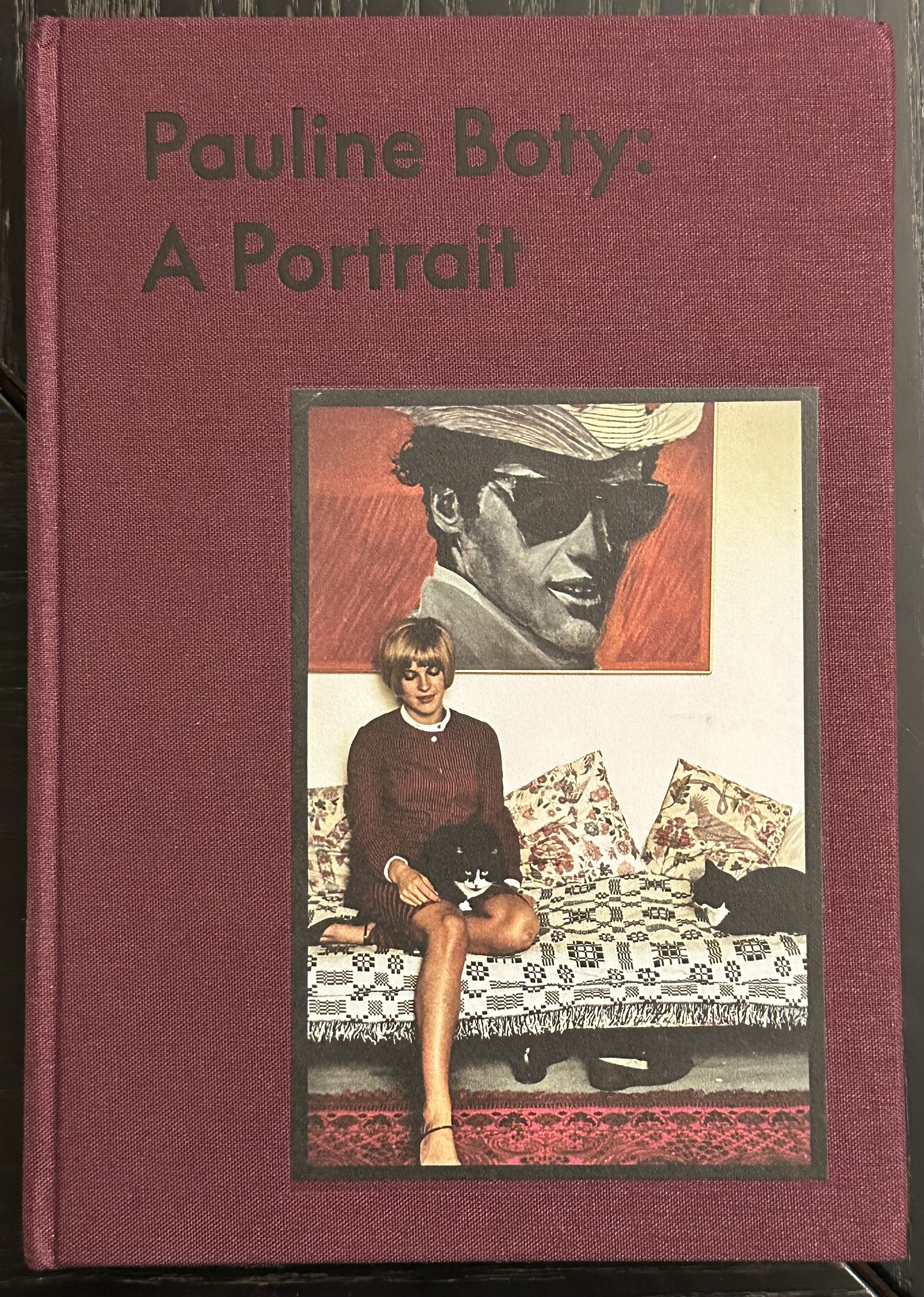
The Gazelli Art House organised a further Boty retrospective in 2023 called “Pauline Boty: A Portrait” that coincided with the publication of Marc Kristal’s major Boty biography “Pauline Boty: British Pop Art’s Sole Sister”. Both Tate’s 2013 and Kristal’s more recent volume tell of Boty’s whirlwind ten-day romance with Clive Goodwin leading up to their wedding. The ten-day romance must, however, have been something of a myth despite being proposed by Pauline herself in her interview with her friend Nell Dunn.[2]

Boty told Nell Dunn how she met her future husband. She was walking together with Philip Saville when they bumped into Goodwin and Kenneth Tynan and Saville introduced Goodwin to Boty. The following day Goodwin phoned Saville to ask if he would mind if he asked to meet Boty again. Boty and Goodwin married at the Chelsea Register Office on 24th June 1963. However, the law required a couple to give twenty-one days’ notice to marry. So, the couple must have known each other for at least three weeks prior to their marriage. The romance was probably not much longer than a month or six weeks, though, as Goodwin, having spent a year in Paris, only returned to London in the spring of 1963, say in April or May.

Why wasn’t Boty’s art saleable during her lifetime? While Boty’s close friends Peter Blake and Derek Boshier were represented by Robert Fraser’s famous Duke Street Gallery, Boty didn’t have a gallery representation. Her work was shown together with that of Peter Blake, Geoffrey Reeve and Christine Porter at the AIA Gallery in 1961 and at a “one man [sic] show” at the Grabowski gallery in 1963. She was also one of the four pop artists featured in the BBC Monitor programme “Pop Goes the Easel” in March 1962, which should have given her work visibilty to people interested in the burgeoning field of pop art.

Pauline was constantly hard up and was initially forced to work as a waitress and then to teach art before turning to modelling and acting to make ends meet. Marrying Goodwin could well have been a survival tactic.

Author Marc Kristal had seen one of Boty’s paintings at a pre-auction show at Christies and was entranced and, having never heard of  her before, started to research her life, leading up to the publication of his extensive biography “Pauline Boty: Pop Art’s Sole Sister”. He repeats the story of Boty’s and Goodwin’s ten-day romance seemingly without considering the reality.

Interest in Boty and her work increased in 2023. Kristal’s book was published in October and Gazelli Art House in London organised the “Pauline Boty: A Portrait” retrospective that opened on December 1st, 2023, and ran till 24th February 2024. Sue Tate contributed to the catalogue.

Gazelli Art House Catalogue “Pauline Boty: A Portrait” 2023-4.

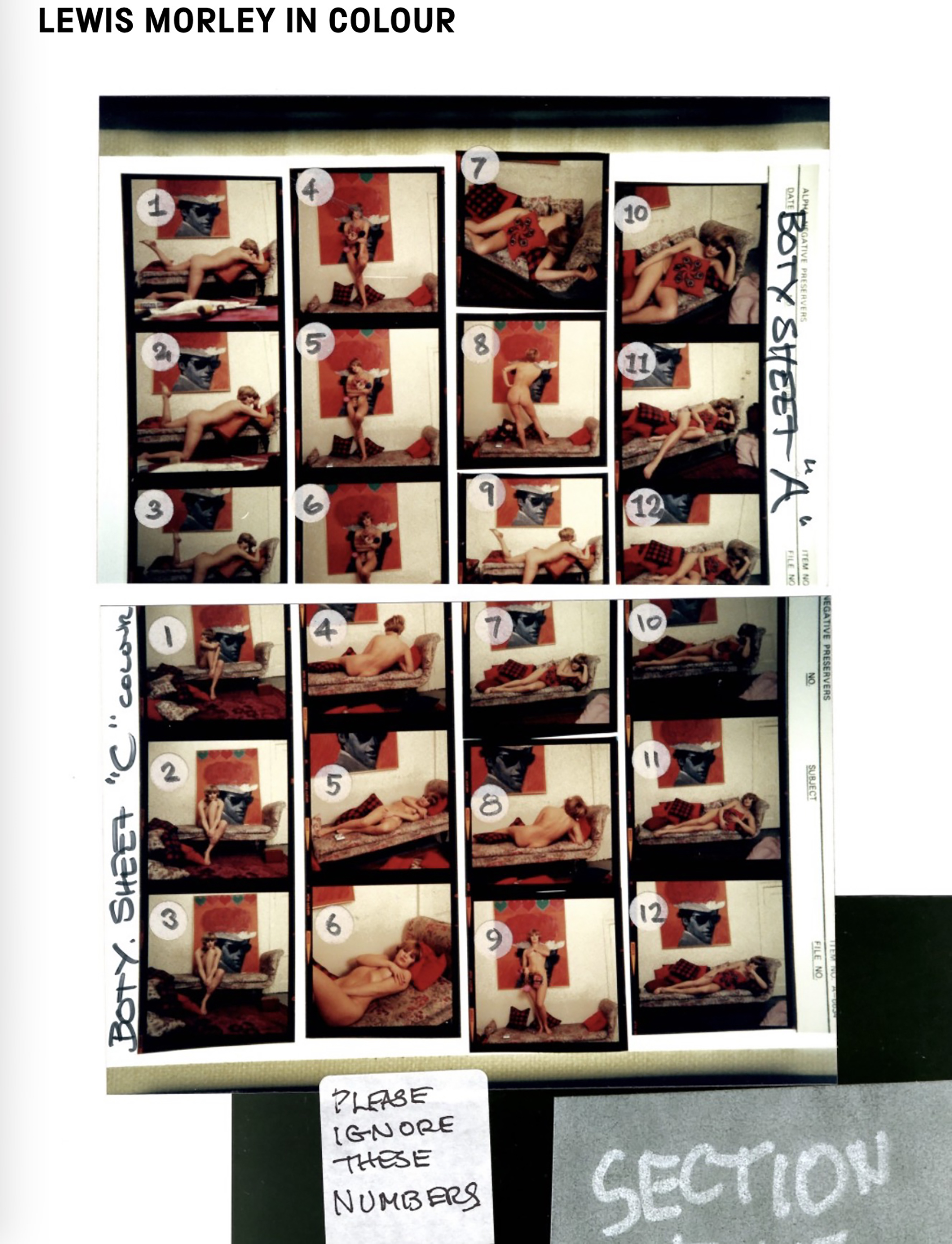
Boty continued to see Philip Saville after her marriage and according to Kristal allowed Lewis Morley to photograph her nude in September 1963, barely three months after her wedding. I think these photos were probably taken earlier; Morley had known Pauline since her time at the RCA and they are rumoured to have had an affair. We can calculate an approximate date for the photos from the two paintings featured in the series of stills.

Lewis Morley’s colour photos

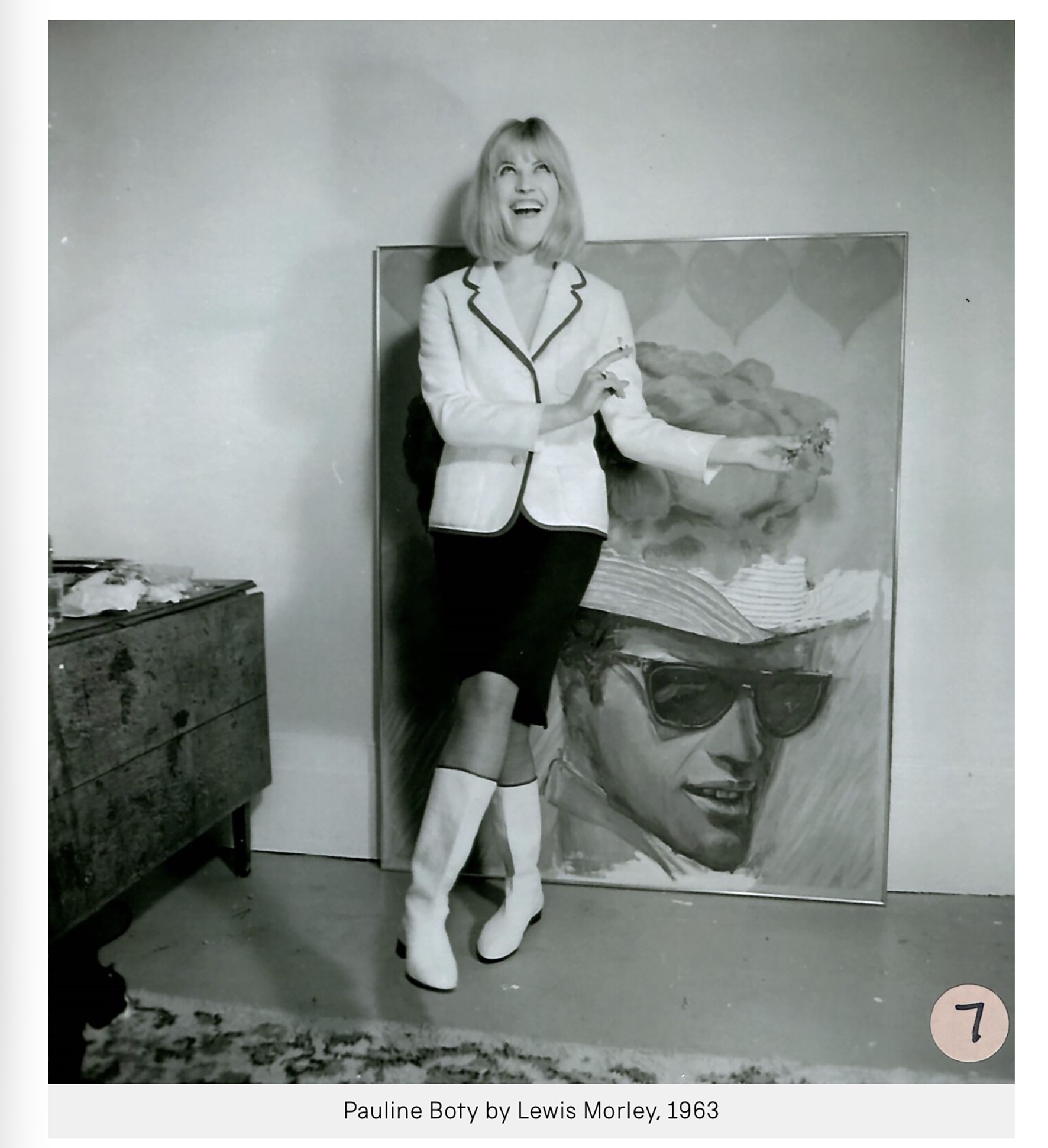
The first painting is Boty’s own “With Love to Jean-Paul Belmondo”, from 1962, and the second is Blake’s “Valentine”, which Boty was probably given in 1961 . So, we can safely date these photos to 1962 (or later). But, if we compare Boty’s relatively unsophisticated, and relatively short hair style in these photos with the fashionable, slightly longer style in Morley’s more formal 1963 portrait, the colour photos were probably taken earlier than the 1963 date. Even taking Pauline’s extra marital adventures into consideration, I would hesitate to suggest that she posed nude for Morley barely three months after her wedding. It is difficult to see that these photos were taken at the same session despite the presence of the “Belmondo” painting in both.

Lewis Morley’s 1963 photos

Peter Blake was understandably upset when he found Pauline had married. Though he married Jann Haworth less than one month later. However, his wedding plans must have been made prior to him hearing of Boty’s and Goodwin’s marriage as he, too, would have needed to give 21 days’ notice of an intended marriage. Some of Boty’s friends thought her marriage was too hasty and that Boty suffered from depression. However, Pauline’s sister-in-law Briget said she had never seemed happier.

The Gazelli Art House exhibition catalogue showed Morley’s photograph of a nude Pauline lying on a chaise longue holding Peter Blake’s “Valentine (for Pauline Boty)” painting but strangely labelled it “Lewis Morley: Untitled. Pauline Boty holding Peter Blake’s ‘Heart’. 1996”. Neither the picture’s title nor the date are correct.

My interest in Pauline Boty and her art arose from the discovery that Peter Blake had recycled his 1959-60 painting “Valentine (for Pauline Boty) for the cover of Band Aid’s 2024 Christmas single “Do They Know It’s Christmas?” I discovered that Pauline Boty was an important member of the early British pop art movement and how her work has become widely recognised after having been lost for almost thirty years after her untimely death in 1966. I found how her relationship with Peter Blake influenced her work and how she acted as a sort of muse for him. I suspect the Lewis Morley photographs of a naked Pauline Boty were probably taken earlier than has generally been accepted. The corrections to the accepted timeline paint a picture of a more purposeful, less impulsive woman than the myth suggests. And the fact that Blake chose this particular painting — a private love token from sixty-five years earlier — as the cover image for the 2024 Band Aid 40 cover gives it an emotional resonance that probably would have gone unrecognised.


[1] Note: Boty was heavily into Americana, using cuttings from American magazines such as Life as sources for her collages. She used the quote from the American song ”My Coloring Book” for the painting’s title. Both Tate and Kristal anglicise the title to ”Colour Her Gone” instead of Boty’s ”Color Her Gone” – or was their mistake simply the result of autocorrection in their manuscripts?

[2] Dunn, Nell: Talking to Women. MacGibbon & Kee, London, 1965.

Collage – The Medium Linking Two Souls: Peter Blake and Pauline Boty.

I’ve been fascinated by Peter Blake’s art since I bought his “Babe Rainbow” print in, I think, 1968. My fascination for his art continued with my collection of Blake’s record cover art and one recent (2024) release has unravelled unexpected aspects of Peter Blake’s life that impinge on his art. The cover I refer to is his design for Band Aid’s 40th anniversary recording of “Do They Know It’s Christmas?”  released as an EP on viny and CD in November 2024.

This design struck me as familiar and I found a picture of a Blake painting from 1959-60 that was strikingly similar. The painting in question is Blake’s “Valentine (for Pauline Boty)”.

Peter Blake’s “Valentine (for Pauline Boty)”, 1959-60.

I immediately wanted to know who Pauline Boty was and why Peter Blake painted her this valentine.

A quick Internet search revealed that the painting had been sold at Sotheby’s in 2019 for £270,000. But the description told the story of Blake’s unrequited love for Pauline Boty.

Peter Blake’s art education began in 1946 when he was only 14 at Gravesend School to learn commercial art. It was there that his interest in typography started. After National Service in the R.A.F., in 1953, he was admitted to the Royal College of Art’s painting school based on a single painting that he submitted. He graduated with first class honours in 1956 and, after a year travelling in Europe, took various teaching jobs while still remaining connected to the RCA. He was a contemporary of David Hockney, R.B. Kitaj, Derek Boshier and Allen Jones. In 1958 a 20-year-old Pauline Boty arrived at the RCA to study stained glass. A subject she had begun to study at Wimbledon College. Boty was a collagist and painter and while at the RCA produced stained glass works, paintings and collages.

There’s considerable similarity between making stained glass pictures and collages. Both consist of cutting out bits of either glass or paper to make a design and Boty became an accomplished collagist alongside her stained glass work.

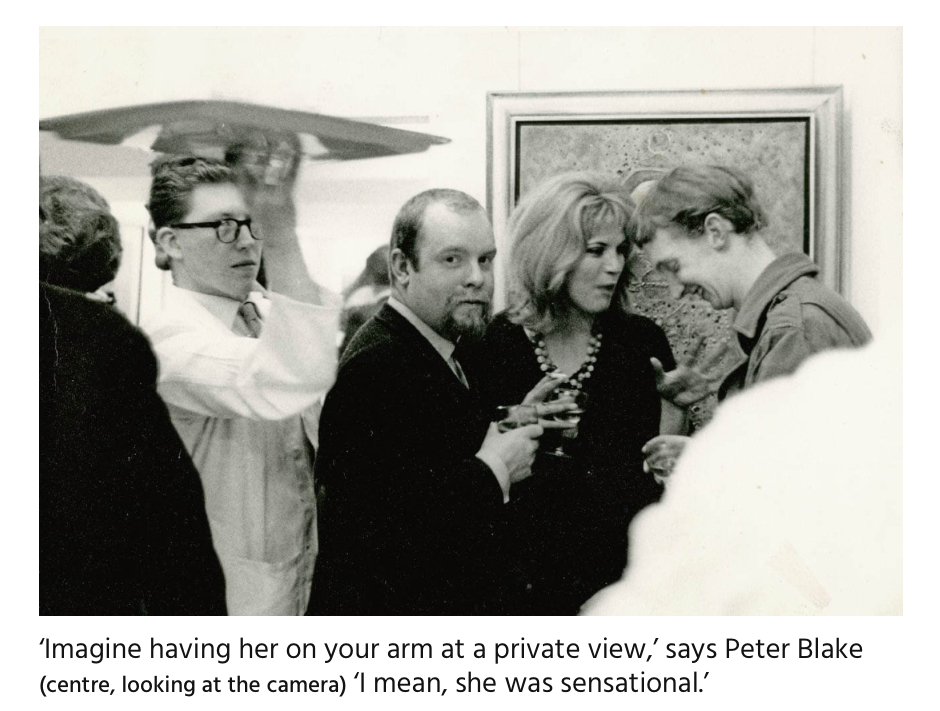
Blake had been making collages since at least 1955. Boty met Blake, six years her senior,  at the RCA and they began a romantic involvement. Blake soon became besotted with the beautiful, vivacious and very talented Pauline. Unfortunately for him her feelings were considerably cooler, but they made a beautiful couple. Blake has said “Imagine having her on your arm at a private view. I mean she was sensational!

So, Blake painted his “Valentine (for Pauline Boty)” early on their relationship. Boty must have been inspired by Blake’s collages, and she must have been a muse for him. Her early collages seem to presage many of Blake’s more recent ones.

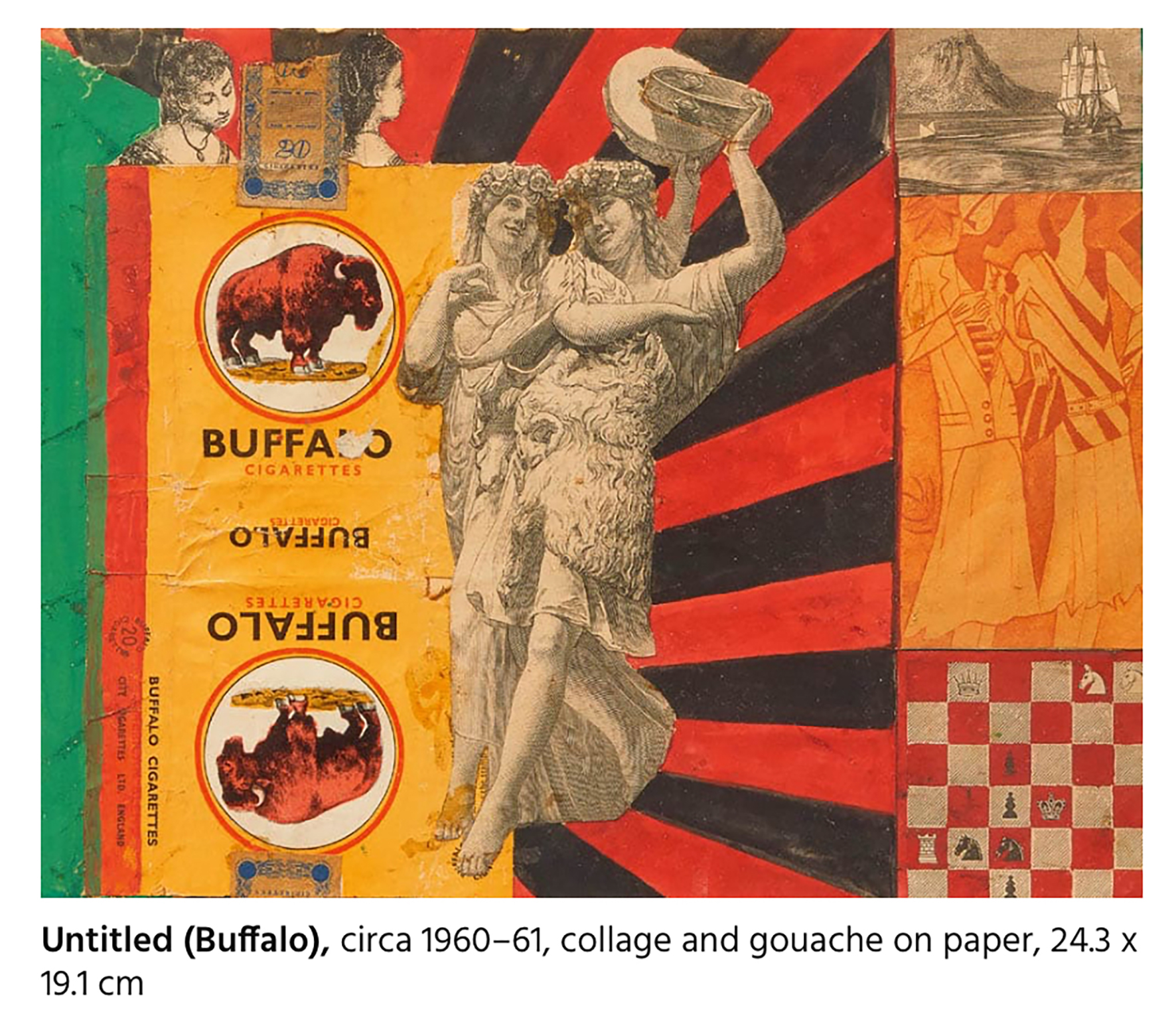
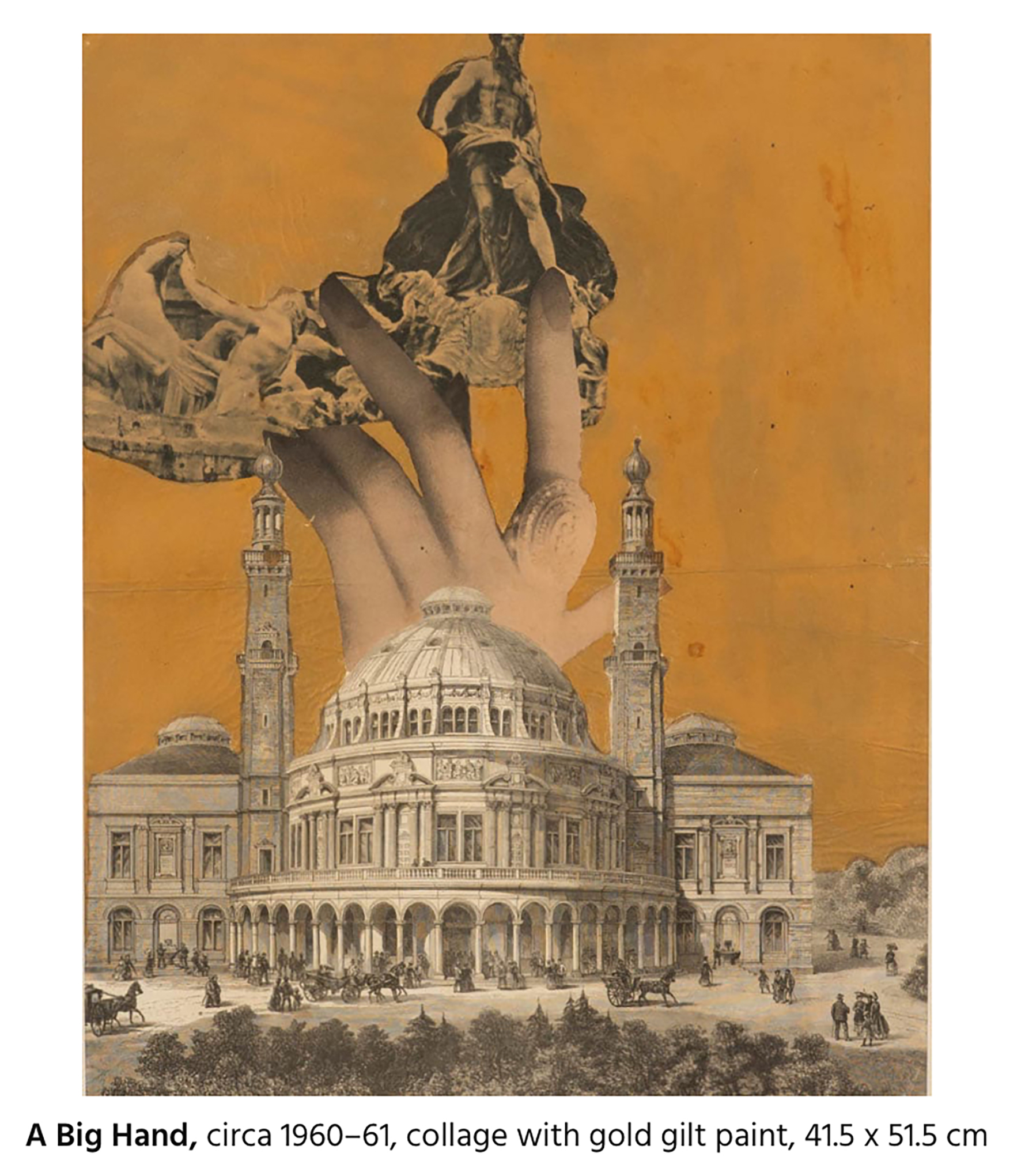
This reuse of Victoriana by Boty is reminiscent of Blake’s later large collages from the “Joseph Cornell’s Holiday” series and other.

Boty was the archetypal “dolly bird”, before the term really became fashionable. She wore Mary Quant clothes and was aware of her sexuality, having several affairs while still dating Blake. The photographer Lewis Morley was one lover, who photographed her nude in September 1961 in a series of photos, the most famous being the portrait holding Blake’s “Valentine (for Pauline Boty)”!

Lewis Morley’s 1961 portrait of Boty holding Blake’s 2Valentine” painting.

Exactly when Blake’s and Boty’s relationship ended is difficult to date. Boty was in a long-term relationship with the married television director Philip Saville and had other assignations. In June 1963 she married literary agent Clive Goodwin after a whirlwind 10-day romance. Both Blake and Saville were reported to have been shocked by her marriage. And Peter Blake married Jann Haworth the following month.

Their artistic partnership was public enough that when the BBC’s Monitor produced ‘Pop Goes the Easel’ in March 1962, Blake ensured Boty was among the four featured artists. (Blake himself, Boty, Derek Boshier and Peter Phillips). The programme opened with presenter Huw Wheldon seated before a recreation of Boty’s ‘collage wall’ – an installation in her London flat that demonstrated how central collage was to her practice, integrated into her daily environment. If this wall dated from 1958-59 when she arrived at the RCA, Blake would have seen it early in their relationship, experiencing collage not just as artworks but as a way of life.

There were three brilliant women artists around in the late fifties and early sixties. These were Brigit Riley (born 1931), Jann Haworth (born 1942) and Pauline Boty (born 1938). Riley, Peter Blake and Jann Haworth were represented by Groovy Bob Fraser’s Duke Street gallery from 1962. Boty graduated from the RCA in 1961 and was forced to become a waitress to make ends meet. Why didn’t Blake introduce his great love to Robert Fraser and kickstart her artistic career? Instead, she jumped into marriage so she could continue her art.

Haworth left Blake in 1979 for the author Richard Severy and Blake met Chrissy Wilson in 1980. They married in 1987.

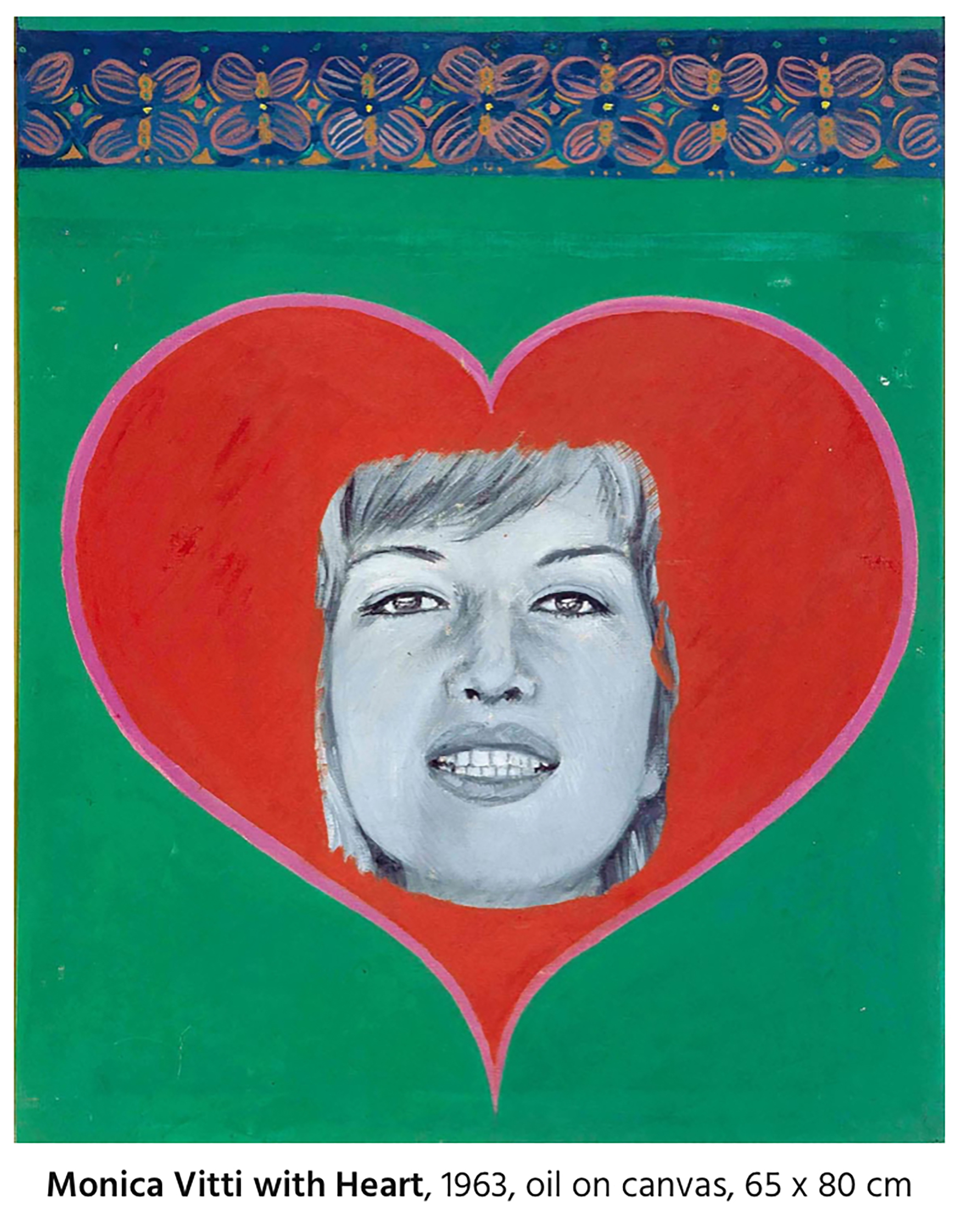
There is no doubt that Peter Blake influenced Pauline Boty’s art. Just compare her “Monica Vitti with Heart” painting from 1963 with Blake’s ”Valentine”.

And there’s no doubt Blake never forgot Boty as he reused the “Valentine” design sixty-four years later as the basis for the cover design for the Band Aid 40 EP. But he hasn’t credited Boty anywhere in his books. His 2021 book “Collage” is dedicated to Chrissy, his three daughters and Joseph Cornell.

Retrospective exhibitions of Boty’s work in 2013 and 2023-4 have brought her pop art paintings and collages back into general view and emphasised her central role as one of the important members of British Pop Art first flowering.

Credits: Photographs taken from Marc Kristal’s 2023 book “Pauline Boty: British Pop Art’s Sole Sister”.

Some More of My Own Art.

I keep trying to be creative, and not only in the record cover collecting field. Last summer I went on another silkscreen course and though I didn’t manage to get as much done as I had hoped, I still did produce a few nice things.

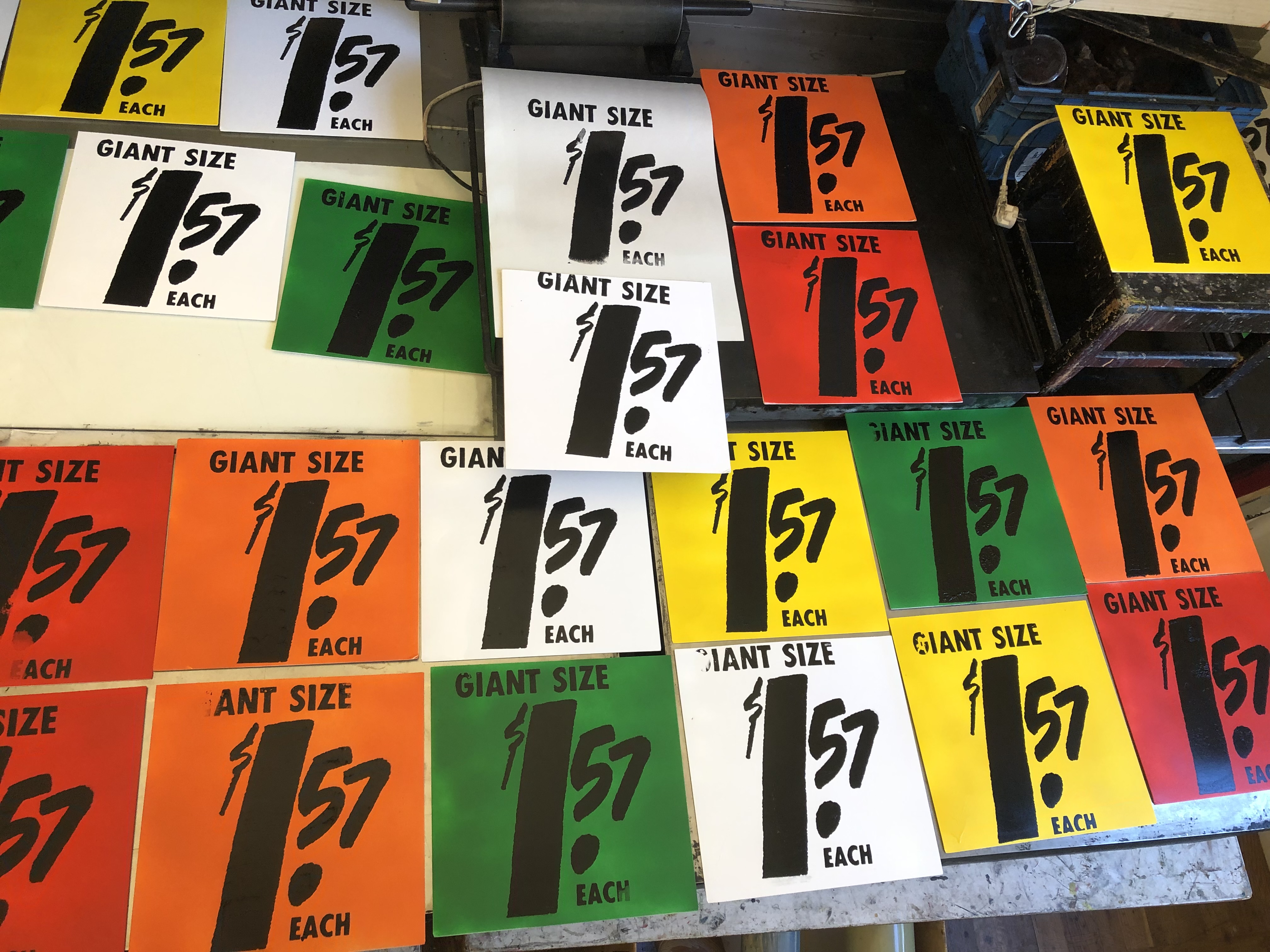
I printed a number of teeshirts and five new sets of Andy Warhol’s and Billy Klüver’s famous Giant Size $1.57 Each record covers. This involved first spray painting the record covers (white, yellow, red, green and orange — the same colours Warhol/Klüver used on the originals) and then screenprinting the Giant Size $1.57 Each text on top. I did 25 covers in all!

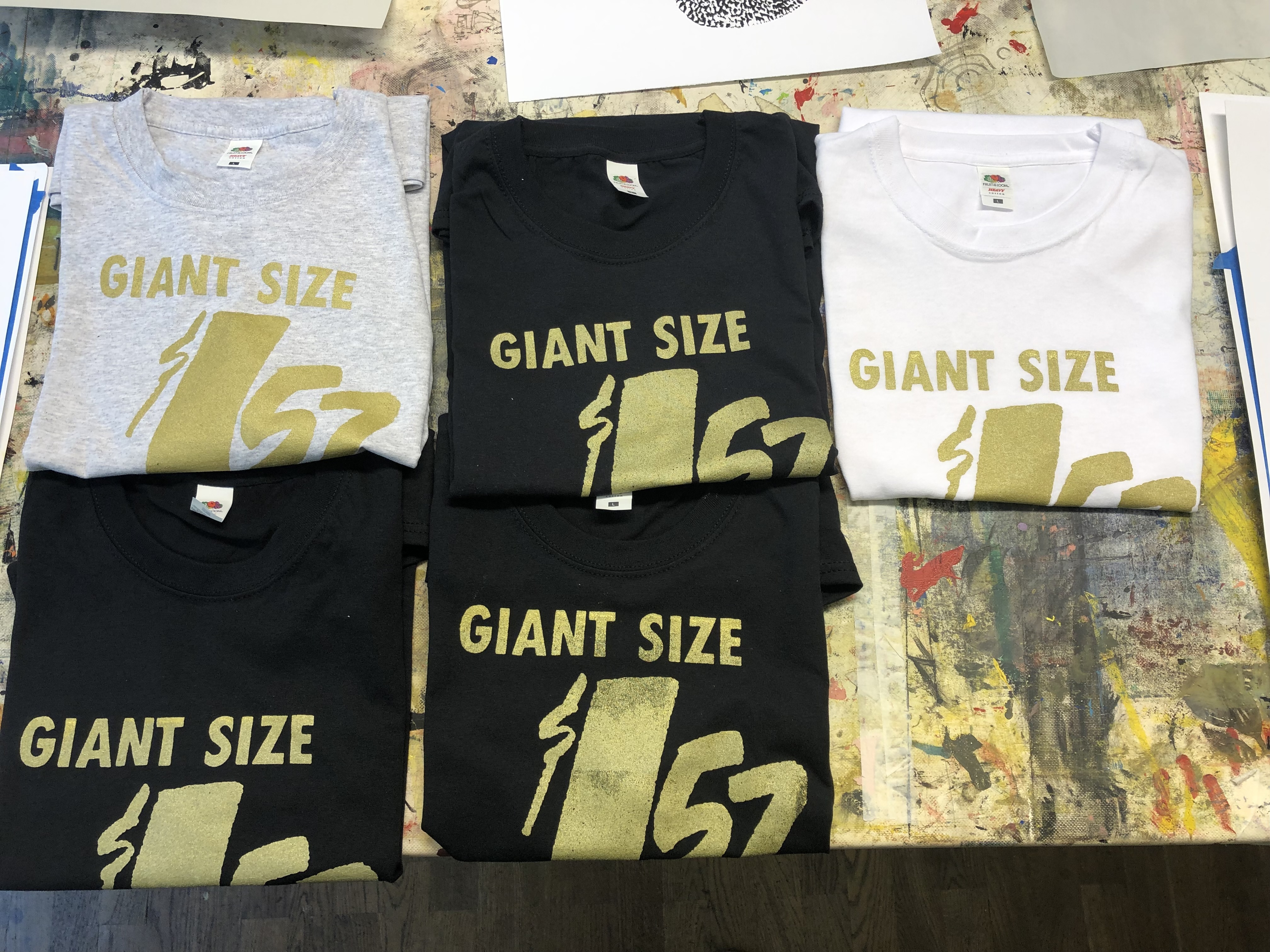
I also printed a number of teeshirts with the same design, but this time in gold.

A bit later, I got Urban, my friendly neighbourhood printer, to print replica record labels that I could stick onto some LPs that I sourced from the record store that I sold my collection to a few years ago. They had loads of records that were unsellable and that they were glad to get rid of!

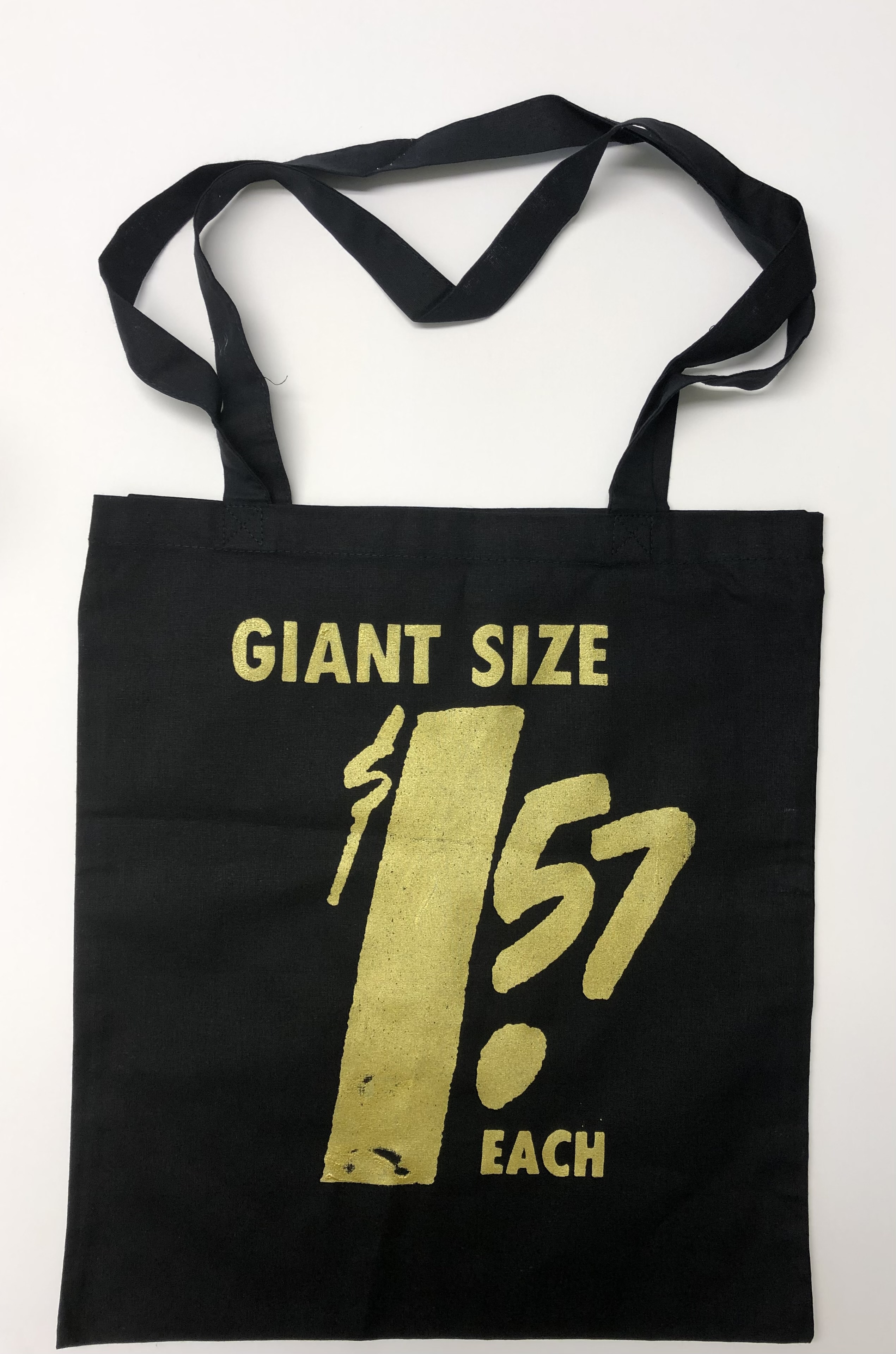
At he same silkscreen course, I printed two pictures using the same Giant Size stencil. These turned out so well that Anette, our course leader, wanted me to print her a tote bag with the design in gold.

But the things I was most pleased with were two large-scale prints 100 x 50 cms that I decided to frame and submit for consideration for inclusion in Liljevalch’s 2023 Spring Salong. Unfortunately they weren’t accepted but I’m pleased I tried.

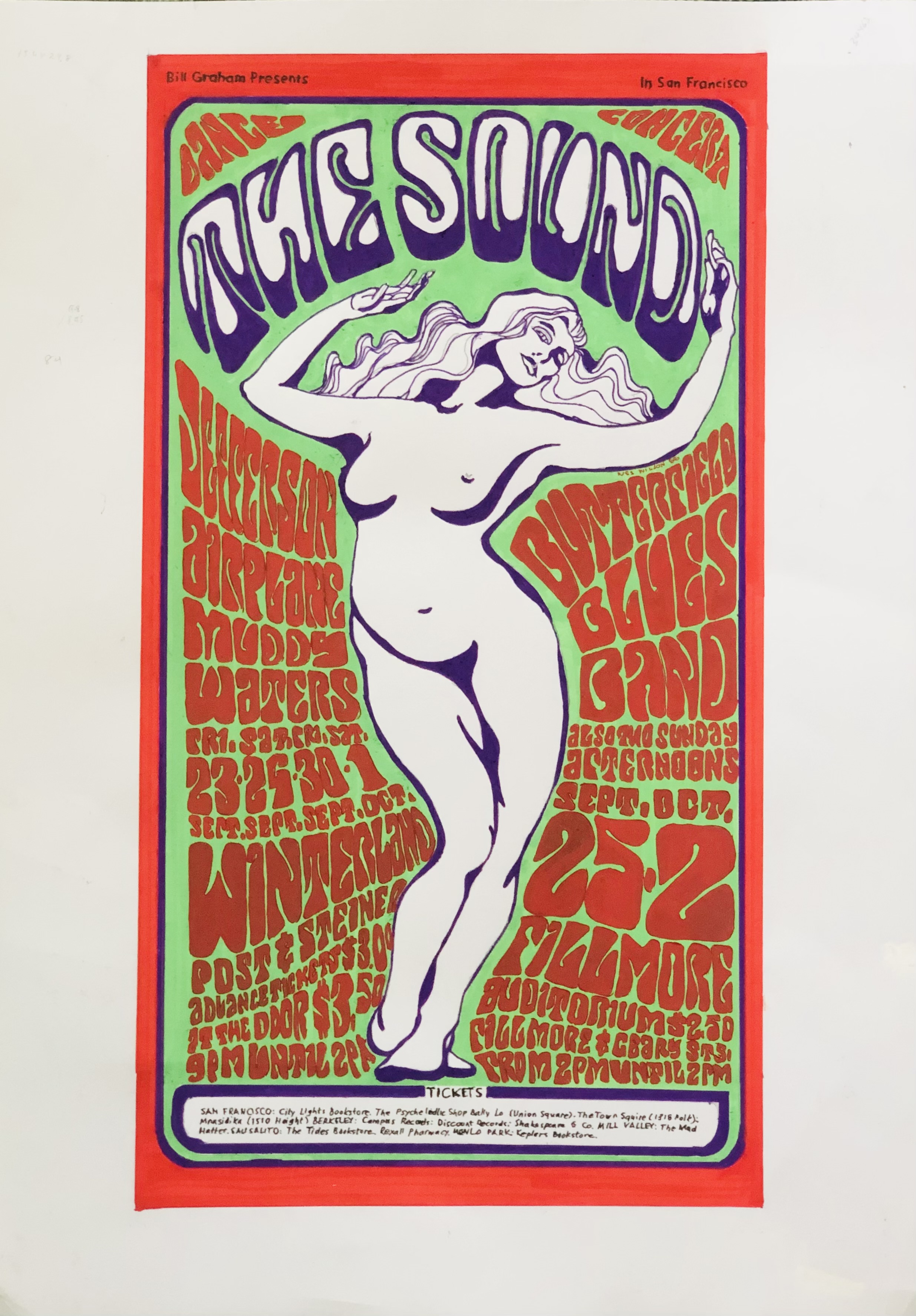
Latterly, I’ve gone back to painting. Anyone who has followed this blog may have read about my collection of sixties Bill Graham Fillmore Autitorium and Avalon Ballroom handbills. The original posters are now fetching large sums at auction and I always wanted Wes Wilson’s The Sound poster from 1966. Knowing I couldn’t afford an original, I reckoned the next best thing woud be to paint a reproduction… Note: not a forgery, a reproduction.

There are many instances of artists appropriating the work of others, ranging from Elaine Sturtevant, who in the sixties reproduced several of Andy Warhol’s paintings to Ulf Linde, who reproduced Marcel Duchamp’s readymades and which are on permanent display at Stockholm’s Moderna Museet (Linde even got Duchamp to sign the reproductions!) He made further copies (I mean reproductions) fifteen years after Duchamp’s death, but then had his widow sign them! Another celebrated case of reproductions is the Brillo Boxes ordered by Pontus Hultén for an exhibition that were made in Malmö, Sweden, and many were later sold as original Warhol Brillo Boxes. The fact that Hultén had commissioned them only came to light six months after his death in 2006.

So now I decided to paint myself a copy/reproduction of Wes Wilson’s magnificent poster as near full size as possible (acrylic on paper) . And here is the result.

I got inspired by how well this turned out and a friend posted a picture of Banksy’s 2004 I Fought the Law and I Won print. I have two record covers that had travestied this design — The Promise’s 2002 album Believer and the test pressing for Embalming Theatre’s and Tersanjung XIII’s split EP called Mommy Died – Mummified / Hellnoise — and I decided to reproduce Banksy’s original. I did a black and white version and then saw that one of the big auction houses was selling a red/orange version. So I decided to paint that one too.

Then I looked for something perhaps more complicated to paint and I saw the cover of the band UFO’s 1979 album Strangers in the Night and decided to give it a go. However, I though the dots might prove tricky.

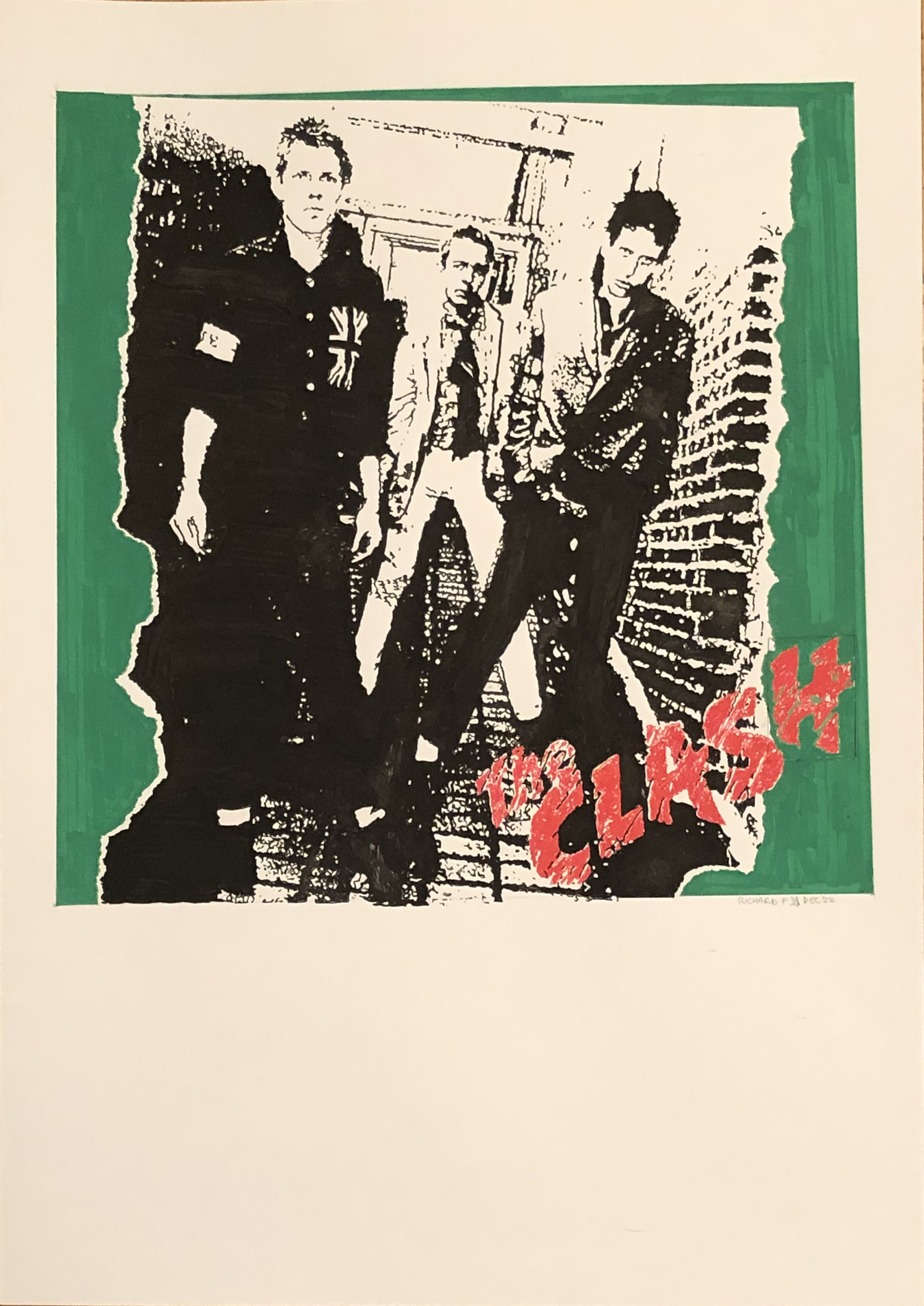
My latest painting, completed only yesterday, is the front cover of The Clash’s eponymous first album with photography by Kate Simon.

Painting these record sleeves makes a great addition to my collection of record cover art. I really feel like painting some more. I thought I might try Kraftwerk’s Die Mensche-Maschine cover. A given for anyone, like me, who likes typography. We’ll see if it materialises.