Barney Bubbles – the Anonymous Record Cover Designer.

One of the first things I look for when I see a record cover I like — or have just bought — is to check the liner notes, back cover or possibly the printed inner sleeve to find out who was responsible for the cover artwork/design. I never knew I had a collection of Barney Bubbles’ record covers despite having (at least) thirteen in my record collection. If he did allow a designer credit he would, as often as not, use a pseudonym.

I suppose I knew that Barney Bubbles (born Colin Fulcher on 30th July 1942, died 14th November 1983) had designed the logos for Stiff and F-beat record labels but none of my Elvis Costello albums or my Wreckless Eric records mentioned a designer. I did like a couple of Hawkwind’s covers, but I never bought any. No mention of a designer on those anyway. Other artists include Nick Lowe, Ian Dury, Quintessence and Billy Bremner. Barney Bubbles even released his own album, Ersatz, credited to The Imperial Pompadours

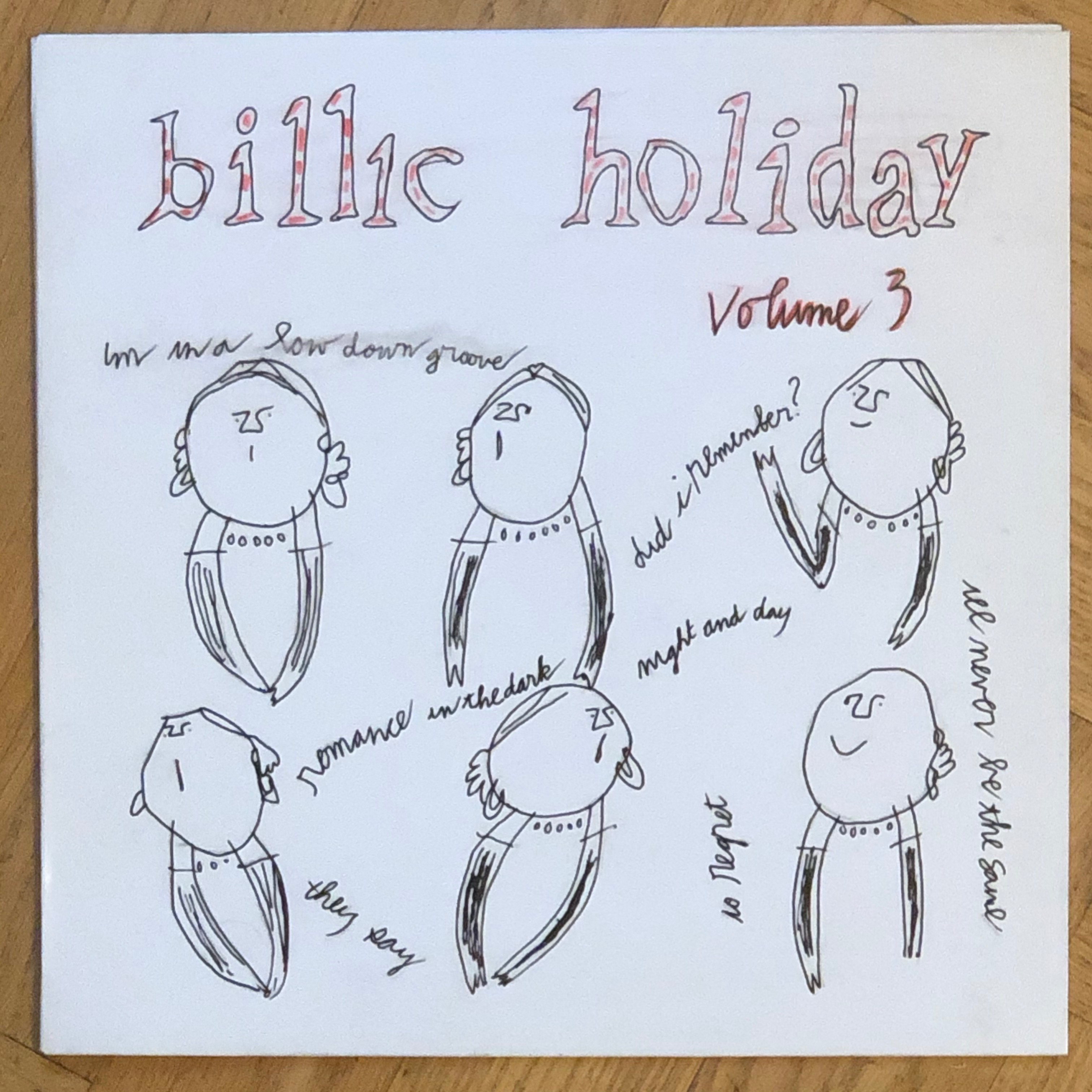
I recently starteed reading Kenneth FitzGerald’s Process Music: Songs, Stories and Studies in Graphic Design. FitzGerald writes beautifully — the book is a collection of his writings on graphic design with focus on a number of designers, one of whom is Barney Bubbles. There I read descriptions of many covers but there aren’t any pictures, so I was constantly searching Discogs to see what FitzGerald was describing. Then I found Discogs list of seventy-two Barney Bubbles cover designs, though incomplete, it is a good way to see images of most of his covers.

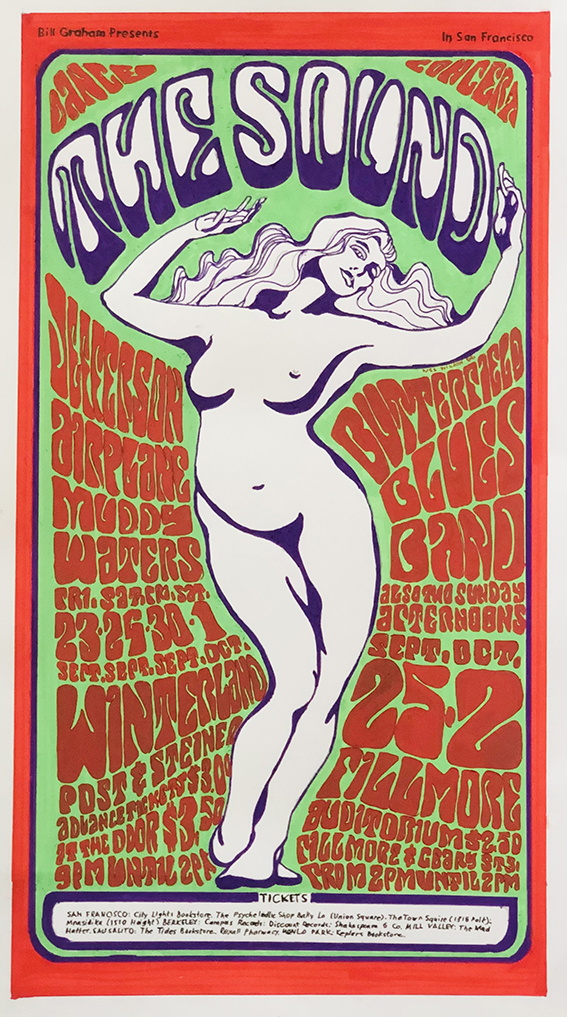
Here are a couple of other Barney Bubbles covers not included in the Discogs list:

These eclectic designs show that Barney Bubbles knew his design history. The Art of Roger Bechirian cover referencing Alex Steinweiss’ early designs for Columbia Records in the 1940s and fifties.

FitzGerald is impressed by the sheer amount of work Barney Bubbles produced between 1977 and his death at the age of forty-one in 1983. In addition to record covers he designed advertising material, posters and was an accomplished draughtsman and painter. He was suppported by Stiff Records, and later Radar Records, founder Jake Riviera.

Paul Gorman, who manages Barney Bubbles’ estate, has written a book, about Barney Bubbles’ art. Reason to Be Cheerful: The Life and Work of Barney Bubbles that was originally published in 2010 and an updated version came out in 2022. There is also a 500 copy, limited edition, box set of Barney Bubbles’ work called A Box of Bubbles.

Richard Prince’s Record Cover Art.

I can’t remember how, or why, I became interested in Richard Prince’s record cover art. I was a fan of Sonic Youth and saw them live at Hultsfreds Festival in 2002. I already owned the Ciccione Youth Burnin’ Up 12″ and Perhaps it was through listening to Sonic Youth and then buying the Sonic Nurse album that introduced me to his art.

Richard Prince was born on 6th August 1949, 21 years to the day after Andy Warhol. He grew up fascinated by Jackson Pollock’s art and that hinted to him that it might be possible to make a living as an artist. The coincidence of Price’s birthday is not the only similarity to Warhol’s art. Like Warhol, Prince has used appropriated images from adverts (his Cowboy series) and photographs. He started by rephotographing pictures and, working for a time at Time Magazine and had his first solo exhbition in 1980 and has had many later exhibitions at prestigious galleries and museums including the Guggenheim (2007).

Like Andy Warhol before him, Prince began appropriating advertisments for his art. He made a series of Cowboy paintings based on the Marlboro Man adverts. And like Warhol, who was sued by Patricia Caulfield for appropriating her photograph of hibiscus flowers for his Flowers paintings and prints, Prince (together with the Gagosian Gallery and Lawrence Gagosian) was sued by photographer Patrick Cariou whose photographs he had appropriated for a series of paintings shown at the Gagosian Gallery. Emily Ratajkowski, another photographer, used a different method to get retribution for Prince appropriating one of her Instagram posts. She photographed herself in front of Prince’s painting and made an NFT of the image that sold at Christies, New York, for $175,000!

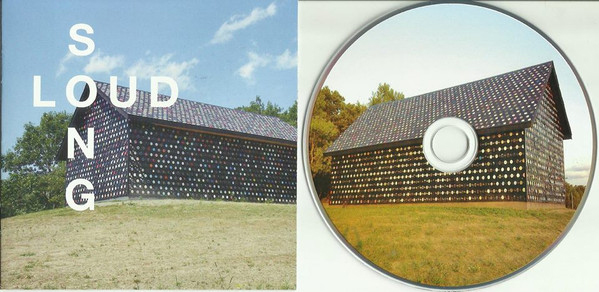
In 1985 Prince recorded his composition Loud Song onto a cassette tape and then rerecorded it onto a second cassette. Prince described the process thus: “Loud Song was recorded in Venice Beach California in a house that I rented in the winter of 1985.
I recorded the song on an electric keyboard.
I used two cassette tape recorders.
I Would play the keyboard and record what was played on the first cassette.
Then I would play what I recorded and play more keyboard and record both sounds on the second cassette.
Then I would play back what I recorded on the second cassette and play more keyboard and record all that onto the first cassette.
It was like I was using the cassette players as musicians.
I would record this way until the song got really loud.”

Kim Gordon painted the cover picture and a limited edition of 250 copies, signed by Prince, was published by 303 Gallery.

There is also a 7″ version released in a limited edition by Eric Doeringer that has Loud Song as its A-side and two tracks, Catherine and My Way, by Doeringer on the B-side. I also feel that the cover is Doeringer’s re-imagination of Kim Gordon’s original painting. Doeringer took the Loud Song track from Richard Prince’s Loud Song CD.

Eric Doeringer is an artist living in Los Angeles, who often appropriates other artists’ works in his art. Many of them, including Richard Prince, have applauded his work, while others have treatened him with legal action to stop him using their work.

I found a further version of Loud Song when, in 2022, I bought Richard Prince’s High Times book. Inside was a single-sided, green flexidisc version released in 2018.

The “Loud Song” flexi from the “High Times” book.

There is also a Loud Song CD that I haven’t managed to find. I’m primarily interested in vinyl so I probably won’t go after the CD.

The next record produced by Richard Prince was Good Revolution / Don’t Belong, a limited edition artwork published in 1992 in an edition of 80 copies. These were presentation gold seven-inch records with an engraved plaque mounted on a C-print, framed, includes a playable black vinyl record by the artist, recorded both sides, “Good Revolution” (1:46) and “Don’t Belong” (1:46), arranged and performed by Richard Prince, recorded and mixed at Harmonic Ranch by Mark Degliantoni, September 1992 (20 1/2 × 16 1/2 × 1 1/2 in | 52.1 × 41.9 × 3.8 cm).

A Tribe Called Quest released their final album, We Got It From Here … Thank You 4 Your Service, in 2017 with cover art bt Richard Prince. Prince’s design harked back to the. femail form on earlier ATCQ albums, althoiugh, to my eyes the figure looks more masculine. The coloration would be repeated in the nine covers Prince produced for his Gagosian exhibiition in 2022 (see below).

In 2018, Prince released a single-sided, 12-inch picture disc in conjunction with the Brigade Commerz Gallery entitled It’s a Free Concert Now. There was a limited “Artist’s” edition of twenty-five signed copies and a further unsigned edition, also of 25 copies. Mine, I think, is the unsigned edition (it’s still sticker-sealed, so I haven’t been able to see the B-side where Prince’s signature would be.)

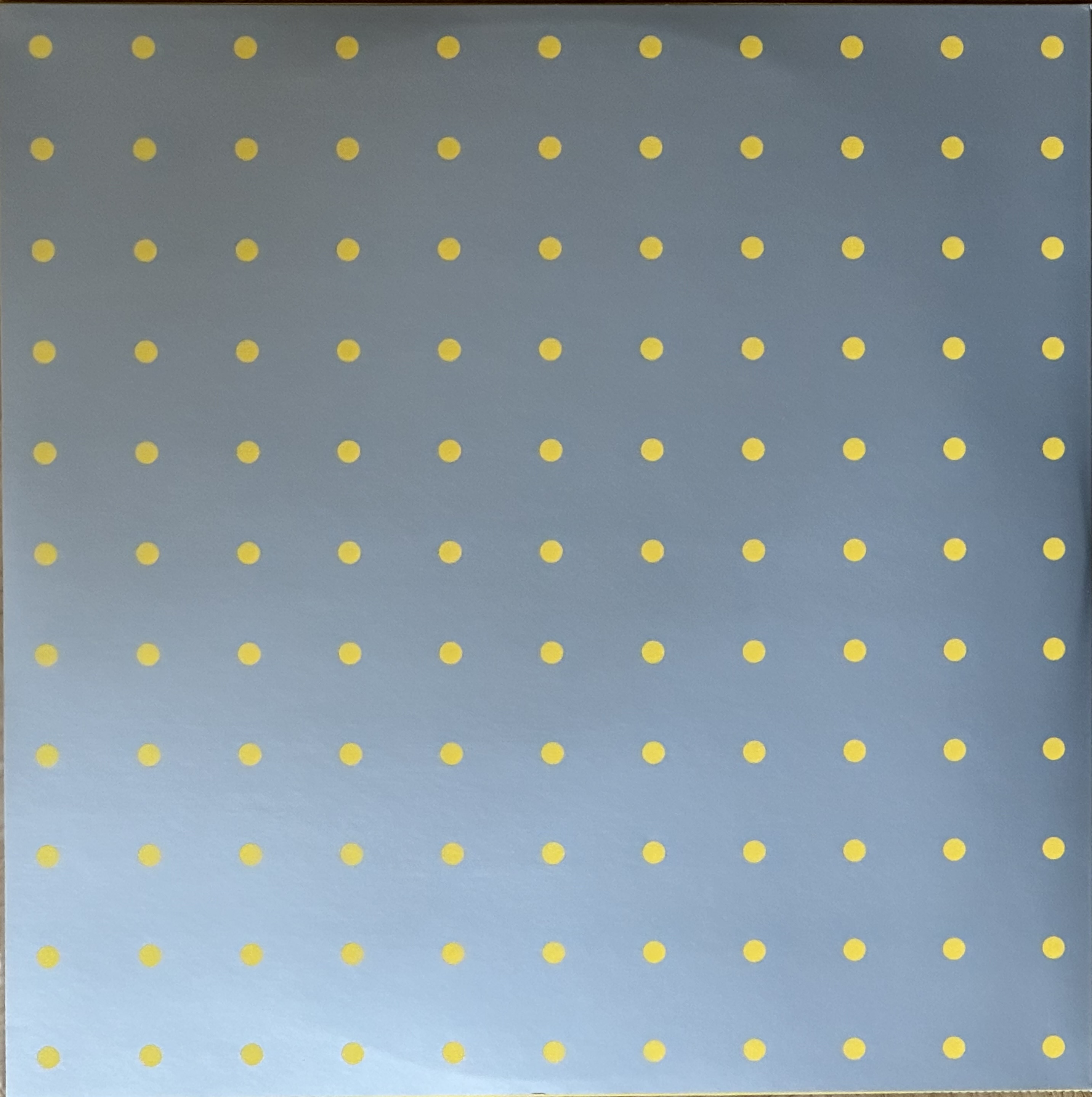
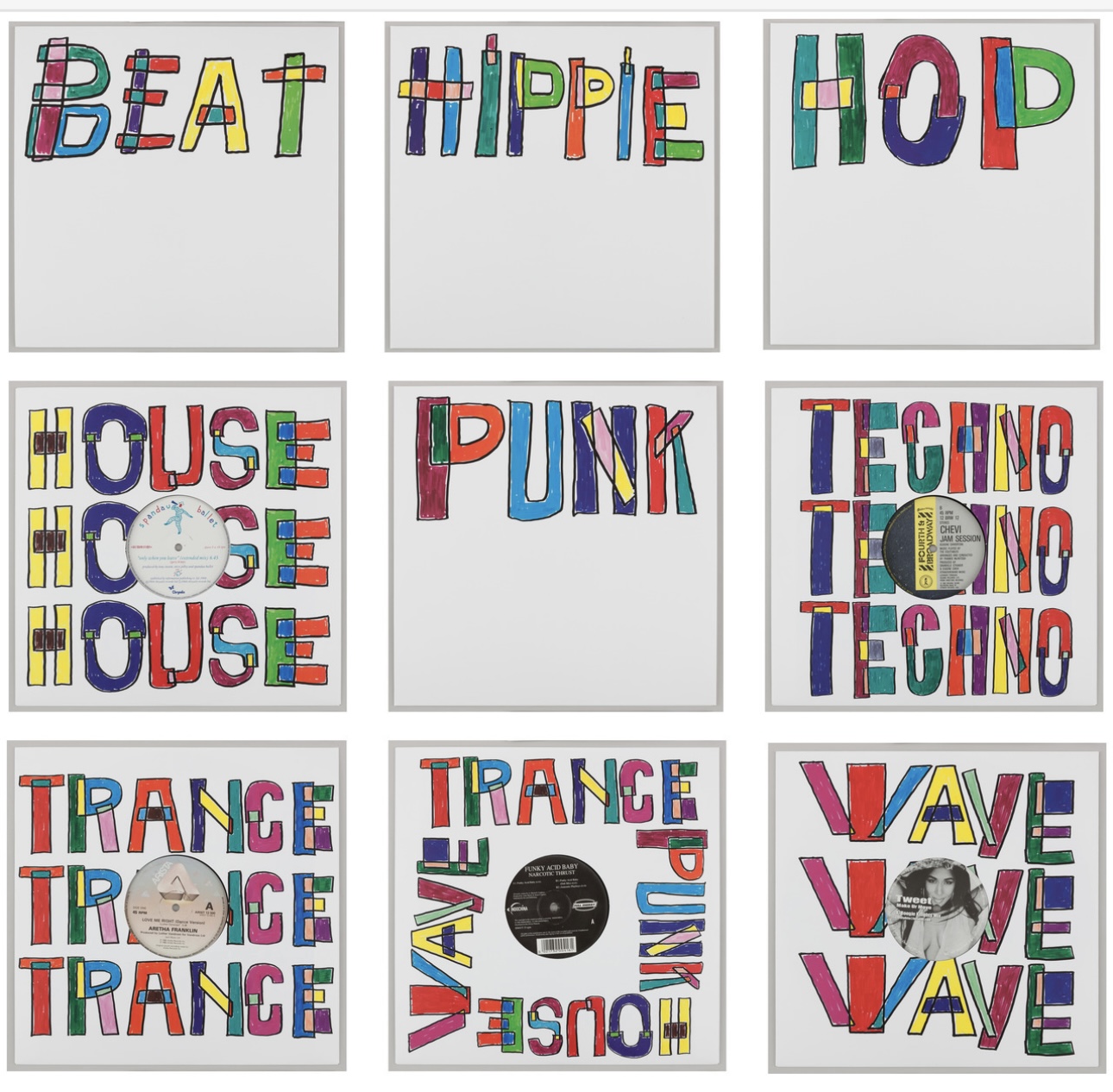
Then in 2022 Prince designed a series of nine record covers that were really just artworks. Each cover contained a random 12″ record. I haven’t been able to establish whether or not these were a limited edition. The covers were part of a Richard Prince exhibition at the Gagosian Gallery in Burlingtin Arcade, London, and apparently sold for £30 each. Unfortunately, I arrived too late to get any.
The final, and most recent, Richard Prince cover is his reimagining of the Nine Inch Nail’s The Downward Spiral album, commissioned by Interscope Records as part of the company’s 2023 thirtieth anniversay set of reissues. I’ve described the twelve Damien Hirst covers in this series in a previous post. Richard Prince only got to reimagine this one cover. It is available in two versions: a picture disc, double LP, in a sngle pocket cover in an edition of 500 copies and a 100 copy, deluxe black vinyl version in a gatefold cover packaged in Gucci packeting. Needless to say, I could only stretch to the picture disc version (I can survvive without the Gucci packaging.)

Nine Inch Nails’ The Downward Spiral cover reimagined by Richard Prince.

These are all the Richard Prince covers I have found so far. I’m sure there may be more. I’ll keep you posted.

Further Damien Hirst and Peter Blake Additions to My Collection.

Just when I thought my record buying days were over I got hit by the Interscope 30th anniversary reissues with covers of classic albums reimagined by contemporary artists including the whole Eminem album catalogue with covers reimagined by Damien Hirst and a Nine Inch Nails cover reimagined by Richard Prince. In all, Interscope reissued 47 albums with reimagined cover art.

Nine Inch Nails The Downward Spiral Reimagined by Richard Prince.

Here’s the full list (thanks to Vinyl Factory for the compilation):
1. Dr. Dre – The Chronic (Adam Pendleton)
2. 6LACK – FREE 6LACK (Amoako Boafo)
3. Billie Eilish – When We All Fall Asleep Where Do We Go? (Anna Park)
4. Gwen Stefani – The Sweet Escape (Anna Weyant)
5. Timbaland – Shock Value (Burnt Toast)
6. N.E.R.D. – Seeing Sounds (Burnt Toast)
7. Billie Eilish – dont smile at me (Cecily Brown)
8. Yeah Yeah Yeahs – It’s Blitz! (Chloe Wise)
9. Eminem – Entire Catalogue (Damien Hirst)
10. Mary J. Blige – The Breakthrough (Derrick Adams)
11. 2Pac – All Eyez On Me (Ed Ruscha)
12. Nine Inch Nails – Broken (Emily Mae Smith)
13. Blackstreet – “No Diggity” (Ferrari Sheppard)
14. Summer Walker – Over It (Genesis Tramaine)
15. Olivia Rodrigo – SOUR (Henni Alftan)
16. Kendrick Lamar – DAMN. (“DNA”) (Henry Taylor )
17. Selena Gomez – Rare (Hilary Pecis)
18. Gwen Stefani – Love. Angel. Music. Baby. (“Cool”) (Issy Wood)
19. Lana Del Rey – Born To Die (Jenna Gribbon)
20. BLACKPINK – THE ALBUM (Jennifer Guidi)
21. U2 – “Beautiful Day” (John Currin)
22. Machine Gun Kelly – Tickets to My Downfall (“My Bloody Valentine”) (Jordy Kerwick)
23. No Doubt – Tragic Kingdom (“Just a Girl”) (Julie Curtiss)
24. Snoop Dogg – Doggystyle (KAWS)
25. Dr. Dre – The Chronic 2001 (Kehinde Wiley)
26. Kendrick Lamar – To Pimp a Butterfly (Lauren Halsey)
27. Billie Eilish – Happier Than Ever (Lisa Yuskavage)
28. Lady Gaga – Fame Monster (Loie Hollowell)
29. No Doubt – Tragic Kingdom (“Spiderwebs”) (Lucy Bull)
30. Machine Gun Kelly – Tickets to My Downfall (Mark Quinn)
31. Lana Del Rey – Paradise (Matthew Wong)
32. The Game – The Documentary (Fulton Leroy Washington
a.k.a. Mr. Wash)
33. Lady Gaga – Joanne (Nicolas Party)
34. 2Pac – The Don Killuminati: The 7 Day Theory (Nina Chanel Abney)
35. Black Eyed Peas – The E.N.D. (OSGEMEOS)
36. Kendrick Lamar – Good Kid MAAD City (Rashid Johnson)
37. Lana Del Rey – Norman Fucking Rockwell (Raymond Pettibon)
38. Kendrick Lamar – Good Kid M.A.A.D City (“Swimming Pools” (Drank)) (Reggie Burrows Hodges)
39. Nine Inch Nails – The Downward Spiral (Richard Prince)
40. 50 Cent – Get Rich or Die Tryin’ (Sayre Gomez)
41. Yeah Yeah Yeahs – Fever To Tell (Shepard Fairey)
42. Kendrick Lamar – To Pimp A Butterfly (“King Kunta”) (Stanley Whitney)
43. Juice WRLD – Goodbye and Good Riddance (Takashi Murakami)
44. Eve – Scorpion (Titus Kaphar)
45. Kendrick Lamar – DAMN. (Toyin Ojih Odutola)
46. Tupac – Me Against The World (Umar Rashid)
47. Helmet – Meantime (Will Boone)

So I reckoned I was up to date with my Damien Hirst collection even though I am going to have to forgo the full Eminem oeuvre as these 12 albums cost a prohibitive $2,500 each (but you get a giclee print of the album’s artwork signed by Damien Hirst in an edition of 100, so effectively you get a free album if you buy the print!) However, no sooner had these five new Damien Hirst creations arrived than I found out the he had designed the cover for Pete Townshend’s (he of The Who) latest single Can’t Outrun the Truth which was released last March in an edition of 200 all autographed by Pete. Despite being on the Who’s mailing list, I missed out on this and had to resort to Discogs to´find a copy. Not the cheapest way to get a rare record.

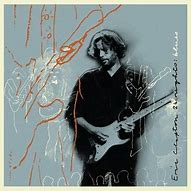
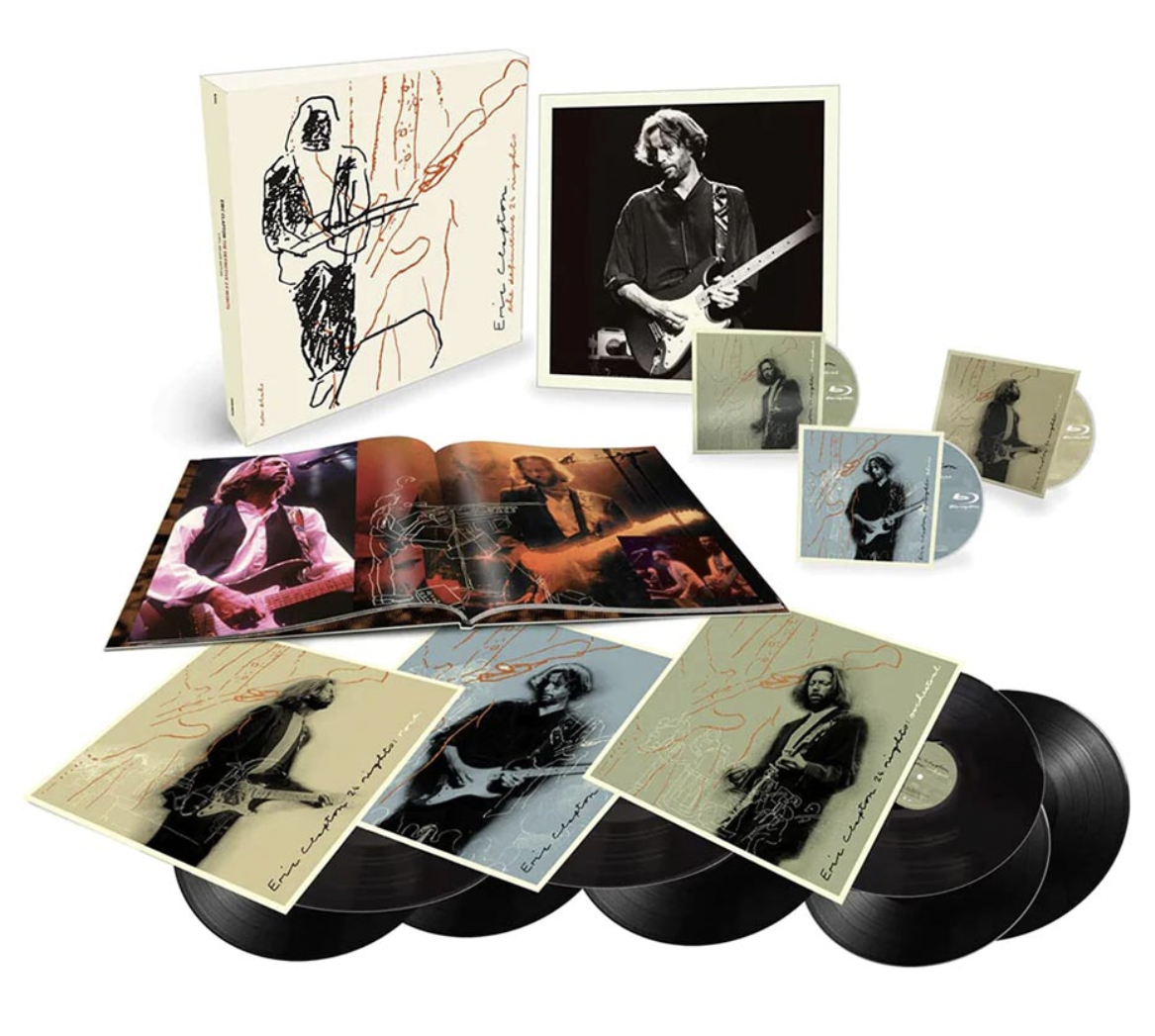
And then I read that Eric Clapton has released three albums of his legendary 1980-81 24 Nights concerts at the Royal Albert Hall, calling them the Definitive 24 Nights. The three albums called 24 Nights – Rock (3 LPs), 24 Nights – Orchestral (3 LPs) and 24 Nights Blues (2 LPs). There is also a deluxe box set of the eight LPs with three Blu-ray discs, a book and a signed lithograph of Eric Clapton. Of course Eric reuses Peter Blake’s sketches from the original 24 Nights album.


The limited edition deluxe box set was available from Clapton’s store but rapidly sold out. However, it is available from most record shops. I’ll have to wait for my copy to see exactly how much Peter Blake was involved in the design of these sleeves.

Some New Re-imagined Covers by Famous Artists That are Way too Expensive for Ordinary Collectors.

Ever heard of Interscope Records? I hadn’t until recently when a good friend and fellow collector tipped me off about a new Damien Hirst cover that was to be released by Interscope Records as part of their thirtieth anniversary celebration.

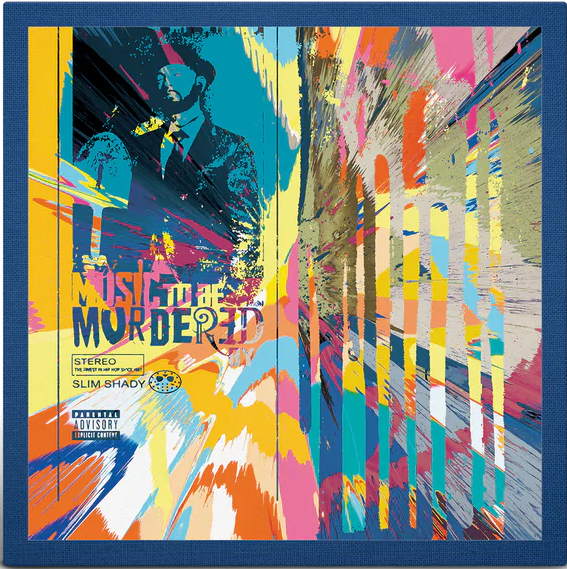
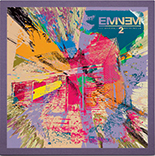
It turns out that the company released Eminem‘s first album The Slim Shady in 1999 and that they are releasing limited edition albums of the Eminem catalogue with new cover art by Damien Hirst. Five of the redesigned albums are picture discs in new Hirst designed covers produced in limited editions of 500, while a further seven are available on black vinyl, in signed editions of 100 that include a giclée print of the cover art packaged in Gucci-designed wrapping. Each picture disc version costs USD 100, and the signed editions cost USD 2,500 each. Damien Hirst has done these reimagined covers for free as the proceeds are going to charity. Despite the fact that the proceeds from the sale of these art covers are going to charity I feel that they are wildly overpriced. The picture discs are each produced in editions of 500 copies and USD 100 strikes me as too expensive. I think a more reasonable price would be around USD 50. I would expect a record priced at USD 2,500, like the black vinyl albums to be in much more limited editions, perhaps even unique items in order to motivate the price. These are probably aimed at galleries or institutions rather than individual collectors and the exorbitant price prevents serious collectos of the individual artists’ covers from buying them.

In addition to these new Damien Hirst covers there is a redesigned Snoop Doggy Dogg Doggy Style LP cover by KAWS for USD 100 in an edition of 500 copies that sold out almost immediately it was released. However, there was only one further release that I was interested in, and that is Richard Prince‘s reinterpretation of Nine Inch NailsThe Downward Spiral LP.

Nine Inch Nails The Downward Spiral Reimagined by Richard Prince.

In addition to the Damien Hirst designed covers for the Eminem albums, Interscope have released twenty-one other albums with redesigned covers priced at USD 2,000-2,500 by artists such as Gwen Stefani, Lana del Rey, Helmet, Dr. Dre, Billy Eilish and others.

These are the black vinyl Damien Hirst albums:

I actually really like these Damien Hirst covers! Obviously I can’t afford the USD2,500 limited editions and so I can never own a complete set of the artist’s record cover art.

I have ordered the five Hirst and the RIchard Prince picture disc editions. Perhaps I’ll make my own versions of the USD2,500 editions later to complete my collection.

All these covers can be bought through the Interscope Records site or via NTWRK app, subject to availability.

Have I Bought My Last Record?

I bought a record the other day. But it wasn’t for me. My Internet friend Ruggiero needed a copy of RATFAB’s single Det brinner en eld / Mörka ögon to complete his collection of Andy Warhol record covers, and I found him one.

Otherwise I haven’t bought a record for over a month — that must be some sort of record for me! Strangely, I don’t feel the urge to buy any more records. I am beginning to realise that I have an impressive collevtion of record cover art — okay, there are a couple (or three) gaps that I could try to fill, but those gaps are so exceeding rare and filling them would be extremely expensive if I ever found any of them. Actually having these rarities might give me a moment of two’s joy, but then my collections would be COMPLETE, and where’s the joy in that? So — I’m thinking of stopping the search.

However, a new though occurred to me: what happens if one of the artists whose record covers I collect produces a new one? Should I go for that? Andy Warhol isn’t going to produce any new covers (though hi art may very well appear on a new cover somewhere.) I’m somewhat doubtful as to whether Sir Peter Blake will produce any either. I have heard that Damien Hirst has at least one cover in the pipeline, as has Richar Prince (another artist I like). Klaus Voormann is still active despite soon being 85 years-old and could well come up with another cover or two. David Shrigley is very much active and still interested in music and, in particular, records. Viz. one of his latest posters Awful Music.

Record covers that parody famous covers always interest me. I have some Sgt. Pepper parodies and a number of Velvet Underground “Banana” cover parodies. one by the aforementioned D. Shrig: his cover for Castle Face Record’s The Velvet Underground & Nico and another of his for Stephen Malkmus & Friends’ rerecording of Can’s Ege Bamyasi.

David Shrigley’s parody of the Velvet Underground & Nico cover.

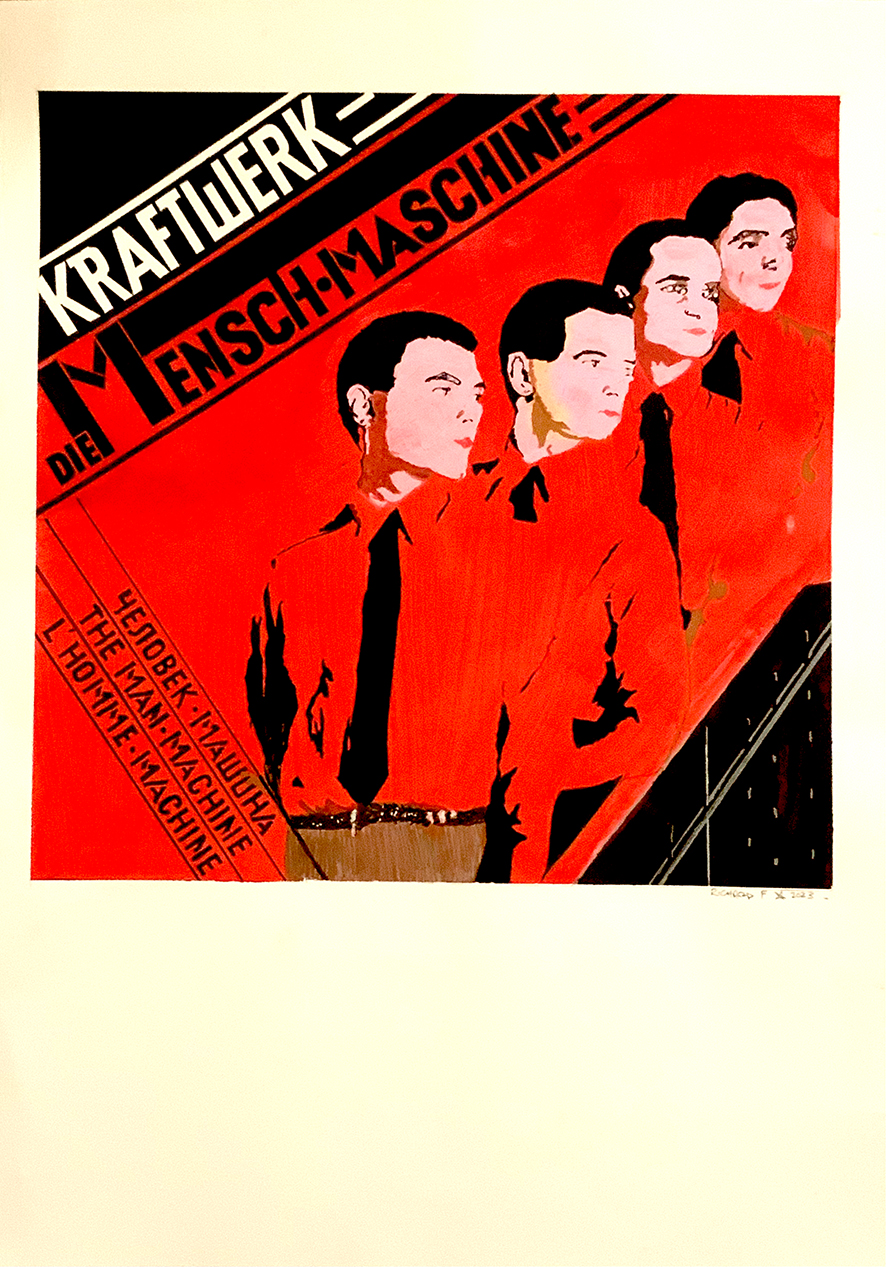
I have always liked Kraftwerk — I’ve seen them live three times — and even have a pullover with the Die Mensche Maschine cover image. I painted a version of that cover not too long ago.

And I recently discovered that the Ebony Steel Band’s cover had recorded a cover version of the album:

Well, I very nearly pressed the Buy it Now button for this one but I realised that I didn’s actually own Kraftwerk’s original, so there was little point in buying this reverential recreation of that famous cover.

So, I don’t think I’ll be buying any new records for the foreseeable future. Unless…

Famous Artists’ Works on Record Sleeves. But are They Really by the Artist?

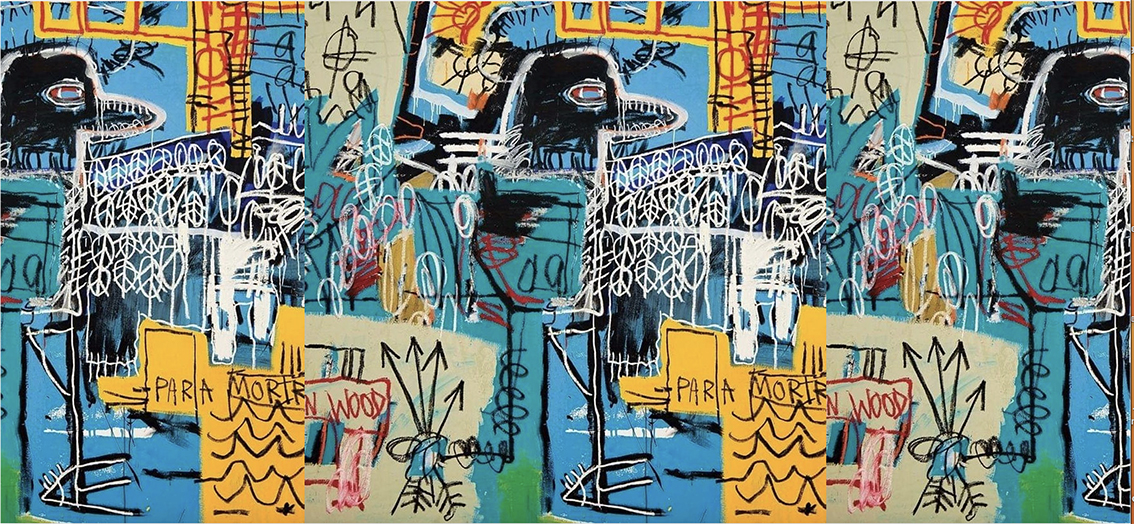
The idea for this post came a couple of days ago when I discovered a “new” (well, new to me, anyway) cover for the Strokes’ 2020 album The New Abnormal (RCA Records), designed by Tina Ibanez that uses part of Jean-Michel Basquiat’s 1981 painting Bird on Money.

Here’s the complete painting: a tribute to Charlie “Bird” Parker.

Now I have a couple of record covers designed by Jean-Michel Basquiat — hos famous Beat Bop for Rammelzee vs K-Rob and the Offs First Record, and these were actually designed by Basquiat. I also have a 2020 reissue of Beat Bop and this is still a “genuine” Basquiat cover. However, can I accept Tina Ibanez’s use of the Bird on Money detail as a Basquiat cover? After all, there’s no offical acknowledgement that Basquiat’s estate had sanctioned the use of the painting.

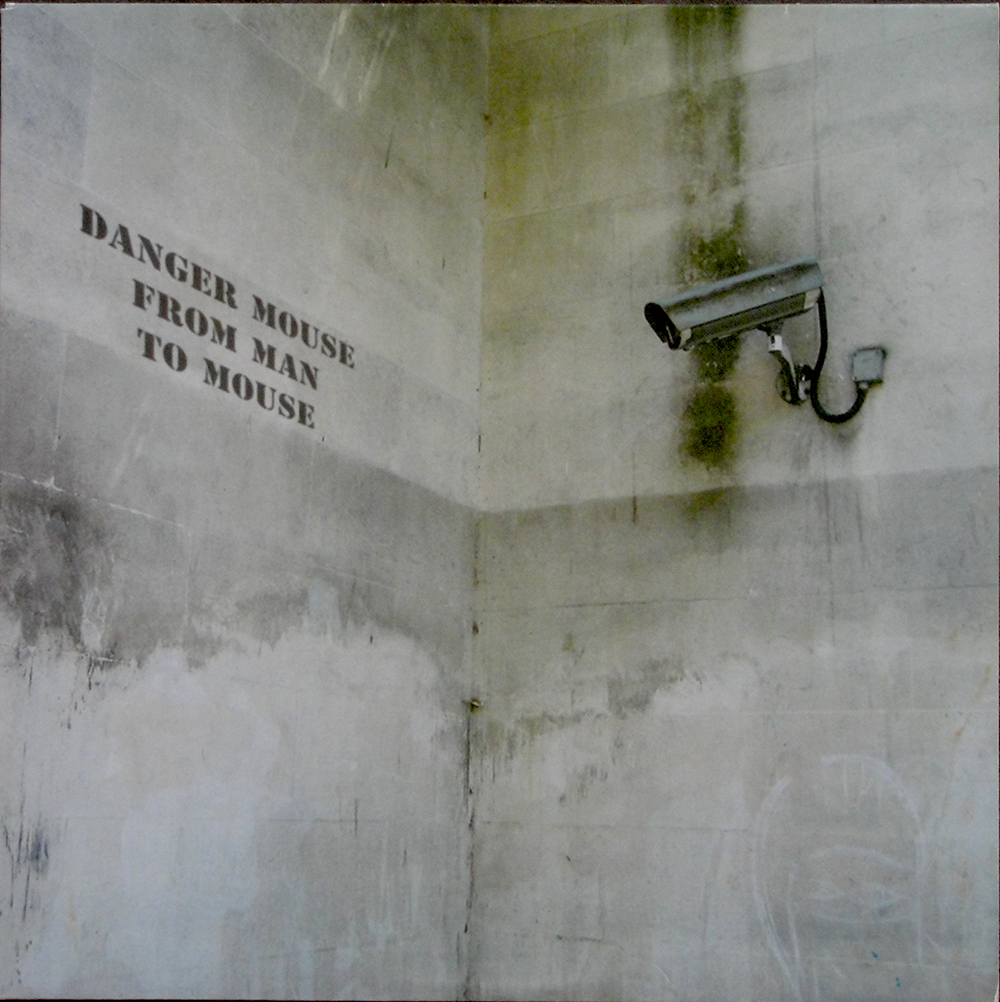
Looking through my cover art collection these are other covers that are of doubtful provenance. There are a lot of covers on vinyl records and CDs that use Banksy’s art without the artist’s authorization — perhaps more than are actually approved! The last record cover with approved Banksy artwork appears to have been released as long ago as 2007 was Danger Mouse’s From Man to Mouse LP (not on label) that I assume was authorised as the artwork is credited on the back cover to Banksy.

Danger Mouse – From Man to Mouse double LP.

There is also one Peter Blake cover that I’m not sure Peter Blake even knows about. I’ve tried to ask him a couple times but without success. It’s the cover to the Fall’s I’m Frank promotional 12″ (Fontana Records).

This was released in 1990 when Blake’s painting Nadia was in private ago. It was donated to the Rhode Island School of Design in 1995 and no one currently at the School knows of it being used on this cover. It’s my guess that Peter Blake doesn’t know either.

In 1986, Debbie Harry released her second album, Rockbird (Geffen Records, 1986), and the cover is generally ascribed to Andy Warhol. However, he didn’t design it; Stephen Sprouse was responsible. The photogrpah of Debbie Harry was taken by the Canadian photographer couple Guzman, not Warhol. However, Sprouse asked Warhol for permission to use his Camouflage pattern as the backdrop. There are four colour variations of the Rockbird cover.

Another cover often included among Warhol’s sleeves is the East Village Other’s Electric Newspaper (ESP Records, 1966). This cover was not by Warhol and his only involvement is the inclusion of his track Silence on the record itself. Other trsck were by Warhol associates Gerard Malanga and Ingrid Superstar but the cover was by East Village Other founder Walter Bowart.

Andy Warhol’s input on the design of Moondog’s The Story of Moondog album (Presige Records, 1957) was limited. The design calligraphy was dione by his mother Julia and Andy only clipped the text to fit the cover frame.

The cover of Thelonious Monk’s 1957 album Monk (Presige Records) was designed by Reid Miles with calligraphy again by Julia Warhola, but the cover is still considered a “Warhol cover”.

The fourth “Warhol cover” not designed by Warhol is the Ultra Violet LP from 1973 (Capitol Records). The front cver photo of Superstar Ultra VIolet (real name Isabelle Collin Dufresne) was taken by photographer Lee Kraft but she icluded a picture of a Polaroid portrait taken by and autographed by Warhol.

And finally there is Loredana Berté’s album Made in Italy CDG Records, 1981). Berté became friends with Warhol and is said to have made him spaghetti dinners while she lived in New York to learn English. He intended to design the cover for this album but it never happened and Christopher Makos took the cover photo and the cover is cretidited to the “Warhol Studio.” Makos also took Berté’s portrait for her next album Jazz but that doesn’t seem to qualify as a “Warhol cover”.

I’m sure there must be other covers in my collection that are incorrectly attributed to a specific designer but I can’t come up with any others just now.

The Nation’s Nightmare — Updated.

I suppose I could date the start of my collection proper of Andy Warhol’s record covers to 1967 when I bought The Velvet Underground & Nico and then, a year later, bought White Light/White Heat (the Velvets’ second album) but although I bought the Rolling Stones’ Sticky Fingers when it came out in April 1971 I didn’t really consider I was collecting Warhol covers. Another Warhol cover — The Rolling Stones’ Love You Live LP arrived in 1977 and then Diana Ross’ Silk Electric turned up in 1982 and I realised I had a collection of Warhol covers! However, I had no knowledge of his early work until I was introduced to his jazz covers by Guy Minnebach, whom I had met online, and who tipped me off about a number of covers and sold me my treasured copy of The Nation’s Nightmare in 2006. While showing obvious signs of wear, this album cover was one of my prized possessions.

I continued to add to my collection of Warhol covers in the years before and after the acquision of The Nation’s Nightmare and was lucky to have started before many of the rarer covers were recognised as being Warhol designs. Some of the rare ones, such as The Story of Moondog and Ultra Violet, evaded me for many years, but I was eventually able to add these, too.

I 2018, I attended the opening of Moderna Museet’s exhibition Andy Warhol 1968, an homage to mark the 50th anniversary of the Museum’s historic Warhol exhibition that ran from February into March 1968. Having toured the exhibition, and just before leaving, I saw eight record sleeves on the final wall. Among them was the cover for East Village Other (aka Electric Newspaper) labelled as being a Warhol cover.

The eight “Warhol” covers at the Warhol 1968 exhibition with the East Village Other cover (bottom row, second from right).

Well, I knew it wasn’t! So I plucked up courage to look for John Peter Nilsson, the exhibition’s curator and pointed out this misstake. I mentioned to him that I had a “complete” collection of Warhol covers and he told me of plans for the exhibition to move to Moderna museets sister site in Malmö from March to September 2019 and the possibility to display my complete collection. In the preparation for the collection of my covers, my The Nation’s Nightmare cover got slightly damaged.

My damaged cover.

Ever since it was returned to me late in 2019, I have had an ambition to replace it with a better copy. Several have appeared on auction sites and Discogs over the past three years but none was in the condition I was looking for until I saw a copy on Discogs in late January 2023 and, after seeing pictures, and doing som haggling, decided to buy it.

The seller was locatred in Connecticut, USA, and posting it to Sweden would make me liable to pay an exorbitant import charge, so I enlisted a friend in Savanna, GA, to receive the record and post it on. The record arrived safely and he posted it on Febrary 8th and I follwed the USPS tracking with bated breath seeing that the package left JFK airport on February 14th. After that there were no further tracking records. I contacted the Swedish postal service Postnord, who told me that they had no record of the shipment and that it might have been flown to any European city and that I should wait for further information from USPS. None was forthcoming, so on 23rd February I phoned USPS who couldn’t trace the shipment. I was desperate and mailed my friend in Savanna to start proceedings to claim for a lost shipment. However, before he could do so, I received notice from USPS on 24th February that the package had indeed been flown to Arlanda (Stockholm) airport and had been handed over to Postnord for customs clearance that day. I breathed a sigh of relief. At least the shipment wasn’t lost. But a week went by, and then ten days, and I still hadn’t received any informatin from the Swedish customs or Postnord, so I phoned again on March 7th and after a ten-minute search the operative told me that the package had been cleared by customs and would be with me in three or four days. It finally arrived on 10th March, a little over a month after it was posted.

The cover is in beautiful condition, I would call it “excellent” with no major wear or writing anywhere. The record looks unplayed with immaculate labels and the rear cover shows some yellowing due to age but is otherwise great. I am greatly relieved that it finally arrived and really pleased to have this lovely copy in my collection.

Hellstrom – A Swedish Street Artist.

As a collector of record cover art, I have tried to limit collecting to a manageable number of artists, and the ones I have chosen are those that have produced a collectible number of covers. I once set out to collect Alex Steinweiss covers but gave up after I had found about fifty as there were still about 2,450 still to collect. I similarly decided not to try to collect Anton Corbijn‘s record covers — he’s been responsible for far too many. As I have mentioned on a previous post I did have a nice collection of Vaughan Oliver‘s record cover art but in the end I couldn’t house it all so it had to go.

My collection of record covers by street artists is limited to only three. I have what seems to be an ever expanding collection of covers by the artist who calls himself Banksy and a few choice covers by Robert del Naja (a.k.a. 3D). However, a couple of years ago I had an exhibition of some of my paintings at a gallery in Stockholm and exchanged a couple of works for posters by the Swedish street artist Iron. At the same time I had begun to notice the appearance of paper deer stuck on hoardings surrounding building sites around town. These turned out to be the work of another Swedish street artist by the name of Hellstrom. Like Iron, he prefers to keep his identity secret but he has been interviewed in a recent book Hellstrom Street Art published in 2019.

The book gives a good overview of Hellstrom‘s work to date. One picture in particular, together with the cover image, struck a chord.

Hellstrom shares his name with the popular Swedish singer Håkan Hellström and it is Hellstrom‘s portrait on Hellström on the cover of the book. It transpires that Hellstrom (no dots over the “o”) stencilled this portrait on a limited edition of Håkan Hellström‘s (with the dotted “o”) 2019 album Illusioner in an edtion of 40 copies.

One day last August I popped into my favourite record shop in Stockholm and saw this album hanging on the wall. It was number 36/40 and it accompanied me home to be the sole representative of Hellstrom‘s (minus the dots) art in my record cover collection.

My Day With the Ramones.

I fancied that I hada pretty compete collection of punk albums ranging from the original 1977 version of Never Mind the Bollocks… through all the Clash albums and Stranglers and Damned albums, too. I had picked up a cutout copy of the Ramones Leave Home and a copy of Road to Ruin but I wasn’t a fan.

I used to read Jan Gradvall’s column i Swedish music magazines and in 1995 bought his essay anthology Artiklar, intervyuer, essäer 1981-1994 (in Swedish) and one of the first essays (on page 66 already) was about the Ramones. The essay started with a list of the timings of the 28 songs on the Ramones It’s Alive album. 1:57, 1:54, 1:56, 2:20, 1:49. 1:34, 2:24, 1:36, 2:15, 1:34, 1:35, 2:40, 2:19, 1:42, 1:40, 1:45, 1:35, 2:16, 1:40, 1:25, 2:40, 2:08, 1:14, 1:51, 2:05, 1:40, 1:20, 2:02. Gradvall used these timings to declare the Ramones as the perfect pop group. I was fascinated and started to listen to them.

A few weeks after reading Gradvall’s eulogy to the band I read in a local newspaper that the Ramones were no longer going to tour. I had sort of decided that I really wanted to see them live. Oh, well, thought I, that ain’t gonna happen. However, only a few weeks later I heard that Ramones were scheduled to play at Skellefteå festival a mere 133 kms south of Luleå, where I lived. Skellefteå festival was a fixture on the northern Swedish festival circuit and “happened” to always be on the same weekend as the huge Roskilde festival in Denmark. Thus Urkraft, the organisers of the Skellefteå festival managed to book artists appearing at Roskilde including Skunk Anansie, Suede, the Stooges alongside top Swedish bands.

So, I phoned Urkraft and simply asked which hotel the band would be staying at and was immediately told that they would be at the Scandic Hotel, so I booked myself in there for the duration of the festival.

So I drove down on the 24th June in the midsummer sunshine and went to check into the hotel. I was standing at the reception desk and asked if the Ramones had arrived just as a man emerged from the lifts behind me and heard my question. It turned out this was Monte Melnick, the legendry Ramones tour manager. He asked who I was and what I was doing there an I explained that I was from the town of Luleå where I worked as a doctor. Monte immediately asked me if I could help him. He had a chronic cough, he said, and doctors couldn’t find the cause. He wondered if I could help. I had to admit that I hadn’t brought my stethoscope with me… We chatted a bit and I showed him the records I had brought with me and asked if there was a chance I could get them signed. Monte said that the band would be in the hotel restaurant at six and that I should meet them there.

Said and done! I arrived at the restaurant on the dot of six and saw one band member sitting alone at a table and so I wandered over and, not knowing what to say, shyly asked “are you with the band?” It was, of course, Johnny. He looked at me and snarled “can’t you see I’m eating?” and he told me to come back when he’d finished.

I was hungry, too, and took a seat at a table almost as far away from Johnny as possible and ordered a hamburger and a beer and waited. No sign of Monte and the other three band members yet.

Johnny finished his meal and came over and joined me at my table and started asking questions about who I was and what I was doing in Skellefteå. He told me how many gigs the Ramones had played in their career (I think I remember he said 1200, but that can’t have been right) anyway we started talking and he told me about his autogrpah collection of over 14,000 signatures. He told me he collected photographs of sports personalities and B-movie stars and sent them to the artist to get them signed. I said I thought he got them back as he was a celebrity and I didn’t think I would be as lucky! We chatted for about 45 minutes while Monte, Marky and Joey arrived in the restaurant. Marky and Joey sat pasty-faced leafing through girly magazines and looking bored. They happily all signed my records though. CJ was already somewhere in the festival area so I had to catch up with him later. Monte gave me a backstage pass (I still have it somewhere, but can’t lay my hands on it) to get into the festival even though I had bought a ticket — so I was enrolled in the Ramones for the rest of the evening. I had to teach Joey how to pronounce Skellefteå (shell-eff-tio) before the gig. Monte invited me to watch from backstage, but I wanted to see the Ramones in action so went out front.

They came on stage at exactly on schedule and — “one, two, three, four” — played without a pause for 75 minutes — an utterly amazing experience! I felt I’d been run over by a steamroller. Hey Ho, Let’s go! These were the days before smartphones so I don’t have any pictures. But I treasure the experience.

In 2011, Swedish author Bengt Ohlsson published his book Rekviem för John Cummings a biography of Johnny Ramone, which I immediately bought and read. I recognised much of what Johnny had told me in Skellefteå.

Fast forward to today. In mid November 2022, I read a review of a new book Ramones i Sverige — världens första punkband skruvar upp tempot i folkhemmet (Ramones in Sweden — the World’s First punk Band Speed up the Welfare State) by Sven Lindström, Jan Lagerström, Petter Lönegård and Kjell Magnusson. The book catalogues the twenty Ramones gigs in Sweden between May 1977 and June 1995, plus a gig in Oslo, Norway in August 1980 and their concert at Roskilde festival, Denmark, in June 1985.

I was too shocked to try to time the songs and I didn’t/couldn’t make a set list either. I spent the rest of the evening in a daze wandering the festival site. A few years later, in 1999, I joined the Skellefteå festival crew as festival doctor looking after both the artists, the festival crew and memebrs of the public. I got quite a few autographs as well.

Mother Samosa’s Two Albums on CD. Designed by Robin Gunningham.

Do we really care who the person behind the Banksy moniker really is? Well, in 2015 the Daily Mail “revealed” that one Robin Gunningham, a public school educated person is indeed Banksy. However, this has never been officially confirmed and collectors of the artist’s work don’t seem to mind who is behind the art and art dealers won’t accept that works signed Robin Gunningham should be classified as being by Banksy.

In the past decade, everything that Banksy seems to have had a hand in has escalated in value; even record and CD covers with his art have become sort after collectors items. Now there are literally hundreds of such covers floating around among collectors but only a few are offically authorised as being by Banksy. The vast majority are covers that use the artist’s works, often subtly modified to suit the us

The earliest authorised Banksy covers are for the Bristol hip hop band One Cut (or OneCut) released on Jamie Eastman’s Hombré label between 1998 and 2000. In 1999 John Stapleton asked Bansky to stencil 100 promotional covers for the Capoeira Twins 12″ single 4 x 3 / Truth Will Out.

At about the same time Banksy had been with the Easton Cowboys football team on their tour to Chiapas, Mexico, where he painted some murals. A cassette of revolutionary songs Called Canciones electorales was released using Banksy’s painting of a Zapatista on the inlay. The cassettes were white, yellow and red and produced in limited quantities.

Back to the artist named Robin Gunningham. Sometime in the mid to late 1990s a guy called Robin visited Leicester and designed the logo for the dub organisation the Vibronics, whose owner, Steve ‘Vibronics’ Gibb is sure must have been Banksy.

More certain, are the covers for two cassettes released by the Bristol group Mother Samosa in 1993 and 1994. The cassette inlays are both credited to Robin Gunningham. Assuming Gunningham to be Banksy, then these cover designs are probably the first “Banksy” covers. The first cassette was called Oh My God It’s Cheeky Clown (1993), and reputedly also released as a CDr at the time. The second was Fairground of Fear (1994). The cassettes were produced as limited editions and I have thus far never seen one.

I was lucky to get hold of printers proofs of these two cassette inlays in late 2020. I recently read that a set of these had been up for sale by Art Broker in 2018 with an estimate of GBP 4000! I got mine from a oen-time friend of the band.

In 2006 and 2007 the band reissued the remastered albums as limited edition Digipak CDs. The first was the nine-track Oh My God It’s Cheeky Clown, while the second, the Fairground of Fear album was released on Digipak CD with only 11 of the original twelve tracks (track five on the tape’s side two Wallace P. Bowl was omitted from the CD.) The person who sold me the cassette inlays contacted me again in early December 2022 and offered me the two CDs, which duly arrived before Christmas!

According to my supplier, these Digipak CDs were released in editions of one hundred numbered copies with a handful released unnumbered. Neither of my CDs is numbered.

Now, I suppose I will have to continue my search for the original cassettes.

Record sleeve art by artists I collect