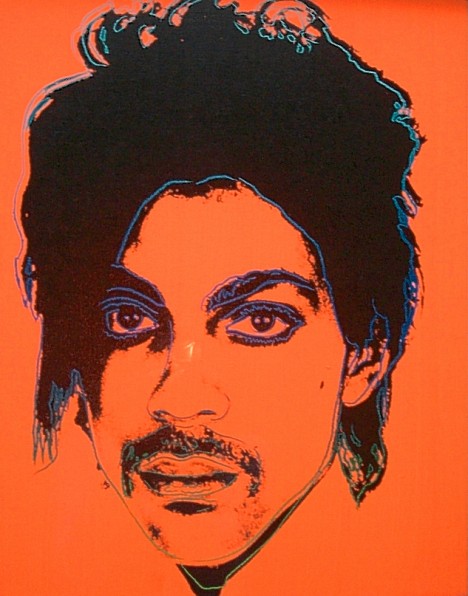
Andy Warhol painted his portrait of Prince Rogers Nelson (June 7, 1958 – April 21, 2016) in 1984 and it appeared in the November issue of Vanity Fair that same year and was used for the cover of Conde Nast’s 2016 memorial magazine “The Genius of Prince”.
The cover of Condé Nast’s Prince commemorative magazine.
Warhol always worked from photographs, usually, though with some famous exceptions, using ones he had taken himself–most commonly with his Polaroid camera.
Andy Warhol’s portrait of Prince.
However, Prince was less than pleased with it, reportedly saying that Warhol’s portrait of MJ (Michael Jackson) was much better!
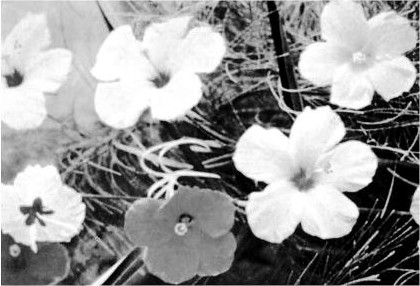
One photograph that Warhol did not take, however, was the basis for his Flower silkscreens in 1964. He found Patricia Caulfield’s photo of hibiscus flowers in a 1964 issue of the magazine Modern Photography and appropriated it.
Patricia Caulfield’s hibiscus flower photograph.
Two years later Caulfield sued Warhol for infringement of copyright and in a settlement, Warhol offered her two sets of the Flowers prints; an offer Caulfield refused preferring a cash settlement.
Lynn Goldsmith (2013).
In 1981, photographer Lynn Goldsmith had taken a publicity photo of Prince. Warhol’s portrait image looks suspiciously like it is copied from Goldsmith’s photograph and Goldsmith tried to achieve a settlement with the Warhol Foundation for the use of the image. However, the Warhol Foundation, in a preemptive move, decided to sue Goldmith to prevent her from taking legal action against it.
Court comparison of Goldsmith’s photo (left) with Warhol’s portrait (right).
It seems that fair use laws in the U.S. mean that an artist may use other artists work as the basis for their own work and that Warhol’s art is protected under these laws. It seems that Lynn Goldsmith will not benefit from Warhol’s possible use of her original photograph.
Thirty years have passed since Andy Warhol died on 22nd February 1987 after what newspapers called “a routine gallbladder operation”. The upcoming anniversary stimulated retired surgeon Dr. John Ryan, of Seattle, WA, to research the circumstances of Warhol’s death, which he presented on the 19th February 2017 at the annual meeting of the Pacific Coast Surgical Association. Dr. Ryan’s findings suggest that the operation was far from “routine”.
Warhol was pathologically afraid of hospitals and wanted to avoid being admitted to hospital or being subjected to any operation. He had a personal physician, a Dr. Denton S. Cox who looked after him for many years. Warhol had symptoms of gallbladder disease for at least fifteen years prior to being admitted to the New York Hospital-Cornell Medical Center on 20th February 1987. He had increased symptoms in the weeks or months before his admission and had barely eaten in the month before seeing renowned surgeon Dr. Bjorn Thorbjarnarson on 17th February. Warhol reportedly said to Dr. Thorbjarnarson “I will make you a rich man if you don’t operate on me.” At the time Warhol who was 5′ 11″ (about 180 cm) tall, weighed 128 lbs (58.2 kg). He was also anaemic and dehydrated.
So, why was the cholecystectomy (gallbladder removal) not “routine”? On 3rd June 1968 Warhol was shot in the chest by playwright and actress Valerie Solanas (1936-1988) who had loaned Warhol a copy of the manuscript to her play “Up Your Ass”, asking Warhol’s opinion of the play. When in May 1968 she asked for the manuscript to be returned, Warhol told her he had lost it. Solanas borrowed $50 and used the money to buy a 32 calibre handgun. She returned to The Factory early on the morning of June 3rd, and was met by Morrissey who asked her what she wanted. She said she wanted to see Warhol, but was told that he would not be at the Factory that day. However, Solanas would not leave, but hung about and eventually Warhol arrived and they got into the lift together. Once inside the Factory, at about 2.00 p.m. Warhol received a telephone call and while on the phone, Solanas fired three shots at him. The first two shots missed, but the third hit Warhol in the chest, puncturing both lungs, his spleen, stomach, liver, and oesophagus. She then turned the gun on art critic Mario Amaya shooting him in the hip and then tried to shoot Warhol’s manager, Fred Hughes, but luckily the gun jammed.
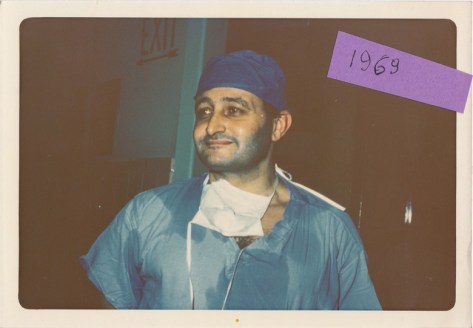
Warhol was seriously injured and taken to the Columbus-Mother Cabrini Hospital where he arrived pulseless. Warhol was pronounced clinically dead at 4.15 p.m. Vascular surgeon Giuseppe Rossi (1928-2016), who had considerable experience in operating on victims of gunshot wounds, was on duty.
Dr. Guiseppe Rossi, photographed in 1969, the surgeon who resuscitated Warhol.
Dr. Rossi found what he thought was a homeless old man, pale and without circulation and started heroic resuscitation. He opened Warhol’s chest and performed open heart massage while transfusing him with 12 units of blood. He then operated for five hours to repair Warhol’s internal injuries, removing the lower lobe of Warhol’s right lung and his spleen in the process. Miraculously, Warhol recovered, but was marked by the event, developing an incisional hernia which forced him to wear a corset for the rest of his life. It is said he also had a constantly weeping abdominal sore. Richard Avedon took a famous photo of Warhol the following year and Robert Levin took a much less well-known photo of him in May 1981, showing him wearing his hernia corset.
Richard Avedon’s 1968 photo of Warhol’s scarred torso.
Photo of Warhol taken by Robert Levin in May of 1981.
Three days after the appointment, Warhol finally allowed himself to be admitted to the New York Hospital and Dr. Thorbjarnarson performed the cholecystectomy on the morning of 21st February 1987. At operation, Warhol’s gallbladder was found to “be gangrenous” and fell apart as it was being removed. Dr. Thorbjarnarson decided also to repair Warhol’s hernia at the same time. Despite the complicated procedure, Warhol recovered well. He spent three hours in the recovery room before returning to his private room where he was in good spirits and in the ecening watched television and at 9.30 p.m. phoned his housekeepers. His nurse, Ms. Min Chou, checked on him at 0400 h on the 22nd February and saw all was well, but at 0545 she found him “blue and unresponsive” and stared “respiratory manoeuvres” and called the hospital’s cardiac arrest team. Despite resuscitation efforts Warhol was pronounced dead at 0631 h.
A post mortem examination was performed and found Warhol to weigh 150 lbs (68.2 kg), significantly more than when he entered the hospital. His lungs were filled with fluid and his trachea was filled with pink, frothy fluid, signifying pulmonary oedema. The cause of death was ascribed to “ventricular fibrillation”. However, Warhol’s death certificate, registered by his brother John Warhola, on 26th February stated simply “pending further study.
Andy Warhol’s death certificate.
At autopsy the cause of death was said to be due to “ventricular fibrillation”. Warhol’s lungs were found to be filled with fluid and his trachea brimmed with a pinkish fluid, signifying fluid overload. It was later said he died of a heart attack secondary to the stress of the operation and fluid overload.
An inquiry into Warhol’s death was held in April 1987 and concluded that his care was unsatisfactory. Warhol had not been properly examined or adequate tests taken before he was operated on. The inquiry found no fault in the surgery.
In 1991, Warhol’s estate (his two brothers and the Warhol Foundation) sued the hospital for lack of care and after a settlement were awarded a sum assumed to be $3 million.
Dr. Guiseppe Rossi knew nothing about Andy Warhol or about Pop Art. Warhol rewarded him with several prints and a complete folio of Soup Cans II. Dr. Rossi didn’t know what to do with them and they were stored under his bed for decades. Since Dr. Rossi’s death in 2016, his family decided to sell the prints and Christies will be auctioning them on 24th-25th October 2017. Warhol also sent Dr. Rossi a cheque for $1000, which bounced
Andy Warhol’s cheque to Dr. Guiseppe Rossi, dated September 1, 1968.
and was returned to Dr. Rossi, who had it framed and hung it on his wall.
Robert del Naja, a.k.a 3D, is a musician, artist and composer probably best known as being a founder member of the trip hop group Massive Attack. He has also other musical projects. del Naja was born in Bristol in 1965 and has been credited as the the city’s first graffiti artist and Banksy has named him as a major influence–it can be noted that suggestions have been made that del Naja IS Banksy! A real fact about him is that he is colour blind. Something that caused him problems in his early works–painting a self-portrait with green hair and brown Christmas trees.
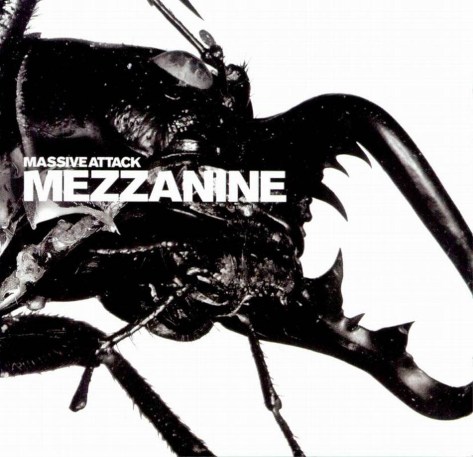
I really liked the deceptively simple cover art for Massive Attack’s “Mezzanine” album, with its stag beetle image. Otherwise I had not paid particular attention to the group’s cover art. I was completely unaware that del Naja had a separate career as a record cover artist. He admits to have been designing covers for Mo’ Wax records for eight years–I once owned the 1994 Mo Wax vinyl samplers “Headz 1” and “Headz 2” with cover paintings by del Naja, though I then had no idea who he was.
Mo Wax 1996 compilation Headz 2A, with cover art by Robert del Naja.
Mo Wax 1996 compilation Headz 2, with cover art by Robert del Naja.
Just recently, The Vinyl Factory published “3D & the Art of Massive Attack” by Robert del Naja and Sean Bidder–a 400 page book of Robert del Naja’s art. There are two versions, a popular edition selling for £50 or a limited edition of 350 signed copies selling for £350. I have the popular edition, which came sealed in cellophane with the Vinyl Factory sticker with bar cove on the outside. The book only contains pictures of del Naja’s artworks with no text apart from a three page interview in a separate 12-page booklet included in the package. Reviews of the book state that Banksy has written the book’s introduction, but I couldn’t find it in my copy–perhaps that’s only included in the limited edition…
The cover of Robert del Naja’s new book.
I was fascinated to find out that Robert del Naja has cooperated with photographer Nick Knight to produce record cover art. The “Mezzanine” cover is one example.
The “Mezzanine” front cover. Photo by Nick Knight.
Del Naja again approached Nick Knight for the cover photo for Massive Attack’s “best of” compilation “Collected”.
Nick Knight’s photograph on the cover of “Collected”.
Nick Knight’s most famous cover photographs are probably David Bowie’s “Aladdin Sane” cover, Björk’s 1997 “Homogenic” or Nick Cave & The Bad Seed’s “The Boatman’s Call” covers, but he has also photographed Miguel Bosé (see a previous recordart post for another Miguel Bosé album) for the cover of his 1987 album “XXX” among many others.
I was disappointed with the book at first, but it lead me to start looking for more examples of Robert del Naja’s record covers and that has proved to be an interesting journey. I will have to try to contain my interest and NOT start collecting his covers.
I have an almost complete collection of records and CDs with cover art by the enigmatic Banksy. I started collecting Banksy cover in 2008, when prices were usually very reasonable–with many records costing as little as £6.99. A few rarer items cost up to £100. The only exceptions were the two covers ostensibly sprayed by Banksy himself. These are the 1999 12″ promotional single “Four (4 x 3)” by the Capoiera Twins and the promotional double LP “Melody A.M.” by Röyksopp. In July 2010 I was contacted by a DJ who was getting married and offered me his copy of the Röyksopp album, which I, naturally, snapped up. By 2016 I had almost all the records and CDs with Banksy cover art with the exception of the original Paris Hilton CD (the one with the sticker on the outside of the front of the jewel case), and the Capoeira Twins 12″.
“Four (4 x 3)” by the Capoiera Twins (BLOWP008).
Numbered promo for Röyksopp’s 2001 album “Melody A.M.” – handstencilled by Banksy.
When, in April 2016, I was invited to show my collection in the major Banksy retrospective “War, Capitalism & Liberty” at Rome’s Palazzo Cipolla, these missing covers irked me. I had made a limited edition copy of the Capoiera Twins cover–almost indistinguishable from the real thing–and that would fill one of the gaps. Suddenly two copies of the first pressing of the Paris Hilton CD appeared on Ebay and I was lucky enough to get one in time for it to travel to Rome with the rest of my collection.
I have been looking for a copy of the Capoiera Twins’ 12″ ever since I first heard about it in 2008 without success. I missed a couple of copies early on, but then no further copies seemed to turn up other than in art galleries at inflated prices, until August 2017.
The stencil used for the cover art was also used on a wall in Bristol–I presume after it had been used for the record covers–at Portland Square (post code BS2 8SA).
Banksy’s Capoeira Twins stencil in Portland Square, Bristol.
According to a seller of a copy of the record, Banksy gave 25 copies of the white label promotional record to friends and supporters, while the remaining 75 copies were sent to DJs and reviewers with no indication of the band name or the record title on the cover or record but with an A4 letter that Blowpop asked to be returned a couple of weeks prior to the release date. The record was a trip hop single that failed to garner much attention when it came out. I suppose the DJs who received copies played them a couple of times and filed them away or–as was common in the nineties and early 00s–sold them to secondhand record shops (one owner owned up to selling his copy in the early 2000s £1,99), or simply chucked them away. And–had it not been for the Banksy cover–would probably never have been heard of again.
A couple came up for sale on Ebay in around 2008 and, if I remember correctly, sold for £400-600. In the last couple of years the prices of vinyl records with Banksy art covers has increased dramatically and suddenly four or five copies of the Capoeira Twins “4 x 3” have been auctioned off for amazing prices of £5000-6000! Another sold in October for a bargain £4223.23. A further two copies appeared in Great Yarmouth, Norfolk, in November and I snatched one of them, the other selling for £6,500.
There is another hand sprayed Banksy cover that has also increased dramatically in price recently. I refer to Röyksopp’s “Melody A.M.” promotional double LP.
Just as I was about to buy my copy of the Capoiera Twins record, a new record with Bnaksy art appeared. This was another white label 12″ single “Funk tha Police” by a band called Boys in Blue that had Banksy’s “Rude Copper” as its cover art. This is said to be a limited edition of 100 copies, so I duly invested.
The cover of the Boys in Blue’s 12″ single “Funk tha Police”.
Thus, as of November 2017, my collection of records and CDs with Banksy art is complete. I’ll have to keep watch for newer covers, of course, but it feels like my job is done here.
Addendum 6th May 2022. As you can read in my later post on this rare promo, I discovered that I’d been sold a fake — and it wasn’t until I could compare with a genuine copy that I discovered this.
It has been an intensive few months on my Warhol front. I have added almost a dozen titles to my collection.
It started in July, when I finally managed to find an original copy of Aretha Franklin’s 1986 CD “Aretha”. This was the only CD with Andy Warhol’s art released in his lifetime, The CD was reissued with extra tracks as a double CD in 2014, but I wanted an original 1986 copy. They seem to be quite rare and it has taken me a long time to find one though it didn’t turn out to be too expensive.
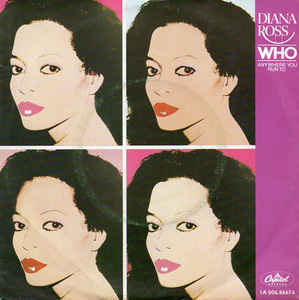
“Aretha” CD booklet.The next records I found were by Diana Ross. First a rather battered copy of her 1983 single “Who / Anywhere You Run to” and a poster cover copy of “So Close / Fool for Your Love”, which was way more expensive than I really wanted to pay.
Diana Ross “Who” 7″ single cover.
Diana Ross “So Close” poster sleeve cover.
Then I found a copy of Arthur Fiedler & The Boston Pops’ “Latin Rhythms by the Boston Pops”, which I got reasonably cheap. I already had a nice copy that with the “A High Fidelity Recording” text below the RCA logo at top right. The copy I now got hold of didn’t have that text, but instead a gold sticker with the same text. My guess is that this was an earlier printing.
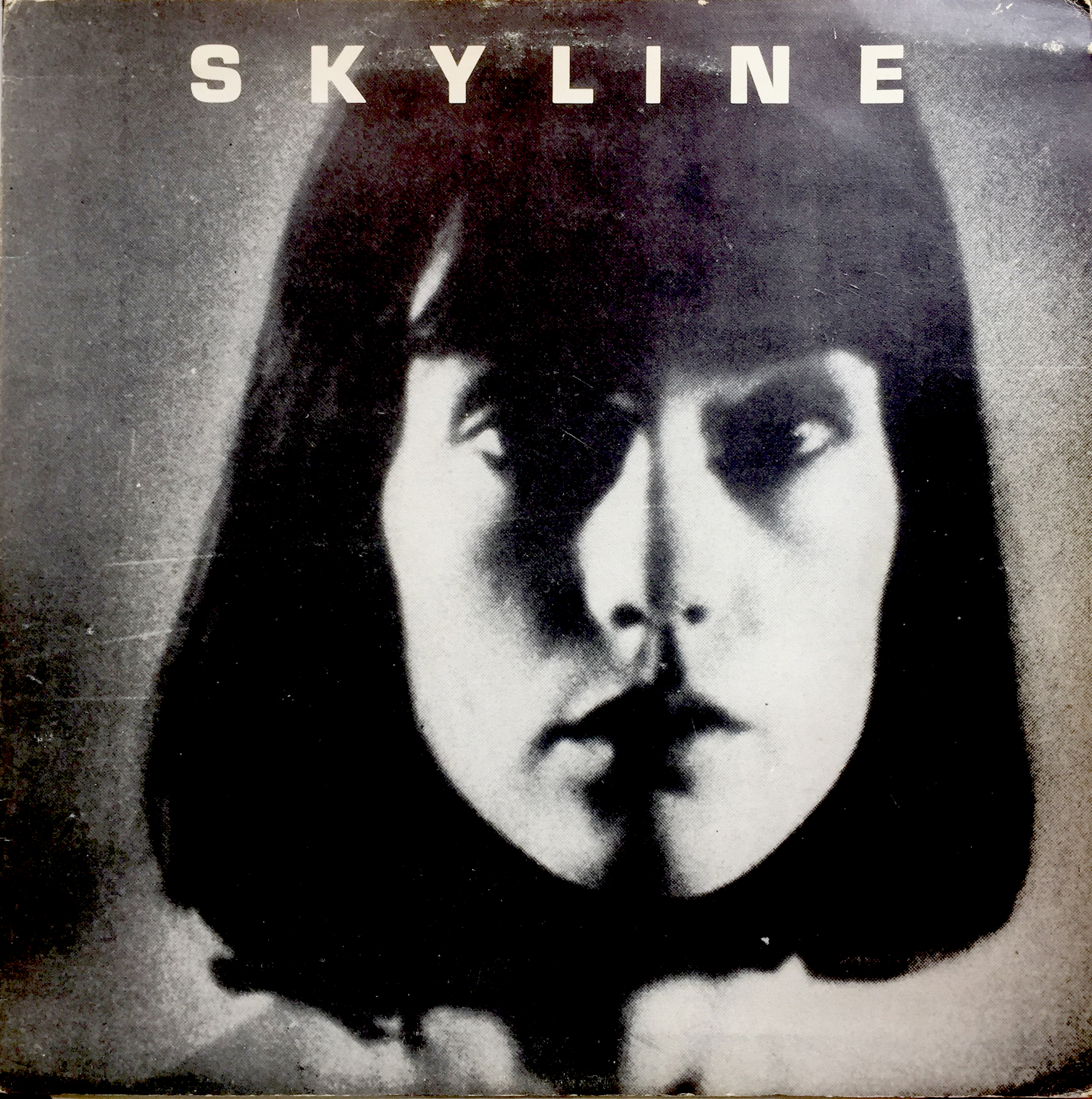
Both versions of the “Latin Rhythms” EP. On the left with the gold sticker and on the right with “A HIFI Recording just visible below the RCA Victor logo at top right.Then I was pleased to find a reasonably priced copy of the original Skyline bootleg album on the Four Stars label that I wrote about in a previous blog post.
The original 1978 Skyline cover.Next up was an Austrian bootleg of The Rolling Stones “Sticky Fingers” album with alternate takes and that used the photo of the Stones that had previously been used on the 1971 “Brown Sugar / Bitch / Let It Rock” EP and again on the numbered RSD reissue in 2011.
The front cover of the Austrian bootleg of outtakes from the “Sticky Fingers” recording sessions.I was in London for a few days in August and popped into HMV on Oxford Street where I found two copies of “The Velvet Underground & Nico” 50th anniversary edition, with a large black label on the shrink wrapper on the rear of the cover covering Eric Emerson’s “torso” emulating the sticker used to cover his photo on the original 1967 release. I bought two copies in the hope that they might be the limited pink vinyl edition. Needless to say, they weren’t! However, I did manage to find a pink vinyl copy not long after. Apparently these were made in America in a limited edition of 1000 copies. The copies I bought at HMV were both pressed in Europe.
“Velvet Underground & Nico” 50th anniversary version with sticker over Eric Emerson’s “torso”.
There are loads of interesting bootlegs with Andy Warhol art. I have been looking for a couple for quite some time. I have already mentioned the Skyline album with Warhol’s photo of Suzanne de Maria on the cover, another was another The Rolling Stones bootleg called “Live in Laxington” [sic] — a live recording from the Rupp Arena in Lexington, Kentucky, recorded on 29th June 1978. The front cover is a typical bootleg cover picture, but the rear cover shows one of Warhol’s “biting” photos from 1975. This version has a green spatter vinyl. There is another black vinyl version with a plain cover á la Beggars Banquet.
The front cover of “Live in Laxington”.
The much more interesting rear cover of “Live in Laxington”.
The purchase that has given me the greatest thrill arrived at the end of September. I knew that there was a limited edition promotional folder of Miguel Bosé’s 1983 album “Made in Spain”. I had never seen one for sale until a copy appeared on Ebay in mid September. I put in a bid was was outbid. “Oh, Well…” I thought. It wasn’t meant to be. However, the following day I received a “second chance” as the high bidder couldn’t afford his final bid. So I got the set. The folder should contain white label versions of the full “Made in Spain” LP, a promo 12″ single “Fuego / Panama Connection” and a single-sided, white label 7″ single “Fuego” and an A4 booklet with a fold-out version of Warhol’s Bosé portraits. When the folder arrived, the singles were missing. The seller had another copy that also lacked the singles and couldn’t help provide them. But Discogs had a single copy of the white label 12″, which I snapped up and several copies of the single-sided, white label 7″ single, so that was easy to get and a little over a week later my foleder was complete with the LP, 12″ and 7″ and the booklet. What a great (and rare) addition to my collection. I laid out my /several) copies of “Made in Spain”, the Fuego 12″ and made a composite of Warhol’s Bosé portraits!
The “Made In Spain” promotional folder.
The “Made In Spain” promotional folder showing the “Made In Spain” LP, the white label 12″ and 7″ Fuego singles.”
The complete set, including the booklet, which contains a fold-out poster of Warhol’s Bosé portraits.
Another cover appeared on Ebay that was a pastiche of the “Velvet Underground & Nico” cover with a banana-shaped chocolate ice cream with “Peel Slowly and See” beside it. Peel the chocolate off to reveal the naked banana. The record is a 12″, three-track single “Family” by the Cru-el Grand Orchestra — a 1999 Japanese recording, whose cover was designed by Ukawa Naohiro (Mom’n’DaD Productions 222). Even the rear cover had a photo that I recognise from a record cover, but can’t place — perhaps a reader can help identify it.
The Cru-el Grand Orchestra’s 12″ single “Family” with its obviously Warhol-inspired banana ice lolly.
The rear cover of the Cru-el Grand Orchestra’s 12″ single “Family”. Another cover pastiche?
There are several other coloured vinyl versions of “The Velvet Underground & Nico”, yellow, red and blue vinyl plus the Newbury Comics yellow/black vinyl. Now that I have the pink copy, do I have to get hold of the other colours too?
Earlier in 2017, Mark Satlof got his 15 minutes of fame when it was revealed that he had collected 800 copies of The Velvet Underground & Nico’s self-titled debut album. Apparently his collection (as everyone else’s) started with a single copy, but his was signed by Lou Reed. I wonder if he actually NEEDS all 800 copies.
Mark Satlof who has collected about 800 copies of the Velvet Underground & Nico album.
Then there is Rutherford Chang who collects The Beatles’ White Album. He boasts that when the article was published he had 1,845 copies of the numbered first edition which he has exhibited in Liverpool. He still buys copies in any condition and will pay up to USD 20 for each.
Rutherford Chang with just some of the 1800+ copies of the Beatles’ White Album that he has collected.
So, that is one kind of cover collecting madness. There are others; like the chap who was prepared to fork out USD 790,000 for Ringo Starr’s personal copy of The Beatles (the White album) with number 0000001. This was named the most expensive record of all time but it obviously ain’t. In 2017 Martin Shkreli’s purchase of The Wu Tang Clan’s “Once Upon a Time in Shaolin” double CD (Okay, I’ll grant that this was a CD not a RECORD”) but only a single copy was pressed (with an embargo that it could not be released commercially until 2103). Shkreli has since sold it on Ebay for USD 1,025,100 after 343 bids. I suppose he can get a tax allowance on his nearly USD 750,000 loss!
Martin Shkreli’s sale of the Wu-Tang Clan’s “Once Upon a Time” in Shaolin CD.
But there are good reasons for owning several copies of the same record. Some collectors might want both the stereo and mono releases, others may collect a record that has different covers–such as the six variations of the cover of Led Zeppelin’s “In Through the Out Door”, while others might want various coloured vinyl releases. In some cases a record is reissued at various times in remastered form or in a different cover and these may also be collectible.
My personal madness has extended to the various releases of The Velvet Underground & Nico–an album I first bought in 1967, unfortunately even then with the airbrushed rear cover photo. Despite its poor initial sales–said to have totalled 30,000 copies in its first five years of existence–the album has seemingly never been out of print, and has had various cover designs and several varieties of coloured vinyl. I haven’t yet got anywhere near 800 copies, but have sixteen at the last count, ranging from my own 1967 original copy, a torso cover, and the cover with the black sticker covering the torso as well as various later editions, including two picture discs and three versions of the Scepter Studios acetate recording. I bought both the 45th and 50th anniversary reissues (both the black and the pink vinyl versions of the latter). But, I still don’t have a mono copy on vinyl.
Another album I have many copies of is a recent release by Henrik Berggren. His debut solo album “Wolf’s Heart” was released on both CD and vinyl with six colour vinyl versions in addition to the standard black vinyl. Obviously I HAD to have all seven versions and so I managed to find them all. I thought they might be a good investment, but it transpires that one can still find all the various coloured vinyls.
The pink and light blue vinyl versions of Henrik Berggren’s “Wolf’s Heart” LP.
Henrik Berggren’s “Wolf’s Heart” album on black, violet, red and yellow vinyl.
I have four copies of The Rolling Stones “Sticky Fingers” and “Love You Live” albums. There are different zips on the U.K. and German versions of “Sticky Fingers”and the U.S. version has the title placed differently from the European versions. I am lucky to have copies of both albums autographed by Andy Warhol, too.
Now I have at least three copies each of Miguel Bosé’s “Made in Spain” (two Spanish and a Mexican) and “Milano-Madrid” albums. I’ll be returning to the “Made in Spain album in a future post.
Finally, an admission. Sometimes I have bought a record I thought I needed and when I got it home realised I already had it! That’s because I don’t carry complete lists of wanted items with me everywhere, not a sign of impending senility.
My collections of artists who have designed record covers seem to grow and grow. There always seems to be another cover to add to them. However, eventually I find that I have got as far as it seems possible to go and my collections just need that one elusive cover that I just cannot find.
My biggest collection is of Andy Warhol’s cover art. I have a broad view of what to include in it and have collected bootlegs, CDs and a few magazine covers, so that I currently have over 200 “Warhol covers”. However, there are still gaps that I suppose I never will fill. The main one is the NBC box set “Night Beat” – a promotional set of three EPs for a 1950s radio show – only one copy of which is known to exist. There is also a Japanese EP of Mendelssohn’s “Scherzo” with Warhol’s drawing of angels on the cover. Again, only a single copy has so far come to light. There are a couple of other albums that it may, one day, be possible to find. I’ll keep you posted on those.
I thought my collection of Peter Blake’s record covers was complete until I was tipped off about a 1983 cover for a recording of Gershwin’s “Rhapsody in Blue/An American In Paris” with a beautiful Blake painting. Luckily that was easy to find. So now I’m only waiting for him to produce his next cover.
I once had a complete collection of Damien Hirst’s record and CD cover designs. However, when I sold my main collection, I wasn’t careful enough to check what went and what stayed, with the result that the promotional booklet for The Hours’ “Ali in the Jungle” with its 3″ CD disappeared along with four of the band’s limited edition 7″ singles. At least I have been able to replace these, but the promo booklet has eluded me.
Again, my collection of Banksy records and CD covers is only missing one very rare item; the promotional 12″ single by The Capoeira Twins. A couple of copies have come up for sale recently, but way over my budget!
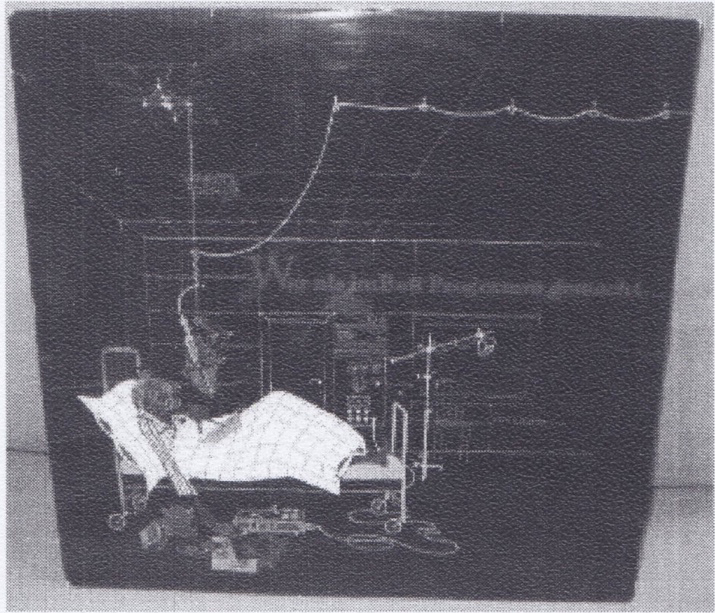
I thought that my collection of Klaus Voormann’s record cover art was complete with about seventy-four covers. I was mistaken. Klaus designed a cover for a jazz LP in the early sixties with artwork in the same style as his covers for the Pioneers of Jazz series of EPs on the Coral label.
The Klaus Voormann’s cover for a German jazz album.
Unfortunately, no one can read the title. Could it be “Wir nie im Bett Programm gemacht”? That’s the nearest I can get to deciphering it. And I have asked Klaus, but he doesn’t remember the artist or the title. I’ve shown the picture to German dealers, but none has seen a copy.
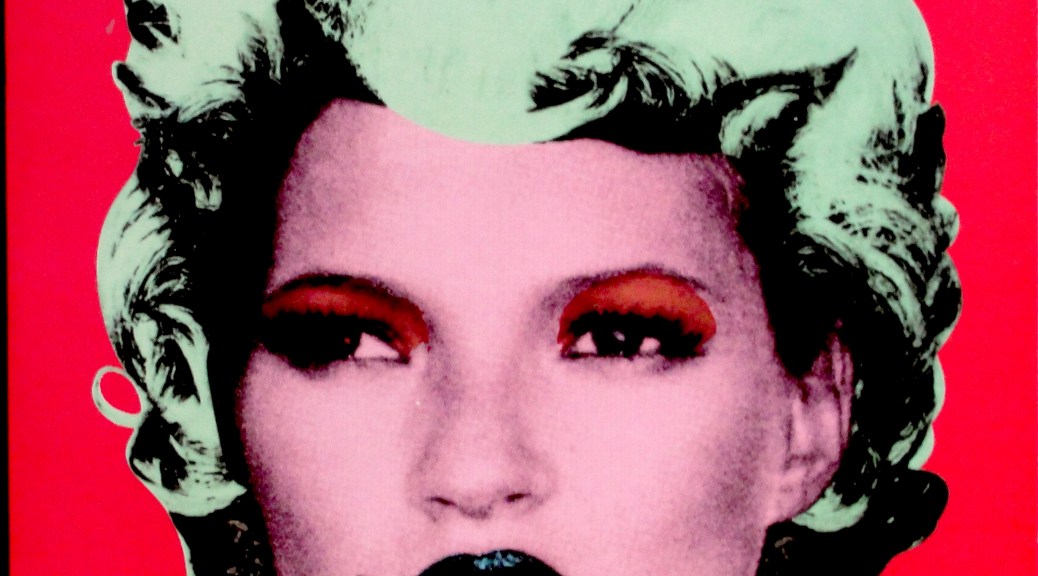
Then I have a collection of record and CD covers featuring supermodel Kate Moss. I got started on collecting Kate Moss covers as I already owned Dirty Funker’s “Let’s Get Dirty” 12″-ers (both first and second versions) and Damien Hirst’s “Use Money, Cheat Death” single sided 12″ with his portrait of Kate with half her face dissected away. Kate has a musical background having cooperated with Primal Scream on their remake of Lee Hazlewood’s “Some Velvet Morning” and there are two 12″-ers that feature Kate on the covers. And also with Babyshambles while she and Pete Doherty were a couple.
2003 – Primal Scream & Kate Moss “Some Velvet Morning”, Columbia 12″.
“Some Velvet Morning” remix 12″ with one of Jane Garner’s 1992 portraits of Kate on front and rear covers.
Bryan Ferry used Adam Whitehead’s photos of Kate on his 2010 Olympia album and on the limited edition 12″ singles and remixes taken from the album. However, one single, “Heartache by Numbers” apparently didn’t make it onto vinyl, though I didn’t know this initially and spent some considerable time searching for a copy, obviously without success.
So collectors, it seems that completing one’s collection of a particular artist is well nigh impossible. But it is the unfinished collection that still provides a challenge. Will I ever find these missing covers?
Gröna Lund is a permanent attraction in Stockholm with exciting rides, restaurants, bars and an important concert stage on which most of the world’s more famous artistes–ranging from Birgit Nilsson via Chuck Berry to The Clash–have performed.
Posters for events and concerts at Gröna Lund have become highly collectible. Between 1971 and 1988 they were designed by one man, Nils Sture Jansson–who produced about 800 individual posters, sometimes with incredibly short deadlines. In 2012 Premium Publishing produced a book containing 200 of Nils Sture Jansson’s poster designs edited by Nils Sture Jansson’s son, Jonas, and Gröna Lund’s own historian Andreas Theve. The book rapidly sold out when it was published–but I was lucky to find a copy in Söders Bokhandel– a little, but extremely well-stocked bookshop in Stockholm. The book has also become highly collectible.
The book’s cover. The cover picture is of The Ramones (see poster below)
Nils Sture Jansson’s relatively simple illutrations capture the spirit of the artists and, according to the introduction, were much admired by them. Only a few were unhappy–and that was sometimes due to the fact that his or her name was misspellt.
Here are some samples (posters for artists I personally like):
Jansson would be supplied with photos of the artist(s) and deconstruct them to make his poster designs.
Kristian Russell has taken over and is continuing the tradition of Gröna lund posters.
Poster for Henrik Berggren’s concert on the 50th anniversary of Jimi Hendrix’s concert on the same stage.
Finding details of where and when Andy Warhol took the nine famous “biting” photographs that were used on the “Love You Live” album cover and other items hasn’t been easy. In a recent interview (July 18th, 2017) in Interview Magazine about the origins of many of Warhol’s photographs Christopher Makos explains where many of Warhol’s photographs were taken. Towards the end of the interview, Makos mentions the photos for the “Love You Live” album.
Makos remembers that Andy was given a “point and shoot” camera sometime around 1975. And he used it constantly throughout the late 1970s, often replacing his Polaroid camera, which he primarily used for his portraits. However, the “biting” photos are nearly always shown as if they were Polaroid pictures, so I cannot be sure which type of camera they were taken with. However, the reproductions on posters and elsewhere suggest that Warhol used both Polaroids and his “point & shoot”camera.
During the summer of 1977, Mick Jagger and Keith Richards rented Peter Beard’s* house in Montauk (East Hamptons, New York State) and Andy took some of the photographs there and some additional ones at Warhol’s third Factory address at 860 Broadway in New York later. Obviously Jagger had brought his daughter Jade to Montauk as it is her hand Mick is “biting” on the “Love You Live” cover. There is also a photo of Jagger and Jade sticking their tongues out at each other.
Andy Warhol’s photographs for the cover of “Love You Live”.
It seems eleven photographs were taken and a contact sheet produced. However the last picture int he second row shows Mick Jagger biting a child’s hand but this is not the photo that appears on the front cover of “Love You Live“.
The Front cover of “Love You Live” showing Mick biting a child’s hand (Jade Jagger). Jade’s arm in a different position from that in the contact sheet photo.
There are also other pictures that do not appear on this contact sheet, in particular the picture of Mick and Jade (born 21 October 1971) sticking their tongues out at each other.
…And here’s how it looked on the “El Mocambo 1977” box set cover.
Mick and Jade Jagger in a picture from the “biting” session on the cover of a limited edition bootleg box set.
The photos were also used on the cover of a four-track promotional EP for the “Love You Live” album, entitled simply “The Rolling Stones” (Rolling Stones Records, EP-PR-287). In addition there was a picture disc (probably a bootleg) with the same four photos.
The “Rolling Stones” promotional single.
The bootleg picture disc.
A new bootleg of a Stones concert, presumably from Lexington, Kentucky, was released in 1978 with the title “Live in Laxington” with a fairly traditional front cover picture of Mick and Ronnie Wood. However, one of the “Biting” photos appeared on the back cover.
Front cover of “Live in Laxington” LP.
Rear cover of “Live in Laxington” LP.
The photographs were also used for other promotional items. The Rolling Stones threw a release party for the “Love You Live” album at the Trax club in New York on September 27, 1977 and the photos featured on the plastic tablecloths used at the reception. These measured 36″ x 48″ (91,4 x 121,9 cm). There were also similarly sized posters on paper. Carrier bags with the photos were also produced, I would guess as goodie bags for guests, though I don’t know if they were appeared at the launch party or later.
Poster and Tablecloth
Carrier bag
Andy Warhol was fastidious about typography and was annoyed by Mick Jagger’s addition of the record title and the Band’s name to the artwork for the “Love You Live” album cover and usually refused to sign the front cover, preferring to sign the inner spread.
“Love You Live” inner spread signed by Warhol.
Warhol’s signature on inner spread.
This autographed copy of “Love You Live” is from my collection of Andy Warhol’s record cover.
*Peter Beard (born 1938) is a photographer, film director, author and artist who has lead an adventurous life. He was friends with the Rolling Stones, Mick Jagger and other celebrities.
I curated what I thought would be the first exhibition of Andy Warhol’s record covers in Piteå, Sweden, in July 2008 I enlisted the help of fellow collector Guy Minnebach to assemble as complete a collection of record Warhol’s record covers as possible. Only later did I find out that Warhol’s record covers had been shown before-usually as part of other exhibitions of his art, and then only exhibiting a few covers. My intention with the 2008 exhibition was to try to gather together all the covers he designed or illustrated.
Just two months after the exhibition in Piteå closed, the Museum of Art in Montreal, Canada, put on a major exhibition entitled “Warhol Live!” which showed the link between Warhol’s art and music. Many of the record covers shown came from the collection of Paul Maréchal and his book “Andy Warhol – The Record Covers 1949-1987: Catalogue Raisonné” was published to coincide with the “Warhol Live!” exhibition.
Just before the Piteå exhibition, Guy Minnebach had discovered the “Waltzes by Johann Strauss Jr.” EP and the “Warhol Live!” exhibition showed Paul Maréchal’s newly discovered “Night Beat” box set. Less than a month after the exhibition in Piteå closed, in September 2008, a friend of mine read an interview in a magazine with Tomas Alfredsson, a Swedish musician turned actor, who had been a member of a band called Roland and the Flying Albatros Band (known as RATFAB for short). In the interview he said that the cover of the Band’s second single had been designed by Andy Warhol. Thus started my search for this cover, and I quickly found three copies. The RATFAB single “Det brinner en eld / Mörka ögon” became the first Warhol cover NOT to be included in Maréchal’s 2008 book!
Since then, a number of covers, unrecognised in 2008, illustrated or designed by Andy Warhol have been identified.
1. Margarita Madrigal’s Magic Key to Spanish, Volume 2 (LP),
2. Vladimir Horowitz – Piano Music of Mendelssohn and Lizst (LP),
3. Mendelssohn – Wedding March / Scherzo (45 RPM EP)
4. Lew White – Melodic Magic (EP),
5. Erika Morini – Tchaikovsky–Violin Concerto
6. George Gershwin / Edvard Grieg – Porgy & Bess / Symphonic Dances (LP and EP box),
7. Curiosity Killed the Cat – Misfit / Man (7″ single).
And this list doesn’t include bootlegs or records and CDs that simply appropriated Warhol’s art for their covers. Nor does it include covers after 1987 that simply use or reuse Warhol’s art, such as Paul Anka’s “Amigos” or Skyline’s “Skyline” or even The Silver Apples’ “Fractal Flow / Lovefingers“.
There has been a problem in having new covers suggested to be by Warhol verified. An example is the rear cover drawing on Keely Smith’s 1957 Capitol Records LP “I Wish You Love“. By this date, Warhol was an acclaimed commercial artist and his “dot and blot” technique was being used by other illustrators. Warhol is not known to have worked with Capitol Records on any other projects, so this drawing cannot certainly be accredited to Warhol. There are similar discussions about the Tchaikovsky (No. 5 in the above list) and the Gershwin / Grieg (No. 6 in the list) designs also released in 1957, but these were at least released on the RCA Victor Bluebird label, and Warhol did many designs for RCA and its other subsidiary Camden Records. Maréchal has included the Tchaikovsky, but not the Gershwin / Grieg in the second edition of his book.
There are variations in some of the covers that Maréchal has described. There are various colour variants of the covers illustrated, starting with the first cover in the book, “A Program of Mexican Music” (Columbia Records – ML 2080). Maréchal includes the green cover variant but doesn’t mention the rarer pale blue coloured version. Similarly, there are five colour variations of the “Alexander Nevsky” (Columbia Records – ML 4247)–pale blue and a deeper, almost turquoise, blue that contained the original LP with dark blue labels. The album was re-released in the late fifties with the cover in green, orange and pink. These copies have records with Columbia 6-eye labels. Maréchal includes the green reissue cover, but not the original blue covers. Then there are minor variations such as the various printings of the “Latin Rhythms by the Boston Pops” EP. Friend and Warhol expert Guy Minnebach noticed that some copies had the text “A High Fidelity Recording” just beneath the RCA logo in the upper right of the cover. Some had this text in silver and some in green. There is a minor variation in the cover of the “Waltzes by Johann Strauss, Jr.” EP. Some copies have “Printed in U.S.A.” at bottom right while others do not (probably due to the way the slick was cut before being affixed to the cover.)
There are probably more cover designs by Andy Warhol waiting to be identified. A recent case in point is the sister box to NBC’s “Night Beat” entitled “Voices and Events“. As with the designs for the “Progressive Piano” EP set and 10″ LP a lithograph of the “Voices and Events” cover design exists in The Warhol Museum and was shown at the “Adman-Warhol Before Pop” exhibition in Australia early in 2017. It isn’t clear whether The Warhol Museum recognised this to be the design for an EP box set, but when I saw it I immediately saw the similarity to the “Night Beat” design with the dots on three sides. No one knows if the “Voices and Events” box was ever released. I suppose, like the “Night Beat” set, it was intended as a promotional teaser but the radio show it was intended to promote only lasted three episodes… so probably not.
By my reckoning, there are some 55 individual covers that can be attributed to Andy Warhol (I do not count different formats that use the same, or similar, designs), but there is no way that a newly identified cover can be given accreditation, other than being recognised by Paul Maréchal and included in future editions of his “Complete Commissioned Record Covers“.