The cover of Oasis’ greatest hits album “Stop the Clocks” very nearly didn’t happen. When Sir Peter Blake sat for NME in September 2006 to discuss the sleeve, he mentioned, almost in passing, the idea he’d abandoned first. The original concept wasn’t the collage of found objects eventually used, but a photograph of the shopfront of Granny Takes a Trip, the King’s Road boutique that had become, by the late 1960s, a fixture of London’s psychedelic scene. “We used an image of the outside of Granny Takes A Trip on the King’s Road as a canvas,” Blake told the magazine, “but then I discovered the shop was bringing out an album, so we had to abandon that.”
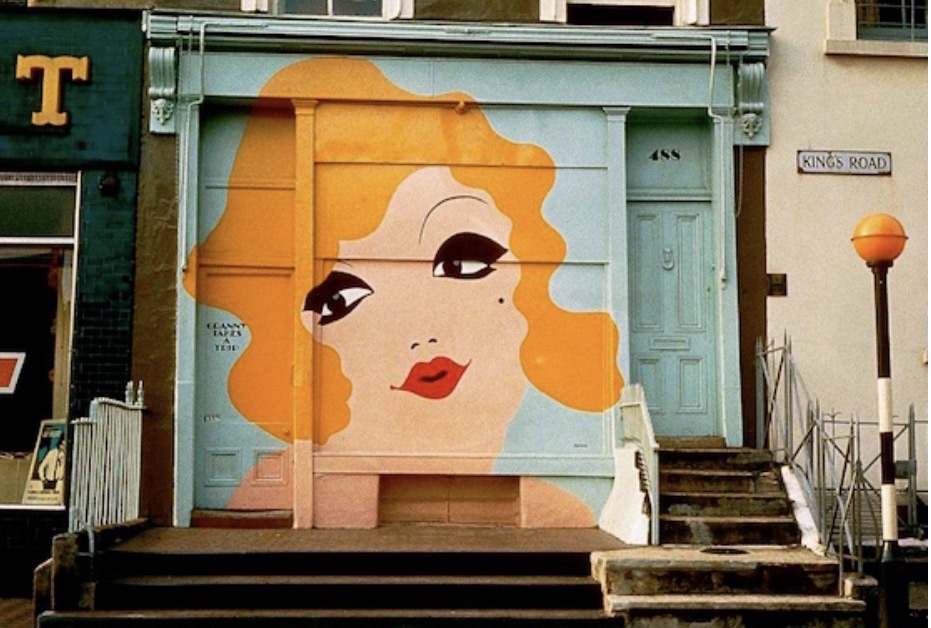
The album in question wasn’t connected to Blake’s project at all — it appears to have been a 2006 compilation of late-1960s tracks that borrowed an archival photograph of the shop’s mural for its own cover, coincidentally the same year as Blake’s work on Stop the Clocks. Two unrelated projects, four decades after the mural itself was painted, reaching for the same image.
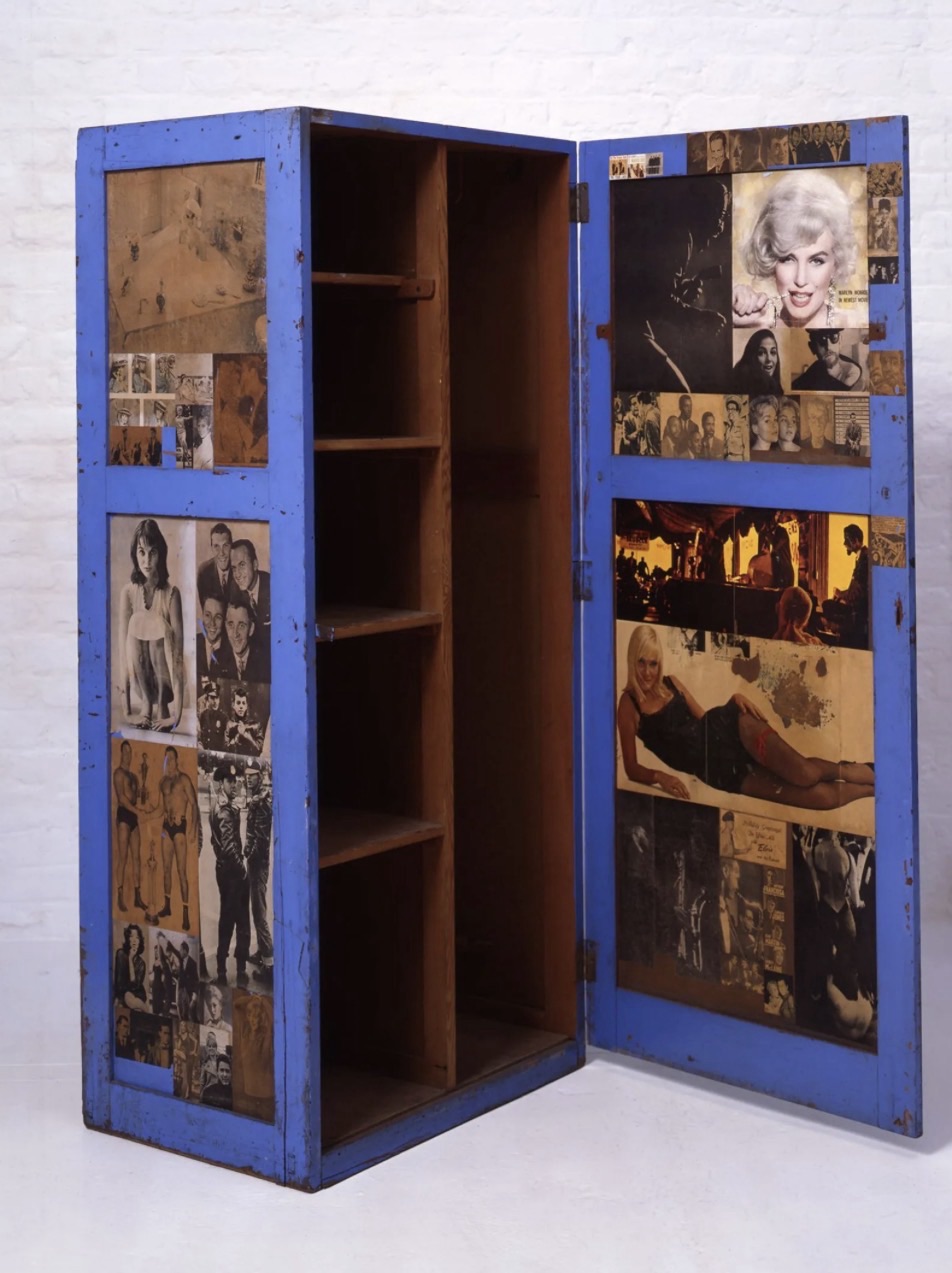
What Blake made instead was Locker, a freestanding cupboard he had first assembled in 1959, filled with objects Noel Gallagher selected during a studio visit — the seven dwarves Blake says he “puts in quite often,” Dorothy from The Wizard of Oz as “my icon, rather than theirs,” and a Michael Caine image standing in for a Marilyn Monroe picture that ongoing litigation ruled out.
It isn’t the only Blake cover with a road not taken behind it. Nearly forty years earlier, Sgt. Pepper very nearly didn’t happen as we know it either — and the abandoned Granny Takes a Trip idea is a useful thread to pull on, because Blake’s career kept intersecting, sometimes directly, sometimes only by proximity, with the small circle of artists who supplied the psychedelic boutique scene with its murals, posters, and record sleeves.
The most direct connection is Chris Jagger, for whose 1974 album The Adventures of Valentine Vox the Ventriloquist Blake supplied a cover. Jagger’s own earlier detour into the boutique trade is recounted in his 2021 memoir, Talking to Myself — including, with an unnamed partner, the painted “eyeball” jacket made for Jimi Hendrix in 1967, later auctioned for several thousand pounds.
A second, more tangled connection runs through Sgt. Pepper. The Apple Boutique on Baker Street was painted with a three-storey psychedelic mural by The Fool — the Dutch collective of Simon Posthuma, Marijke Koger, Josje Leeger and Barry Finch — before local complaints forced it to be painted over. The Fool also produced a design for Sgt. Pepper itself, rejected by the art dealer Robert Fraser (“Groovy Bob”), who suggested Peter Blake and Jann Haworth instead. Most accounts have Brian Epstein bringing the design to Fraser; I think Paul McCartney the more likely candidate, given that Fraser had taken him to Paris the previous year to buy a painting by Magritte — evidence of a closer working relationship between the two than anything on record between Fraser and Epstein.
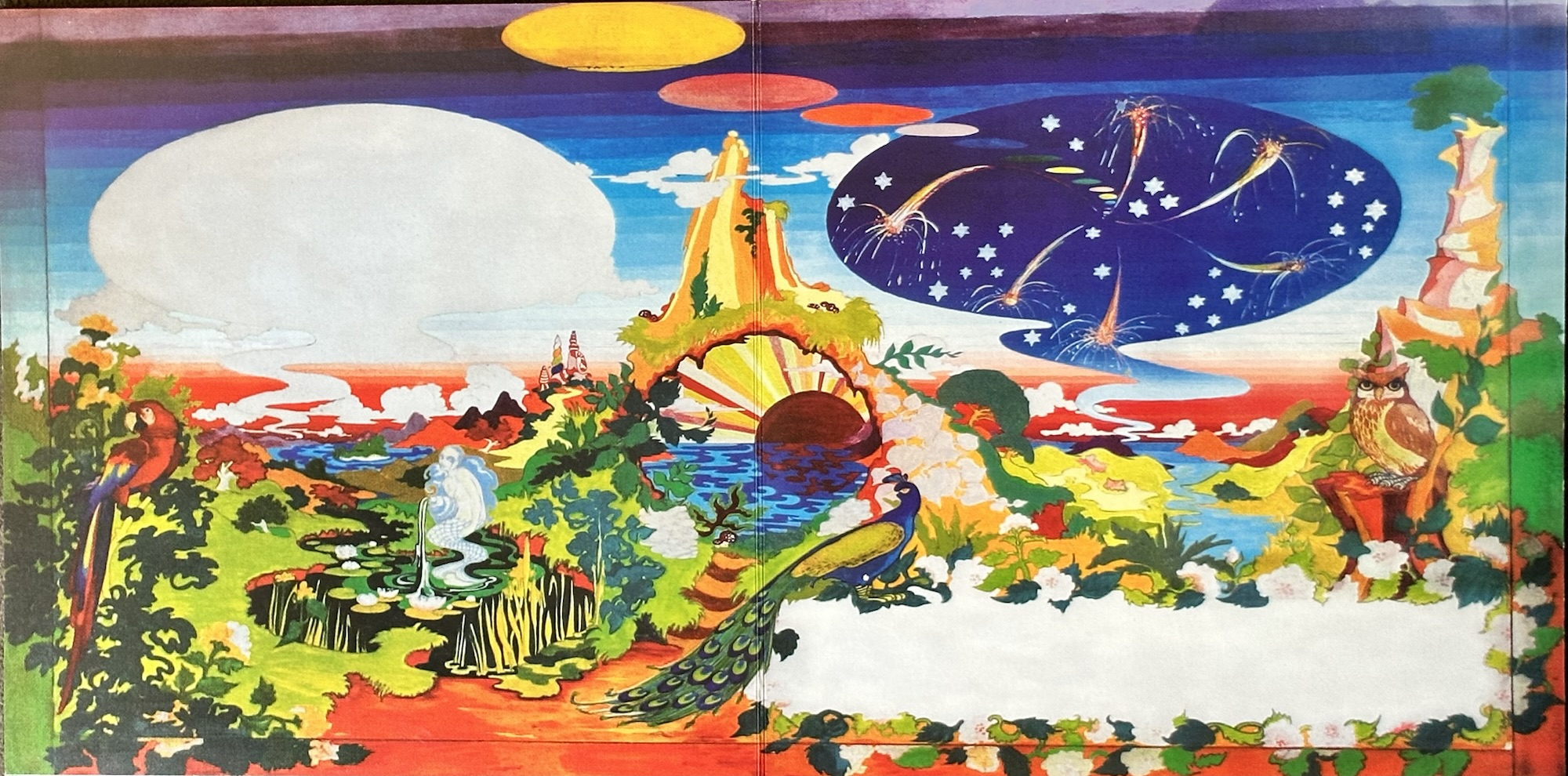
The surviving Fool artwork itself, sold at Sotheby’s in 2018, is usually described — including by Marijke Koger Dunham in the lot’s own catalogue notes — as intended for the inner gatefold spread, its blank panel on the painting’s right, reserved for the Beatles’ name, song titles and photographs. Obviously, this blank space is much too small for all this information, and my feeling it was intended for the album’s title, which, at the time the Fool was given the commission, wasn’t known. So, I’m not convinced that the Fool’s design was intended to be the inner spread of a gatefold cover. The scale and ambition of the piece makes me think it was intended as the front cover — why else would McCartney (or Epstein, whichever it was) bother to take an inner sleeve design to Robert Fraser?
The clearest case of a boutique artist becoming a record artist in his own right is Nigel Waymouth, half of the poster partnership Hapshash and the Coloured Coat together with Michael English. Waymouth had painted the earlier Granny Takes a Trip shopfront murals himself; in 1967 Hapshash released their own LP, Featuring the Human Host and the Heavy Metal Kids, sleeve included.
None of this explains anything about Stop the Clocks. Blake’s actual concept for Locker owes nothing to any of it. The Granny Takes a Trip idea was simply the first thing tried and dropped. But it’s a reminder of how small and interconnected that late-1960s design world was, and how easily a single abandoned idea for one album cover can lead back through half a dozen others.

