Tag Archives: Exhibitions

The Resurrection of Pauline Boty.

Pauline Boty (1938 – 1966) was a founder member of the British school of Pop Art. She was a painter, collagist, poet, model, dancer and actress. I came across her name when researching Peter Blake’s record cover art and found that Blake had recycled his 1959-60 painting “Valentine (for Pauline Boty)” for the cover of Band Aid’s 40th anniversary release of “Do They Know It’s Christmas?” with just a few changes in the collaged upper panel.
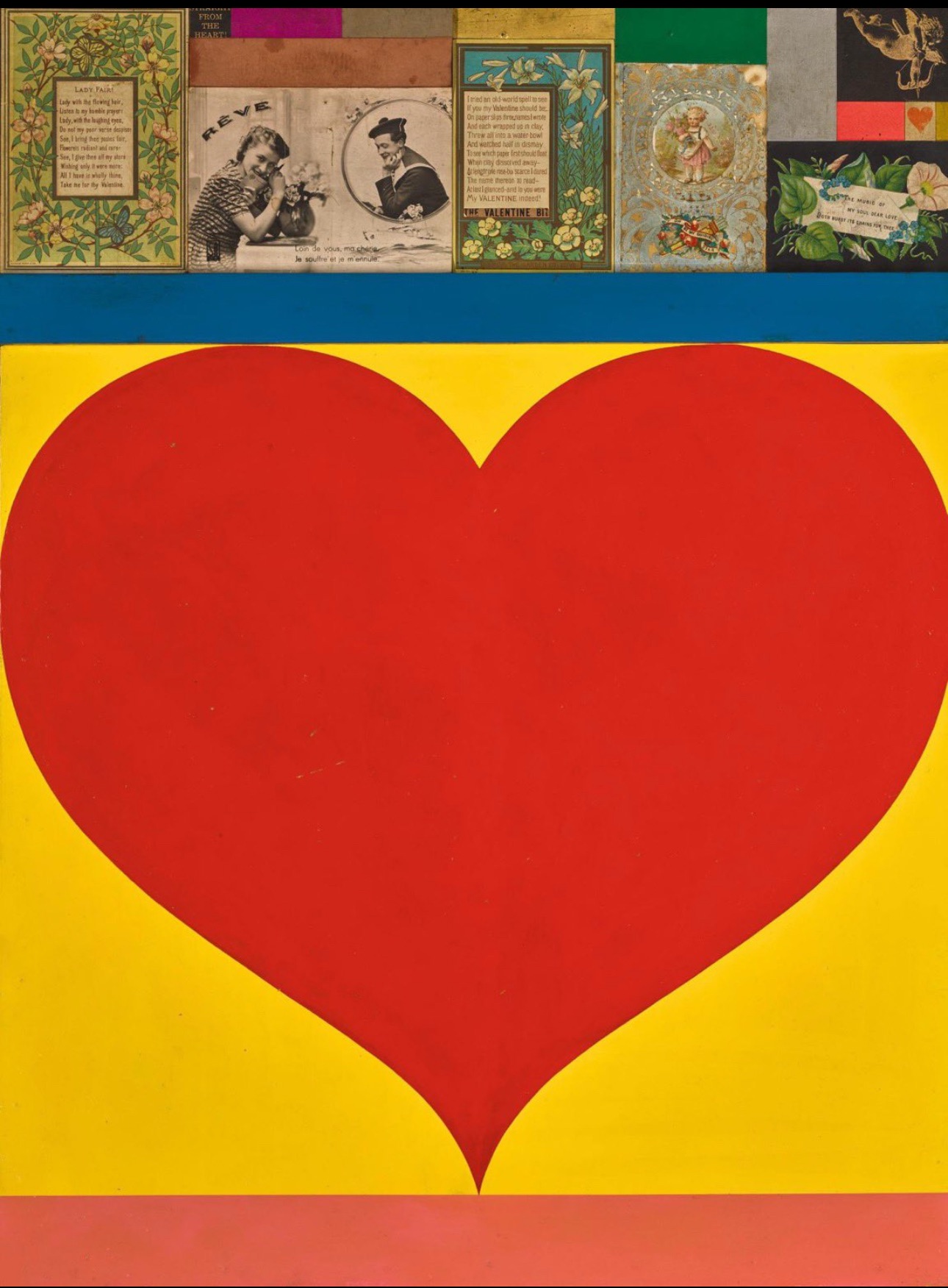
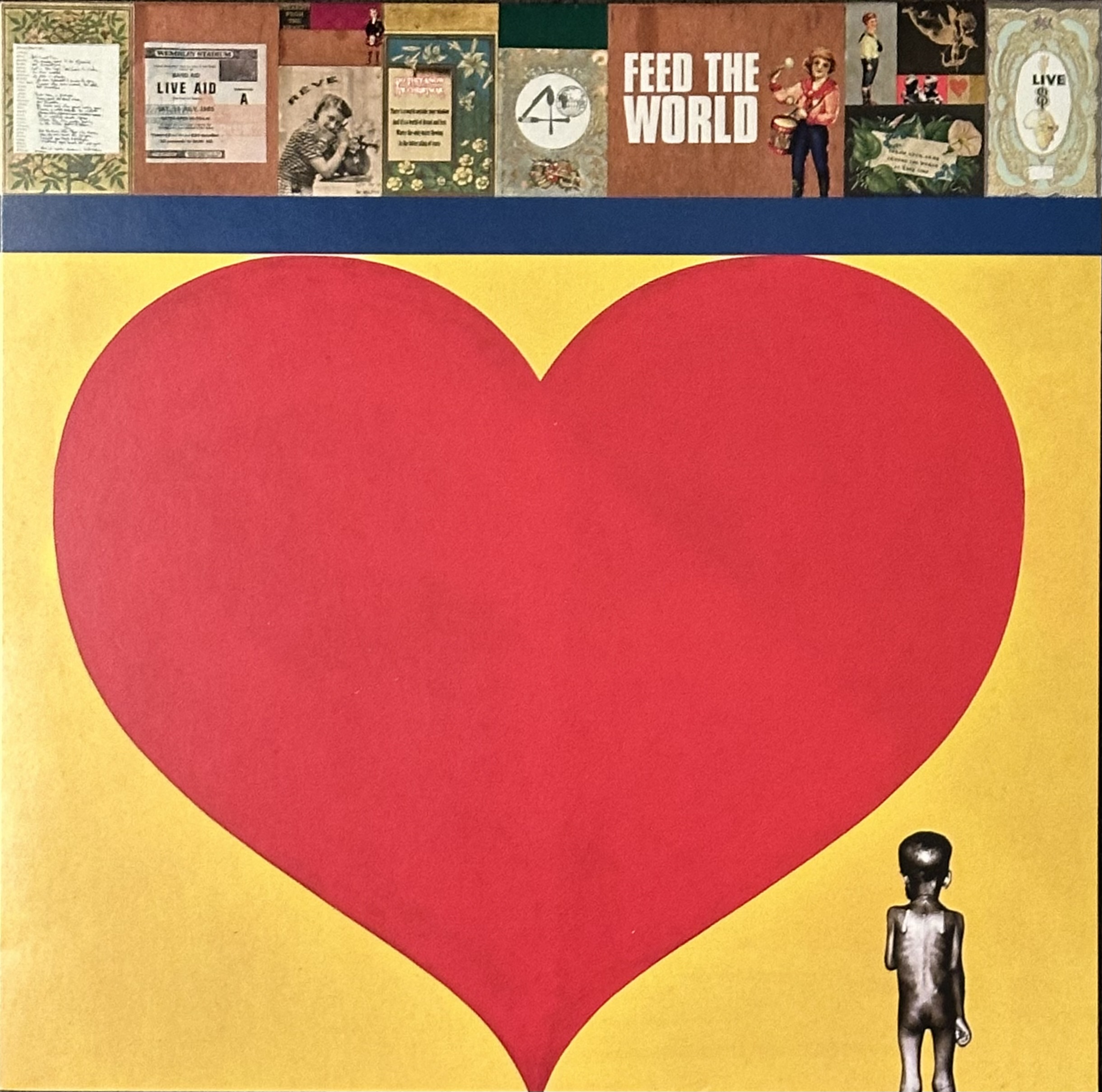
Peter Blake’s “Valentine (for Pauline Boty)” and  the cover of Band Aid’s 40th anniversary release 

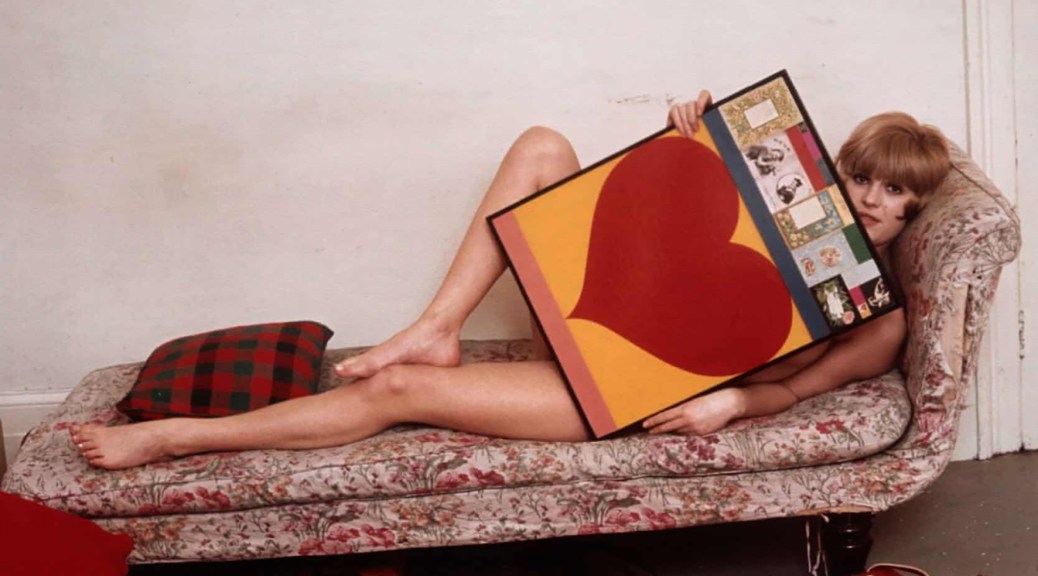
I then found Lewis Morley’s portrait of Pauline holding the painting.
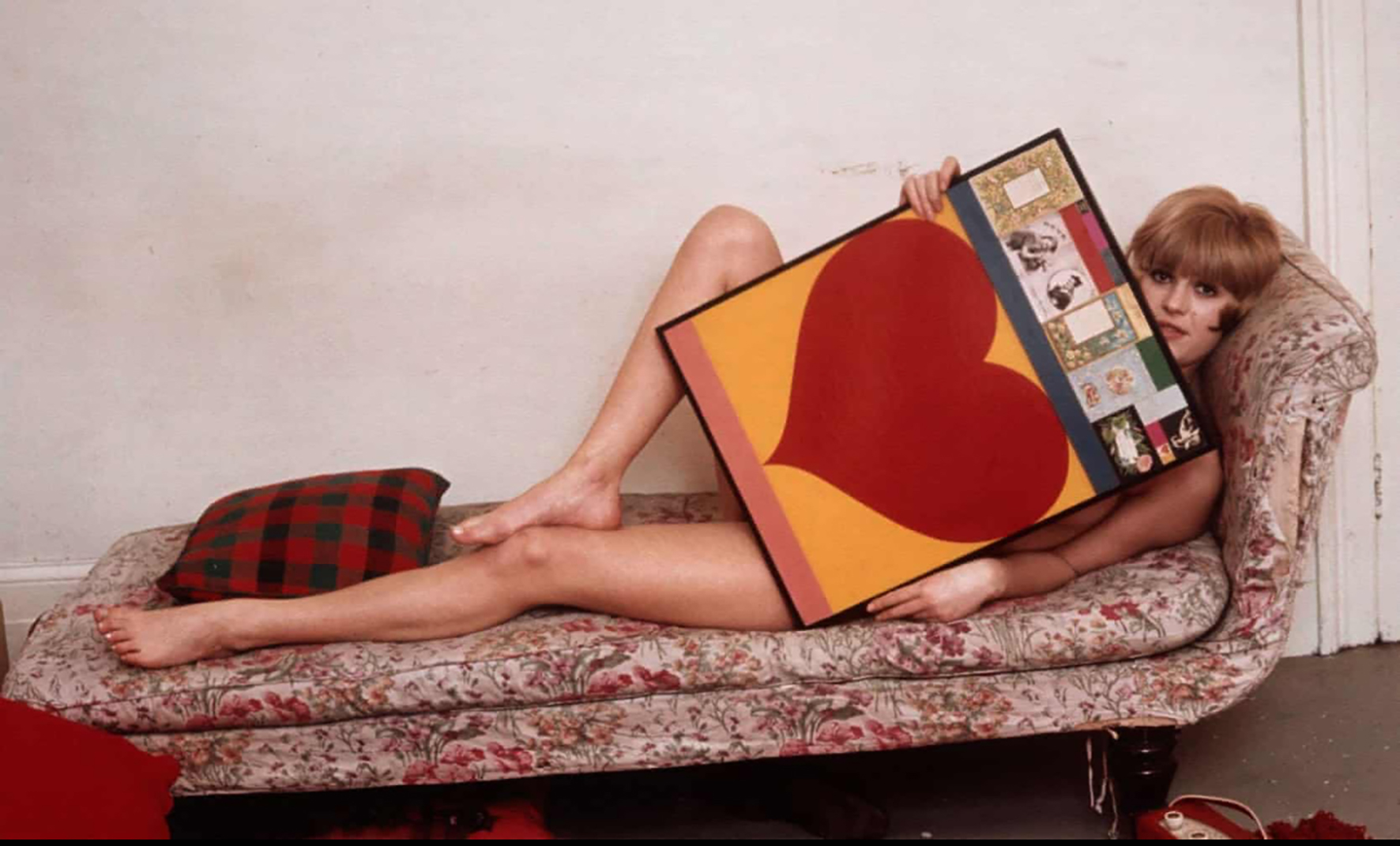
Lewis Morley’s photograph of Pauline Boty holding Peter Blake’s “Valentine” painting.

This photograph of Boty is striking for several reasons. First because she was free-spirited enough to allow herself to be photographed nude and also because in most other portraits she is shown with her own paintings. In this picture she holds Blake’s “Valentine”.

Boty’s art was all but forgotten until a retrospective in 1993 when David Mellor discovered a collection of her paintings on Pauline’s brother’s farm and showed them in a major show at The Barbican called “The Sixties Art Scene in London”. Art historian Sue Tate started researching Boty’s life and work and helped curate the 1998 joint exhibition at London’s Whitford Fine Art and Mayor Galleries called “The Only Blonde in the World” and the Tate Gallery bought the eponymous painting .
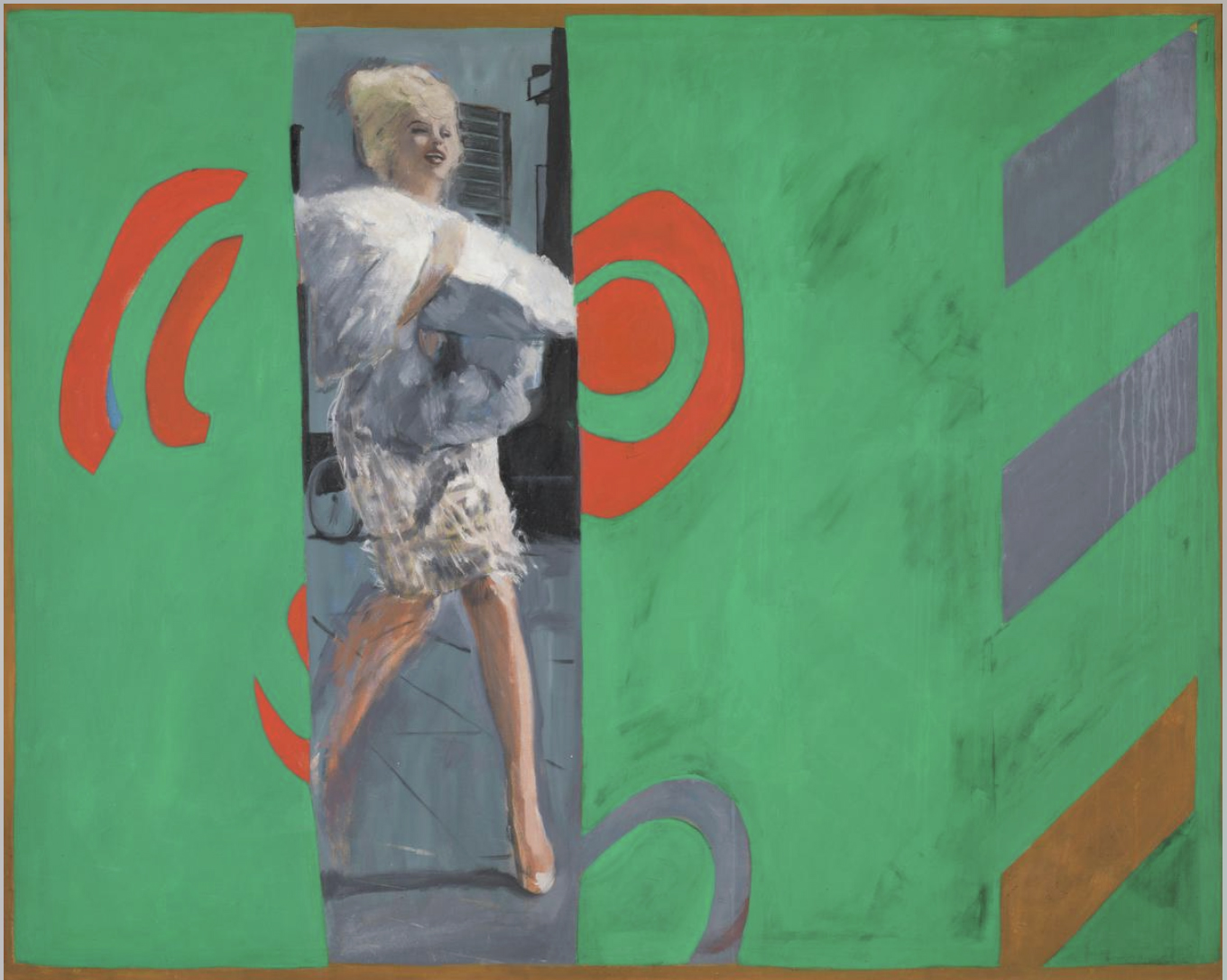
Pauline Boty “The Only Blonde in the World” 1963. Tate London.

The Wolverhampton Art Gallery bought Boty’s painting “Color Her Gone”[1] in 2012 and in 2013 invited Tate to curate a major retrospective of her work “Pauline Boty: Pop Artist and Woman”. Tate wrote an illustrated biography of Boty to accompany the exhibition which travelled to the Pallant House Gallery and to a museum in Poland.
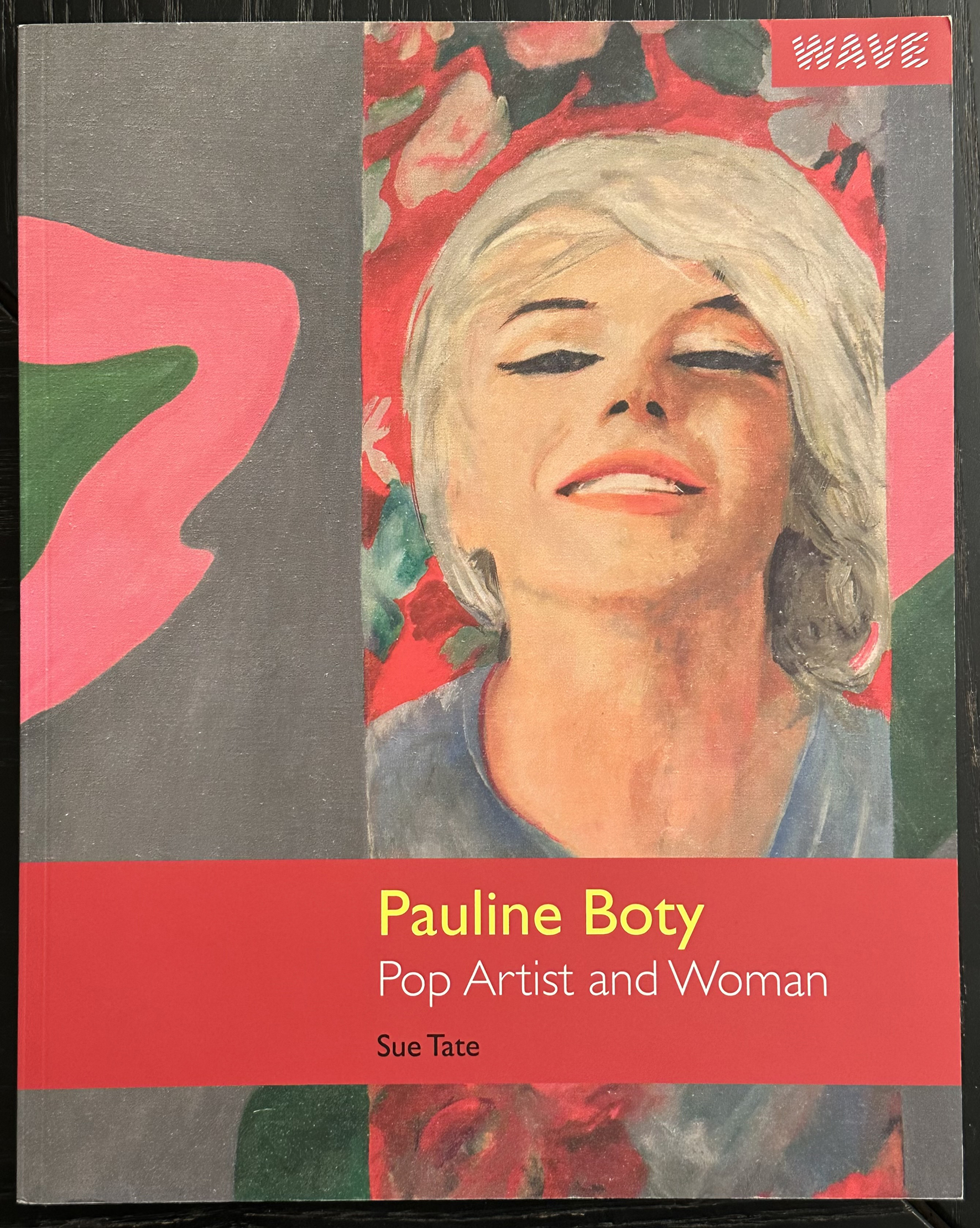
Sue Tate’s book cover

Peter Blake’s “Valentine” painting was sold at Sotheby’s in 2019, and the auction catalogue described how the painting came about. Boty met Peter Blake while she was a student at the Royal College of Art and became his girlfriend while having relationships with other men. She had a long-term relationship with the television producer Philip Saville, who would have an important role in her life and career, providing acting opportunities and introducing her to her future husband Clive Goodwin, who she helped start his literary agency. Blake was besotted with Boty, who, unfortunately for him, wasn’t so romantically engaged. However, he gave her the “Valentine” as a demonstration of his affection and it was obviously important for her as she allowed herself to be photographed holding it. The only photograph of Pauline with a painting that wasn’t one of her own.

The Gazelli Art House organised a further Boty retrospective in 2023 called “Pauline Boty: A Portrait” that coincided with the publication of Marc Kristal’s major Boty biography “Pauline Boty: British Pop Art’s Sole Sister”. Both Tate’s 2013 and Kristal’s more recent volume tell of Boty’s whirlwind ten-day romance with Clive Goodwin leading up to their wedding. The ten-day romance must, however, have been something of a myth despite being proposed by Pauline herself in her interview with her friend Nell Dunn.[2]

Boty told Nell Dunn how she met her future husband. She was walking together with Philip Saville when they bumped into Goodwin and Kenneth Tynan and Saville introduced Goodwin to Boty. The following day Goodwin phoned Saville to ask if he would mind if he asked to meet Boty again. Boty and Goodwin married at the Chelsea Register Office on 24th June 1963. However, the law required a couple to give twenty-one days’ notice to marry. So, the couple must have known each other for at least three weeks prior to their marriage. The romance was probably not much longer than a month or six weeks, though, as Goodwin, having spent a year in Paris, only returned to London in the spring of 1963, say in April or May.

Why wasn’t Boty’s art saleable during her lifetime? While Boty’s close friends Peter Blake and Derek Boshier were represented by Robert Fraser’s famous Duke Street Gallery, Boty didn’t have a gallery representation. Her work was shown together with that of Peter Blake, Geoffrey Reeve and Christine Porter at the AIA Gallery in 1961 and at a “one man [sic] show” at the Grabowski gallery in 1963. She was also one of the four pop artists featured in the BBC Monitor programme “Pop Goes the Easel” in March 1962, which should have given her work visibilty to people interested in the burgeoning field of pop art.

Pauline was constantly hard up and was initially forced to work as a waitress and then to teach art before turning to modelling and acting to make ends meet. Marrying Goodwin could well have been a survival tactic.

Author Marc Kristal had seen one of Boty’s paintings at a pre-auction show at Christies and was entranced and, having never heard of  her before, started to research her life, leading up to the publication of his extensive biography “Pauline Boty: Pop Art’s Sole Sister”. He repeats the story of Boty’s and Goodwin’s ten-day romance seemingly without considering the reality.

Interest in Boty and her work increased in 2023. Kristal’s book was published in October and Gazelli Art House in London organised the “Pauline Boty: A Portrait” retrospective that opened on December 1st, 2023, and ran till 24th February 2024. Sue Tate contributed to the catalogue.
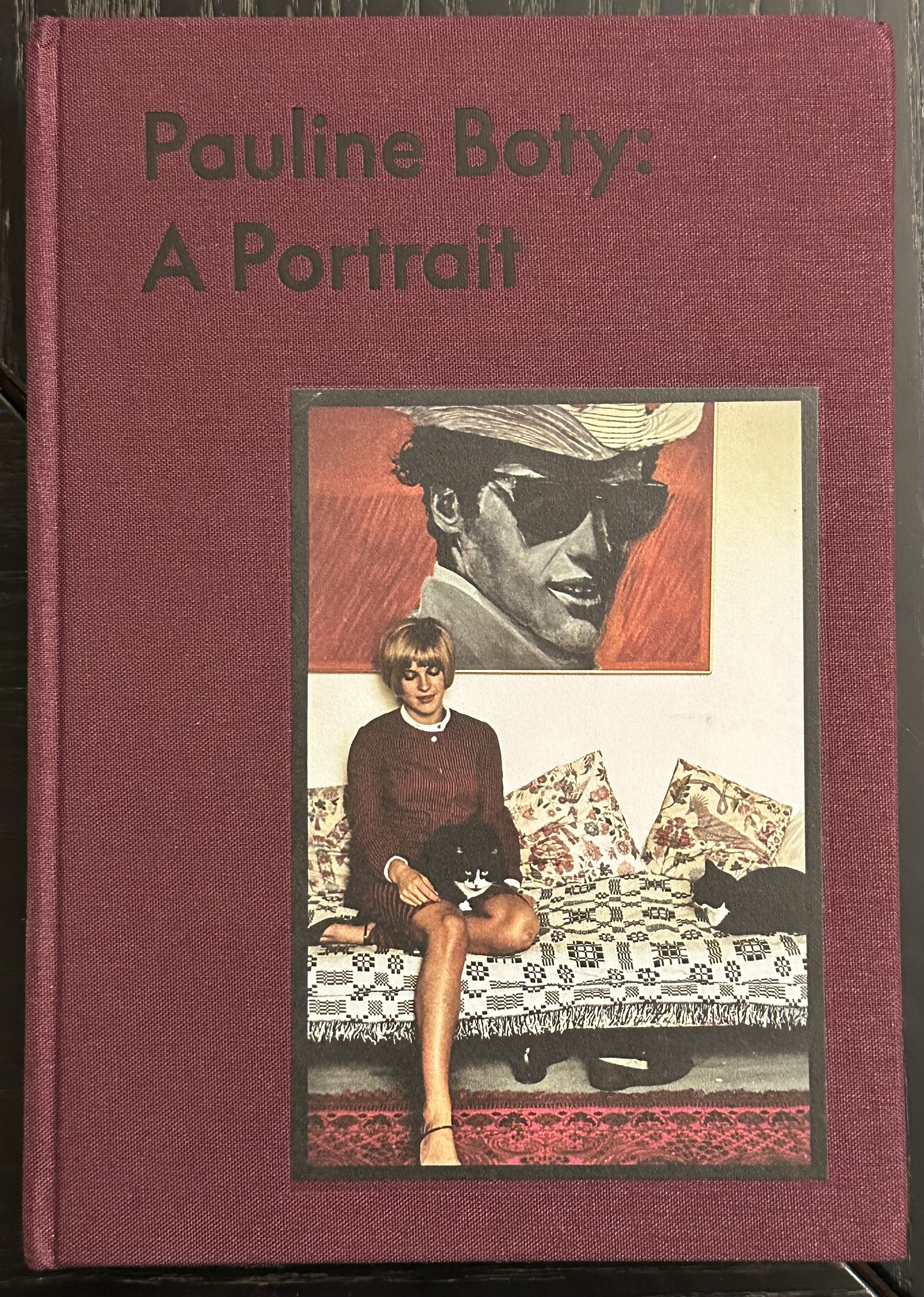
Gazelli Art House Catalogue “Pauline Boty: A Portrait” 2023-4.

Boty continued to see Philip Saville after her marriage and according to Kristal allowed Lewis Morley to photograph her nude in September 1963, barely three months after her wedding. I think these photos were probably taken earlier; Morley had known Pauline since her time at the RCA and they are rumoured to have had an affair. We can calculate an approximate date for the photos from the two paintings featured in the series of stills.
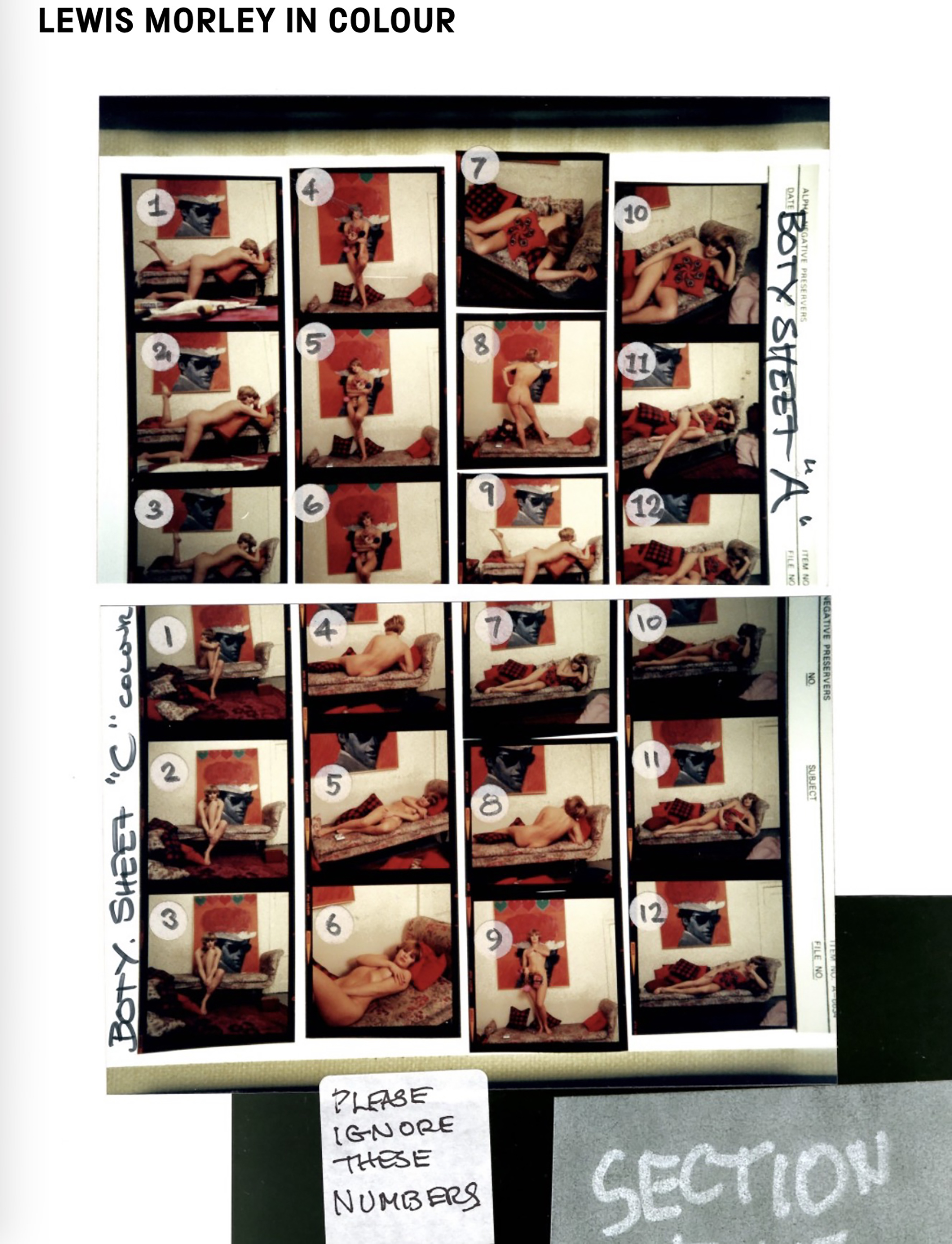
Lewis Morley’s colour photos

The first painting is Boty’s own “With Love to Jean-Paul Belmondo”, from 1962, and the second is Blake’s “Valentine”, which Boty was probably given in 1961 . So, we can safely date these photos to 1962 (or later). But, if we compare Boty’s relatively unsophisticated, and relatively short hair style in these photos with the fashionable, slightly longer style in Morley’s more formal 1963 portrait, the colour photos were probably taken earlier than the 1963 date. Even taking Pauline’s extra marital adventures into consideration, I would hesitate to suggest that she posed nude for Morley barely three months after her wedding. It is difficult to see that these photos were taken at the same session despite the presence of the “Belmondo” painting in both.
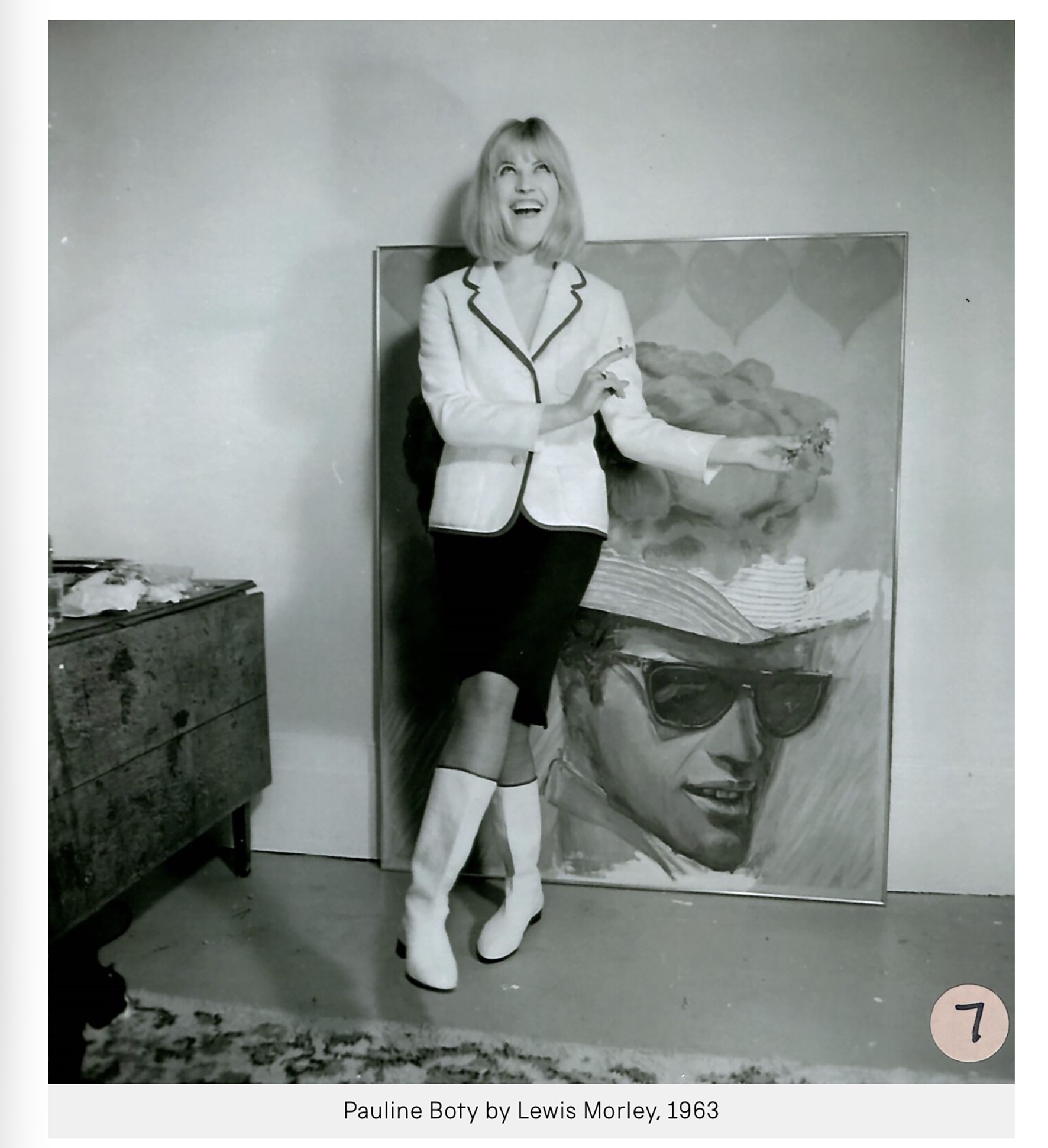
Lewis Morley’s 1963 photos

Peter Blake was understandably upset when he found Pauline had married. Though he married Jann Haworth less than one month later. However, his wedding plans must have been made prior to him hearing of Boty’s and Goodwin’s marriage as he, too, would have needed to give 21 days’ notice of an intended marriage. Some of Boty’s friends thought her marriage was too hasty and that Boty suffered from depression. However, Pauline’s sister-in-law Briget said she had never seemed happier.

The Gazelli Art House exhibition catalogue showed Morley’s photograph of a nude Pauline lying on a chaise longue holding Peter Blake’s “Valentine (for Pauline Boty)” painting but strangely labelled it “Lewis Morley: Untitled. Pauline Boty holding Peter Blake’s ‘Heart’. 1996”. Neither the picture’s title nor the date are correct.

My interest in Pauline Boty and her art arose from the discovery that Peter Blake had recycled his 1959-60 painting “Valentine (for Pauline Boty) for the cover of Band Aid’s 2024 Christmas single “Do They Know It’s Christmas?” I discovered that Pauline Boty was an important member of the early British pop art movement and how her work has become widely recognised after having been lost for almost thirty years after her untimely death in 1966. I found how her relationship with Peter Blake influenced her work and how she acted as a sort of muse for him. I suspect the Lewis Morley photographs of a naked Pauline Boty were probably taken earlier than has generally been accepted. The corrections to the accepted timeline paint a picture of a more purposeful, less impulsive woman than the myth suggests. And the fact that Blake chose this particular painting — a private love token from sixty-five years earlier — as the cover image for the 2024 Band Aid 40 cover gives it an emotional resonance that probably would have gone unrecognised.


[1] Note: Boty was heavily into Americana, using cuttings from American magazines such as Life as sources for her collages. She used the quote from the American song ”My Coloring Book” for the painting’s title. Both Tate and Kristal anglicise the title to ”Colour Her Gone” instead of Boty’s ”Color Her Gone” – or was their mistake simply the result of autocorrection in their manuscripts?

[2] Dunn, Nell: Talking to Women. MacGibbon & Kee, London, 1965.

A New David Shrigley Cover and Some Thoughts About Collecting Record Cover Art.

I’m in a contemplative mood. I collect, I make lists, and recently people have been asking for copies. I try to help and get compliments. How unusual. I’m not really used to those.

DB wants a list of Cindy Sherman and David Shrigley covers, Felix wants a list of Damien Hirst covers and I send them with explanations. A friend casually asks “how many Banksy covers are there?” And I answer “Well, I have about two hundred.” I check my curent list, that doesn’t have them all.

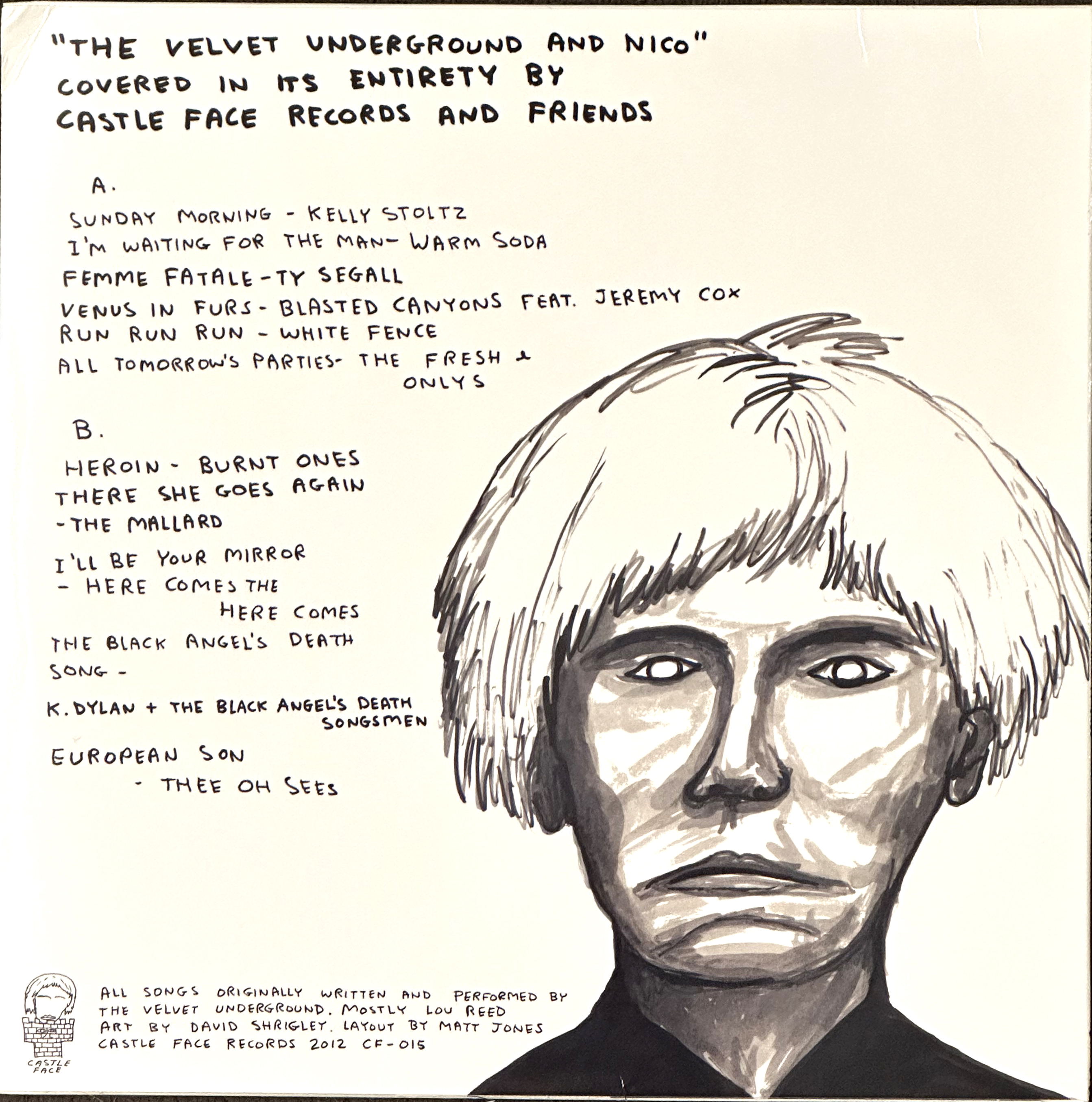
DB gets back to me and wonders if I’ve missed one Shrigley cover and sends me a picture of the Velvet Undergrund & Nico album released by Castle Face Records with its Shrigley rendition of Warhol’s Banana on the cover and his portrait of Andy on the rear. I check my list and note number 37–listed as a Various Artists compilation. It’s the Castle Face album. I remember that I asked David Shrigley to sign it when he visited Spritmuseum in Stockholm a few years ago.

Then, in late November 2024, Paul emails that there is a new record being released with a cover designed by David Shrigley. Another to
a. add to my collection, and
b. add to my Shrigley list.
Paul says it’s a limited edition and I better hurry. By the time I get his mail I’ve already ordered it. Then the following week he emails me again about what I assume is the same release, only it isn’t. It’s a second version of the record, this time pressed on red vinyl. The first version came on yellow vinyl. I rush to order a copy but find it has already sold out. Ouch! I check Ebay. There’s a copy for sale there and I manage to grab it.

So now my Shrigley list has sixty-six titles, although that includes a few doubles.

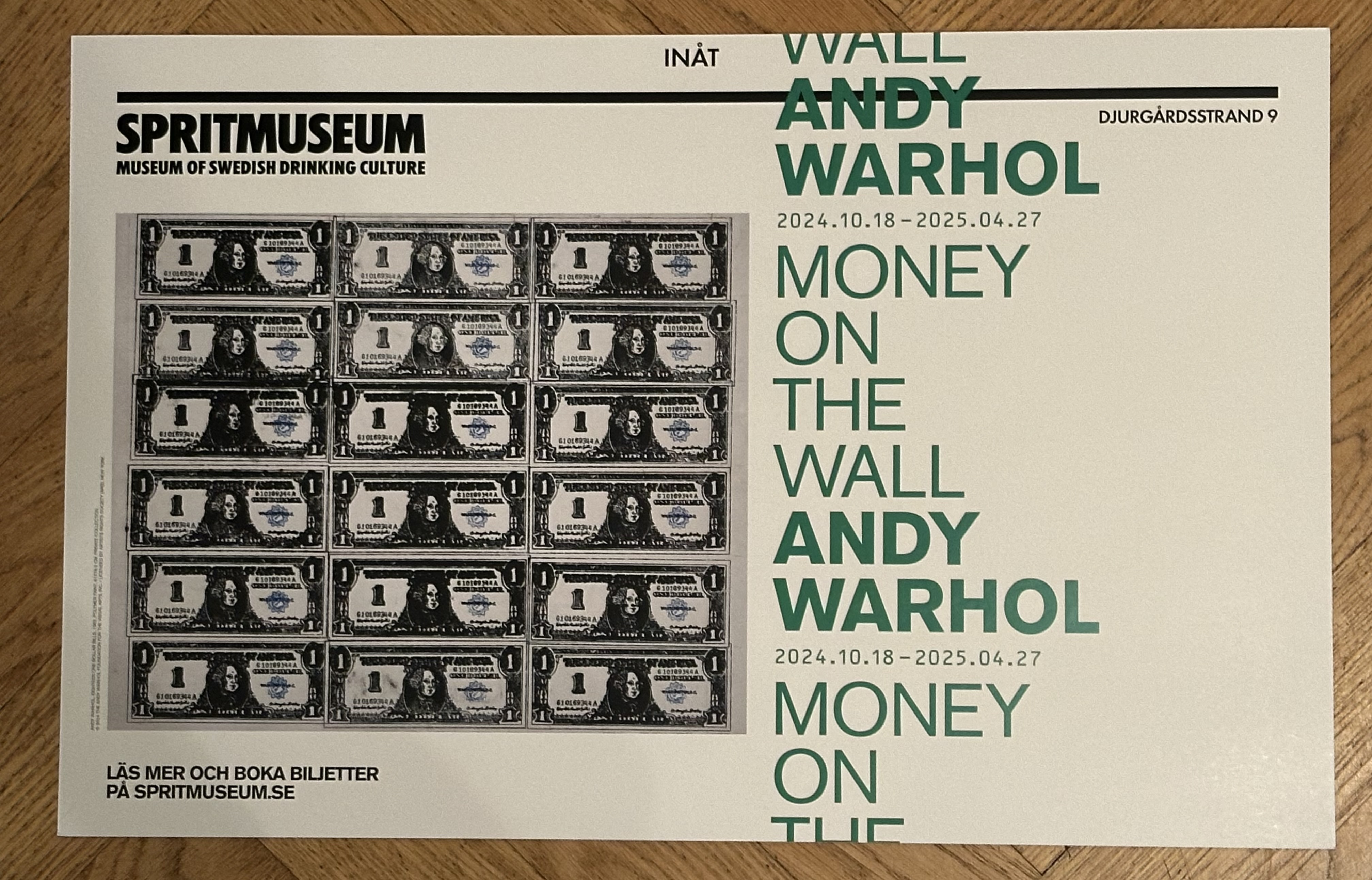
And, another little compliment–Spritmuseum, in Stockholm, where their current exhibition Money on the Wall: Andy Warhol is a critically lauded success has eighteen of my Andy Warhol designed record sleeves on display, want me to give a talk about record cover art at the end of January 2025.

I’ve called it Record Cover Art from Warhol to Banksy. Now all I need to do is put it all together. I’m making a new list of important covers.

My Collection of Andy Warhol’s Record Cover Art — Is This as Far as I Can Go?

I have been collecting Andy Warhol’s record cover art more seriously since about 1982. Once Ebay started I found research into Warhol’s 1950s cover art easier and in the early part of the 2000s could collect some rare covers quite reasonably. But, I suppose it was in about 2006 or 2007 that I got to know Warhol collector Guy Minnebach, who gave me amazing help to boost my collection.

In around 2007, I had the (not too original) idea of putting on an exhibition of ALL of Andy Warhol’s record covers and it came about in time for what would have been Warhol’s 80th Birthday in 2008. The exhibition, at Piteå Museum, in northern Sweden, wouldn’t have been possible without the help of Jan Wimander and, of course, Guy Minnebach–who lent me several extremely rare covers to photograph for the exhibition and who helped hang the covers. Little did I know at the time that the Montreal Museum of Fine Arts was planning a major Warhol retrospective entitled “Warhol Live!” that concentrated on his connection to music and film and included what would have been the first properly curated exhibition of Warhol’s record cover art had we not pipped the Montreal Museum at the post, by opening a couple of months earlier!

Our exhibition included sixty-five covers. The Montreal exhibition showed Paul Maréchal’s wonderful cover collection that included the “Night Beat” box, that neither Guy nor I had seen. In addition, the Montreal Museum of Fine Arts launched Paul Maréchal’s book “Andy Warhol – The Record Covers, 1949-1987. Catalogue Raisonné”, the first serious attempt to document Warhol’s record cover art.

The discovery of the “Night Beat” box, together with Guy Minnebach’s earlier discovery of the “Waltzes by Johann Strauss, Jr.” EP showed that there were probably more previously unrecognised Warhol covers out there, and, only a month after our exhibition in Piteå closed, I was tipped off about a cover by the Swedish band RATFAB (Roland and the Flying Albatross Band) that Warhol had drawn in 1984. Since then more covers have been found and motivated an updated version of Paul Maréchal’s catalogue raisonné, this time renamed “Andy Warhol–The Complete Commissioned Record Covers, 1949-1987”.

I have several times in blog posts warned against saying a collection is “complete”–as  new items usually turn up immediately one says a collection is complete. So, even with Paul Maréchal’s book!

My list of Warhol covers includes bootlegs and records and CDs released after Warhol’s death in 1987 and today has 248 separate items. 228 of them are currently in my collection, with only five of the twenty omissions that I would call “essential”–the pink version of Prokofiev’s “Alexander Nevsky” (from 1949), the “Night Beat” box (1949 or 1950), the Japanese EP of Mendelsson’s “Scherzo” (with the “Cool Gabriels artwork) , an original “Giant Size $1.57 Each” cover (1963) and the limited edition Keith Richards bootleg LP “Unknown Dreams” (1977).

I have made facsimile editions of the “Night Beat” box, the five versions of the “Giant Size $1.57 Each” cover (with white, red, yellow, green & orange backgrounds) as well as a version of the unreleased “Progressive Piano” EP and 10″ LP and the recently “discovered” “Voices and Events” box. I’m toying with the idea of making a facsimile of the pink “Alexander Nevsky”, which shouldn’t be too difficult, but I don’t have a decent high resolution image for the “Unknown Dreams” album cover to be able to make one of those. So, is this as near completion as I can get?

Collecting Andy Warhol’s Record Cover Art. How to Credit Previously Unrecognised covers?

I curated what I thought would be the first exhibition of Andy Warhol’s record covers in Piteå, Sweden, in July 2008 I enlisted the help of fellow collector Guy Minnebach to assemble as complete a collection of record Warhol’s record covers as possible. Only later did I find out that Warhol’s record covers had been shown before-usually as part of other exhibitions of his art, and then only exhibiting a few covers. My intention with the 2008 exhibition was to try to gather together all the covers he designed or illustrated.

Just two months after the exhibition in Piteå closed, the Museum of Art in Montreal, Canada, put on a major exhibition entitled “Warhol Live!” which showed the link between Warhol’s art and music. Many of the record covers shown came from the collection of Paul Maréchal and his book “Andy Warhol – The Record Covers 1949-1987: Catalogue Raisonné” was published to coincide with the “Warhol Live!” exhibition.

Just before the Piteå exhibition, Guy Minnebach had discovered the “Waltzes by Johann Strauss Jr.” EP and the “Warhol Live!” exhibition showed Paul Maréchal’s newly discovered “Night Beat” box set. Less than a month after the exhibition in Piteå closed, in September 2008, a friend of mine read an interview in a magazine with Tomas Alfredsson, a Swedish musician turned actor, who had been a member of a band called Roland and the Flying Albatros Band (known as RATFAB for short). In the interview he said that the cover of the Band’s second single had been designed by Andy Warhol. Thus started my search for this cover, and I quickly found three copies. The RATFAB single “Det brinner en eld / Mörka ögon” became the first Warhol cover NOT to be included in Maréchal’s 2008 book!

Since then, a number of covers, unrecognised in 2008, illustrated or designed by Andy Warhol have been identified.
1. Margarita Madrigal’s Magic Key to Spanish, Volume 2 (LP),
2. Vladimir Horowitz – Piano Music of Mendelssohn and Lizst (LP),
3. Mendelssohn – Wedding March / Scherzo (45 RPM EP)
4. Lew White – Melodic Magic (EP),
5. Erika Morini – Tchaikovsky–Violin Concerto
6. George Gershwin / Edvard Grieg – Porgy & Bess / Symphonic Dances (LP and EP box),
7. Curiosity Killed the Cat – Misfit / Man (7″ single).

And this list doesn’t include bootlegs or records and CDs that simply appropriated Warhol’s art for their covers. Nor does it include covers after 1987 that simply use or reuse Warhol’s art, such as Paul Anka’s “Amigos” or Skyline’s “Skyline” or even The Silver Apples’ “Fractal Flow / Lovefingers“.

There has been a problem in having new covers suggested to be by Warhol verified. An example is the rear cover drawing on Keely Smith’s 1957 Capitol Records LP “I Wish You Love“. By this date, Warhol was an acclaimed commercial artist and his “dot and blot” technique was being used by other illustrators. Warhol is not known to have worked with Capitol Records on any other projects, so this drawing cannot certainly be accredited to Warhol. There are similar discussions about the Tchaikovsky (No. 5 in the above list) and the Gershwin / Grieg (No. 6 in the list) designs also released in 1957, but these were at least released on the RCA Victor Bluebird label, and Warhol did many designs for RCA and its other subsidiary Camden Records. Maréchal has included the Tchaikovsky, but not the Gershwin / Grieg in the second edition of his book.

There are variations in some of the covers that Maréchal has described. There are various colour variants of the covers illustrated, starting with the first cover in the book, “A Program of Mexican Music” (Columbia Records – ML 2080). Maréchal includes the green cover variant but doesn’t mention the rarer pale blue coloured version. Similarly, there are five colour variations of the “Alexander Nevsky” (Columbia Records – ML 4247)–pale blue and a deeper, almost turquoise, blue that contained the original LP with dark blue labels. The album was re-released in the late fifties with the cover in green, orange and pink. These copies have records with Columbia 6-eye labels. Maréchal includes the green reissue cover, but not the original blue covers. Then there are minor variations such as the various printings of the “Latin Rhythms by the Boston Pops” EP. Friend and Warhol expert Guy Minnebach noticed that some copies had the text “A High Fidelity Recording” just beneath the RCA logo in the upper right of the cover. Some had this text in silver and some in green. There is a minor variation in the cover of the “Waltzes by Johann Strauss, Jr.” EP. Some copies have “Printed in U.S.A.” at bottom right while others do not (probably due to the way the slick was cut before being affixed to the cover.)

There are probably more cover designs by Andy Warhol waiting to be identified. A recent case in point is the sister box to NBC’s “Night Beat” entitled “Voices and Events“. As with the designs for the “Progressive Piano” EP set and 10″ LP a lithograph of the “Voices and Events” cover design exists in The Warhol Museum and was shown at the “Adman-Warhol Before Pop” exhibition in Australia early in 2017. It isn’t clear whether The Warhol Museum recognised this to be the design for an EP box set, but when I saw it I immediately saw the similarity to the “Night Beat” design with the dots on three sides. No one knows if the “Voices and Events” box was ever released. I suppose, like the “Night Beat” set, it was intended as a promotional teaser but the radio show it was intended to promote only lasted three episodes… so probably not.

By my reckoning, there are some 55 individual covers that can be attributed to Andy Warhol (I do not count different formats that use the same, or similar, designs), but there is no way that a newly identified cover can be given accreditation, other than being recognised by Paul Maréchal and included in future editions of his “Complete Commissioned Record Covers“.


“Voices and Events” – A Previously Unrecognised Andy Warhol Record Cover.”

Occasionally serendipity strikes. A week ago I went to Stockholm’s Moderna Museet to see the retrospective exhibition of Marie-Louise Ekman’s art. In true Banksy style I left thru’ the gift shop and while there I noticed a new book about Andy Warhol’s early career–“Adman-Warhol Before Pop“, published b the Art Gallery of New South Wales, Australia, to coincide with their exhibition of the same name, which ran from February to 28th May 2017.

IMG_0265
Nicholas Chamber’s exhibition book published by the Art Gallery of New South Wales.

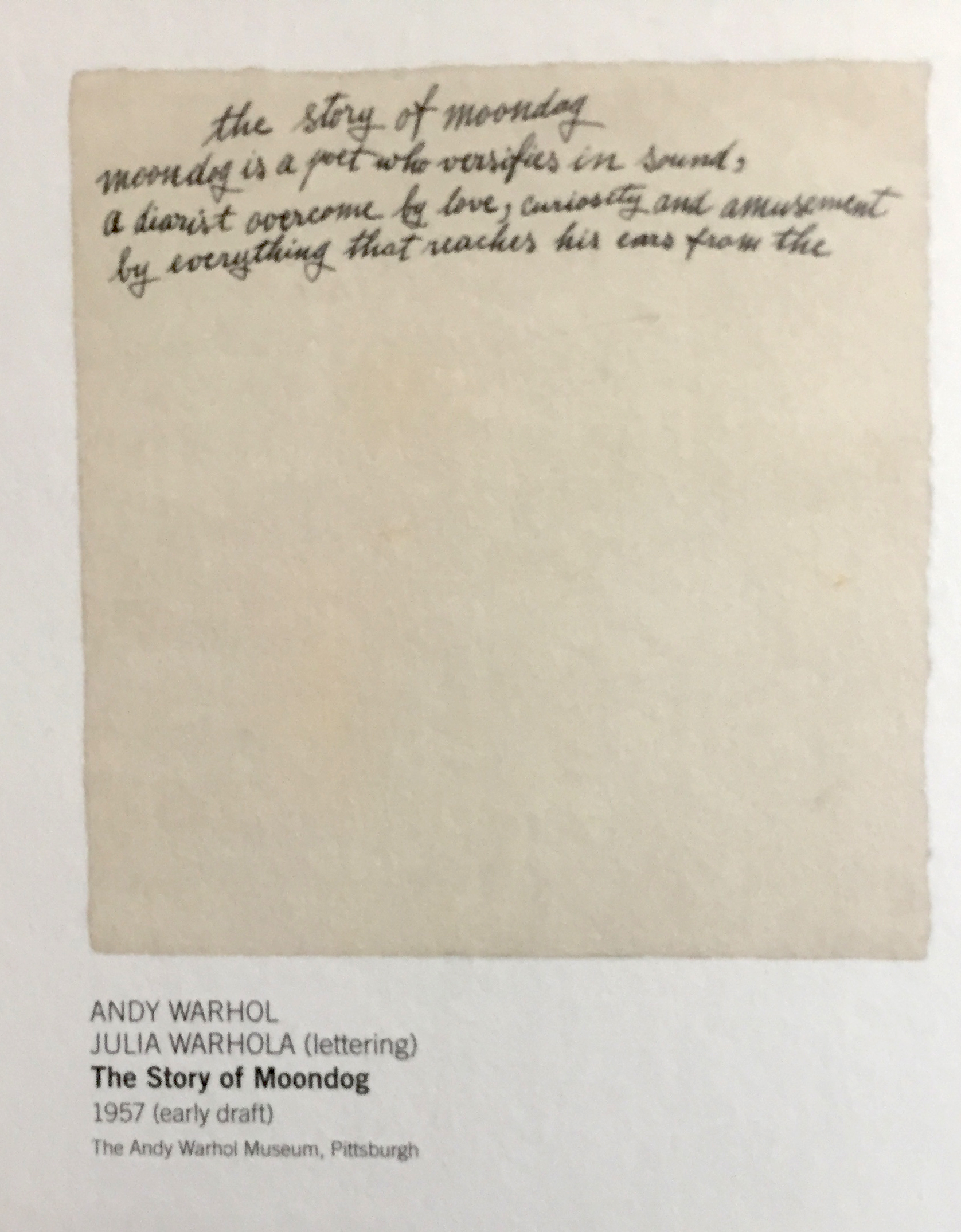
I couldn’t resist a quick flick through just to see if there were any record covers featured. I was excited to see quite a few of Warhol’s earliest covers, including “A Program of Mexican Music“, “The Story of Moondog“, with Julia Warhola’s beautifully querky calligraphy, Johnny Griffin’s “The Congregation” and sketches for the Tennessee Williams LP, Billie Holiday EPs and one of the “Progressive Piano” designs. There was also a picture of one of Julia Warhola’s early attempts to write the cover for “The Story of Moondog” album.

Adman-Spread5
Julia Warhola’s trial version of the cover text for “The Story of Moondog”.

But what I wasn’t prepared for was:

Adman-Spread3
Page 97 in “Adman-Warhol Before Pop” with a picture of the cover slick for an recording of an NBC radio programme called “Voices and Events“.

Voices&Events-slick
The cover slick for “Voices and Events” box set.

Having made reproductions of the “Night Beat” box set, I immediately recognised that this was the design for a similar box. While there exists a physical example of the “Night Beat” set, discovered by famous Warhol collector and author, Paul Maréchal, that has a record company catalogue number, as far as I know no physical example of the “Voices and Events” box exists and so I cannot know if it was actually released. I don’t even know if it was intended for a box of seven-inch EPs or for LPs, but I suspect the former.

So–all you Warhol cover collectors out there please start searching! Meanwhile I’m gonna try to make me a copy.