I used to be a music nerd with a large collection of all sorts of recorded music, though mainly a vinyl freak. I started out in the sixties, got swept away by psychedelia and into music posters which I continued to collect up until 2013, when space shortage meant I had to sell the major part of my collection. I had already started collecting record cover art and had large collections of art by Vaughan Oliver (4AD) and Neville Brody (Fetish Records), which unfortunately had to go. My collections of Andy Warhol’s, Sir Peter Blake's and Banksy’s and the Swedish band kent’s record covers have been exhibited in major exhibitions both in Sweden and internationally. I also have collections of David Shrigley’s, Damien Hirst’s, Klaus Voorman’s, Cindy Sherman’s and Richard Prince’s record cover art and a couple od Jean-Michel Basquiat’s covers.
When Noel Gallagher was planning Oasis‘s retrospective album “Stop the Clocks” in 2006 he wanted Peter Blake to design the cover. The story that I have heard is that Peter Blake allowed Noel to select items from Peter‘s collection to fill Blake‘s Blue Cupboard–an artwork that Blake had created in 1959. Blake then placed other objects, including an antique dartboard, beside the open cupboard.
The front cover of Oasis’s “Stop the Clocks” album with two dartboards behind the table on the right.
Blake designed the cover slipcase and the inner sleeves of the tripple LP set as well as using the dartboard as the cover image of the double EP also entitled “Stop the Clocks“.
The cover of the double 7″ EP “Stop the Clocks”. This was a numbered, limited edition of 5000.
What I didn’t know until very recently (June 2016) that Oasis‘s record company (Sony Music) had produced a promotional item of the dartboard with three darts with tailfeathers bearing the Oasis logo. This would be a great addition to my Peter Blake collection.
The dartboard is obviously a facsimile of Peter Blake‘s originals. This would look great displayed beside the record covers!
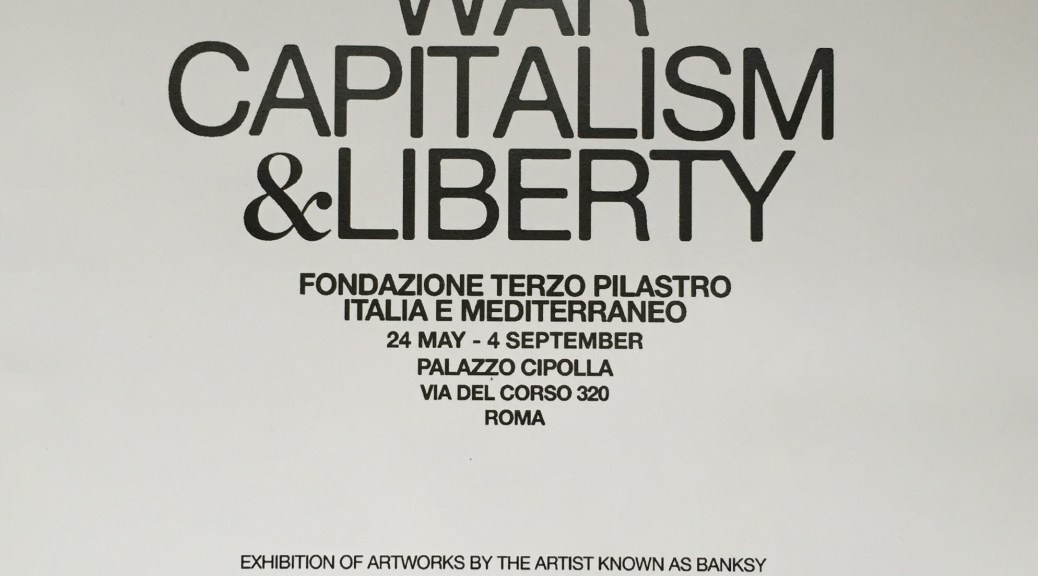
I don’t really know why I haven’t done it before. I felt kind of forced to make a list of my covers with art by Banksy before the collection was shipped off to Rome for the “War, Capitalism & Liberty” exhibition which opened in May 2016. I had a basic list of my collection of covers with Andy Warhol art, but I needed lists of Peter Blake‘s, Damien Hirst‘s and Klaus Voormann‘s covers. Finally last month I sat down and started compiling these lists and was surprised to find that there are seventy-six covers with Klaus Voormann‘s art!
Then, just as I had finished my list I saw an advert for a book entitled “Albums with Cover Art by Klaus Voormann“. Well, naturally, I thought someone else had done the work for me. So I bought it. What a disappointment! It only lists eleven covers designed by Klaus and included a number of covers not designed by him. None of his covers designed for German artists are mentioned and none of his early jazz covers. There are several pages devoted to the recording of “Concert for Bangladesh” with pictures of the original box set and a reissue, neither of which were designed by Voormann! The book, produced by Books LLC, Wiki Series, Memphis, Tennessee, is thus a complete waste of money. Well, not quite–the book did show a picture of Wet Wet Wet‘s 2007 single “Too Many People” which has a cover drawing by Klaus Voormann.
A little booklet purporting to list Klaus Voormann’s record covers.
I already have Wet Wet Wet‘s CD “Timeless“, both as the official CD and a promo version with two different Voormann covers. After a bit of research I found the there were two CDs of the “Too Many People” too.
CD 1 and CD 2 cover art for Wet Wet Wet’s 2007 single “Too Many People”
Then Thorsten Knublauch, an expert on The Beatles‘ early days in Hamburg, who sold me my original copy of the Paddy, Klaus & Gibson 10″ compilation EP tipped me off about a CD by Albert Lee & Hogan’s Heroes entitled “Fretterning Behaviour” with classic Voormann art.
Cover art for Albert Lee & Hogan’s Heroes CD “Fretterning Behaviour”.
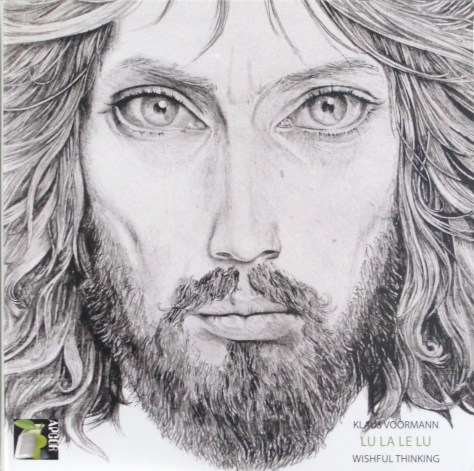
Almost simultaneously, I saw a seven-inch single advertised on Ebay of Klaus Voormann‘s song “Lu Le La Lu“, which he recorded for Apple in the sixties but which was never released. A group called Wishful Thinking released the song as a single in 1974. Now http://www.aisforapplebooks.com released a limited edition of 1000 copies (250 of which were autographed by Klaus) featuring a remastered version of Klaus‘s recording of the song backed with Wishful Thinking‘s version. The single, in a gatefold cover with Klaus Voormann‘s self portrait from 1960 on the front cover, is sold in aid of a charity for refugees.
The front cover of the split single with Klaus Voormann’s version of “Lu Le La Lu” on the “A” side and Wishful Thinking’s version on the “B” side. The cover picture is Klaus Voormann’s 1960 selfportrait.
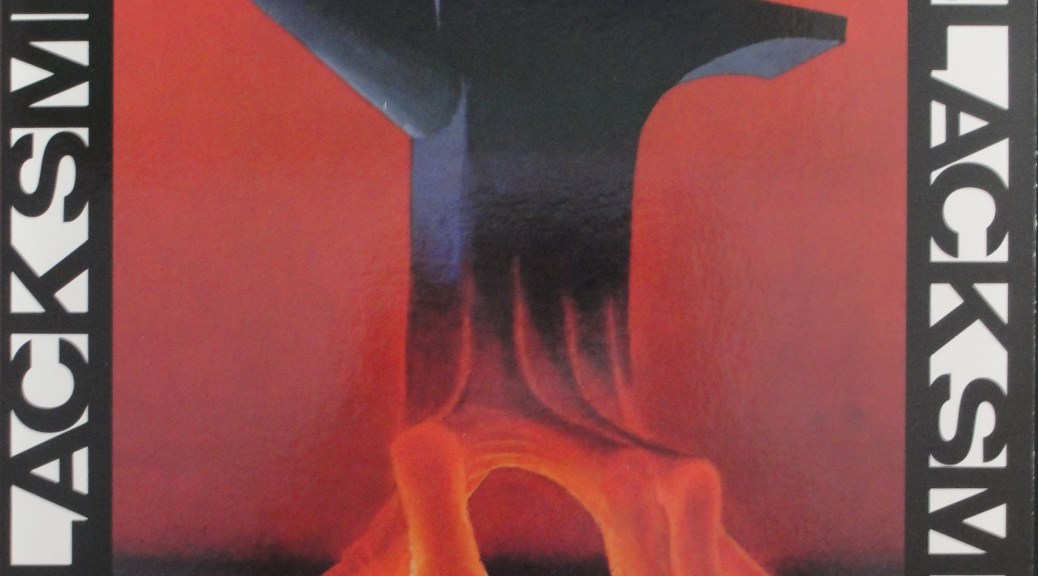
At the same time another Ebay seller was selling a 1974 Jimmy Smith album entitled “Black Smith” and stated that the cover was by Klaus Voormann. I was very surprised to see this and started searching for confirmation that the cover art was by Klaus as I didn’t feel that it was typical of his work. It didn’t take long to find a picture of the rear cover with clear credit to Voormann. So I had to order a copy, which wasn’t too difficult as there were many for sale at very reasonable prices.
Suddenly there were these five Klaus Voormann covers, which I had missed! I could have almost done without the book on Klaus Voormann‘s record cover art, although it did tell me about the Wet Wet Wet singles. But, apart from that, I’m sure I could do a better job myself.
Okay, as you probably have gathered if you read my blog, I live in Sweden. This is not a very important piece of information, but it explains why this post was inspired (probably not the right word) by a recent book and a magazine number. The book, by Olle Johansson, is called “En skivsamlares memoarer” (ISBN 9789163776618, Rabarber förlag, Stockholm, 2015), which translates to “A Record Collector’s Memoirs” and the magazine is the Spring 2016 number of the Swedish music magazine Sonic–a 116 page special number entitled “Alla talar om skivsamlande“, again in translation “Everyone is talking about record collecting“.
Most people would not see any difference between a record collector and a music collector, but there is huge difference and these two publications illustrate it perfectly. Olle Johansson is a MUSIC collector. He is not interested in the format the recording is presented on. He does not care about record labels, catalogue numbers, or the cover art. He wants the music, and it doesn’t matter if it is a reissued CD or vinyl. He doesn’t search for original pressings or special editions. He just wants the music or the artist.
A record collector, however, cares about all, or at least some, of these things. There are those who collect a particular artist–and must have EVERYTHING released by that artist, including unofficial (bootleg) releases. Alternatively, the collector may collect a particular record label, quite independently of the type of music released (though the label will probably have released music that suits the collector’s taste). Then there are collectors who will collect a particular format– say 1960s EPs, or picture discs; the options are endless. And there are strange types, like me, who collect record cover art. Even here there are subdivisions; record cover art by a particular artist, cover art by any famous artist, or cover art that uses a particular design feature or a certain typography.
There are loads of books on record cover art and others on greater or lesser celebrities’ record collections. One recent, almost encyclopaedic one is Eilon Paz‘s “Dust & Grooves: Adventures in Record Collecting“. Paz visited record collectors and photographed them with their hoards of vinyl–everything from rare 78s to the world’s largest collection of coloured vinyl records. Sonic magazine interviewed musicians, DJs, record collectors and record buyers at record stores. I used to have a library of books about record cover art. I have only kept a few that I really treasure. These include Nick de Ville‘s “Album: Classic Sleeve Design: Style and Image in Sleeve Design“, Richard Evans‘ “The Art of the Record Cover“, Paul Maréchal‘s “The Complete Commissioned Record Covers“, Jennifer McKnight-Trontz’ & Alex Steinweiss’ “For the Record: The Life and Work of Alex Steinweiss, Inventor of the Album Cover” and the catalogue from Stockholm’s Nationalmuseum’s 1981-2 exhibition “Ytans innehåll: utställning av skivomslag” [“The Surface’s Contents: An Exhibition of Record Covers“].
Where did my collection begin? Born in the mid forties, I was raised on vinyl records. My father loved music and had a few hundred LPs and a few 78s. In my late teens I had a friend, Chris, who worked on Saturdays at The Chelsea Record Centre, a shop on The King’s Road, Chelsea. We used to go to pubs and listen to R ‘n’ B and, when I went to University we started going regularly to the 100 Club on Oxford Street. We could see The Pretty Things, The Graham Bond Organisation or The Artwoods. One night–I suppose in 1964 or 1965– we went to see Bo Diddley and his famous band (who I had at that time only heard of through some Buddy Holly recordings.) Well, to call that concert mindblowing was an understatement.
The first records I bought were LPs–Eddie Cochran‘s “Memorial Album“, “The Buddy Holly Story” and John Lee Hooker‘s “Don’t Turn Me From Your Door“. One evening in late November 1963 my friend Chris came home with a copy of “With the Beatles” and we spent an evening just playing and replaying the album. And almost a year later on the 24th October 1964, Chris and I went to the Gaumont State Cinema in Kilburn to see The Beatles–I can’t say we heard them because of all the screaming. I still have the “Four Aces” programme from the concert! I started buying records and became a regular at two of London’s independent record shops that imported American albums; One Stop Records in South Moulton Street and Musicland in Berwick Street.
In early 1967, My brother, who had been living in America, returned to England and presented me with a bundle of records including Big Brother & The Holding Company‘s eponymous first album (on the Mainstream label), Country Joe & The Fish‘s “I Feel Like I’m Fixin’ to Die“, The Jefferson Airplane‘s “Takes Off” and “Surrealistic Pillow“. I bought The Doors‘ first album, which was one of the greatest albums of 1967, at One Stop, and they recommended an album by The Velvet Underground & Nico, which I bought but didn’t really get into. I liked the cover, though. Then I discovered bluebeat, ska and reggae and for the first time bought singles. Prince Buster, The Ethiopians and Desmond Dekker before finding Phil Spector and then soul music in the form of Doo Wop with Clyde McPhatter & the Dominoes, The Coasters, The Drifters, Don Covay, Joe Tex and, of course, Otis Redding. Thus far, I was still a music collector.
Then in April 1971, I bought The Rolling Stones‘ “Sticky Fingers” with its Andy Warhol designed cover. I already had The Velvet Underground & Nico, so this was my second Andy Warhol cover. I also had two covers by Peter Blake: “Sgt Pepper’s Lonely Hearts Club Band” and The Pentangle‘s “Sweet Child“. So I had the beginnings of two cover art collections. In the early 1980s I stumbled across an album by The Cocteau Twins and soon started collecting albums on the 4AD label designed by Vaughan Oliver and Nigel Grierson (as 23 Envelope) and Vaughan Oliver and Chris Bigg (as v23). I also found Fetish Record‘s “Final Testament” and collected every cover I could find with Neville Brody‘s art.I also had all three of Joy Division‘s albums but didn’t start collecting Peter Saville‘s record covers in any systematic way, though a few did find their way into my collection. In the early 2000s I fell for Rob Jones‘ work–both as a poster artist for the White Stripes, The Raconteurs and Dead Weather–and for his record cover art. I also collected Swedish designer Martin Kann‘s covers for the band bob hund. All the while my collection of covers by Warhol and Blake grew. I also found that I had many covers by Klaus Voormann and then Damien Hirst produced a few record covers that found their way into my collection. In about 2008 I picked up a couple of albums with cover art by the artist known as Banksy and managed over the course of two years to collect almost all the covers bearing his art.
When I retired in 2010 it was apparent that my wife and I would have to move to a flat and that I would not be able to take my collection of records, posters and CDs with me. I had to downsize. I decided only to keep my collections of record cover art. I said “good bye” to my 4AD, Martin Kann, and Rob Jones records and kept only my Banksy, Blake, Hirst, Voormann and Warhol collections. So now I am a RECORD collector rather than a music collector. The music is secondary to the cover art.
I suppose it was bound to happen! Early in 2016 Sir Peter Blake painted a couple of portraits of his good friend Eric Clapton and these appeared on the cover of the programme for Clapton’s seventieth birthday celebration concerts at Madison Square Garden and The Royal Albert Hall in May 2016. However, the official album of the concerts “Slowhand at 70“–a tripple LP with DVD–did not use the Blake portraits at all. However, two unofficial CD releases included both (please see my previous post on these). Now we know why the “Slowhand at 70” cover didn’t use the Blake portraits–Clapton was saving them for his next studio album “I Still Do“, released on 16th May 2016, exactly one year after the 70th birthday concerts.
Peter Blake’s 2015 portrait of Eric Clapton used on the cover of “I Stil Do”.
The front cover is beautiful in that Clapton and the record company have chosen not to place either the album’s title or Clapton‘s name on it, but rather allow Blake‘s lovely portrait to send the message. This is the second time Clapton has allowed an unadorned portrait to grace the cover of one of his albums–the previous one was 2004’s “Me and Mr Johnson“.
Eric Clapton’s “Me & Mr Johnson” album cover.
I have to thank Guy Minnebach for pointing out that these two covers join Andy Warhol‘s cover for “The Velvet Underground & Nico” and Martin Kann‘s cover for bob hund‘s “Omslag: Martin Kann” as the only covers that have the graphic designer’s/painter’s name on the cover rather than the artists’ or the album’s title.
I think the latest album cover by Sir Peter Blake is one of his best. It emphasises just what a great portraitist he is.
The largest exhibition of the works of the artist known as Banksy opened at the Palazzo Cipolla in Rome on 24th May–4th September 2016. The exhibition is organised by the Fondazione Terzo Pilastro – Italia e Mediterraneo and curated by Stefano Antonelli, Francesca Mezzano and Acoris Andipa and collects works from private collections including paintings, prints, sculptures and – not least in my humble opinion – record and CD cover art and a book cover. There are no works removed from walls.
Acoris Andipa, director of the Andipa Gallery in Knightsbridge, London, which has sold many works by the artist known as Banksy, contacted me in March 2016 to enquire whether I would be willing to lend my collection of records and CDs with Banksy’s cover art to the exhibition. He had been tipped off about my collection by fellow gallerist John Brandler to whom I had once sold some covers. I was flattered by the invitation and agreed.
In return for the loan, my wife and I would be invited to the private showing of the exhibition on 23rd May.
Coincidentally, we had previously booked a trip to Rome at the end of April and we had the opportunity to meet Andipa’s chief assistant Chiara Tognacci with exhibition curator Francesca Mezzano who showed us round the Palazzo Cipolla. We could see the exhibition hall, which was in a very raw state before the carpenters and painters started preparing for the exhibition.
We flew into Rome after lunch on Monday the 23rd Maj and were picked up by limo and driven to our hotel. we had time for a short walk, and relax for an hour and dress for the viewing. Just before 6 p.m. a car collected us and drove us the short distance to the Palazzo Cipolla. We were checked in and given tickets to admit us to the reception after he viewing.
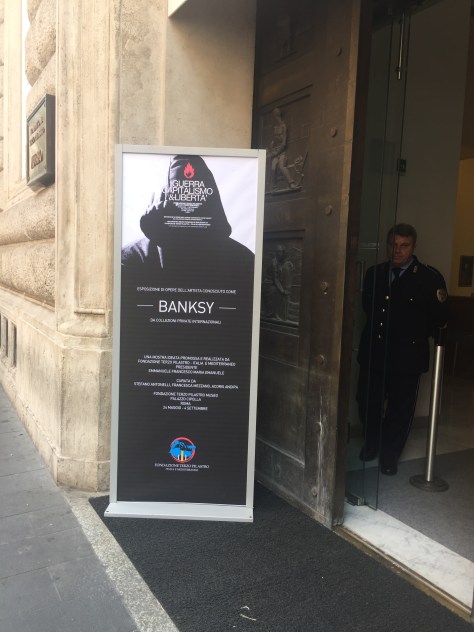
Palazzo Cipolla with the War, Capitalism & Liberty Exhibition.The official poster at the entrance to the Palazzo Cipolla.
We were greeted at the exhibition by the head of the FondazioneTerzo Pilastro, Prof Emmanuele F. M. Emanuele and a group of officials together with Acoris Andipa, who presented us as lenders to the exhibition! We were then free to view the show and were impressed by the breadth of the exhibits, which were arranged by themes – war, capitalism and liberty.
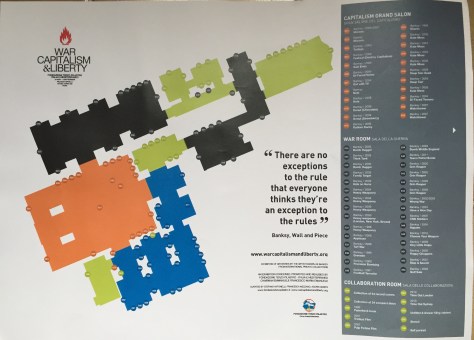
The War, Capitalism & Liberty exhibition’s layout at the Palazzo Cipolla.
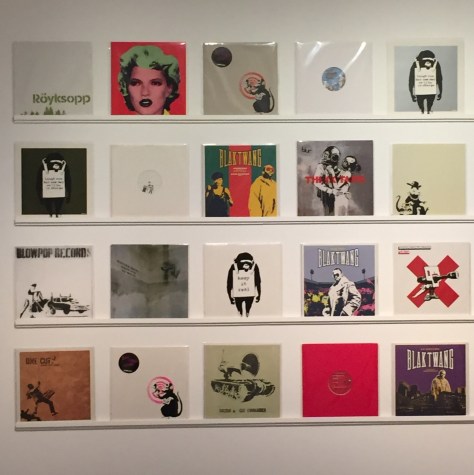
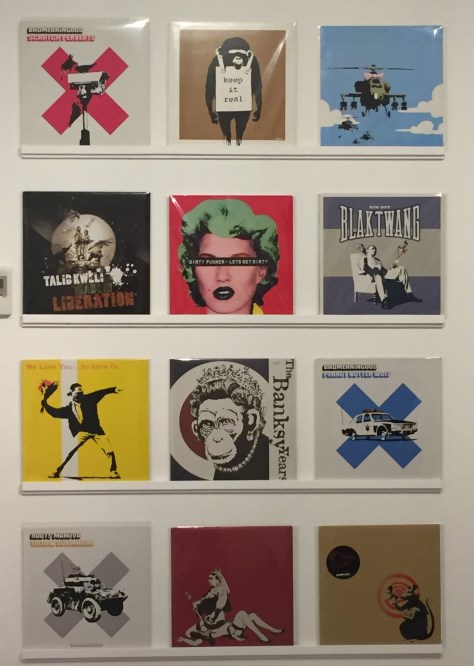
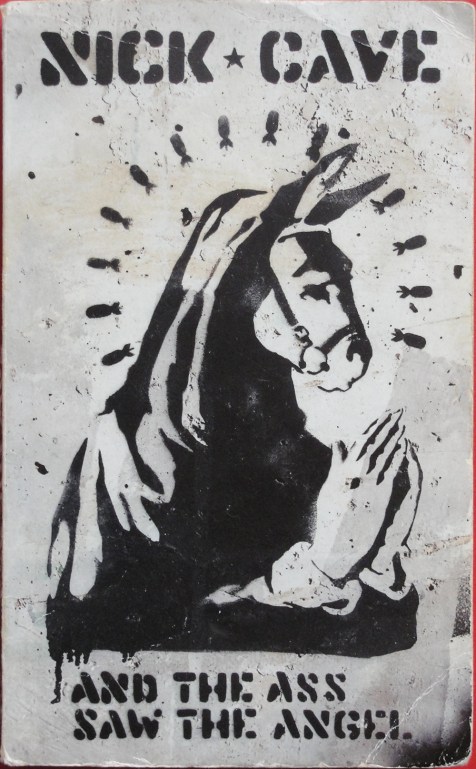
The orange area is the entrance hall with several classic Banksy works including four portraits of Kate Moss. The black are is the “war” room that leads to the green area and the first room on the left contains my records and CDs and Nick Cave‘s book “And the Ass Saw the Angel” with its Banksy cover.
Thus 44 records and 28 CDs are on display – all from my personal collection. There was only one small problem. The curators had intended that the records and CDs would be protected by a plexiglass cover. However, this was not ready for the exhibition’s opening, so an armed guard was on duty in the room!
I would like to thank Acoris Andipa for including my collection in this wonderful exhibition.
As I write this, a major exhibition of The Artist Known as Banksy is being planned to open at the Palazzo Cipolla in Rome on 23rd May 2016. The exhibition is called “War, Capitalism and Liberty” is not sanctioned by or involves the artist, will show works from private collections and hopefully many record and CD covers.
Well, hearing about the exhibition prompted me to return to my collection of records and CDs designed by The Artist Known as Banksy or that use his images. I have, for the first time, made a proper catalogue of ALL my records and CDs. I don’t really know why I haven’t done it before!
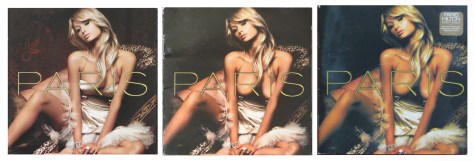
The urge to catalogue my collection was further stimulated by my most recent purchase of a rare–and, dare I say–classic piece of Banksy‘s art: The infamous spoof on Paris Hilton‘s debut CD “Paris” from 2006. You probably already know the story… Heiress Paris Hilton, apparently not satisfied with being a television and American Society celebrity, decided that she should be a music star too and gathered well-known songwriters and music producers to help her make a CD. Banksy and his compadre DJ Danger Mouse got wind of the project and decided to play a trick on a series of HMV record stores throughout the United Kingdom by placing 500 copies of a CD-rom with music by DJ Danger Mouse in a jewel case with cover art taken from Paris Hilton‘s original CD but with her portrait on the front rendered “topless” and Banksy quotes placed over the pictures on the inside of the booklet. Banksy and his assistants managed to get these spoof CDs onto HMV’s shelves beside the real CDs so that customers buying the album would, by mistake, take the “wrong” version and find DJ Danger Mouse‘s music rather than Paris Hilton‘s. I suspect that many who made this mistake returned to HMV to exchange their “defect” CD for the real thing or to get a refund. No one knows exactly how many of the 500 CDs placed in the HMV stores still exist. Genuine ones have sold at auction for over £3500!
A second edition of 1000 CDs with similar artwork, but with the sticker that was on the outside of the Jewel case on the first 500 copies now smaller and printed at top right on the front of the booklet. For this edition the CD was a proper mastered CD with printed design rather than the CD-rom with “Paris” written on the front that had been included in the HMV version. I got hold of one of these “second pressing” “Paris” CDs soon after it was released in about 2008.
Paris Hilton’s “Paris” CD in its three forms. Left: the original “Paris” cover, centre: Banksy/Danger Mouse HMV version, and right the second pressing of the Banksy/Danger Mouse version.The CDs. Left Banksy/Danger Mouse CD-ROM included in the HMV version of “Paris” and right: the pressed CD included in the second pressing.
So, once the Banksy/Danger Mouse HMV version of the “Paris” CD arrived I invested in a copy of the original Paris Hilton CD as a comparison.
Now with my set of “Paris” CDs complete, I set about compiling a list of all my records and CDs with Banksy artwork.
The earliest Banksy artwork I have is not on a record or CD at all. It is on the cover of Nick Cave‘s 1989 book “And the Ass Saw the Angel“, originally published by Black Spring Press in 1989 and reprinted by Penguin Books the following year. I have the Penguin edition.
The cover of the Penguin edition of Nick Cave’s book “And the Ass Saw the Angel”.
The first record cover to have Banky‘s art was released almost ten years later, in 1998, and was for Banksy‘s friend Jamie Eastman‘s Hombre record label. It was by the hip Hop group One Cut and was an EP entitled “Cut Commander“. One Cut, sometimes written as OneCut were a trio formed in Bristol in 1989. Band members were Riski Le Bizniz, MC Reds and Master Chef and their music is described as being made up of “crusty beats and deep sub bass”. Jamie Eastman continued to release One Cut‘s EPs, singles and sole LP “Grand Theft Audio” as well as a compilation CD “Hombremix” remixed by Riski Le Bizniz despite having left Bristol for London around 1990; in total six releases plus two promotional 12″ singles.
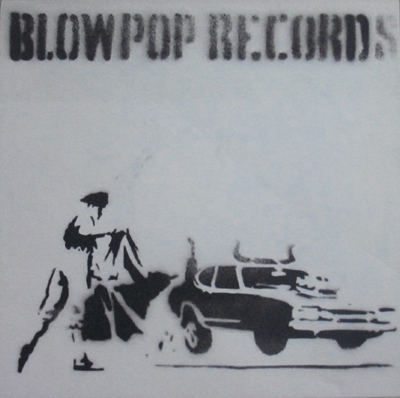
Banksy‘s official designs appear on only four record labels. Hombre Records owned by his friend and former flatmate, Jamie Eastman, Blowpop Records from Bristol, owned by John Stapleton. The third label that Banksy has designed for is Wall of Sound Records and the final one was Parlophone Records which commissioned him to design the cover for Blur‘s 2003 album “Think Tank” and three singles and CDs/DVDs from that release. Interestingly, Blowpop Record’s office was in the same Bristol building as Banksy‘s studio and in 1999 Stapleton just popped in to ask Banksy if he would like to design the cover for a promotional version of The Capoeira Twins first single “4 x 3/Truth Will Out“. Banksy took a stencil he had used on a Bristol wall to advertise Blowpop Records and handsprayed 100 covers.
Promo for The Capoeira Twins “4 x 3“. 100 copies handstencilled by Banksy.
The Capoeira Twins were unknown and this was their first single. The promotional copies were sent out to DJs, record stations and music journalists, but the record was not a commercial success and the majority of the promotional copies just got lost. A few have surfaced and are becoming increasingly sought after. This was the sole cover Banksy did for Blowpop.
The two most interesting Banksy designs for Wall of Sounds Records are the promotional copies of Norwegian group Röyksopp‘s first LP “Melody A.M.“, released in 2002. The double LP was housed in a sleeve once again handsprayed by Banksy.
Numbered promo for Röyksopp’s 2002 album “Melody A.M.” – handstencilled by Banksy.
The second Wall of Sound album with special interest is the label’s compilation triple LP “Off the Wall – 10 years of Wall of Sound“. The cover, designed by Banksy, shows some of the artists who recorded for the label and, at far right on the cover, with his back to the camera is a man purported to be Banksy himself!
The cover of Wall of Sound Records’ compilation “Off the Wall – 10 Years of Wall of Sound” – with Banksy at far right with his back to the camera.
The list of officially accredited covers thus includes those covers for these four record labels. (Note: The Bad Magic label, which released all the Blak Twang records and CDs is part of the Wall of Sound group).
In 2009 Banksy terminated his association with manager Steve Lazarides and nominated Pest Control to be his official spokespeople. Pest Control has been unwilling to assign accreditation to Banksy‘s record cover art, so I have had to guess which covers are “official” and which are not. There are some that I am not sure about. First the “official” cover list:
List of Banksy’s cover art that are officially recognized.
Then there are several covers that I cannot be certain are “official”:
List of covers which I cannot be certain are “official”.
And, the list of those covers whose artwork has definitely not been authorized:
The unauthorized covers list.
So, as of April 2016, I know of a total of seventy records, CDs, DVDs with Banksy‘s cover art. While I have included Nick Cave‘s book “The Ass Saw the Angel“, however, I have not included Banksy‘s film “Exit Through the Gift Shop“. Perhaps this should make item number seventy one.
Interest in everything by Banksy has increased since 2010 and record covers are – as Andy Warhol foresaw – a way for the ordinary person to collect fine art. I hope records and CDs with Banksy designs will continue to be affordable. However, many covers, particularly those LP and 12″ covers, have become very scarce, while CDs remain affordable. One Cut‘s recordings were not released in very large numbers, the two handsprayed covers are already considered fine art prints as are Dirty Funker‘s “Let’s Get Dirty” covers with their Banksy portraits of Kate Moss. In particular, the first pressing without the title strips is extremely rare.
First pressing of Dirty Funker’s “Let’s Get Dirty” Single with Banksy’s portrait of Kate Moss.
The second pressing had the title banner across Kate’s eyes.
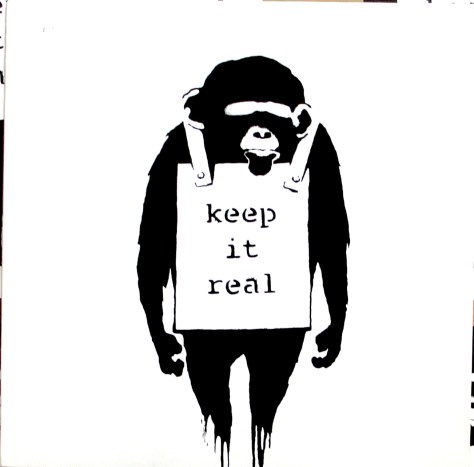
Banksy‘s and DJ Danger Mouse‘s “Paris” CD is also difficult to find, even the second pressing has increased in value. Complete sets of Dirty Funker‘s “Future” single with “Radar Rat” on the covers and DJ Danger Mouse‘s “Keep It Real/Laugh Now” are commanding high prices on auction sites.
Five cover variations of Dirty Funker’s “Future” single, featuring Radar Rat.DJ Danger Mouse’s “Keep It Real / Laugh Now” covers.
An even rarer variation of the “Keep It Real/Laugh Now” single is a test pressing whose cover has a white background.
In February 2004, the magazine The Big Issue included a compilation CD entitled “Peace Not War” with Banksy‘s cover art. The CDs were taped to the magazine with sellotape and most, if not all covers were damaged when the tape was removed. This CD has become extremely rare.
“Peace Not War” compilation CD given away with The Big Issue with Banksy’s “Girl clutching a bomb” image on the cover and CD.
I am considering returning to the subject of Banksy’s record cover art with a picture discography of all his covers. That will take some considerable time, so I wouldn’t hold my breath.
On 26th February 2016 Jeff Wootton (born 12 May 1987) released his first solo album entitled “The Way the Light“. The album, is released on the British Sympathy for Vinyl (not to be confused with the American Sympathy for the Record Industry) label. Well, I had not heard of Jeff Wootton but a quick gander at his CV reveals that he is a demon guitarist. When Noel Gallagher left Oasis, Liam Gallagher recruited him to his new group Beady Eye. Wootton has played along side Damon Albarn in Gorillaz and on Albarn‘s solo project as well as with Brian Eno,Noel Gallagher (appearing in Gallagher‘s 2015 video “Ballad of the Mighty“). He also travelled to Mali together with several other musicians, including Damon Albarn, Brian Eno and Nick Zinner with a group called Africa Express to record a version of Terry Riley‘s “In C“–a work I first heard in the mid sixties.
Jeff Wootton’s 2016 album “The Way the Light”
“The Way the Light“album is released in a limited edition of 500 copies (mine is No. 403) which include a limited edition book with ten new Damien Hirst spin paintings–one for each album track. The gatefold album cover also has one of the Damien Hirst paintings on the rear cover.
Damien Hirst’s spin painting on the rear cover of the “The Way the Light” album (almost identical to that illustrating track 7 in the booklet.
The booklet contains a number of classy photos of Wootton playing his guitar (a Stratocaster) and another is used on the centre spread of the gatefold cover.
Centre spead of the album cover. Is this a Gibson guitar?
And here are the ten Damien Hirst spin paintings mounted together.
I have not yet been able to find any details of how Damien Hirst came to cooperate with Jeff Wootton on this album project. This is Damien Hirst’s 28th record cover.
Well, well, well! This is a surprise! A record on ventriloquism! What on earth is it doing in my record collection?
As anyone can see the cover picture is a pastiche of Peter Blake‘s and Jann Haworth‘s “Sgt Pepper’s Lonely Hearts Club Band” cover, but that’s not why I bought it. I really love the “drum” with the title “Constable O’Rourke’s Wooden Hearts Club Band“! That adds something extra that is not often found on other pastiches. And there, just right of centre is Jack himself; in front of just over forty ventriloquists’ dummies.
The story begins with Chris Jagger‘s 1974 album “The Adventures if Valentine Vox the Ventriloquist“.
Chris Jagger’s “The Adventures of Valentine Vox the Ventriloquist”. Asylum 7E-1009, 1974.
I started doing some research on Peter Blake‘s record covers and mailed Chris Jagger for details about how this LP cover came about. He told me that he had come across the book “The Life and Adventures of Valentine Vox”, by Henry Cockton (1807-1853). The book was originally published in 1840 in installments and in 1842 in a single volume with sixty illustrations by Onwhyn) and Jagger liked the title and decided to use it for his second album. Peter Blake apparently supplied the ventriloquist’s dummy. So, I got hold of a late 19th Century copy of the book, unfortunately though not the illustrated version.
Then curiosity took hold. I found out that there is (or was) a ventriloquist by the name of Valentine Vox and started to search for information about him, but turned up little. But my searches did find a museum of ventriloquism at Vent Haven, Kentucky, and I contacted the curator Lisa Sweasy for information. She told be that at least six ventriloquists have used the stage name Valentine Vox, or variations on it, such as Valentine Fox or Valentine Faux and wondered which I was interested in. Of course I had no idea! So I suggested the most recent. She informed me of a Jack Riley that used the used the Valentine Vox alias and told me that he had written a book on ventriloquism called “I Can See Your Lips Moving–the History and Art of Ventriloquism“, published in 1993 under that name. However, Riley had also appeared using the stage name Jack O’Reilly and had recorded the LP entitled “You Can Be a Ventriloquist“, in 1969. It has since been re-issued as a CD.
Now to find out more about the mysterious Jack Riley. Apparently, he was born in England in 1939. He moved to America and–at some point–to Toronto, Canada, where the “You Can Be a Ventriloquist” was released. In 2003 he married fellow ventriloquist Eyvonne Carter. That’s what I have been able to find out so far.
And, before anyone starts to ask–No, I’m not going to learn to be a ventriloquist. But researching a record cover can turn up some weird and wonderful stuff.
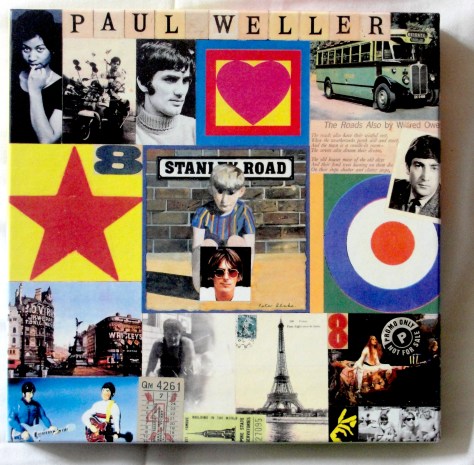
As readers of this blog will have noticed, I have been spending an alarming amount of time adding to my collection of record covers with Peter Blake‘s art. I recently noticed that I had failed to describe two somewhat rare items–the boxed sets of seven inch singles of Eric Clapton‘s “24 Nights” album and a similar box of Paul Weller‘s “Stanley Road” album.
“24 Nights” Promotional Box Set [Warner Brothers – EC3] The “24 Nights” boxed set of seven singles, each in it’s own picture sleeve, was released as a promotional set by Warner Brothers, who also produced a limited edition lithograph with Peter Blake‘s drawing from the concert series.
I hadn’t realised until very recently that each single had its own specific cover all using Peter Blake‘s handwriting as the font for the track titles.
Here are the seven singles’ front designs:
And here are the reverse designs:
“Stanley Road” Limited Edition Box Set [Go Discs! 850 070-7] There were two limited editions of the “Stanley Road” album–this box set of six seven inch singles and a twelve inch box set containing a booklet, a 7-inch print and the CD. The Singles box also contained a 7-inch version of the booklet and a print. Once again Peter Blake had designed individual covers for each of the singles:
The front covers:
Once again Peter Blake‘s characteristic handwriting was used for the titles. And the rear covers all had individual designs too:
These thirteen covers should thus be added to the list of Peter Blake‘s record cover art.
I shall be returning to a deeper analysis of each of Peter Blake‘s individual record art in future posts.
I have not been able to find any record or CD covers with Banksy art since the release of Danger Mouse‘s set of limited edition 12″ singles “Keep It Real/Laugh Now” in 2008, so in December 2015 I was surprised to see an LP advertised that uses a modified version of Banksy‘s “Flower Thrower” image where a ball had been substituted for the bunch of flowers.
This record is purported to be a test pressing for Junichi Masuda‘s unofficial album entitled “Pokémon“released in 2015 with a sort of “Sgt Pepper’s Lonely Hearts Club Band” pastiche cover. The album was released on red/white swirl vinyl, which I suspect is the reference for the red/white ball being thrown. The test pressing album, however, was only available on black vinyl.
Junichi Masuda (born 12th January, 1968) is extremely influential in the field of computer games and is a director of the Pokémon company and designs games for the company and composes music to accompany them.
Apparently, the idea for the test pressings of this album was to stencil 100 covers with the “Flower Thrower” image but something happened during the spraying and (I suppose) the stencil was damaged so the final ten copies were sprayed with a stylised rabbit chasing a balloon – a pastiche (to my mind unsuccessful) of Banksy‘s “Girl With Balloon” artwork.
This one, however, seems too far from the Banksy original for my taste. I was lucky to be able to get hold of the “Flower Thrower” version at a reasonable price but this “Rabbit” version would cost between $300-400, which helps solve my quandry as to whether or not to include one in my collection.























 recordart