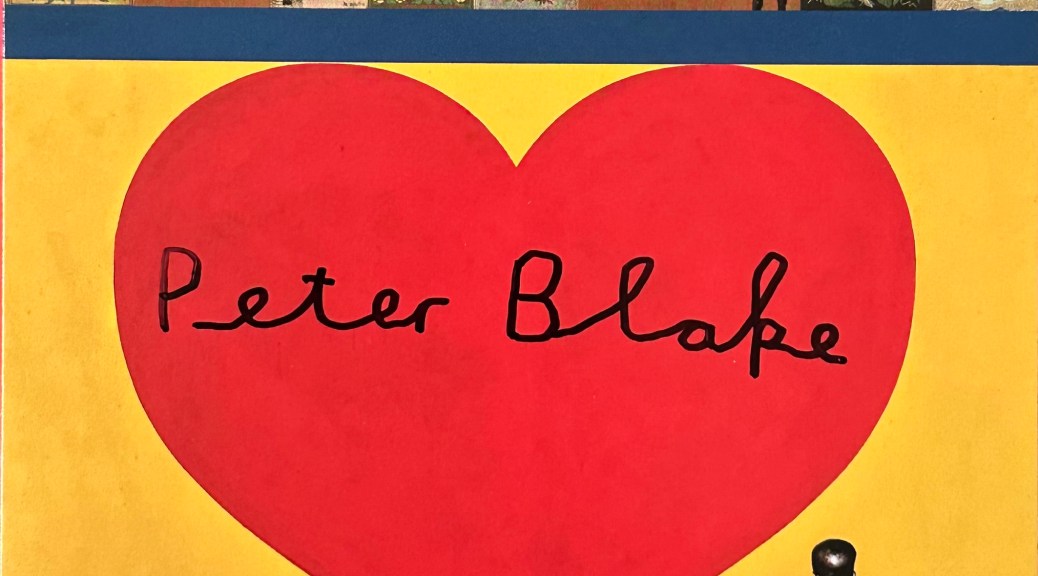
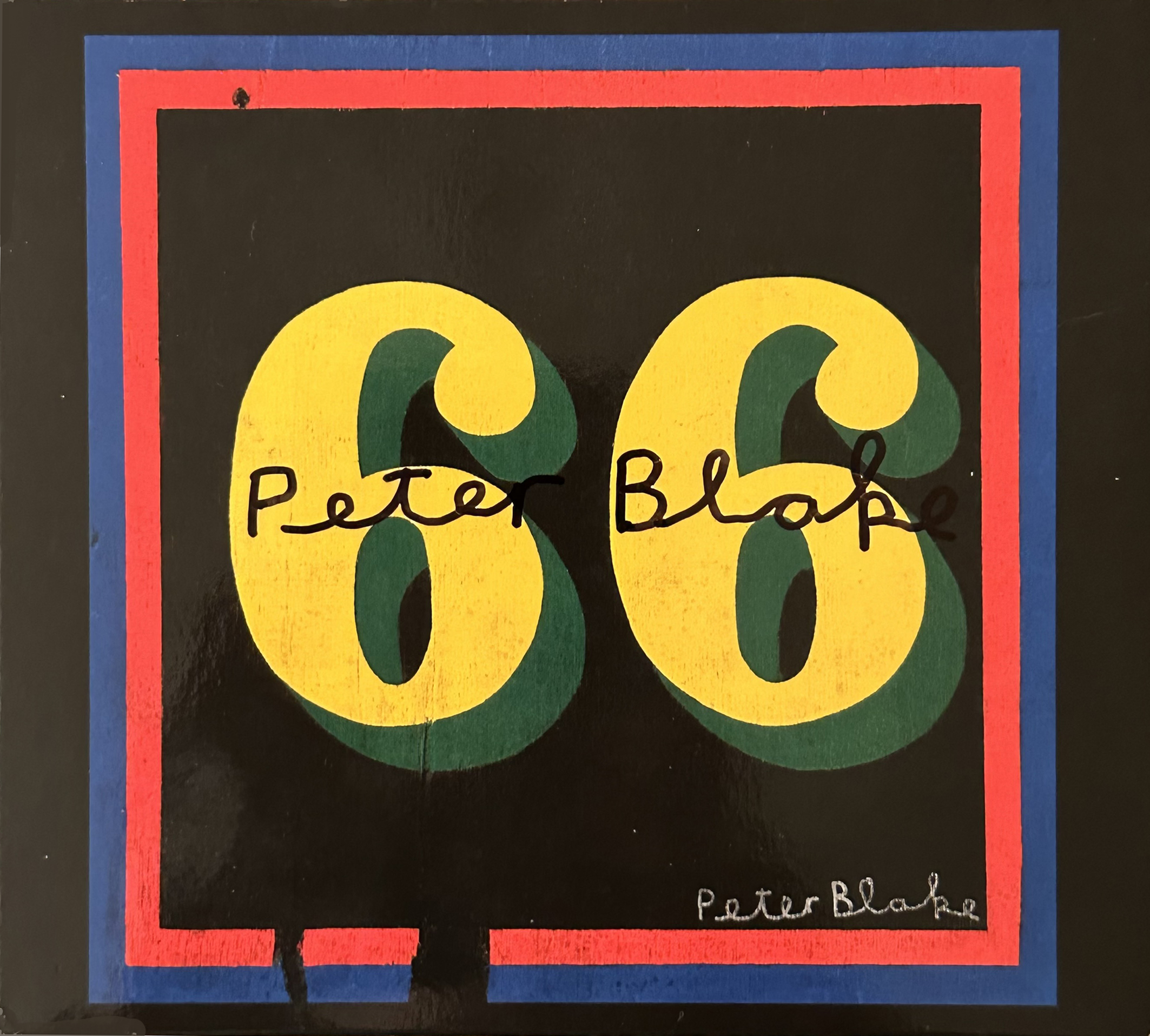
I’ve been fascinated by Peter Blake’s art since I bought his “Babe Rainbow” print in, I think, 1968. My fascination for his art continued with my collection of Blake’s record cover art and one recent (2024) release has unravelled unexpected aspects of Peter Blake’s life that impinge on his art. The cover I refer to is his design for Band Aid’s 40th anniversary recording of “Do They Know It’s Christmas?” released as an EP on viny and CD in November 2024.

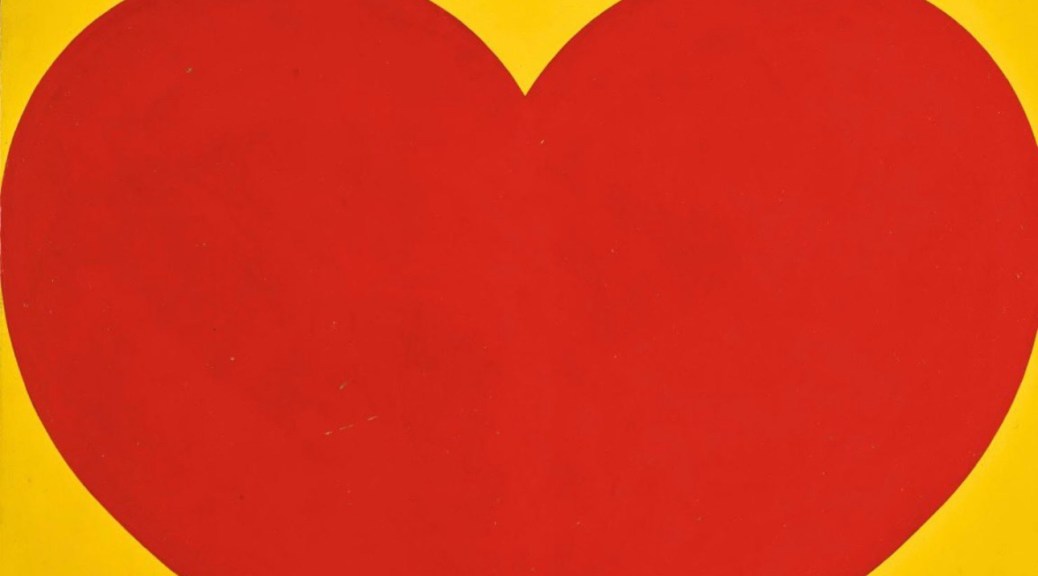
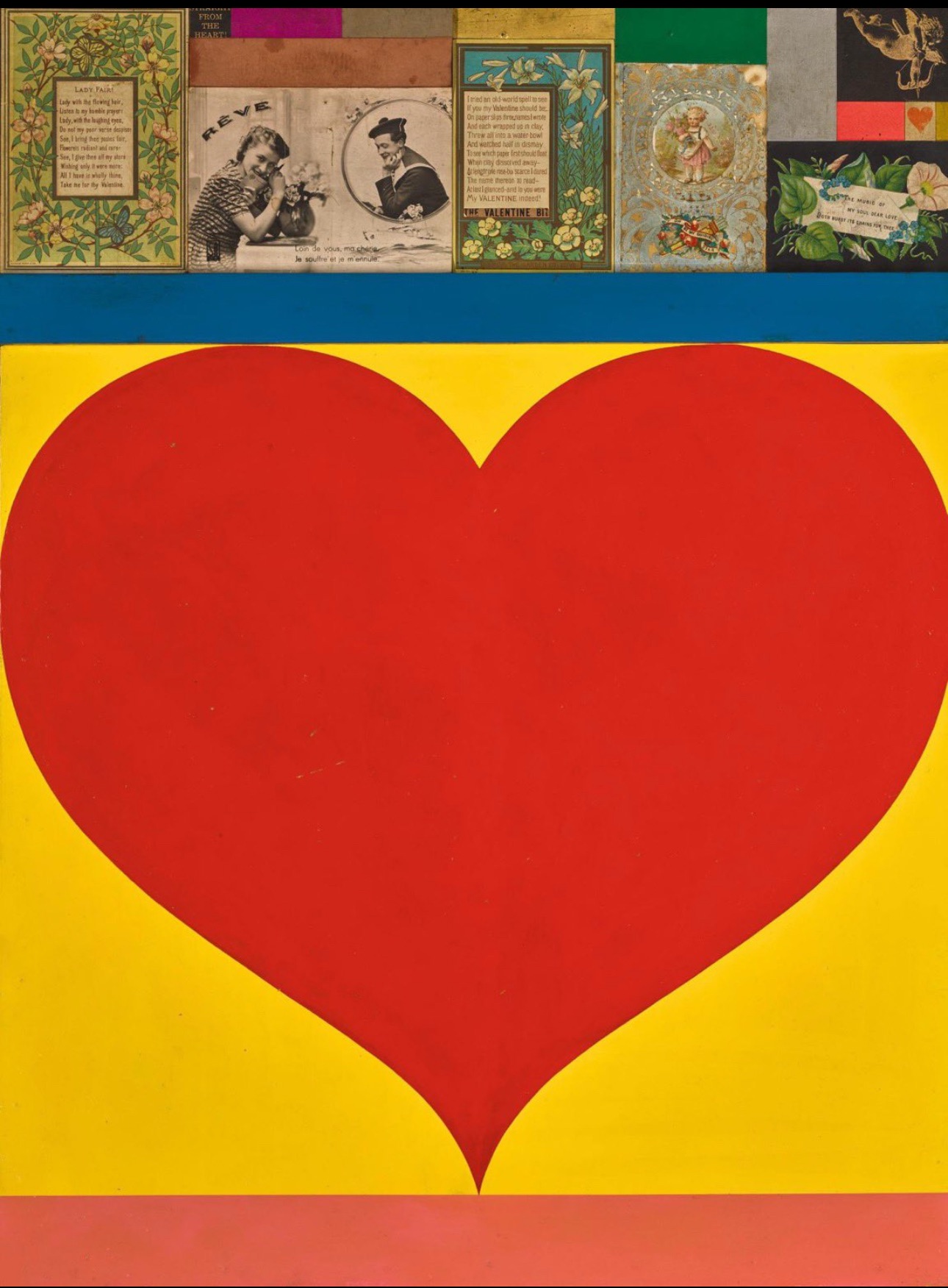
This design struck me as familiar and I found a picture of a Blake painting from 1959-60 that was strikingly similar. The painting in question is Blake’s “Valentine (for Pauline Boty)”.

I immediately wanted to know who Pauline Boty was and why Peter Blake painted her this valentine.
A quick Internet search revealed that the painting had been sold at Sotheby’s in 2019 for £270,000. But the description told the story of Blake’s unrequited love for Pauline Boty.
Peter Blake’s art education began in 1946 when he was only 14 at Gravesend School to learn commercial art. It was there that his interest in typography started. After National Service in the R.A.F., in 1953, he was admitted to the Royal College of Art’s painting school based on a single painting that he submitted. He graduated with first class honours in 1956 and, after a year travelling in Europe, took various teaching jobs while still remaining connected to the RCA. He was a contemporary of David Hockney, R.B. Kitaj, Derek Boshier and Allen Jones. In 1958 a 20-year-old Pauline Boty arrived at the RCA to study stained glass. A subject she had begun to study at Wimbledon College. Boty was a collagist and painter and while at the RCA produced stained glass works, paintings and collages.
There’s considerable similarity between making stained glass pictures and collages. Both consist of cutting out bits of either glass or paper to make a design and Boty became an accomplished collagist alongside her stained glass work.
Blake had been making collages since at least 1955. Boty met Blake, six years her senior, at the RCA and they began a romantic involvement. Blake soon became besotted with the beautiful, vivacious and very talented Pauline. Unfortunately for him her feelings were considerably cooler, but they made a beautiful couple. Blake has said “Imagine having her on your arm at a private view. I mean she was sensational!”
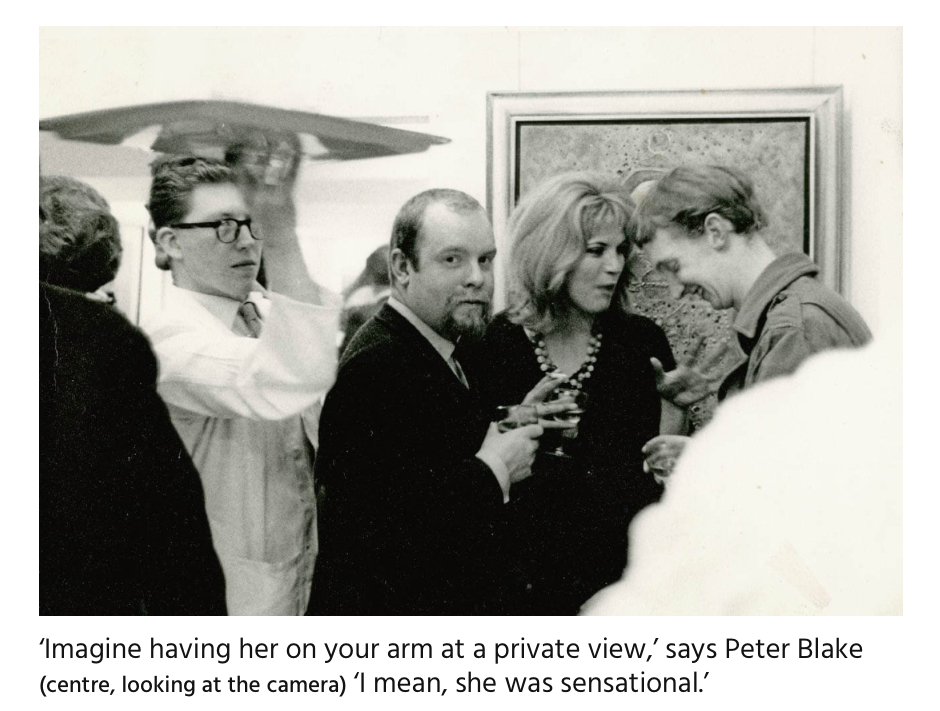
So, Blake painted his “Valentine (for Pauline Boty)” early on their relationship. Boty must have been inspired by Blake’s collages, and she must have been a muse for him. Her early collages seem to presage many of Blake’s more recent ones.
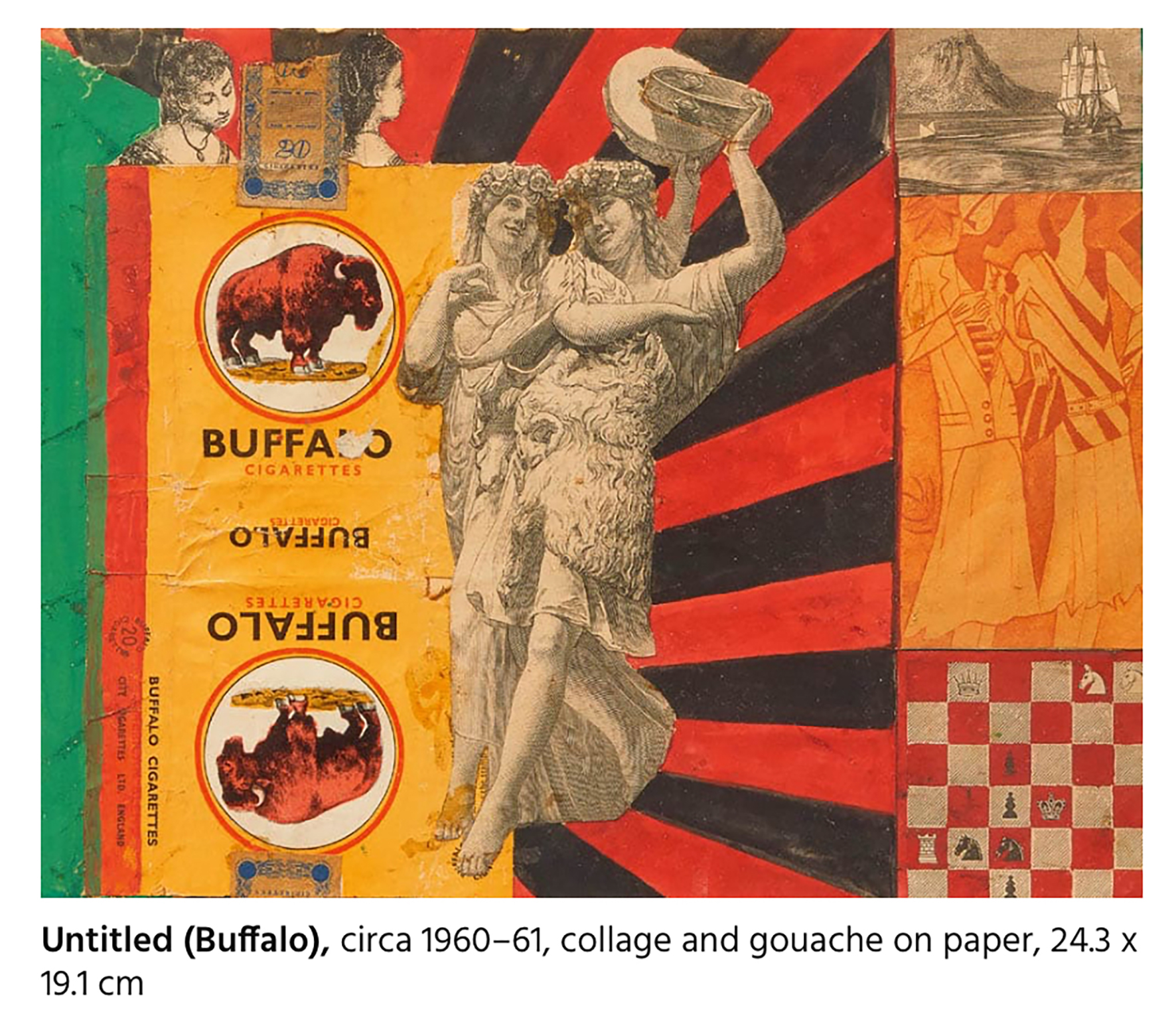
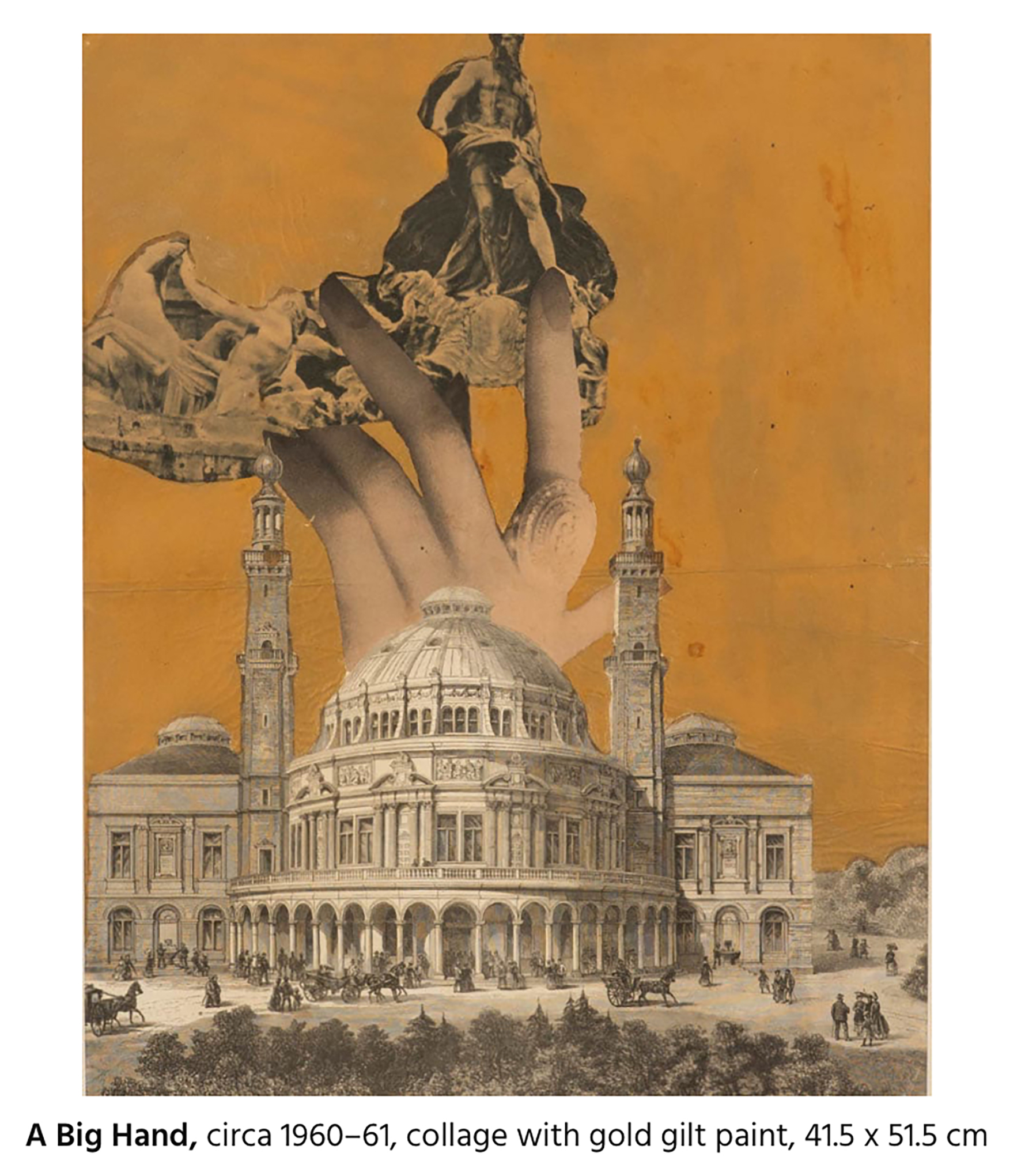
This reuse of Victoriana by Boty is reminiscent of Blake’s later large collages from the “Joseph Cornell’s Holiday” series and other.
Boty was the archetypal “dolly bird”, before the term really became fashionable. She wore Mary Quant clothes and was aware of her sexuality, having several affairs while still dating Blake. The photographer Lewis Morley was one lover, who photographed her nude in September 1961 in a series of photos, the most famous being the portrait holding Blake’s “Valentine (for Pauline Boty)”!
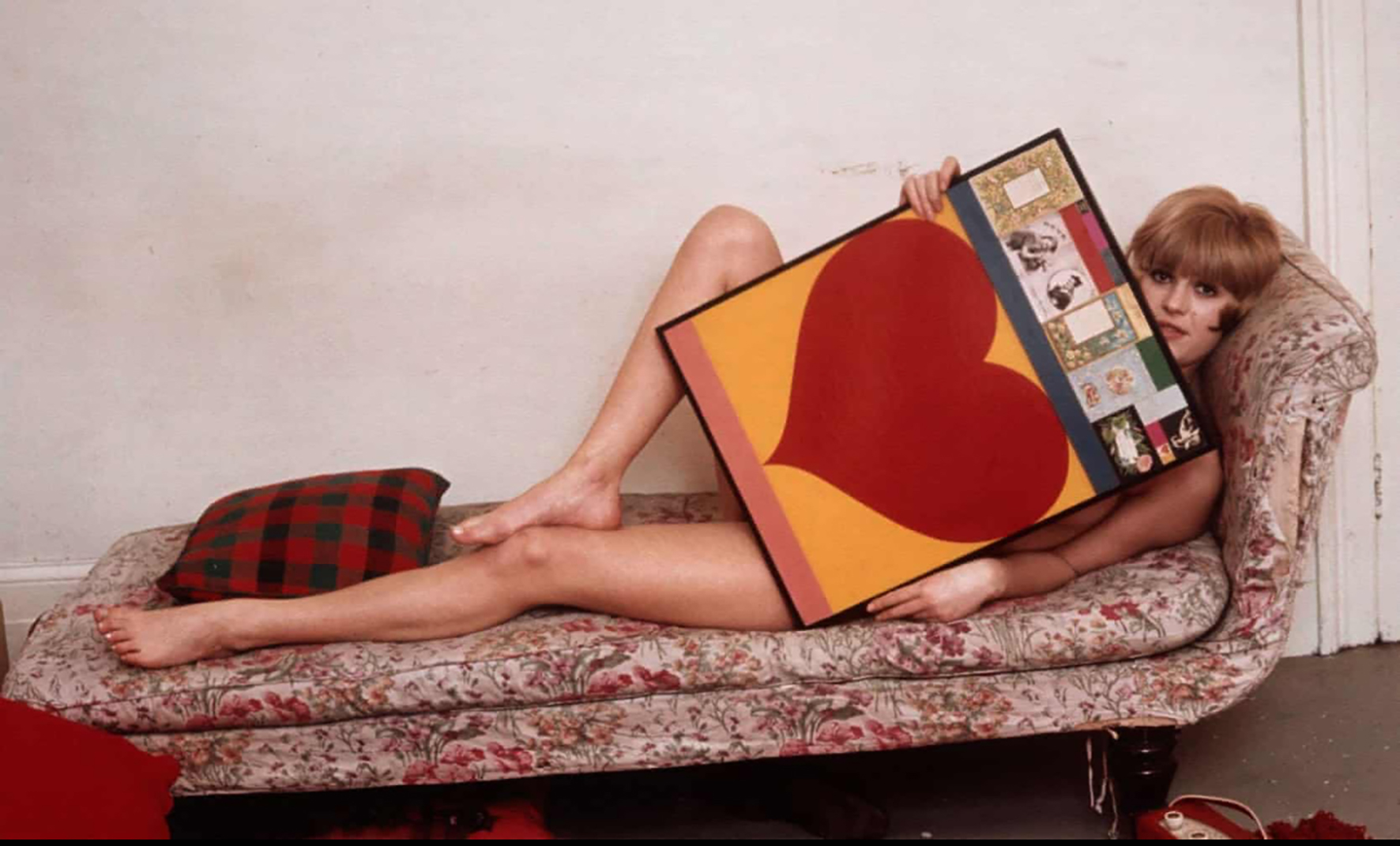
Lewis Morley’s 1961 portrait of Boty holding Blake’s 2Valentine” painting.
Exactly when Blake’s and Boty’s relationship ended is difficult to date. Boty was in a long-term relationship with the married television director Philip Saville and had other assignations. In June 1963 she married literary agent Clive Goodwin after a whirlwind 10-day romance. Both Blake and Saville were reported to have been shocked by her marriage. And Peter Blake married Jann Haworth the following month.
Their artistic partnership was public enough that when the BBC’s Monitor produced ‘Pop Goes the Easel’ in March 1962, Blake ensured Boty was among the four featured artists. (Blake himself, Boty, Derek Boshier and Peter Phillips). The programme opened with presenter Huw Wheldon seated before a recreation of Boty’s ‘collage wall’ – an installation in her London flat that demonstrated how central collage was to her practice, integrated into her daily environment. If this wall dated from 1958-59 when she arrived at the RCA, Blake would have seen it early in their relationship, experiencing collage not just as artworks but as a way of life.
There were three brilliant women artists around in the late fifties and early sixties. These were Brigit Riley (born 1931), Jann Haworth (born 1942) and Pauline Boty (born 1938). Riley, Peter Blake and Jann Haworth were represented by Groovy Bob Fraser’s Duke Street gallery from 1962. Boty graduated from the RCA in 1961 and was forced to become a waitress to make ends meet. Why didn’t Blake introduce his great love to Robert Fraser and kickstart her artistic career? Instead, she jumped into marriage so she could continue her art.
Haworth left Blake in 1979 for the author Richard Severy and Blake met Chrissy Wilson in 1980. They married in 1987.
There is no doubt that Peter Blake influenced Pauline Boty’s art. Just compare her “Monica Vitti with Heart” painting from 1963 with Blake’s ”Valentine”.
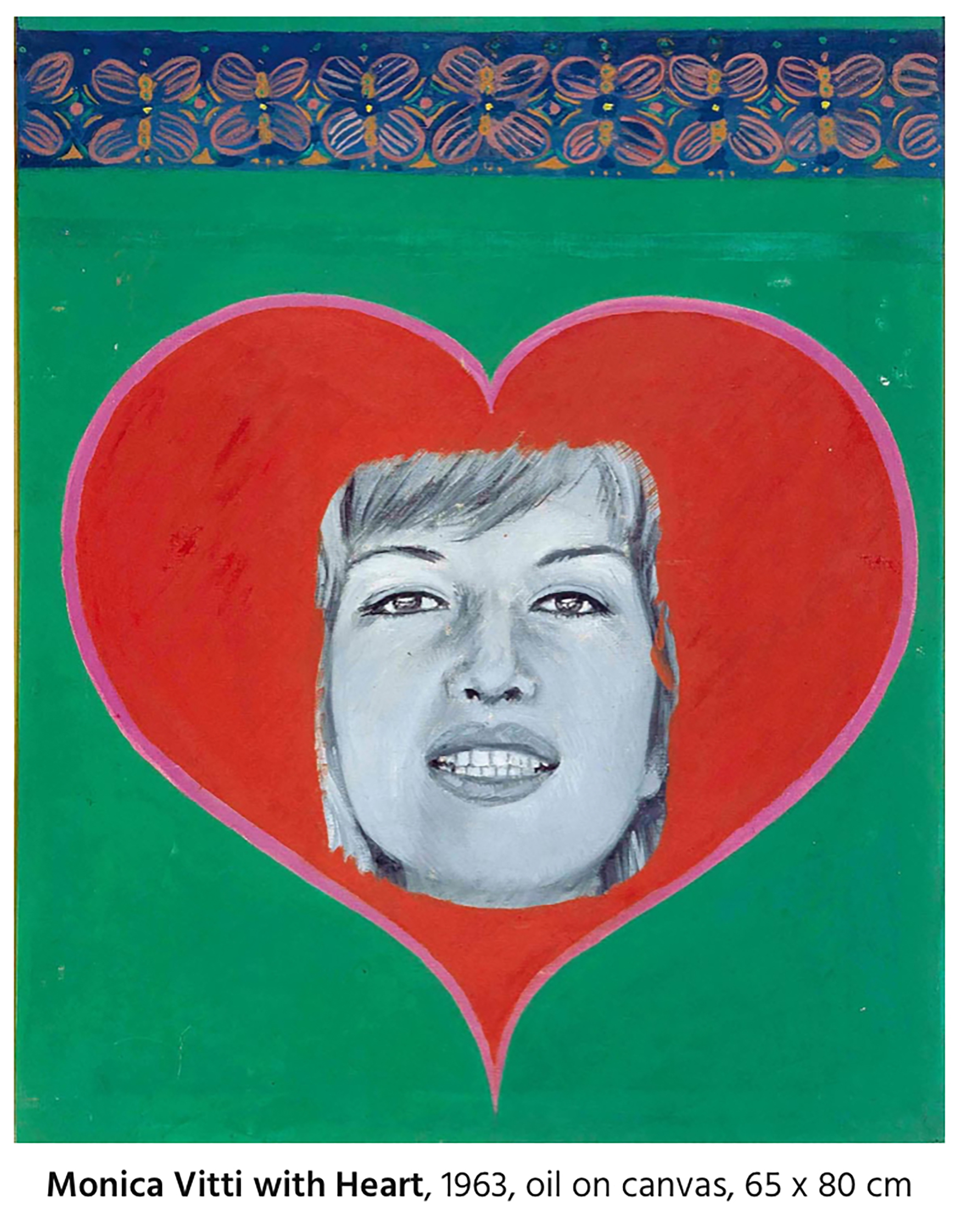
And there’s no doubt Blake never forgot Boty as he reused the “Valentine” design sixty-four years later as the basis for the cover design for the Band Aid 40 EP. But he hasn’t credited Boty anywhere in his books. His 2021 book “Collage” is dedicated to Chrissy, his three daughters and Joseph Cornell.
Retrospective exhibitions of Boty’s work in 2013 and 2023-4 have brought her pop art paintings and collages back into general view and emphasised her central role as one of the important members of British Pop Art first flowering.
Credits: Photographs taken from Marc Kristal’s 2023 book “Pauline Boty: British Pop Art’s Sole Sister”.

 recordart