Peter Blake’s Cover for Mark Knopfler’s Guitar Heroes’ “Going Home” Single Revisited.

This single was made to raise money for the Teenage Cancer Trust and Knopfler put together a stellar crowd of international guitarists for the re-recording of Knopfler’s “Going Home (Theme from Local Hero)”. Knopfler named them Mark Knopfler’s Guitar Heroes and features a line-up of some of the greatest guitarists and musicians in history[1]. The track was recorded was recorded in late 2023 and early 2024 at British Grove Studios in West London with additions from the various contributors recorded in their own studios. The recording, produced by Knopfler’s long-time musical partner Guy Fletcher, was condensed to the nine minute track on the record. The guitar intro, played by Jeff Beck, turned out to be his final recording before his death on 10th January 2023.

I haven’t been able to find out how Blake became involved in this project but given the charity connection and Roger Daltrey’s and Pete Townshend’s involvement I would hazard a guess that Pete suggested that Blake provide the cover art.

Roger Daltrey has been an Honorary Patron of the Teenage Cancer Trust, founded by Dr Adrian Whiteson and his wife, Myrna. Daltrey has organised concerts in support of the trust and this charity single was released in aid of the trust and Teen Cancer America. I don’t know how Mark Knopfler became involved in the trust, but he decided to re-record his hit from the 1983 film “Local Hero” with a galaxy of guitar heroes, starting with Pete Townshend, Eric Clapton and Albert Lee, and many others. Daltrey plays harmonica and Ringo Starr, and his son Zak play drums. I got my copy of the U.K. version as soon as it was released
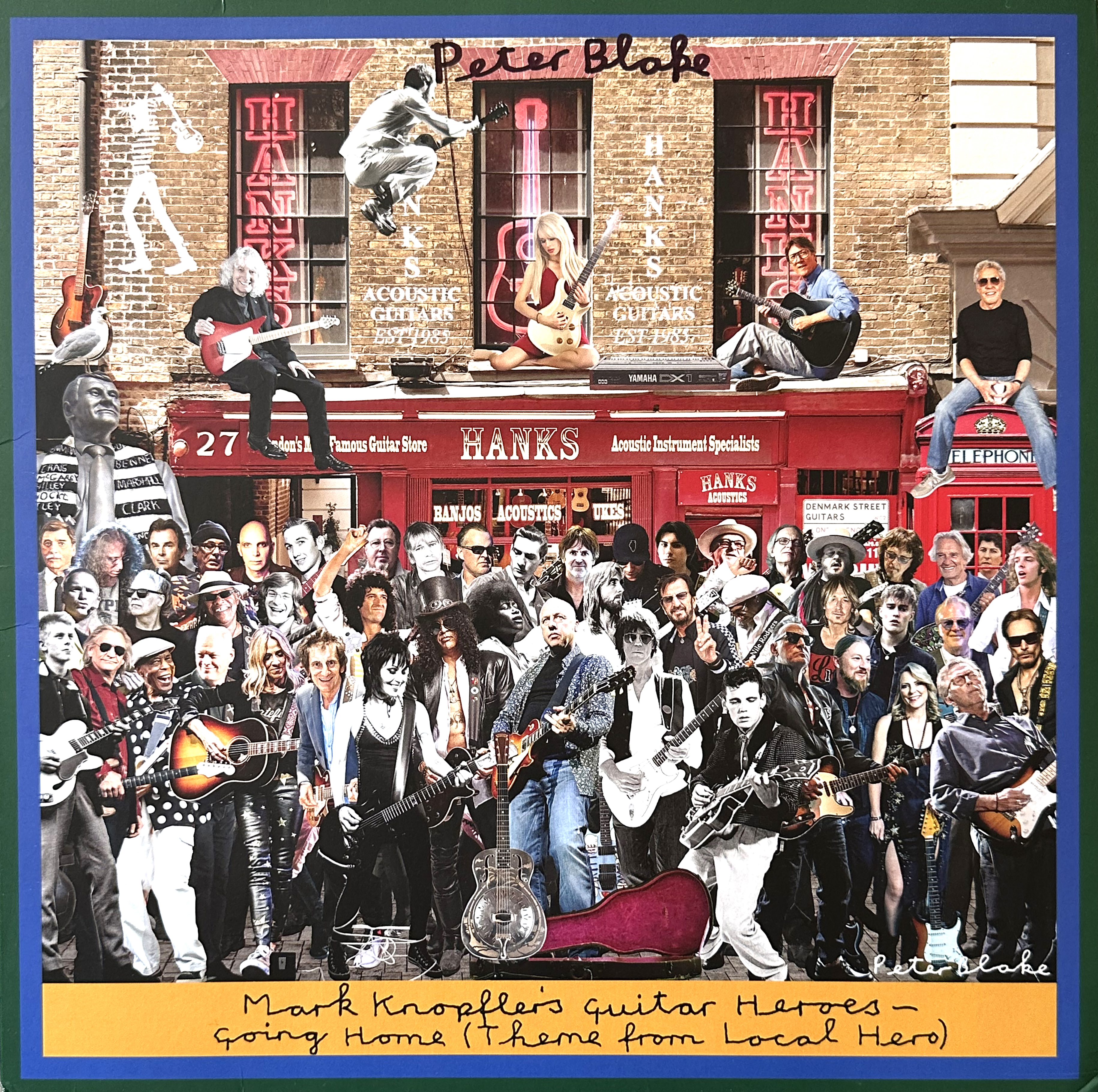
I had no idea that Peter Blake had designed two cover variations. The one for the U.K. and European release shows a collage of the guitarists in front of Hanks Music Store (located in London’s Denmark Street) while the cover version released in the U.S. shows the same guitarist collage but in front of Rudy’s Music Store in SOHO, New York. Interestingly, the US version has a circular “Who cares” sticker in the left upper window that doesn’t appear on the UK version. I only found out about the U.S. version eighteen months after it had been released and it’s now quite hard to find..

Both the U.K. and U.S. singles were single-sided with an etched B-side and both versions were manufactured in the Czech Republic.


[1] The complete list of all 66 participants in the “Going Home” recording:
Joan Armatrading, Jeff Beck, Richard Bennett, Joe Bonamassa, Joe Brown, James Burton, Jonathan Cain, Paul Carrack, Eric Clapton, Ry Cooder, Jim Cox, Steve Cropper, Sheryl Crow, Danny Cummings, Roger Daltrey, Duane Eddy, Sam Fender, Guy Fletcher, Peter Frampton, Audley Freed, Vince Gill, David Gilmour, Buddy Guy, Keiji Haino, Tony Iommi, Joan Jett, John Jorgenson, Mark Knopfler, Sonny Landreth, Albert Lee, Greg Leisz, Alex Lifeson, Steve Lukather, Phil Manzanera, Dave Mason, Hank Marvin, Brian May, Robbie McIntosh, John McLaughlin, Tom Morello, Rick Nielsen, Orianthi, Brad Paisley, Nile Rodgers, Mike Rutherford, Joe Satriani, John Sebastian, Connor Selby, Slash, Bruce Springsteen, Ringo Starr and Zak Starkey, Sting, Andy Taylor, Susan Tedeschi and Derek Trucks, Ian Thomas, Pete Townshend, Keith Urban, Steve Vai, Waddy Wachtel, Joe Louis Walker, Joe Walsh, Ronnie Wood, Glenn Worf, Zucchero

The Cover of the Who’s “Face Dances” Album.

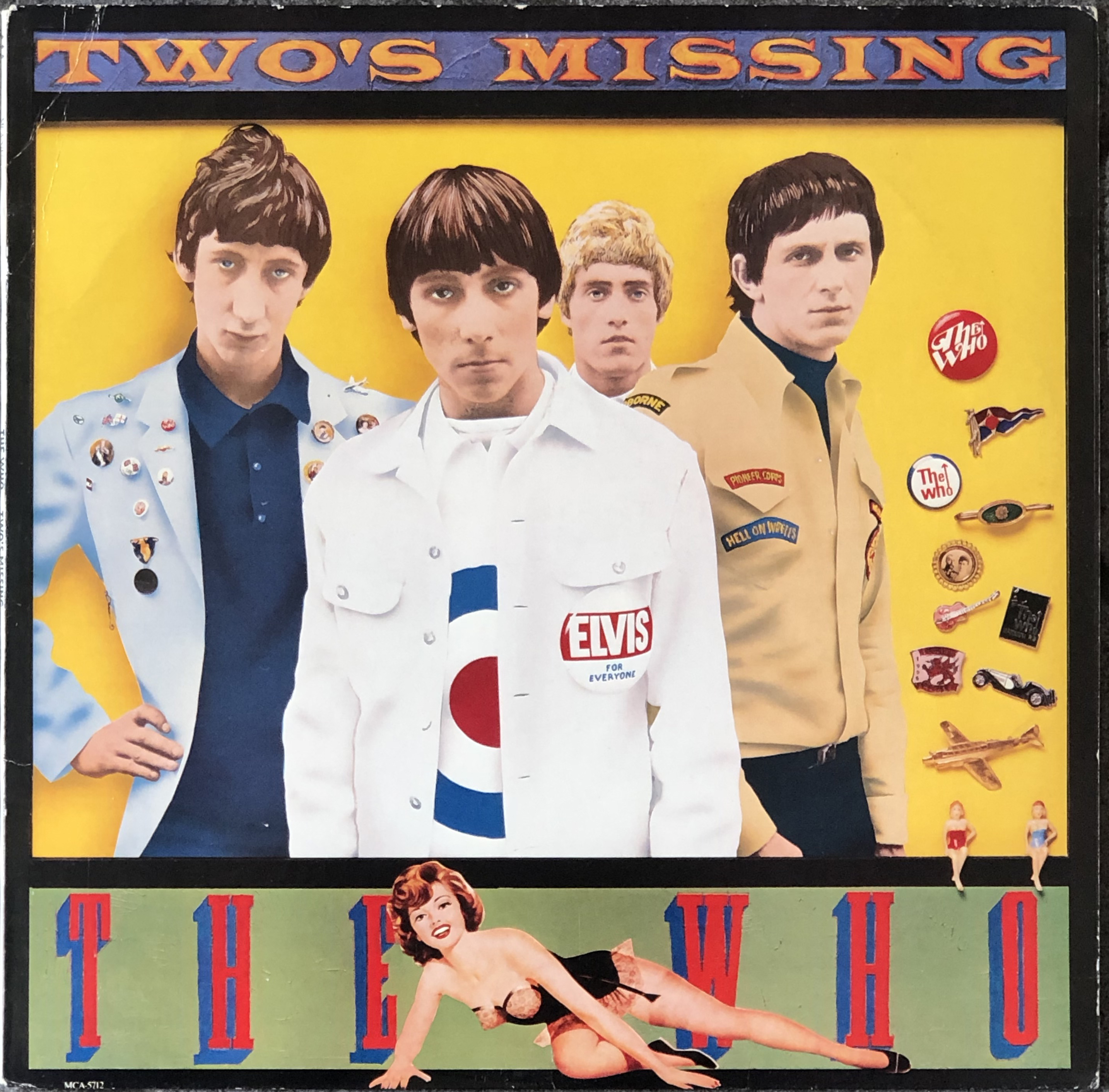
.Richard Evans (born 1945) is a designer who began his career with the legendary design group Hipgnosis before starting his own company. He has designed record covers for many bands including Robert Plant, Van Morrison and World Party. But he is best known for his covers for the Who and Pete Townshend, including “Who’s Missing”–with it’s nod to Peter Blake’s “Got a Girl” painting and its companion “Two’s Missing”

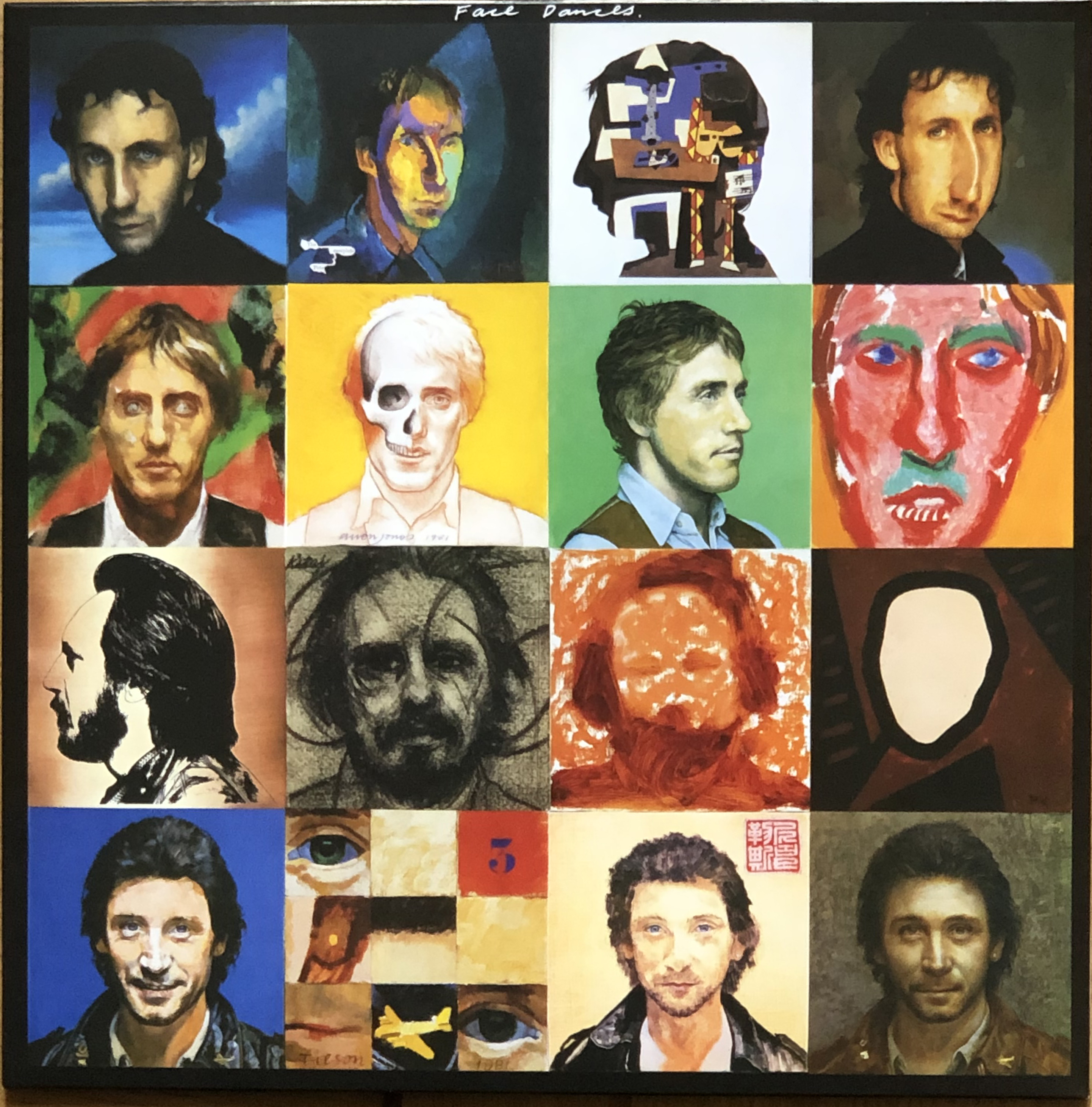
The first Who cover he worked on was their 1981 “Faces Dances” LP. This was the first Who album after Keith Moon’s death and the band had recruited former Small Faces drummer Kenney Jones to replace him. Pete Townshend met Peter Blake on the set of the television show “Ready, Steady, Go!” in 1965 and they became friends, which is how Townshend came to ask Blake to design the cover for what would be the Band’s nineth album. Evans also designed the cover for “Filling in the Gaps” the promotional album for “Fasce Dances”, a recording of Pete Townshend discussing the album.

Blake’s four-by-four square layout with four individual portraits of the band members has become a classic cover. Blake got fifteen of his artist friends to each paint one band member.

 Gavin Cochrane took a photo of each member of the band, which the 16 artists used to paint on 6 in × 6 in (150 mm × 150 mm) canvases the portraits of each member of the band for the front cover , although it seems that Jo Tilson based his painting of Kenney on Blake’s portrait  rather than the photograph.

Gavin Cochrane’s photos of the Who members that the artists used to paiint the cover portraits.

Pete Townshend on the top row, painted by Bill Jacklin, Tom Phillips, Colin Self and Richard Hamilton.
Second row: Roger Daltrey by Michael Andrews, Allen Jones, David Inshaw and David Hockney.
Third row: John Entwistle painted by Clive Barker, R. B. Kitaj, Howard Hodgkin and Patrick Caulfield.
Bottom row: New member Kenney Jones painted by Peter Blake, Joe Tilson, Patrick Procktor, and David Tindle.

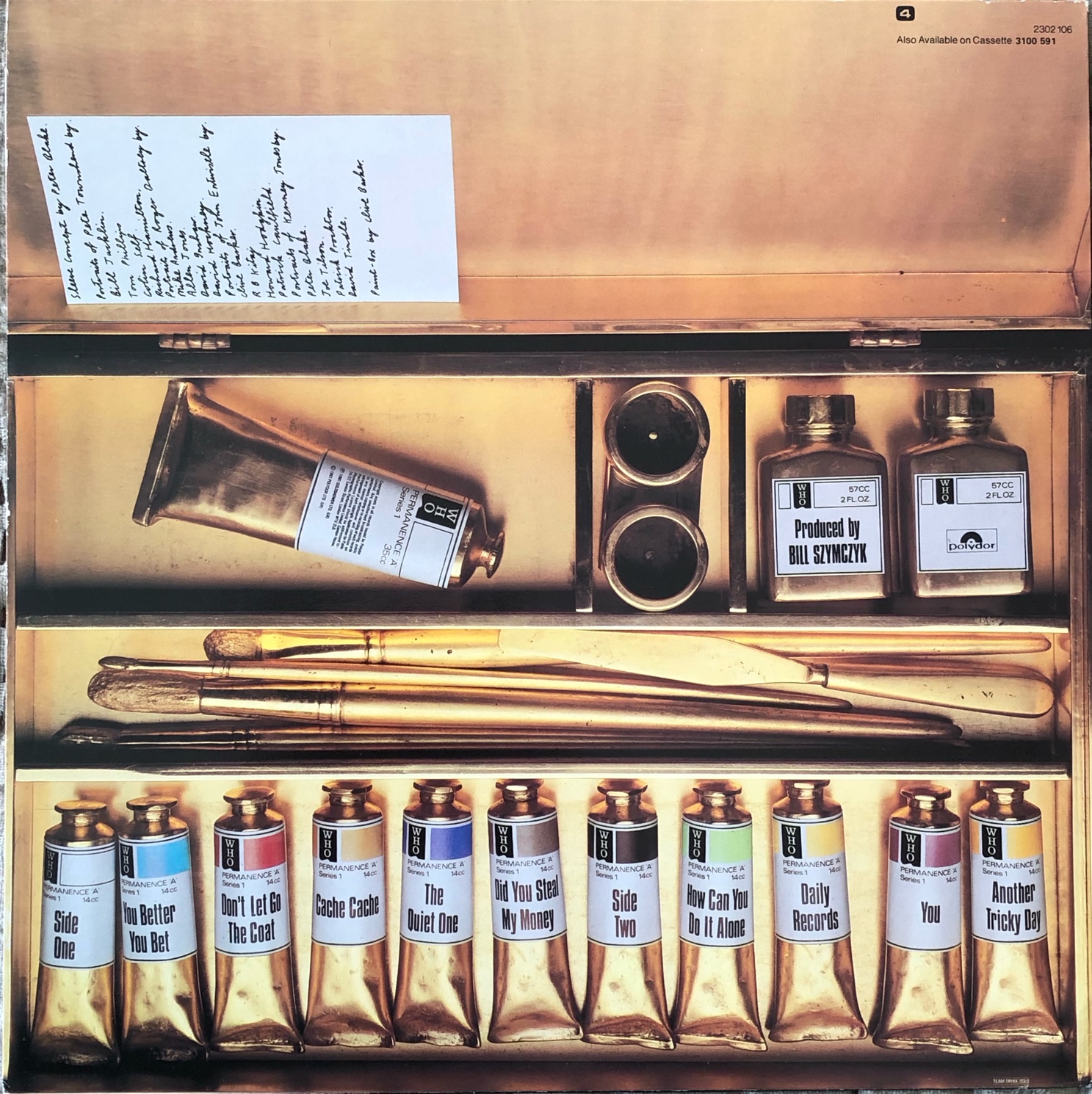
Richard Evans provided the graphic design of the back cover that featured Clive Barker’s 1967 sculpture of a gold-plated, bronze paintbox. Barker had been one of four pop artists shown in a joint exhibition at Robert “Groovy Bob” Fraser’s Duke Street gallery in 1967 together with Peter Blake, Jann Haworth and Colin Self. I suppose the paintbox was on show there and Blake acquired it. Evans had Blake write the portrait credits on a card and he designed the paint tubes creating a typeface reminiscent of the one Windsor & Newton used on their paint tubes. Once again, Gavin Cochrane photographed the paintbox at his studio with Blake and Evans in attendance.

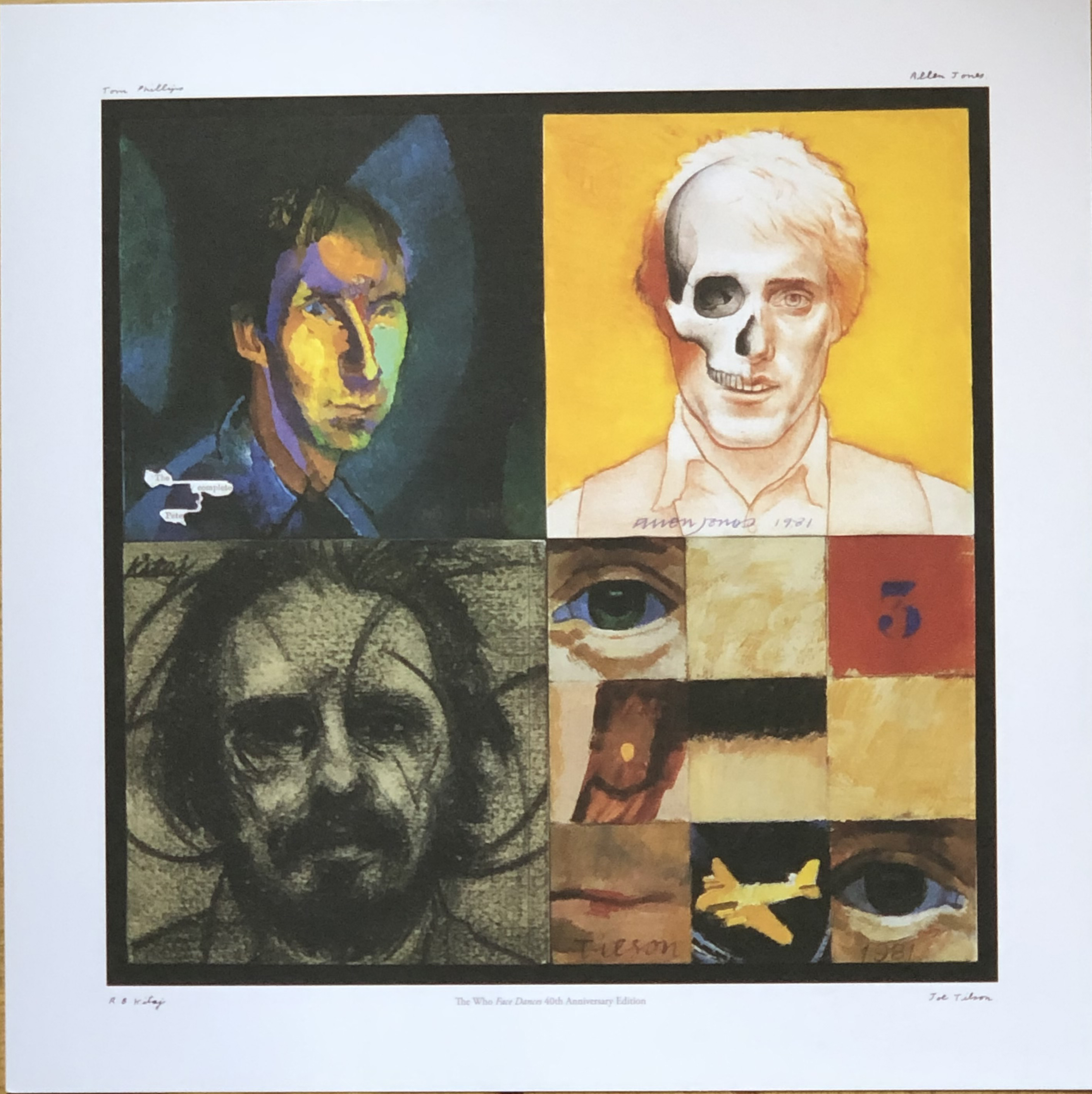
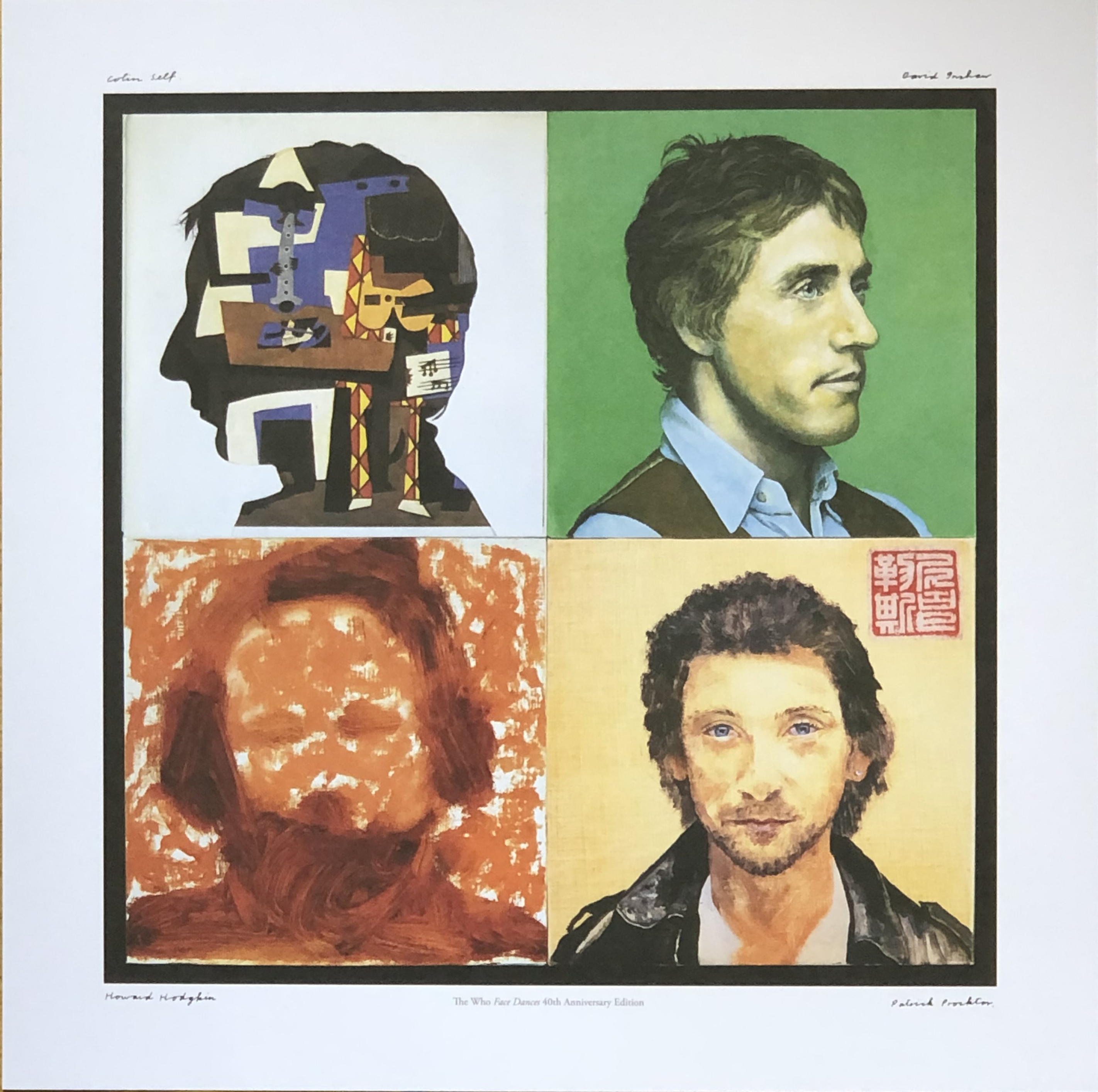
The ”Face Dances” album has become a classic Who album and has been reissued several  times. The 2021 reissue included four prints of the cover portraits.


One of the limited edition prints.

The prints included in the 2021 re-issue of Face Dances.

Robert “Groovy Bob” Fraser Remembered.

Does anyone remember art gallery owner Robert Fraser any more? Well, I do. I have been researching Peter Blake’s record cover art and discovered that Robert Fraser was more than just an advisor suggesting to Brian Epstein that a fine art cover would last longer than a Fool(ish) psychedelic cover. It transpires that “Groovy Bob” as he was known to his friends was a central figure in what Richard Hamilton called “Swingeing London”. Fraser’s Duke Street Gallery was more than just an art gallery. From 1962 to 1969, Fraser put on ground-breaking exhibitions, introducing Pop Art before anyone else. The gallery was a meeting place for artists, musicians, film makers and trendsetters. Paul McCartney, John Lennon, Yoko Ono, Mick Jagger, Keith Richards, Marianne Faithfull, John Dunbar were regular visitors. Fraser helped start McCartney’s art collection, taking him to Paris in 1965 to buy a Magritte painting!

The Duke Street Gallery closed in 1969 but Fraser opened a new gallery in nearby Cork Street in 1983 and ran it until 1985. Fraser died in January 1986—one of the first celebrities in England to die of Aids.

In 1999, Harriet Vyner, who had become friends with Groovy Bob in the eighties, published her book “Groovy Bob: The Life and Times of Robert Fraser”—a book of interviews and impressions from artists and gallery regulars about Robert, his business and his feelings and what the gallery meant.

The sheer number of artists who exhibited at Fraser’s galleries  is impressive; ranging from the cream of American Pop Art, like Andy Warhol, Jim Dine, Ed Ruscha, Keith Haring and Jean-Michel Basquiat, as well as emerging British Pop Artists, including Richard Hamilton, Derek Boshier, Colin Self, Peter Blake, Clive Barker  and Bridget Riley.

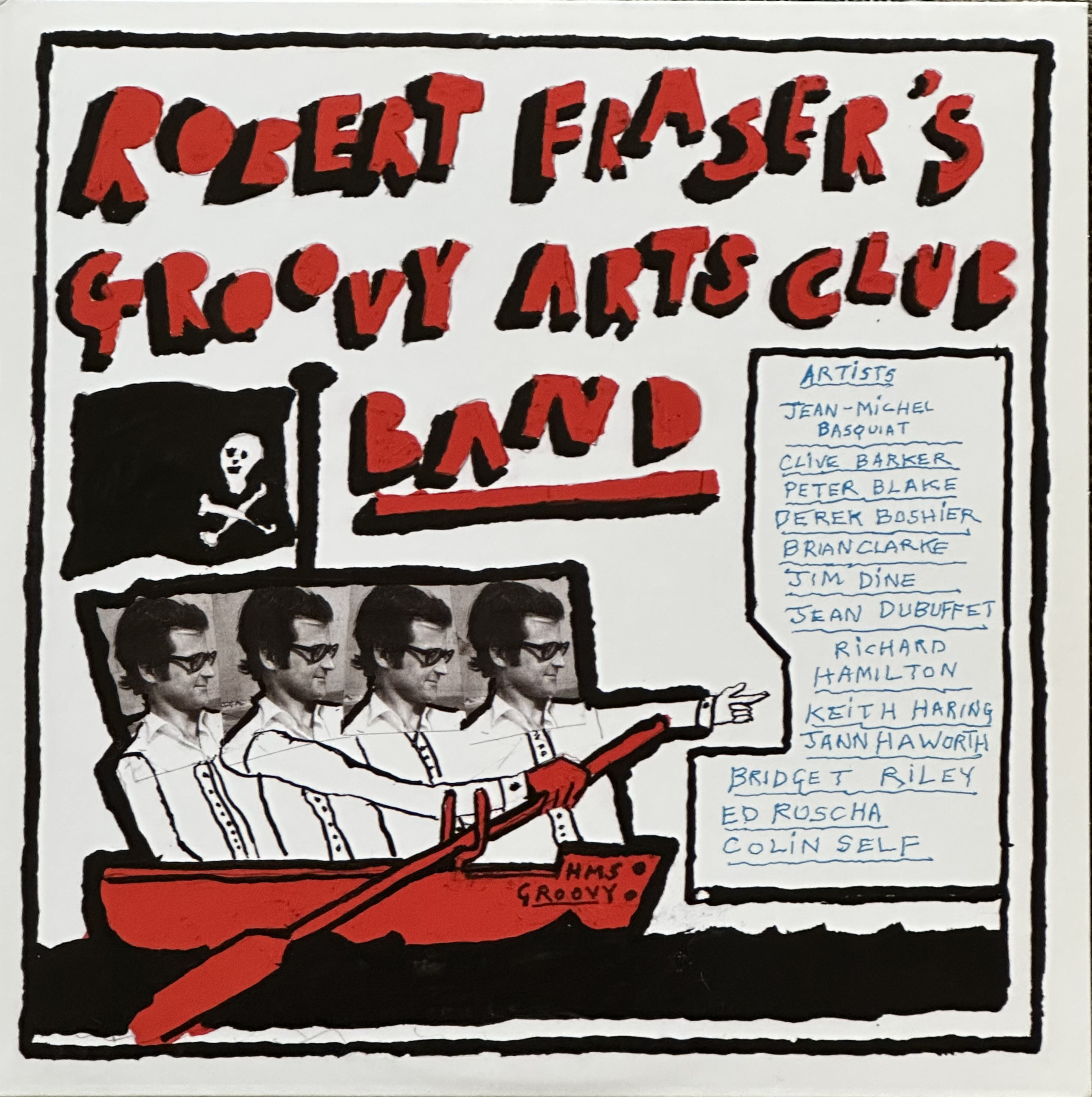
So, tuned in as I was to Groovy Bob’s influences on both art and music I was intrigued when I discovered that there was an album called “Robert Fraser’s Groovy Art Club Band”—a limited edition double LP released on the occasion of a group exhibition at London’s Gazelli Art House from 11th January to 23rd February 2019 called just “Robert Fraser’s Groovy Art Club Band” with contributions from Clive Barker, Peter Blake, Derek Boshier, Brian Clarke, Jim Dine, Jean Dubuffet, Richard Hamilton, Keith Haring, Jann Haworth, Bridget Riley, Ed Ruscha and Colin Self. The gallery even produced the album recorded by David G. A. Stephenson and Josh Stapleton and a hard cover book.

I found a copy for sale on Discogs and immediately ordered it. Cover art by Derek Boshier, it was released at the pre-opening on January 10th, 2019.

Each of the fourteen tracks is dedicated to one artist with the first track called “Groovy Bob”, so you know who that’s about. The second track, “From Sir With Love” is Peter Blake’s. “Jim Dine’s Toolbox” is next, and then “Dubuffet or Not Dubuffet”, followed by “Slip It to Me” which is a reggae paean to Richard Hamilton. “Optical Tactical” celebrates Bridget Riley. No prizes for guessing who “I Want to Hang Out with Ed Ruscha” is about. Then it’s “Clive Barker and His Midas Touch” that celebrates Barker’s burnished bronze sculptures of everyday articles (like the paintbox on the back cover of the Who’s “Face Dances” LP that he made). “Leopard Skin Nuclear Bomber” is a Clash-like rocker that references Colin Self’s 1963 “Leopardskin Nuclear Bomber” sculpture. This is followed by “ Keith Haring’s Pop Shop” and thereafter “Samo”, which was Jean-Michel Basquiat’s street art tag in the early days. After “Samo” there’s “Dangerous Visions of Brian Clarke”, followed by “An Englishman in L.A.” , a reference to Derek Boshier, who lived in the City of Angels until his death in 2024. The final track is a song about Jann Haworth and her mural S.L.C. Pepper (Salt Lake City Pepper), Haworth’s hometown, where her new version of the Pepper cover addresses the lack of representation of women and people of colour in the original Sgt. Pepper line-up.

The album is on Spotify, so you can give it a listen.
Don’t hold your breath, but there’s much more to come from my research into Peter Blake’s record cover art that this post is a tangential part of.

R.I.P. Derek Boshier 1937-2024.

A Valentine Lost: Peter Blake’s Pattern of Heartbreak.

When Sotheby’s offered Peter Blake’s painting “Valentine (for Pauline Boty)” for auction in 2019, they described the two artists as “inseparable.” The work sold for £287,500—a significant sum for what appeared to be a simple valentine. But this wasn’t just any love token. It was evidence of a relationship that would shape Blake’s emotional life and set a pattern of loss that would haunt him for decades.

Robert Fraser opened his famous art gallery at 69 Duke Street in London in 1962 and attracted the cream of pop art artists to the gallery’s roster: Richard Hamilton, Derek Boshier, Peter Blake, Colin Self and Jann Haworth. Fraser’s gallery attracted visitors from the world of film, music and art. He was the first to show American pop artists such as Andy Warhol and Jim Dine in London. The Beatles and the Rolling Stones were gallery regulars—Robert Fraser helped Paul McCartney build his art collection.

There was one English pop artist who wasn’t represented by Groovy Bob Fraser. She was Pauline Boty (1938-1966), a polymath: pop artist, poet, radio programme host, actress and dancer. You could have seen her bopping to the music on TV’s “Ready, Steady, Go”. She studied at the Royal College of Art from 1958-61 alongside Peter Blake, David Hockney and Derek Boshier.

Wikipedia describes her as “the heartbreaker of the sixties art scene. Talented and outspoken, she was loved by countless men…” Boty and Blake became inseparable. Between 1959-60, Blake painted a valentine for her, simply titled “Valentine (for Pauline Boty)”.

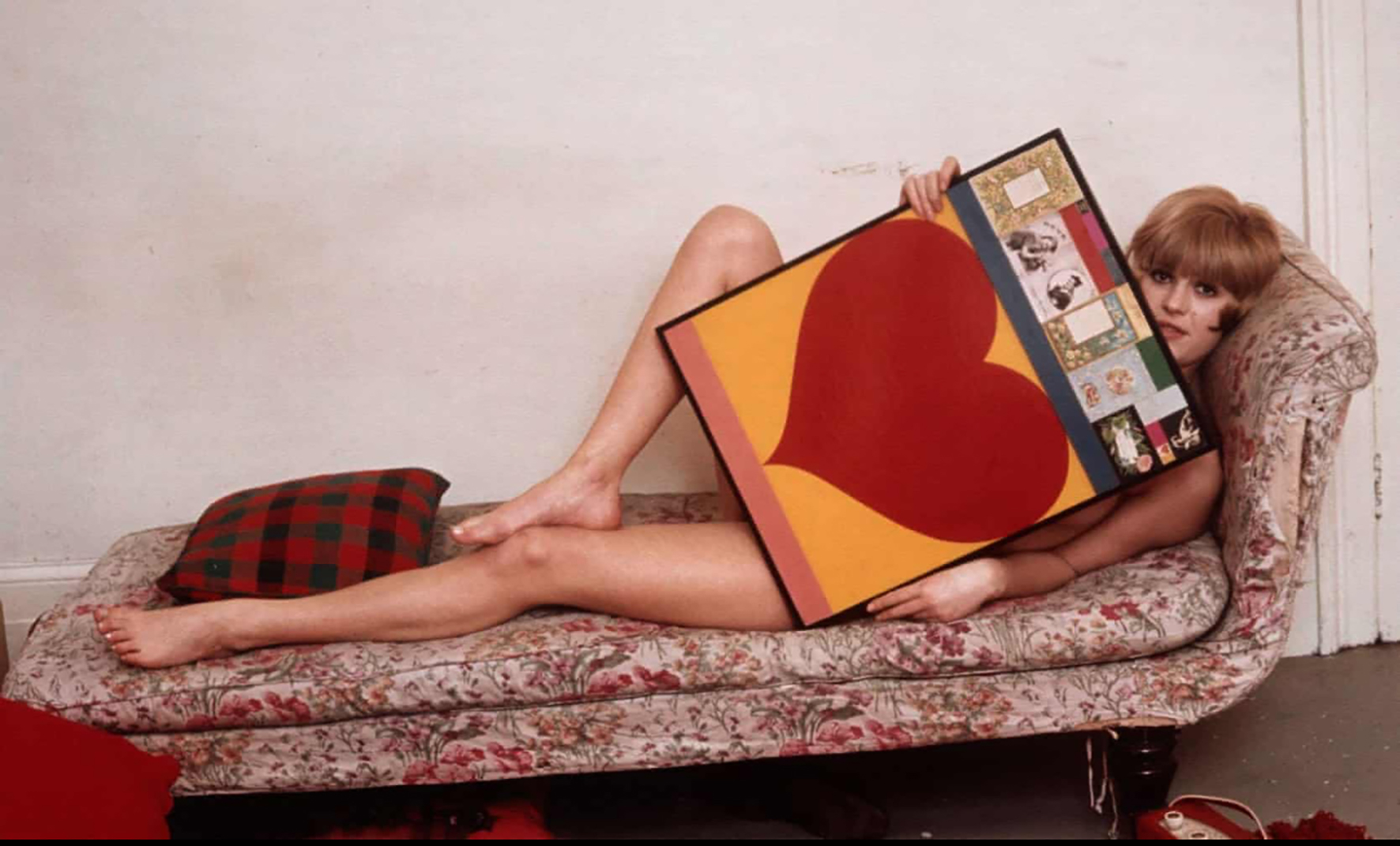
Peter Blake: Valentine (for Pauline Boty), 1959-60.

There’s Lewis Morley’s famous photograph of Pauline holding the Valentine painting.

Boty and Jann Haworth were the only two women among the pop artists at the time. Haworth, like Blake, was represented by Robert Fraser and had solo shows at his gallery as well as a joint exhibition with Peter Blake, Derek Boshier and Colin Self.But Boty’s romantic life was complicated. She was having an affair with TV director Philip Saville (who was already married) while involved with Blake. Then in June 1963, after a whirlwind ten-day romance, she married literary agent Clive Goodwin. Blake—and Saville—must have been devastated.

Blake’s response was swift. Just one month later, in July 1963, he married the other female pop artist, Jann Haworth, whom he had met at a party while she was a student at the Slade School of Art. Another whirlwind romance. The newlyweds immediately left for an extended honeymoon in California, where Jann’s father, Academy Award-winning art director Ted Haworth, lent them his Stingray sports car. They drove to Malibu listening to the Beach Boys, and Ted got Blake access to a film studio storeroom filled with props from the Elizabeth Taylor film Cleopatra. They were still in California in November when President Kennedy was assassinated.

Pauline Boty’s remarkable artistic and acting career ended abruptly when, in 1965 while pregnant, she developed a malignant tumour. Boty refused abortion and treatment as it would harm the foetus. Her daughter Katy was born on 12th February 1966, and Pauline died on 1st July, aged only 28. The “Valentine” painting passed to her husband Clive Goodwin until his death in 1977. It was later acquired by art collector Muriel Wilson (1933-2018), who donated it to the Pallant House Gallery in Chichester along with many other works from her collection.

Blake and Haworth remained together for sixteen years, founding the Brotherhood of Ruralists in 1975. But in 1979, history repeated itself. Haworth met author Richard Severy and left Blake. Devastated, Blake left Somerset and the Ruralists and returned to London. He was reported to have been unable to work for almost a year after this separation—a testament to how deeply the loss affected him.

When the Valentine painting came up for sale at Sotheby’s in 2019, it was featured in an article titled “Unrequited Love and Peter Blake’s Pop Art Valentine.” But the image had clearly stayed with Blake. Sixty-five years after its creation, it reappeared on the cover of Band Aid 40’s 2024 single “Do They Know It’s Christmas?”—suggesting that his feelings for Boty, and that moment in time, had never entirely left him.

There’s another possible legacy of Blake’s relationship with Boty that art historians may have overlooked. Boty was herself an accomplished collage artist. While the textbooks credit Joseph Cornell and Kurt Schwitters as Blake’s influences in collage, perhaps the woman who was ‘inseparable’ from him during those formative years played a more significant role than history has acknowledged. It wouldn’t be the first time a male artist’s female partner influenced his work without receiving credit.

Blake met artist Chrissy Wilson in 1980, soon after returning to London, and they married in 1987 after his divorce from Haworth was finalized in 1981. They are still together after more than 40 years—perhaps Blake had finally found lasting love.

Haworth and Severy remained together until Severy’s death..